Discussion Intel Meteor, Arrow, Lunar & Panther Lakes + WCL Discussion Threads

Page 747 - Seeking answers? Join the AnandTech community: where nearly half-a-million members share solutions and discuss the latest tech.

Tigerick

Senior member
Apr 1, 2022
941
857
106
Wildcat Lake (WCL) Specs

Intel Wildcat Lake (WCL) is upcoming mobile SoC replacing Raptor Lake-U. WCL consists of 2 tiles: compute tile and PCD tile. It is true single die consists of CPU, GPU and NPU that is fabbed by 18-A process. Last time I checked, PCD tile is fabbed by TSMC N6 process. They are connected through UCIe, not D2D; a first from Intel. Expecting launching in Q1 2026.
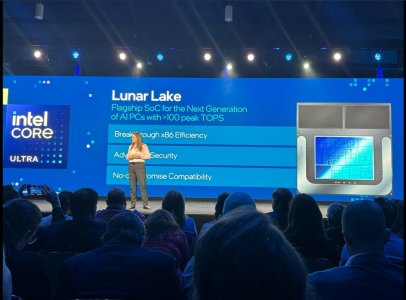
Intel Raptor Lake UIntel Wildcat Lake 15W?Intel Lunar LakeIntel Panther Lake 4+0+4
Launch DateQ1-2024Q2-2026Q3-2024Q1-2026
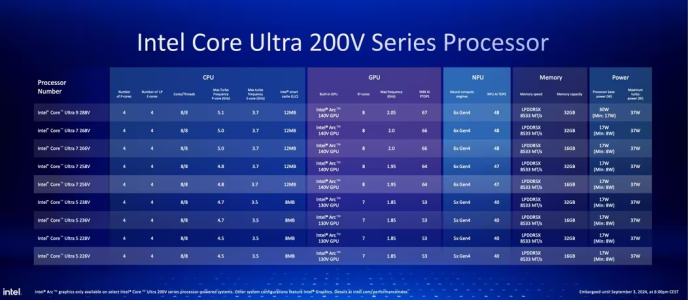
ModelIntel 150UIntel Core 7Core Ultra 7 268VCore Ultra 7 365
Dies2223
NodeIntel 7 + ?Intel 18-A + TSMC N6TSMC N3B + N6Intel 18-A + Intel 3 + TSMC N6
CPU2 P-core + 8 E-cores2 P-core + 4 LP E-cores4 P-core + 4 LP E-cores4 P-core + 4 LP E-cores
Threads12688
Max Clock5.4 GHz?5 GHz4.8 GHz
L3 Cache12 MB12 MB12 MB
TDP15 - 55 W15 W ?17 - 37 W25 - 55 W
Memory128-bit LPDDR5-520064-bit LPDDR5128-bit LPDDR5x-8533128-bit LPDDR5x-7467
Size96 GB32 GB128 GB
Bandwidth136 GB/s
GPUIntel GraphicsIntel GraphicsArc 140VIntel Graphics
RTNoNoYESYES
EU / Xe96 EU2 Xe8 Xe4 Xe
Max Clock1.3 GHz?2 GHz2.5 GHz
NPUGNA 3.018 TOPS48 TOPS49 TOPS


PPT1.jpg
PPT2.jpg
PPT3.jpg


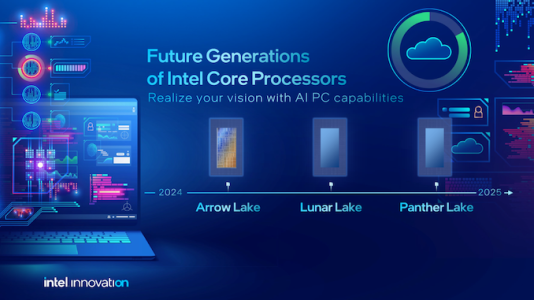
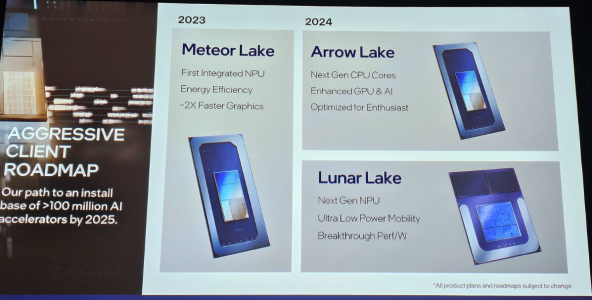
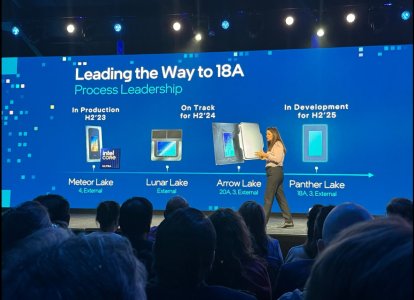
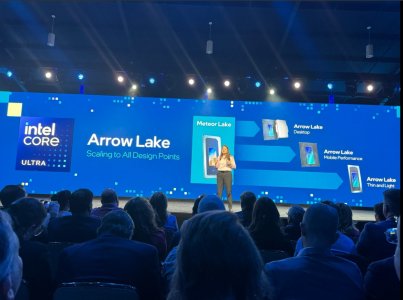
As Hot Chips 34 starting this week, Intel will unveil technical information of upcoming Meteor Lake (MTL) and Arrow Lake (ARL), new generation platform after Raptor Lake. Both MTL and ARL represent new direction which Intel will move to multiple chiplets and combine as one SoC platform.

MTL also represents new compute tile that based on Intel 4 process which is based on EUV lithography, a first from Intel. Intel expects to ship MTL mobile SoC in 2023.

ARL will come after MTL so Intel should be shipping it in 2024, that is what Intel roadmap is telling us. ARL compute tile will be manufactured by Intel 20A process, a first from Intel to use GAA transistors called RibbonFET.


LNL-MX.png
 

Attachments

  • PantherLake.png
    PantherLake.png
    283.5 KB · Views: 24,042
  • LNL.png
    LNL.png
    881.8 KB · Views: 25,531
  • INTEL-CORE-100-ULTRA-METEOR-LAKE-OFFCIAL-SLIDE-2.jpg
    INTEL-CORE-100-ULTRA-METEOR-LAKE-OFFCIAL-SLIDE-2.jpg
    181.4 KB · Views: 72,439
  • Clockspeed.png
    Clockspeed.png
    611.8 KB · Views: 72,325
Last edited:

dullard

Elite Member
May 21, 2001
26,191
4,857
126
And I struggle to see how Intel plans to double core counts at any reasonable TDP.
Easy: less power to each core. There are always have 35 W base and ~112 W turbo chips in Intel's top segment (formerly i9). There is absolutely no reason that you have to run Intel chips at high power. The reviewers just choose to feed them with massive power supplies, huge coolers, and unlimited power settings on the motherboard. But, they could just have easily ran the chips with less power. Performance would be different, but it is quite functional.

NVL-SK: 2x 8+16
NVL-HX: 1x 8+16
NVL-S / NVL-H: 4+8
NVL-U: 4+0
Videocardz is attributing that to Exist50 on Reddit. Is that our very own Exist50? https://videocardz.com/newz/intel-nova-lake-s-for-desktops-rumored-to-feature-2x8p16e-configuration
 
  • Like
Reactions: 511 and Hulk

Abwx

Lifer
Apr 2, 2011
12,000
4,954
136
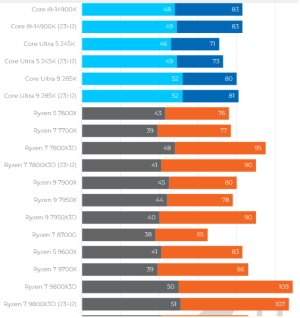
Does anyone here know if a Ryzen 7 9800X3D beats a Core Ultra 9 285K in X-Plane 12?
At this site they know, with Windows updates comparisons for both CPUs.


Attachments

  • Screenshot 2025-02-01 at 00-05-53 Test du Ryzen 7 9800X3D le nouveau maître du jeu !.png
    Screenshot 2025-02-01 at 00-05-53 Test du Ryzen 7 9800X3D le nouveau maître du jeu !.png
    86.1 KB · Views: 39

Hulk

Diamond Member
Oct 9, 1999
5,352
4,049
136
Easy: less power to each core. There are always have 35 W base and ~112 W turbo chips in Intel's top segment (formerly i9). There is absolutely no reason that you have to run Intel chips at high power. The reviewers just choose to feed them with massive power supplies, huge coolers, and unlimited power settings on the motherboard. But, they could just have easily ran the chips with less power. Performance would be different, but it is quite functional.


Videocardz is attributing that to Exist50 on Reddit. Is that our very own Exist50? https://videocardz.com/newz/intel-nova-lake-s-for-desktops-rumored-to-feature-2x8p16e-configuration
Exactly. v/f curve is nonlinear. Relatively small decrease in frequency provides a significant drop in power.

100 cores running at 5GHz don't use twice the power of 100 cores running at 2.5GHz. You could probably run 150 cores at 2.5GHz at that power envelope. Therefore in a well threaded application you see up to 50% increase in performance. The tradeoff of course if more die area (or more transistors on a smaller node). For a long while Intel "worked around" the die area issue by ramping up clocks. Eventually it caught up to them.

As I've written before I'd be happy with a Zen 6 that is 5% better IPC and 24 cores. Very happy actually. For my day-to-day usage I'm more MT bottlenecked than ST bottlenecked.
I run a few apps that are well threaded and I often run them simultaneously.
Like converting RAW photos in PureRaw4 while rendering out a video in Vegas Pro while editing in PS while working on a word doc. I need my PC to remain responsive and get stuff done. That requires a lot of cores. I max out my 9950X all the time.
 

Abwx

Lifer
Apr 2, 2011
12,000
4,954
136
Exactly. v/f curve is nonlinear. Relatively small decrease in frequency provides a significant drop in power.

100 cores running at 5GHz don't use twice the power of 100 cores running at 2.5GHz.
100 cores at 5GHz use as much power as 400 cores at 2.5GHz, and it s even as much as 500 cores at 2.5Ghz given that around 5GHz power increase as a cube of frequency or so.
 

DavidC1

Platinum Member
Dec 29, 2023
2,145
3,289
106
That's just a natural consequence of the square root scaling law...
He's just wrong. It's 30% area increase with 30% Int improvement + 20-30% area on top of that for doubled FP block, which got us 70% improvement.

Unless they are planning to double the FP block again, it's likely it'll be 1:1 increase again. Eg, 30% Int/FP for 30% area.
100 cores at 5GHz use as much power as 400 cores at 2.5GHz, and it s even as much as 500 cores at 2.5Ghz given that around 5GHz power increase as a cube of frequency or so.
This is based on the nonsensical assumption we're still in the late 90's, early 2000's where there was PLENTY of voltage scaling. It stopped once it reached about ~1.5V.

There's nothing easy anymore. NOTHING. It's obvious to anyone not lying to themselves and have played with simple GPU voltage/frequency scaling. At about 0.6V it can barely reach 300MHz.

From that point it scales superlinearly in regards to voltage - 5-10% voltage may double frequency, or 1.05x1.05 x 2 = 2.2x power for 2.2x frequency assuming we ignore static leakage+fixed block power.
Exactly. v/f curve is nonlinear. Relatively small decrease in frequency provides a significant drop in power.
V/F curve has a superlinear, linear, and sublinear relation depending on what frequency curve you are at. It's not that simple.

It used to be simple as @Abwx claims back in the 0.35u days when the voltages were in the 2-2.5V range. Not anymore. The transistors in modern CPUs have been stuck not far above threshold voltage for a long, long time.
 
Last edited:

desrever

Senior member
Nov 6, 2021
338
828
136
He's just wrong. It's 30% area increase with 30% Int improvement + 20-30% area on top of that for doubled FP block, which got us 70% improvement.
So you think 30% area increase on 3NM vs 10NM isn't going to affect the calculations. The density increase from process alone would be >100%.
 

Hulk

Diamond Member
Oct 9, 1999
5,352
4,049
136
He's just wrong. It's 30% area increase with 30% Int improvement + 20-30% area on top of that for doubled FP block, which got us 70% improvement.

Unless they are planning to double the FP block again, it's likely it'll be 1:1 increase again. Eg, 30% Int/FP for 30% area.

This is based on the nonsensical assumption we're still in the late 90's, early 2000's where there was PLENTY of voltage scaling. It stopped once it reached about ~1.5V.

There's nothing easy anymore. NOTHING. It's obvious to anyone not lying to themselves and have played with simple GPU voltage/frequency scaling. At about 0.6V it can barely reach 300MHz.

From that point it scales superlinearly in regards to voltage - 5-10% voltage may double frequency, or 1.05x1.05 x 2 = 2.2x power for 2.2x frequency assuming we ignore static leakage+fixed block power.

V/F curve has a superlinear, linear, and sublinear relation depending on what frequency curve you are at. It's not that simple.

It used to be simple as @Abwx claims back in the 0.35u days when the voltages were in the 2-2.5V range. Not anymore. The transistors in modern CPUs have been stuck not far above threshold voltage for a long, long time.

I was referring to the part of the curve that is generally relevant to our discussions, which is of course at the higher voltages and frequencies where things are not linear at all.
 

DavidC1

Platinum Member
Dec 29, 2023
2,145
3,289
106
They are moving to FP-256 to support AVX10
I still think Intel was retarded in pushing 512-bit FP on a CPU but since they did it anyway, if they straight up double the block again, it'll have superior peak throughput in 256-bit FP operations versus Zen 5 and definitely Lion Cove.
 

511

Diamond Member
Jul 12, 2024
5,401
4,819
106
I still think Intel was retarded in pushing 512-bit FP on a CPU but since they did it anyway, if they straight up double the block again, it'll have superior peak throughput in 256-bit FP operations versus Zen 5 and definitely Lion Cove.
There are lots of retard at the company 😂
 
  • Haha
Reactions: SiliconFly

desrever

Senior member
Nov 6, 2021
338
828
136
It's ISO-process, but let your bias cloud your judgment.
If you say so lol.

Skymont performance improvement barely makes up for losing HT from RPT vs ARL. This is going from less than 1/3 the size of the respective P core to almost 1/2 the size of the P core.

Shrinking Raptor lake to 3nm would probably yeild more area efficient cores than either of the ones in Arrow lake.

Especially since people keep talking core area, not including L2 cache, which means logic scaling will dominate. If we assume Intel 7 roughtly equals N7 in logic density then:

density-a.jpg


With 3x the logic density, it would have to perform a lot better to keep the same perf/area ISO process.
 

511

Diamond Member
Jul 12, 2024
5,401
4,819
106
If you say so lol.

Skymont performance improvement barely makes up for losing HT from RPT vs ARL. This is going from less than 1/3 the size of the respective P core to almost 1/2 the size of the P core.

Shrinking Raptor lake to 3nm would probably yeild more area efficient cores than either of the ones in Arrow lake.

Especially since people keep talking core area, not including L2 cache, which means logic scaling will dominate. If we assume Intel 7 roughtly equals N7 in logic density then:

density-a.jpg


With 3x the logic density, it would have to perform a lot better to keep the same perf/area ISO process.
Uhh those are HD Libs btw and then 291mm2 number is based on 1-1 Fin library that no one uses at minimum designer use 2-1 and for CPU 3-2/3-3 is the most common library
 

511

Diamond Member
Jul 12, 2024
5,401
4,819
106
Btw so we have leaked NVL Cores any idea how much ST increase will we get this much MT is too much for most of the people
 
Jul 27, 2020
28,173
19,210
146
Does anyone here know if a Ryzen 7 9800X3D beats a Core Ultra 9 285K in X-Plane 12?
 

Hulk

Diamond Member
Oct 9, 1999
5,352
4,049
136
There are some cases where the 285K is more performant than the 9950X but you have to look closely at those results. I noticed this when I was deciding between the 285K and 9950X.
For example, the 285K is faster when encoding x264, but not x265 or SV1.
x264 encoding speed isn't really relevant in my opinion for two reasons. x265 is the new standard and is more efficient with encoding and SV1 is next up.
In addition, x264 is not nearly as processor intensive as x265 so encoding speed really isn't an issue. Any processor from Skylake on can handle x264 encoding in a timely manner.