• We’re currently investigating an issue related to the forum theme and styling that is impacting page layout and visual formatting. The problem has been identified, and we are actively working on a resolution. There is no impact to user data or functionality, this is strictly a front-end display issue. We’ll post an update once the fix has been deployed. Thanks for your patience while we get this sorted.

Intel Coffee Lake and Cannonlake in H2-2017, Icelake in 2018 (DigiTimes)

Sweepr

Diamond Member
Mainstream 6C/12T next year, followed by a new CPU architecture in 2018?

According to Intel's roadmap, the chipmaker is expected to roll out its 10nm notebook-use Cannon Lake and 14nm desktop-use Coffee Lake CPUs in the second half of 2017 and to bring out Ice Lake CPUs in 2018.

www.digitimes.com/news/a20160904PD201.html

Original Coffee Lake 'leak' from PC Watch in July (mobile roadmap):
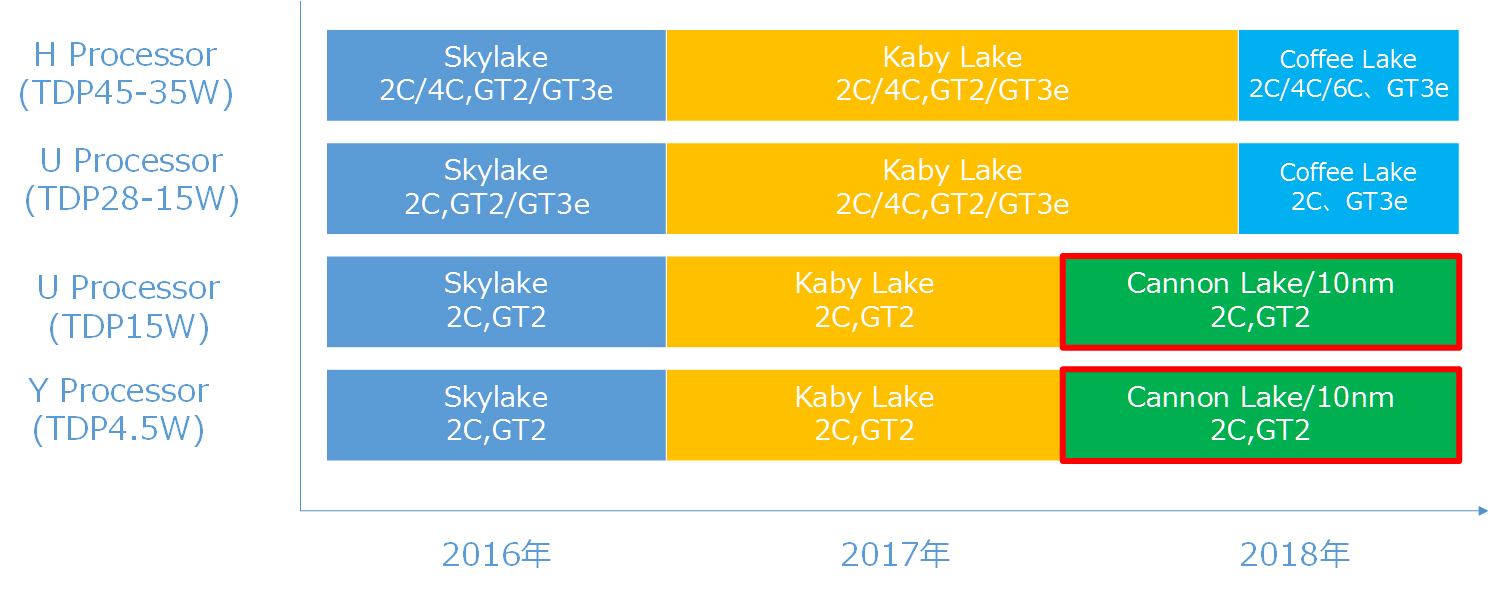
Intel-Coffee-Lake-Roadmap.jpg
 
Last edited:
Mainstream 6C/12T next year, followed by a new CPU architecture in 2018?


www.digitimes.com/news/a20160904PD201.html

A good way for Intel to get around the fact that 10nm yields won't be mature until later in 2018. The products that need 10nm the most get it (i.e. power constrained notebooks) while the parts that can deal with a bit more power consumption for more performance (i.e. desktops and "H" series notebooks) stay on 14nm.
 
@Arachnotronic

Keep in mind that 10nm will be about 12-18 months later than planned and that it is the 2nd gen of SADP, so that will be more matuire. So I would expect healthy yields from the start, that's the whole reason for the delay. The only thing that 10nm needs isn't mature health, but better health than 14nm at same point in development. Because of the improvement in density, cost will be better (although offset for a part by bigger dies).

Edit: The article does not mention Coffe Lake, and only the last paragraph is about Cannonlake, which we already know.
 
Edit: The article does not mention Coffe Lake, and only the last paragraph is about Cannonlake, which we already know.

According to Intel's roadmap, the chipmaker is expected to roll out its 10nm notebook-use Cannon Lake and 14nm desktop-use Coffee Lake CPUs in the second half of 2017 and to bring out Ice Lake CPUs in 2018.
 
According to Intel's roadmap, the chipmaker is expected to roll out its 10nm notebook-use Cannon Lake and 14nm desktop-use Coffee Lake CPUs in the second half of 2017 and to bring out Ice Lake CPUs in 2018.

Are you talking about a different roadmap than the above ??
 
This is the original mobile roadmap where Coffee Lake was leaked, certainly not the one DigiTimes saw.
 
Desktop KabyLake is Q1 2017, i dont see Desktop CoffeLake any time sooner than Q1 2018. Unless Kaby gets the same treatment as Broadwell which i find it not realistic at this time.
 
Desktop KabyLake is Q1 2017, i dont see Desktop CoffeLake any time sooner than Q1 2018. Unless Kaby gets the same treatment as Broadwell which i find it not realistic at this time.

I imagine it would be like Kabylake in that Coffee Lake could ship to OEMs in Q4 2017, but you won't see products until Q1 2018.
 
Intel 10nm interconnect pitch information

Okay guys, so I stand corrected. Previously in this thread (https://forums.anandtech.com/threads/arm-and-intel-team-up-for-10nm.2483328/), I followed Arachnotronic's reasoning that Intel's interconnect pitch would be 31nm (to achieve 0.46x scaling), or at least an upper bound of 34nm (same scaling of 0.65x as 14nm, because scaling of gate pitch also is the same as 14nm).

However, now it seems the actual interconnect pitch is 38nm. This would mean a rather meager 0.74x scaling, resulting in an area scaling of 0.57x.

Source is the discussion page of Wikichip's 10nm article, where I asked the question: http://en.wikichip.org/wiki/Talk:10_nm_lithography_process.

To be clear Intel hasn't "formally" disclose any values. The Pitch and Gate are initial values given by Mark Bohr during one of his presentations. Wish I could actually link to anything, but these slides are not online anywhere.

It's still possible however that these pitches are conservative numbers, because earlier (before I corrected it) the page said that gate pitch would be 55nm (instead of the actual value of 54nm disclosed at IDF).
 
Digitimes claims to be referencing an official Intel roadmap, yet all of the available ones from Intel show no such thing as Coffee Lake. I think they need to include some sort of reference for us to take that as fact, since in this claim they do not appear to be saying they have insider sources.
 
Digitimes claims to be referencing an official Intel roadmap, yet all of the available ones from Intel show no such thing as Coffee Lake. I think they need to include some sort of reference for us to take that as fact, since in this claim they do not appear to be saying they have insider sources.

Intel doesn't seem to provide real roadmaps publicly anymore. You can be assured Coffee Lake exists.
 
Desktop KabyLake is Q1 2017, i dont see Desktop CoffeLake any time sooner than Q1 2018. Unless Kaby gets the same treatment as Broadwell which i find it not realistic at this time.

DigiTimes is aware of this:

Volume shipments of desktop-use Kaby Lake CPUs will come at the end of 2016 and new motherboards based on Z270 and H270 chips are expected to hit vendors' shelves by year-end, indicated the sources.

And they still say desktop Coffee Lake is H2-2017 in Intel's roadmap. If DigiTimes got this one right, like they did many times regarding Intel products in the past, next year we will have:

- Insane ST performance in the form of 7700K (up to 4.5 GHz) / Kaby Lake-X (>4.5 GHz Turbo?)
- Top notch MT performance with 6C/8C/10C Skylake-X for enthusiasts
- Brand new HEDT platform supporting Skylake-X and future Cannonlake-X parts
- The long awaited mainstream hexa-core with Coffee Lake
- Possibly a new GT3 + eDRAM SKU for regular LGA desktops with Coffee Lake
- Brand new 10nm Cannonlake-Y/U parts to counter Raven Ridge APUs in mobile
 
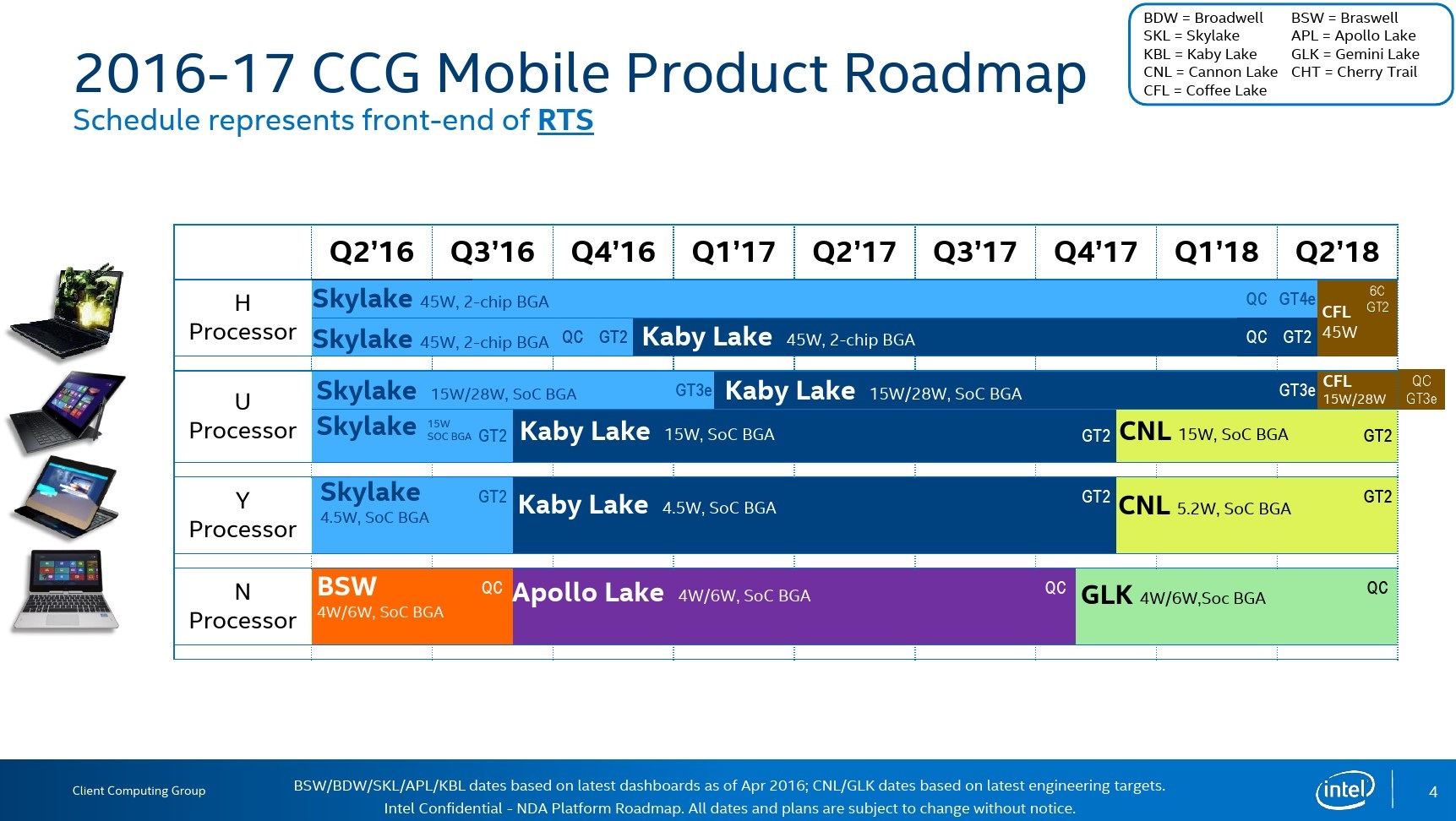
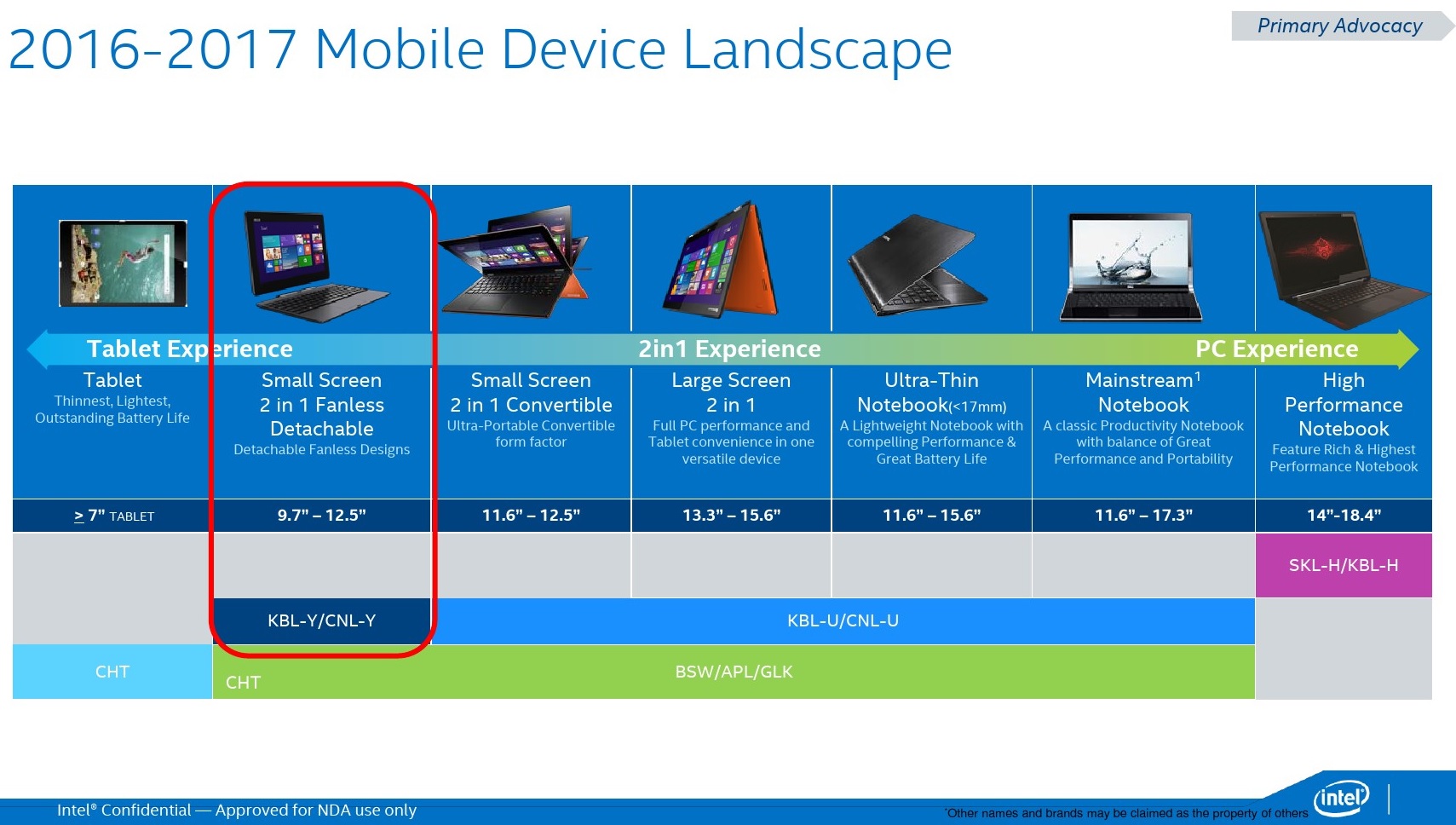
I want to share two slides from an Intel Mobile Roadmap.

97pc7s9n.jpg


efww33ez.jpg


It confirms 4 cores for ULT and 6 cores for H proccessors. But it looks like GT3e was incorrect from watch.impress. 6+2 makes more sense because 6+3e would be huge on 14nm and Intel don't like huge Mainstream Dies. We can hope that it comes with Gen10 nevertheless.

I wonder why CNL TDP increases to 5.2W, possibly because of a FIVR comeback?
 
That roadmap makes more sense, although that's pretty disappointing they can't get Cannon Lake or Coffee Lake out earlier. Still no leaks about the desktop roadmap either. And no GT4e, seems like they are giving up on that too.

I wonder why CNL TDP increases to 5.2W, possibly because of a FIVR comeback?

Possibly. I do expect the FIVR to be back.
 
Broadwell-Y had FIVR 2 and was 4.5W. Maybe PCH integrated on die?

So this confirms that Kaby Lake was delayed. Hope this does not impact CNL which is already late compared to other foundries. I wonder why. Maybe because of 14nm+ yield issues?
 
I want to share two slides from an Intel Mobile Roadmap.

It confirms 4 cores for ULT and 6 cores for H proccessors. But it looks like GT3e was incorrect from watch.impress. 6+2 makes more sense because 6+3e would be huge on 14nm and Intel don't like huge Mainstream Dies. We can hope that it comes with Gen10 nevertheless.

I wonder why CNL TDP increases to 5.2W, possibly because of a FIVR comeback?

Thank you for once again sharing interesting info! I will post this in other threads if you don't mind.

Apollo Lake successor in less than a year?
 
Broadwell-Y had FIVR 2 and was 4.5W. Maybe PCH integrated on die?

So this confirms that Kaby Lake was delayed. Hope this does not impact CNL which is already late compared to other foundries. I wonder why. Maybe because of 14nm+ yield issues?


For a very long time we knew that the second wave of Kabylake with HDMI 2.0 was scheduled for late 2016/early 2017. I don't see a delay.
 
I want to share two slides from an Intel Mobile Roadmap.

97pc7s9n.jpg


efww33ez.jpg


It confirms 4 cores for ULT and 6 cores for H proccessors. But it looks like GT3e was incorrect from watch.impress. 6+2 makes more sense because 6+3e would be huge on 14nm and Intel don't like huge Mainstream Dies. We can hope that it comes with Gen10 nevertheless.

I wonder why CNL TDP increases to 5.2W, possibly because of a FIVR comeback?

Great info, thanks.
 
Broadwell-Y had FIVR 2 and was 4.5W. Maybe PCH integrated on die?

So this confirms that Kaby Lake was delayed. Hope this does not impact CNL which is already late compared to other foundries. I wonder why. Maybe because of 14nm+ yield issues?

The changes to 14nm+ do not affect the yield learning that Intel has done on 14nm in general.
 
Not looking good. They must have caught wind that Zen sucks!

So this confirms that Kaby Lake was delayed. Hope this does not impact CNL which is already late compared to other foundries. I wonder why. Maybe because of 14nm+ yield issues?

Of course CNL is impacted. Only low performance get the update. Everything else is CFL. Hopefully,, this doesn't mean that in the future, the performance segments will still be behind with little updates here and there (i.e. moar cores, GT3e, 14nm ++++) But I'm kind of skeptical Intel will catch them all up at Icelake.
 
Back
Top