
-
We’re currently investigating an issue related to the forum theme and styling that is impacting page layout and visual formatting. The problem has been identified, and we are actively working on a resolution. There is no impact to user data or functionality, this is strictly a front-end display issue. We’ll post an update once the fix has been deployed. Thanks for your patience while we get this sorted.
You are using an out of date browser. It may not display this or other websites correctly.
You should upgrade or use an alternative browser.
You should upgrade or use an alternative browser.
New Zen microarchitecture details
Page 207 - Seeking answers? Join the AnandTech community: where nearly half-a-million members share solutions and discuss the latest tech.
At least he is optimistic and get many things right. I dont always agree with him - far from- but very much value his approach and try to learn from it.You once 'calculated' 4GHz base 95W LAUNCH too... With 4.5GHz Turbo. Based on your FO4+Neon claims.
Say so a billion wrongs things and you're bound to get something right.
Sent from HTC 10
(Opinions are own)
But can you stop whining? You have been whining and making personal attack on bjt for 100 post. Ask yourself when you will stop crying.
If prices are true it seems to me they got it right this time unlike eg phenom and bd that was overpriced.
This will enable stable prices during the year and an updated zen can continue this segmentation. Just like the core line. Stable and predictable. There might be shortages because this looks like an optimal server solution so that market will eat a lot, but this will again establish amd as a trustworthy brand with prices that dont colaps.
I am sure they did lisnt to my pricing advice a month ago. Good boys 😉
This will enable stable prices during the year and an updated zen can continue this segmentation. Just like the core line. Stable and predictable. There might be shortages because this looks like an optimal server solution so that market will eat a lot, but this will again establish amd as a trustworthy brand with prices that dont colaps.
I am sure they did lisnt to my pricing advice a month ago. Good boys 😉
I'
The debate between bjt2 and KTE is an interesting one, and instead of jumping on bjt2's defense with excuses of 'optimism,' I'd much rather sit back and watch the reviews flow in and see who was right. bjt2 seems quite knowledgeable on the subject and I for one am interested in seeing whether he's right about 14nm FO4 process and it's potentially high frequency potential in the Zen implementation. (4.5/4.6Ghz, single core turbo).At least he is optimistic and get many things right. I dont always agree with him - far from- but very much value his approach and try to learn from it.
But can you stop whining? You have been whining and making personal attack on bjt for 100 post. Ask yourself when you will stop crying.

You once 'calculated' 4GHz base 95W LAUNCH too... With 4.5GHz Turbo. Based on your FO4+Neon claims.
Say so a billion wrongs things and you're bound to get something right.
Sent from HTC 10
(Opinions are own)
I have not lost hopes that this can happen. If you remember well, i also stated that probabily 4GHz will not be achieved in the first batches, but maybe later in the year. Don't report only the part that is, for now, wrong... Finally, if the frequency leaked in those e-shops are base and not turbo, then i was right...
Didn't you support Kanter who claimed a 3.2GHz base clock and "unknown" turbo? At least this bjt guy has balls enough to stick his neck out on turbo speeds.
If 3.6GHz base clock is true then Kanter is at least 12.5% out on his base clocks. If Zen launches at 4.0GHz turbo then bjt will also be 12.5% out on that with his 4.5GHz assumption. It would be smart to assume 3.6GHz is the very least and 4GHz too. 😉
Yeah I'm aware that clocks don't scale that way esp with power, but consider how different the scenario is to what you all thought it would be even only 6 months ago. 🙂
I predicted 4 base and 4.5 turbo (but on another forum, more AMD friendly, i made a stronger prediction: 4 base and 4.8-5 max turbo).
It looks vastly superior to what Intel is doing.Looking at the per-core voltage regulation in Ryzen with the LDO, I wonder how Intel's voltage regulation differs from it? It seems that this is a big factor in lowering the power consumption of the Zen cores.
Anyone knows so far if XFR could be turn on-off in BIOS setting? This might sound weird, but this could be important in research works. You would want the clock frequency to be relatively constant while you are benchmarking some new algorithms.
I think will be sufficient lower the TDP knob to the minimum to lock the frequency to the base clock...
Some thoughts on two slides: (excuse me for font size but with small font is unreadable)

Last line can even mean lower FO4 than Excavator.
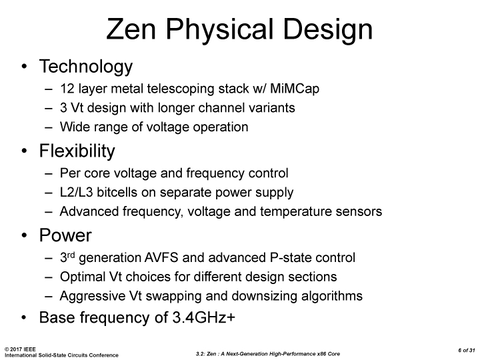
Second line: XV was a 9T (HDL) design. The second phrase can mean that Zen is made with 10.5T libraries. Namely the Highest performance...
Last line can even mean lower FO4 than Excavator.
Second line: XV was a 9T (HDL) design. The second phrase can mean that Zen is made with 10.5T libraries. Namely the Highest performance...

The Stilt
Golden Member
Looking at the per-core voltage regulation in Ryzen with the LDO, I wonder how Intel's voltage regulation differs from it? It seems that this is a big factor in lowering the power consumption of the Zen cores.
Intel's FIVR is a ultra high frequency (>= 140MHz) switching converter. AMD's converters are digital low-dropout (dLDO). The consumers should not worry about these, for reasons I will not disclose until the release.

coercitiv
Diamond Member
Worry about this consumers should not: Zen balanced is throughout, but hidden it must stay until the light of day.The consumers should not worry about these
Now this is consumer talk 😀
Intel's FIVR is a ultra high frequency (>= 140MHz) switching converter. AMD's converters are digital low-dropout (dLDO). The consumers should not worry about these, for reasons I will not disclose until the release.
Hey, can you share info if we will be able to overclock Ryzen past the stock TDP. Will motherboards allow disabling TDP throttling?
It would be huge issue if 65W Zen couldn't be OCed past the TDP limit without custom bios 😛
The Stilt
Golden Member
Hey, can you share info if we will be able to overclock Ryzen past the stock TDP. Will motherboards allow disabling TDP throttling?
It would be huge issue if 65W Zen couldn't be OCed past the TDP limit without custom bios 😛
What TDP limits? 😉
What TDP limits? 😉
Oh... Oh... nevermind then 😀
FX8xxxE was pain in the ass 😛
The Stilt
Golden Member
Oh... Oh... nevermind then 😀
FX8xxxE was pain in the ass 😛
FX-8xxxE overclocking was just matter of disabling the ApmMaster feature, same way it was on every other 15h family CPU?
Disable ApmMaster and no more TDP limits.

CatMerc
Golden Member
Not worry about it as in the implementations are equal in results?The Stilt said:Intel's FIVR is a ultra high frequency (>= 140MHz) switching converter. AMD's converters are digital low-dropout (dLDO). The consumers should not worry about these, for reasons I will not disclose until the release.

Glo.
Diamond Member
Yup.Are quotes working for everyone else?

The Stilt
Golden Member
Not worry about it as in the implementations are equal in results?
Personally, I absolutely hate both of them.
They are two completely different animals, but they have the same down sides.
Consumers never have to deal with any of the dLDO related stuff. Business as usual.
The Stilt
Golden Member
"Are quotes working for everyone else?"
What's the problem?

Quote doesn't work, reply to does.

PhonakV30
Senior member
ZD3406BAM88F4
From reddit.com/r/amd
https://www.pic-upload.de/view-32649656/RyzenSampleRevision6.png.html
From reddit.com/r/amd
https://www.pic-upload.de/view-32649656/RyzenSampleRevision6.png.html
TRENDING THREADS
-
 Discussion Zen 5 Speculation (EPYC Turin and Strix Point/Granite Ridge - Ryzen 9000)
- Started by DisEnchantment
- Replies: 25K
-
Discussion Intel Meteor, Arrow, Lunar & Panther Lakes + WCL Discussion Threads
- Started by Tigerick
- Replies: 25K
-
 Discussion Intel current and future Lakes & Rapids thread
- Started by TheF34RChannel
- Replies: 24K
-

-
