• We’re currently investigating an issue related to the forum theme and styling that is impacting page layout and visual formatting. The problem has been identified, and we are actively working on a resolution. There is no impact to user data or functionality, this is strictly a front-end display issue. We’ll post an update once the fix has been deployed. Thanks for your patience while we get this sorted.

Discussion Intel Meteor, Arrow, Lunar & Panther Lakes + WCL Discussion Threads

Page 518 - Seeking answers? Join the AnandTech community: where nearly half-a-million members share solutions and discuss the latest tech.

Tigerick

Senior member
Wildcat Lake (WCL) Specs

Intel Wildcat Lake (WCL) is upcoming mobile SoC replacing Raptor Lake-U. WCL consists of 2 tiles: compute tile and PCD tile. It is true single die consists of CPU, GPU and NPU that is fabbed by 18-A process. Last time I checked, PCD tile is fabbed by TSMC N6 process. They are connected through UCIe, not D2D; a first from Intel. Expecting launching in Q1 2026.
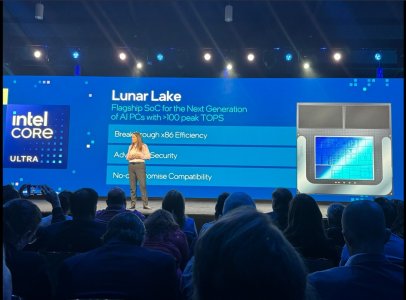
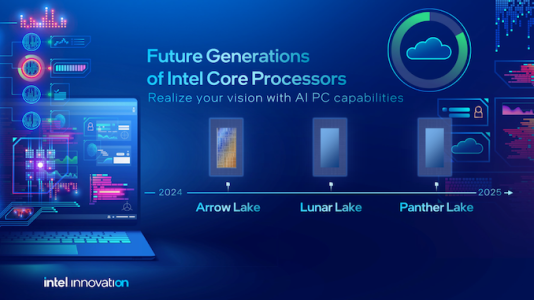
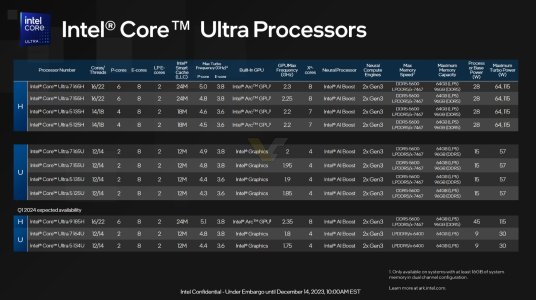
Intel Raptor Lake UIntel Wildcat Lake 15WIntel Lunar LakeIntel Panther Lake 4+0+4
Launch DateQ1-2024Q2-2026Q3-2024Q1-2026
ModelIntel 150UIntel Core 7 360Core Ultra 7 268VCore Ultra 7 365
Dies2223
NodeIntel 7 + ?Intel 18-A + TSMC N6TSMC N3B + N6Intel 18-A + Intel 3 + TSMC N6
CPU2 P-core + 8 E-cores2 P-core + 4 LP E-cores4 P-core + 4 LP E-cores4 P-core + 4 LP E-cores
Threads12688
Max Clock5.4 GHz4.8 GHz5 GHz4.8 GHz
L3 Cache12 MB6 MB12 MB12 MB
TDP15 - 55 W15 - 35 W17 - 37 W25 - 55 W
Memory128-bit LPDDR5-520064-bit LPDDR5x-7467128-bit LPDDR5x-8533128-bit LPDDR5x-7467
Size96 GB48 GB32 GB128 GB
Bandwidth83 GB/s60 GB/s136 GB/s120 GB/s
GPUIntel GraphicsIntel GraphicsArc 140VIntel Graphics
RTNoNoYESYES
EU / Xe96 EU2 Xe8 Xe4 Xe
Max Clock1.3 GHz2.6 GHz2 GHz2.5 GHz
NPUGNA 3.017 TOPS48 TOPS49 TOPS


PPT1.jpg
PPT2.jpg
PPT3.jpg


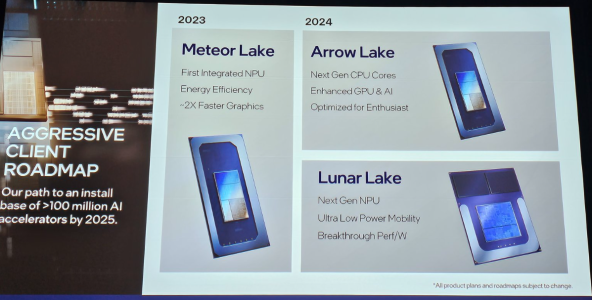
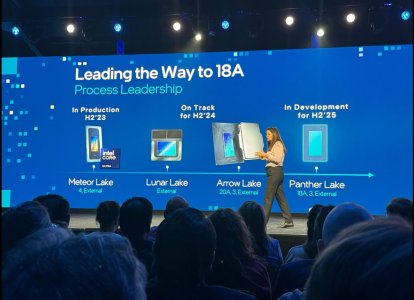
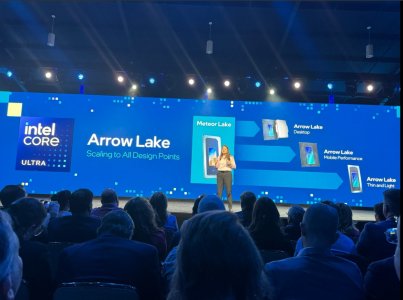
As Hot Chips 34 starting this week, Intel will unveil technical information of upcoming Meteor Lake (MTL) and Arrow Lake (ARL), new generation platform after Raptor Lake. Both MTL and ARL represent new direction which Intel will move to multiple chiplets and combine as one SoC platform.

MTL also represents new compute tile that based on Intel 4 process which is based on EUV lithography, a first from Intel. Intel expects to ship MTL mobile SoC in 2023.

ARL will come after MTL so Intel should be shipping it in 2024, that is what Intel roadmap is telling us. ARL compute tile will be manufactured by Intel 20A process, a first from Intel to use GAA transistors called RibbonFET.


LNL-MX.png
 

Attachments

  • PantherLake.png
    PantherLake.png
    283.5 KB · Views: 24,049
  • LNL.png
    LNL.png
    881.8 KB · Views: 25,534
  • INTEL-CORE-100-ULTRA-METEOR-LAKE-OFFCIAL-SLIDE-2.jpg
    INTEL-CORE-100-ULTRA-METEOR-LAKE-OFFCIAL-SLIDE-2.jpg
    181.4 KB · Views: 72,443
  • Clockspeed.png
    Clockspeed.png
    611.8 KB · Views: 72,329
Last edited:
Last edited:
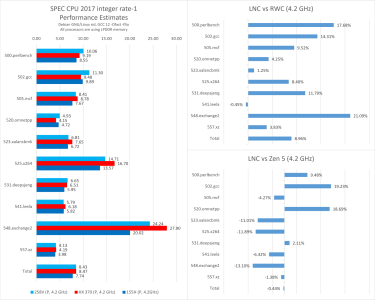
33% more cores and 25% higher power for a mere 11.8% better perf than a 2 years old CPU, quite a "win", if you set those 96C Epyc at the same 500W they would be on par, so if a 96C Zen 4 match Intel s 128C at same power i let you imagine what will happen soon with the Zen 5 based Epyc.
He didn't have power draw numbers lol from RAPL which he usually does but anyway it will still be better than 64C vs 96C from 2 years ago won't be a bloodbath it will be closer i still expect them to loose by 15-20% outside of their libraries
 
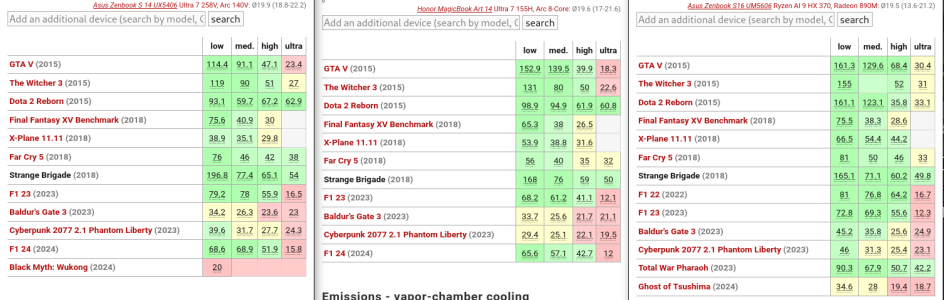
Quick comparison of the gaming performance of Lunar Lake vs Meteor lake vs Strix Point. The second two are older reviews, so they likely score higher now. Power consumption is different between models as well. In Cyberpunk FHD ultra they consume 33.1W average, 40.7W average, and 49.2W average respectively. For ram they have 32GB LPDDR5x-8533, 32 GB LPDDR5x-7467, and 32 GB LPDDR5x-7500 respectively.

1727192707423.png
Overall good showing from Lunar Lake. Lunar lake pulls ahead of Meteor lake at higher graphics settings, but at lower settings it seems to have regressed in perf/watt in a couple games. I'm guessing the drivers need work.
 
He didn't have power draw numbers lol from RAPL which he usually does but anyway it will still be better than 64C vs 96C from 2 years ago won't be a bloodbath it will be closer i still expect them to loose by 15-20% outside of their libraries

There s a page about this subject here :


Anyway based on these number we can infer that Zen 5 128C Epyc wil be largely ahead due to core count parity and also a slightly better process, add the augmented IPC and you get the picture
 
There s a page about this subject here :


Anyway based on these number we can infer that Zen 5 128C Epyc wil be largely ahead due to core count parity and also a slightly better process, add the augmented IPC and you get the picture
There is no process advantage tbf this time Intel 3 is more or less on par with what Turin has there will not be largely this time the per core performance will be higher we will see in 16 days anyway
 
CB23 1T tests, after SemiAccurate's claims (confirmed by ASUS to KitGuru)

Seems to be smaller than ASUS predicted. Perhaps some mitigation? The update itself also failed to update a few times, but finally went through:

CB23 1T score on the 258V
1859 (before the "bad" Windows update)
1819 (after the "bad" Windows Update)

 
Overall good showing from Lunar Lake. Lunar lake pulls ahead of Meteor lake at higher graphics settings, but at lower settings it seems to have regressed in perf/watt in a couple games. I'm guessing the drivers need work.
Performance at lower settings is primarily a function of the lower power consumption limiting the CPU performance side. Could potentially be improved by modifying the power allocation between CPU and GPU, but maybe not meaningfully.
 
ASUS Zenbook S 14 OLEDs power modes confirm, again, power profiles allow OEMs to exceed Intel's PL1.


Whisper - 12W PL1
Balanced - 17W PL1
Performance - 24W PL1
Full Speed - 28W PL1

//

CPU Package power:

~3W to ~10W while browsing & text editing
~3W while Netflix

//

However, their 258V GB6.2 1T score is quite low: performance mode 1T is 2422.
 
Performance at lower settings is primarily a function of the lower power consumption limiting the CPU performance side. Could potentially be improved by modifying the power allocation between CPU and GPU, but maybe not meaningfully.
I don't think that's the problem here. GTA 5 and X-Plane 11 are the only two games out of the 11 where this is happening, and X-Plane 11 is the only game where Lunar Lake loses to Meteor Lake at high or ultra settings.
 
33% more cores and 25% higher power for a mere 11.8% better perf than a 2 years old CPU, quite a "win", if you set those 96C Epyc at the same 500W they would be on par, so if a 96C Zen 4 match Intel s 128C at same power i let you imagine what will happen soon with the Zen 5 based Epyc.

yes, Turin = KO for Intel serverspace
 
Looks really good, though I will point out that a significant number of those tests are on Intel software. Will be interesting to see how well AMD can punch back with Turin. Definitely the most competitive it's been in quite a while though.
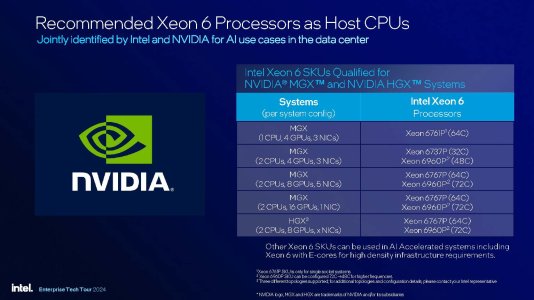
Only openVino but OpenVino is what fugaku supercomputer uses which is an ARM CPU they ported openVINO to Arm CPU embree is multi architecture Intel's SW Stack is something amd is unable to match even when intel was in trouble AMD may have better HW but Intel's software support is superior in industry there is no double also the funniest slide Intel-Xeon-6-Granite-Rapids-AP-Launch-NVIDIA-Head-Nodes.jpg
 
Only openVino but OpenVino is what fugaku supercomputer uses which is an ARM CPU they ported openVINO to Arm CPU embree is multi architecture Intel's SW Stack is something amd is unable to match even when intel was in trouble AMD may have better HW but Intel's software support is superior in industry there is no double also the funniest slide View attachment 108155

OpenVINO, OSPRay, Embree, OpenVKL, and Open Image Denoise are all Intel software.
 
OpenVINO, OSPRay, Embree, OpenVKL, and Open Image Denoise are all Intel software.
They are not vendor locked to Intel and we use them in Blender/V ray corona and we know how they behave they are all open source I don't see the point outside of the use of AMX even for rigging purpose it's not CUDA 🤣
 
They are not vendor locked to Intel and we use them in Blender/V ray corona and we know how they behave they are all open source I don't see the point outside of the use of AMX even for rigging purpose

Of course they are not vendor locked, otherwise we wouldn’t have results on non-Intel CPUs. The point is that in the real world, Intel software doesn’t make up such a large portion of used software and of course Intel is going to optimize their own software for their own products. Just because it is open source, doesn’t mean equal optimizations for all architectures, especially with the “stock” software.
 
Back
Top