Discussion Cinebench 2026

Page 5 - Seeking answers? Join the AnandTech community: where nearly half-a-million members share solutions and discuss the latest tech.

mikegg

Platinum Member
Jan 30, 2010
2,091
632
136
I've seen people who may not realise but seem to assume that. There was that guy who claimed that Apple has a "7X" or "9X" something like that advantage on efficiency over AMD, that AMD has to "overcome". Yeah, an exact number, although I'm not sure if I remember the value right.

Almost every time this topic comes up and somebody compares a desktop CPU with usually an Apple SoC and uses their TDPs (or some guesses at power consumption in case of Apple) to make claims about efficiency of the microarchitectures in the processors, there's the implicit forgetting that the desktop chip is merely at one of its possible efficiency settings (usually close to the worst one).
You're interpreting it incorrectly. You want your AMD chip to appear more efficient compared to Apple Silicon, right?

Here's what you need to answer: If I want my program to run at X speed, how much power does the chip need?

Apple Silicon is be 3-4x more efficient at default settings vs AMD's default settings while being faster in CInebench 2024. It may be more or less efficient at different power levels.

Run AMD chips at lower wattage and it becomes more efficient. But it's already drastically slower at higher wattage.

Literally no one here has stated that CPU efficient isn't on a curve. Don't make things up.
 
Last edited:
  • Like
Reactions: mvprod123

Joe NYC

Diamond Member
Jun 26, 2021
4,042
5,591
136
You're interpreting it incorrectly. You want your AMD chip to appear more efficient compared to Apple Silicon, right?

Here's what you need to answer: If I want my program to run at X speed, how much power does the chip need?

Apple Silicon is be 3-4x more efficient at default settings vs AMD's default settings while being faster in CInebench 2024. It may be more or less efficient at different power levels.

Run AMD chips at lower wattage and it becomes more efficient. But it's already drastically slower at higher wattage.

Literally no one here has stated that CPU efficient isn't on a curve. Don't make things up.

It was you who came up with the idea that AMD would have to improve efficiency by something like 720% to keep up with Apple.

"Apple Silicon is be 3-4x more efficient" = smoking the same crack pipe.

I think everyone will acknowledge that Apple silicon is more efficient than either Intel or AMD. But the gap is nowhere near either 300-400% or 700-800%
 

Abwx

Lifer
Apr 2, 2011
11,983
4,942
136
It was you who came up with the idea that AMD would have to improve efficiency by something like 720% to keep up with Apple.

"Apple Silicon is be 3-4x more efficient" = smoking the same crack pipe.

I think everyone will acknowledge that Apple silicon is more efficient than either Intel or AMD. But the gap is nowhere near either 300-400% or 700-800%

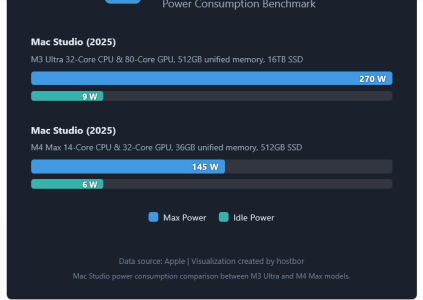
The M3 ultra mini PC pull 270W, given that idle power is 9W this make a 260W delta,
so the CPU consume roughly 200W, hence in CB2026 despite its 32 cores and better process it s barely 20% more efficient than a well cooled stock 9950X3D.

Dunno what was the load because those numbers are provided by Apple, but as a hint
NBC tested a device with a M4 that was supposed to be set at 50-57W, yet the measured delta in CB was about 90W, wich is indicative that the actual CPU power is more like 70W
than what is advertised.


jdubs03

Golden Member
Oct 1, 2013
1,416
990
136
Dunno what was the load because those numbers are provided by Apple, but as a hint
NBC tested a device with a M4 that was supposed to be set at 50-57W, yet the measured delta in CB was about 90W, wich is indicative that the actual CPU power is more like 70W than what is advertised.
M4 Max*
Zen6? 😛
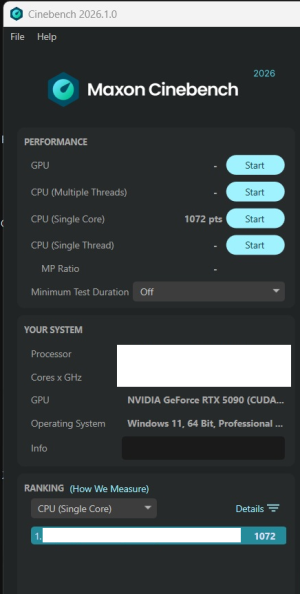
That single core score would be converted to roughly 780-790 single-thread. What magic is that?

Zen 6 this early would be an eng sample at best, stretches to be incredulity.
 
  • Like
Reactions: lightmanek

poke01

Diamond Member
Mar 8, 2022
4,681
6,021
106
You're interpreting it incorrectly. You want your AMD chip to appear more efficient compared to Apple Silicon, right?

Here's what you need to answer: If I want my program to run at X speed, how much power does the chip need?

Apple Silicon is be 3-4x more efficient at default settings vs AMD's default settings while being faster in CInebench 2024. It may be more or less efficient at different power levels.

Run AMD chips at lower wattage and it becomes more efficient. But it's already drastically slower at higher wattage.

Literally no one here has stated that CPU efficient isn't on a curve. Don't make things up.

The M3 ultra mini PC pull 270W, given that idle power is 9W this make a 260W delta,
so the CPU consume roughly 200W, hence in CB2026 despite its 32 cores and better process it s barely 20% more efficient than a well cooled stock 9950X3D.

Dunno what was the load because those numbers are provided by Apple, but as a hint
NBC tested a device with a M4 that was supposed to be set at 50-57W, yet the measured delta in CB was about 90W, wich is indicative that the actual CPU power is more like 70W
than what is advertised.

Both sides here are wrong but I’ll just say Apple doesn’t advertise TDP because it varies based on load and application.

Also the M3 Ultra is more like 140 watts for the 24P+8E CPU in Cinebench not 200 watts. Based on M3 Max wall power.
 
  • Like
Reactions: Tlh97 and mvprod123

Abwx

Lifer
Apr 2, 2011
11,983
4,942
136
Both sides here are wrong but I’ll just say Apple doesn’t advertise TDP because it varies based on load and application.

Also the M3 Ultra is more like 140 watts for the 24P+8E CPU in Cinebench not 200 watts. Based on M3 Max wall power.
Even at 140W that s not that exceptional given the core count and better process, with 2x the core count you ll perform roughly 1.4x better at same power and more likely 1.5x, and SMT in CB for the 9950X is far from getting you 2x the throughput.
 
  • Haha
Reactions: mvprod123

poke01

Diamond Member
Mar 8, 2022
4,681
6,021
106
Right, and i noticed that a 7945HX3D laptop should have comparable, or even better, perf/watt at isoperf in Blender 3.3 Classroom , so Cinebench is the best case figure for Apple and is not reproducible in other tasks be it also a rendering one.
That’s the problem at what cTDP?
75watts, 100watts?

Then at wall power that same cpu uses around ~160watts in Cinebench.
 

jdubs03

Golden Member
Oct 1, 2013
1,416
990
136
Even at 140W that s not that exceptional given the core count and better process, with 2x the core count you ll perform roughly 1.4x better at same power and more likely 1.5x, and SMT in CB for the 9950X is far from getting you 2x the throughput.
Just a note (sourced from NBC):

In CB R23 the M4 Max tops out at 101W, averages 98W. Idle is 6W.

That 7945HX3D in CB R23 tops out at 171W, averages 159W. Idles at 29W… Scores 10% better in Blender v3.3. That’s a pretty big gap.

The 9955HX3D which might be a better comparison, does 25% better in Blender, but in CB R23 tops out at 225W, averages 210W, and idles at 12W (big improvement there).

I’ll say this, I hope we get to see an M5 Ultra (which seems more likely than not ) go up against the Zen6 successor to the 9955HX3D.
 
  • Like
Reactions: Nothingness

Abwx

Lifer
Apr 2, 2011
11,983
4,942
136
That’s the problem at what cTDP?
75watts, 100watts?

Then at wall power that same cpu uses around ~160watts in Cinebench.

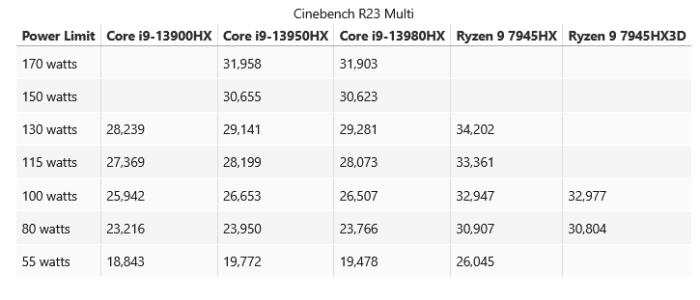
I m talking of CPU power, the 7945HX is set at 100-115W, at 80W is score 30.9k in CB R23 and at 115W 33.6k, so not even 10% better despite 44% more power, it s easy to have good efficiency by sligthly dialing down the perfs.
 
Last edited:

poke01

Diamond Member
Mar 8, 2022
4,681
6,021
106
Even at 140W that s not that exceptional given the core count and better process, with 2x the core count you ll perform roughly 1.4x better at same power and more likely 1.5x, and SMT in CB for the 9950X is far from getting you 2x the throughput.
Yep it’s not exceptional but then again the M3 CPU architecture wasn’t anything special for FP uplifts.
 

Abwx

Lifer
Apr 2, 2011
11,983
4,942
136
Just a note (sourced from NBC):

In CB R23 the M4 Max tops out at 101W, averages 98W. Idle is 6W.

That 7945HX3D in CB R23 tops out at 171W, averages 159W. Idles at 29W… Scores 10% better in Blender v3.3. That’s a pretty big gap.

The 9955HX3D which might be a better comparison, does 25% better in Blender, but in CB R23 tops out at 225W, averages 210W, and idles at 12W (big improvement there).

I’ll say this, I hope we get to see an M5 Ultra (which seems more likely than not ) go up against the Zen6 successor to the 9955HX3D.
Read my previous post, the same apply to the 9955HX3D, slightly less perfs for much lower power comsumption.
 

poke01

Diamond Member
Mar 8, 2022
4,681
6,021
106
I m talking of CPU power, the 7945HX is set at 100-115W, at 80W is score 30.9k in CB R23 and at 115W 33.6k, so not even 10% better despite 44% more power, it s easy to have good efficiency by slighly dialing down the perfs.
Why do you compare with wall power for Apple CPUs and then for AMD use set defined TDPs for the CPU which will be lower than when measuring at the wall?

Kinda confusing.
 

Abwx

Lifer
Apr 2, 2011
11,983
4,942
136
Why do you compare with wall power for Apple CPUs and then for AMD use set defined TDPs for the CPU which will be lower than when measuring at the wall?

Kinda confusing.
I didnt compare wall power to CPU power, you didnt read right, i estimated the CPU power, for the M4 Max, i stated 70W CPU power while wall power is supposedly 95W on average and idle wall power about 6W.

Same for the M3 Ultra, wall idle is about 9W and wall load power is 270W, so about 200W CPU power, all this was explicitely stated in my previous posts.


Attachments

  • Screenshot 2026-01-02 at 22-08-45 Mac Studio M3 Ultra Tested Ultimate Power But for Who - Host...png
    Screenshot 2026-01-02 at 22-08-45 Mac Studio M3 Ultra Tested Ultimate Power But for Who - Host...png
    32 KB · Views: 15
Last edited:

Doug S

Diamond Member
Feb 8, 2020
3,777
6,687
136
Why do you compare with wall power for Apple CPUs and then for AMD use set defined TDPs for the CPU which will be lower than when measuring at the wall?

Kinda confusing.

Yes, this.

If you want to claim you are measuring "fairly" by using wall power for Apple you have to do the same for EVERYTHING. Measure wall power on AMD, Intel, Qualcomm, whatever you are comparing with.

That's too noisy for ST results on any platform, but for MT the noise of the power consumption of other parts of the system become less and less important the more cores you're testing with.
 
  • Like
Reactions: Nothingness

poke01

Diamond Member
Mar 8, 2022
4,681
6,021
106
I didnt compare wall power to CPU power, you didnt read right, i estimated the CPU power, for the M4 Max, i stated 70W CPU power while wall power is supposedly 95W on average and idle wall power about 6W.
Fair enough but NBC Cinebench results for the CPU M4 Max power figures you stated are derived from the wall regardless.

You should do the same for the AMD laptop you are comparing with.
 

Abwx

Lifer
Apr 2, 2011
11,983
4,942
136
Fair enough but NBC Cinebench results for the CPU M4 Max power figures you stated are derived from the wall regardless.

You should do the same for the AMD laptop you are comparing with.

They are derived from the wall of course, there s a 95W average delta between idle and load.

An AC adapter has generaly a better efficiency than an ATX PSU, easily 90%, and then there s the integrated SMPS in the MB to feed the CPU that has typicaly 90% efficency for reasonable powers.

That make 0.9 x 0.9 = 0.81% efficency, and assuming that the CPU use almost zero watt at idle that make 95 X 0.81 = 76.95W CPU power, so my 70W was quite forgiving for Apple compared to a more accurate estimation.

For the the AMD 7945HX laptop NBC did set different CPU powers, either in the bios or using AMD s software, to compare efficiency at different power levels, so they made the work for us, from those numbers optimal efficency is at 80W in respect of the process power/frequency scaling.
 

Attachments

  • Screenshot 2026-01-02 at 23-16-09 AMD Ryzen 9 7945HX3D Zen4 analysis - The fastest mobile gami...png
    Screenshot 2026-01-02 at 23-16-09 AMD Ryzen 9 7945HX3D Zen4 analysis - The fastest mobile gami...png
    24 KB · Views: 14
Last edited:

AMDK11

Senior member
Jul 15, 2019
489
435
136
M4 Max*

That single core score would be converted to roughly 780-790 single-thread. What magic is that?

Zen 6 this early would be an eng sample at best, stretches to be incredulity.
Zen5(R5 9600X) + DDR5 2x16GB 5600MT
~5.4GHz
ST 525p
SC(SMT) 719p

SC(SMT) 1072p(+49%!!!)
 
  • Like
Reactions: lightmanek

Joe NYC

Diamond Member
Jun 26, 2021
4,042
5,591
136
Yes, this.

If you want to claim you are measuring "fairly" by using wall power for Apple you have to do the same for EVERYTHING. Measure wall power on AMD, Intel, Qualcomm, whatever you are comparing with.

That's too noisy for ST results on any platform, but for MT the noise of the power consumption of other parts of the system become less and less important the more cores you're testing with.

Exactly.

It should not be that difficult to get the apples to apples, Mac Min vs. Mini PC comparison between Apple and PCs - but for some reason it is. Maybe there is just no market for this type of comparison.
 

jdubs03

Golden Member
Oct 1, 2013
1,416
990
136
Zen5(R5 9600X) + DDR5 2x16GB 5600MT
~5.4GHz
ST 525p
SC(SMT) 719p

SC(SMT) 1072p(+49%!!!)
Not sure that’s a good comparison.

The best would be a 9950X3D which I’ve seen go as high as 810 in SC(SMT), and I’m pretty sure that wasn’t stock. So 1072 would be a 32% increase from that.

From the looks of it SMT is doing a lot of the heavy lifting because the ST score only increases by 15-16% compared to the 7950X(3D), so I take it’s SMT efficiency must be a lot better in Zen 5 compared to Zen 4. But could it see such an improvement again with a Zen 6?

But I guess I’ll amend my statement when looking at some of the 7950X(3D) results versus the 9950X(3D), and there is about a 30% or so increase in SC(SMT). So I guess it maybe* could be a top-end Zen 6, but still seems like it would be an engineering sample since we’re about nine months away from products in all likelihood.

They are derived from the wall of course, there s a 95W average delta between idle and load.

An AC adapter has generaly a better efficiency than an ATX PSU, easily 90%, and then there s the integrated SMPS in the MB to feed the CPU that has typicaly 90% efficency for reasonable powers.

That make 0.9 x 0.9 = 0.81% efficency, and assuming that the CPU use almost zero watt at idle that make 95 X 0.81 = 76.95W CPU power, so my 70W was quite forgiving for Apple compared to a more accurate estimation.

For the the AMD 7945HX laptop NBC did set different CPU powers, either in the bios or using AMD s software, to compare efficiency at different power levels, so they made the work for us, from those numbers optimal efficency is at 80W in respect of the process power/frequency scaling.
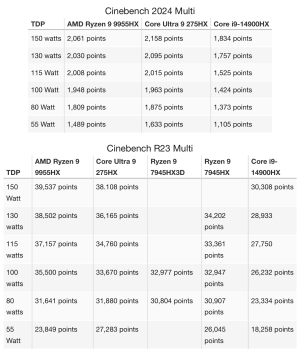
This is another good comparison:
1767394754262.png
That 9955HX really stretches It’s legs after 100W in CB R23. But not in 2024.

One thing to note as well is that the M-Series isn’t native in CB R23, so score comparisons with that aren’t apples-to-apples.
 
Last edited: