Discussion Cinebench 2026

Page 2 - Seeking answers? Join the AnandTech community: where nearly half-a-million members share solutions and discuss the latest tech.

Abwx

Lifer
Apr 2, 2011
11,972
4,938
136
Is there a rule that SMT gains must be equal between all renderers?

AMD leads in this benchmark regardless if the SMT gain is 35% or 44%.
Guess that it depend of the exact code, with CB R20/23 versions it was the only renderer where Intel was ahead, and the one with the lower SMT gain, also it seemed that CB 2024 was a lighter load than older CB versions for power usage, dunno for this one, some members could give us some hints.

EDIT : Computerbase has an article and publish their members scores here as well as their own for both CPUs and GPUs :

 
Last edited:

Jan Olšan

Senior member
Jan 12, 2017
617
1,239
136
Ryzen 9 7950X stock settings, air cooled, 32GB DDR5-6000(EXPO)

Multithread: 8167
Single Thread: 481
Single Core: 629 (!)
(Radeon RX 7700 XT 12GB: 35127)

BTW, I got 6333 MT score when limiting the processor to TDP:65W/PPT:88W. That's 77,5 % performance with 38,3 % of the maximum power, should be about 2x better power efficiency when only considering processor SoC power. And that's with the large fixed overhead of the IO Die's power consumption that AM4 and AM5 chiplet CPUs suffer from and which likely doesn't scale down when TDP is lowered, so the efficiency gain may be even bigger?

Let that be a reminder for people that think CPU cores have one given level of power efficiency. The reality is that it's a whole range where the progression is very non-linear and the single most important thing is which point (what clock/voltage combination out of the particular core's range) you are running at.
 

MS_AT

Senior member
Jul 15, 2024
919
1,840
96
So did anyone try to observe if 1core setting acutally pins 2 sibling logical cores of single physical core for the whole duration? Or if it lets them migrate, does the pair always land on the same physical core?

Would try myself but won't have access to a PC for few more days.
 

Det0x

Golden Member
Sep 11, 2014
1,484
5,088
136
So did anyone try to observe if 1core setting acutally pins 2 sibling logical cores of single physical core for the whole duration? Or if it lets them migrate, does the pair always land on the same physical core?

Would try myself but won't have access to a PC for few more days.
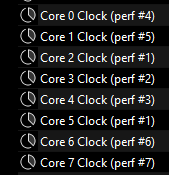
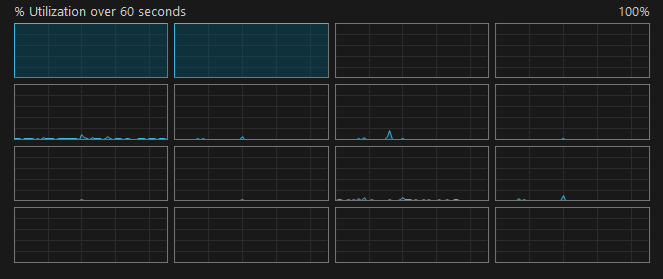
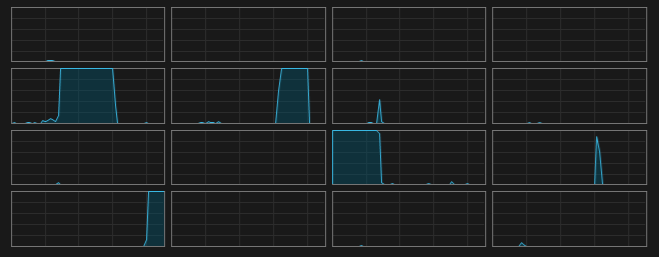
Not exactly what you are asking about, but i saw something else when running the single core benchmark.
All the load is always get put on core #0, which means it dont follow the CPPC ranking (this core is ranked #4)

1767114319945.png

This is how it looks like running the single core bench on a 8core v-cache CPU with SMT enabled
1767114540354.png

Running the singlethreaded benchmark, the workload are jumps around between cores/threads
1767114790309.png

So this benchmarks single core benchmark kinda seems to have a little issue with the windows scheduling / following the correct CPPC core ranking
Anyone else getting the same results ?
 
Last edited:

Jan Olšan

Senior member
Jan 12, 2017
617
1,239
136
No one thinks that.
I've seen people who may not realise but seem to assume that. There was that guy who claimed that Apple has a "7X" or "9X" something like that advantage on efficiency over AMD, that AMD has to "overcome". Yeah, an exact number, although I'm not sure if I remember the value right.

Almost every time this topic comes up and somebody compares a desktop CPU with usually an Apple SoC and uses their TDPs (or some guesses at power consumption in case of Apple) to make claims about efficiency of the microarchitectures in the processors, there's the implicit forgetting that the desktop chip is merely at one of its possible efficiency settings (usually close to the worst one).
 
Last edited:

511

Diamond Member
Jul 12, 2024
5,221
4,678
106
I've seen people who may not realise but seem to assume that. There was that guy who claimed that Apple has a "7X" or "9X" something like that advantage on efficiency over AMD, that AMS has to "overcome". Yeah, an exact number, although I'm not sure if I remember the value right.
well X86 Camp likes to run cores higher Frequency way outside of optimal power/performance curve on DT and in general as well
 

MS_AT

Senior member
Jul 15, 2024
919
1,840
96
So this benchmarks single core benchmark kinda seems to have a little issue with the windows scheduling / following the correct CPPC core ranking
Thanks for checking. It seems they have hardcoded the affinity to (logical) cores 0-1 then. While for single threaded benchmark they probably don't set the affinity at all to let Windows decide.
 
  • Like
Reactions: lightmanek

Gideon

Platinum Member
Nov 27, 2007
2,043
5,096
136
Here are my runs:

For my 2 work computers and home rig:
  • 14" Mac M1 Pro (Late 2021 model)
  • 14" Lenovo T14s, Zen 3 6850U (March 2022 model)
  • Ryzen 5800X3D with RTX 4090 (Still rocking on a B350 Tomahawk from 2017)
The work macines are somewhat interesting as they are about the same form/factor and models from the same timeframe. Too bad neither CB2024 nor CB2026 GPU test run on the AMD iGPU, despite it being RDNA2. That would have been very interesting (as even the memory setup is similar)

14" Macbook M1 ProThinkpad T14s Zen3Home Desktop
CPUM1 Pro 10C @ 3.23 GHzRyzen 6850U @ 2.7GHz (ST 4.7 Ghz)Ryzen 5800X3D, PBO undervolt
GPUM1 Pro 16-coreRadeon 680M (RDNA2)RTX 4090 24GB
Memory:32GB LPDDR5 @ 6400 MT/s32GB LPDDR5 @ 6400 MT/s32GB DDR4 @ 3600MT/s
Cinebench 2026 GPU11 157-140 327
Cinebench 2026 MT326621763621
Cinebench 2026 SC-418472
Cinebench 2026 ST430332337
Screenshotimgimgimg
Notes:Mode: -
MT clocks: ~3.2 Ghz
SC clocks: ~3.2 Ghz
ST clocks: ~3.2 Ghz
OS: Macos Sequia 15.6.1
Mode: High Performance
MT clocks: ~3.1 Ghz
SC clocks: ~4.2 Ghz
ST clocks: ~4.35 Ghz
OS: Windows 11 25H2
Mode: Balanced
MT clocks: ~4.38 Ghz
SC clocks: ~4.48 Ghz
ST clocks: ~4.422 Ghz
OS: Windows 11 25H2

Some notes:
  • These are all runs in day-to-day rigs with years old OSes and unchanged thermal paste on the laptops. I just closed most of the resource consuming apps (and real-time protection in Windows Defender), but that was it.
  • The 8/16 Ryzen 6850U barely finished the first MT run in 10 minutes (in fact it only did 1 run with Mode set to Balanced). In contrast the average run of the RTX 4090 was 8.35 seconds (doing 71 passes in total) No wonder people are saying CPU rendering is dead.
  • ST load bounces around in windows thus lowering the max clocks vs the pinned SC load on my desktop
  • The 5800X3D manages to beat the reference 5800X in MT but falsl behind in ST (due to relatively low clocks)
 
Last edited:

eek2121

Diamond Member
Aug 2, 2005
3,468
5,131
136
So did anyone try to observe if 1core setting acutally pins 2 sibling logical cores of single physical core for the whole duration? Or if it lets them migrate, does the pair always land on the same physical core?

Would try myself but won't have access to a PC for few more days.

Not exactly what you are asking about, but i saw something else when running the single core benchmark.
All the load is always get put on core #0, which means it dont follow the CPPC ranking (this core is ranked #4)

View attachment 135872

This is how it looks like running the single core bench on a 8core v-cache CPU with SMT enabled
View attachment 135873

Running the singlethreaded benchmark, the workload are jumps around between cores/threads
View attachment 135874

So this benchmarks single core benchmark kinda seems to have a little issue with the windows scheduling / following the correct CPPC core ranking
Anyone else getting the same results ?
Yes, I read on the overclock forums that they pin the workload to core 0, which is less than ideal.

It would also be nice if we could get a Linux port. Alas…
 

MS_AT

Senior member
Jul 15, 2024
919
1,840
96
which is less than ideal.
Well it could be worse. I mean on both Intel and AMD CPUs there is a high chance that physical core 0 is among the highest clocking cores. (On AMD the CCD0 will clock higher than CCD1 and variance within CCD is negligible most of the time. On Intel core 0 is bound to be Pcore). Otherwise they would need to write additional code to figure out which core clocks the highest.

I am not sure if Windows has an api to read this info out so might be they would need a custom solution and different one for each CPU vendor if Windows does not make this info accesible to 3rd party devs.
 

Det0x

Golden Member
Sep 11, 2014
1,484
5,088
136
Well it could be worse. I mean on both Intel and AMD CPUs there is a high chance that physical core 0 is among the highest clocking cores. (On AMD the CCD0 will clock higher than CCD1 and variance within CCD is negligible most of the time. On Intel core 0 is bound to be Pcore). Otherwise they would need to write additional code to figure out which core clocks the highest.
Well except the all the dual CCD X3D cpus where CCD1 is the higher clocking one 🤷‍♀️
Such as 7950X3D, 7900X3D, 9950X3D and 9900X3D i believe

And there seems to be very little if not zero benefit from the v-cache in this benchmark (?)
 

Hulk

Diamond Member
Oct 9, 1999
5,266
3,953
136
Well except the all the dual CCD X3D cpus where CCD1 is the higher clocking one 🤷‍♀️
Such as 7950X3D, 7900X3D, 9950X3D and 9900X3D i believe

And there seems to be very little if not zero benefit from the v-cache in this benchmark (?)
No benefit from v-cache. Data is not being "needed" from the v-cache. It's more of a "fight for data in the L3" as more threads are added to the mix. But that is even pretty minimal with this bench. It's really a "straight through" number cruncher.
 
Last edited:
  • Like
Reactions: Joe NYC

lightmanek

Senior member
Feb 19, 2017
519
1,275
136
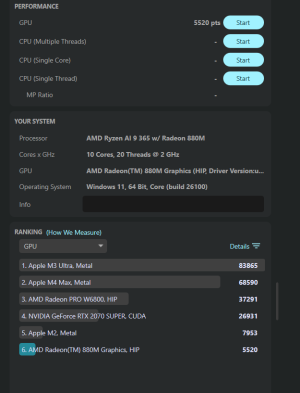
My contribution is from ASUS Vivobook S16 with Ryzen 7 365 and 32GB LPDDR5 7500MT.

CineR26 Radeon 880M.png
iGPU to start, laptop plugged-in in Balanced power plan.

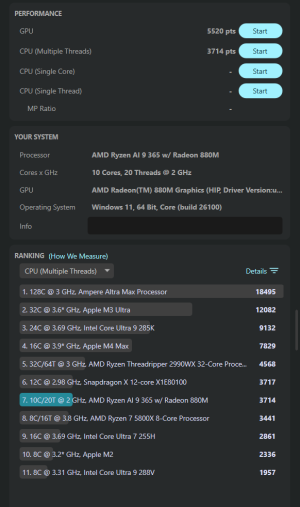
How nicely aligned my CPU is with Snapdragon 12C ... first run and Balanced power profile on my work W11 install with a ton of spyware ...
CineR26 Ryzen 7 365 MT.png

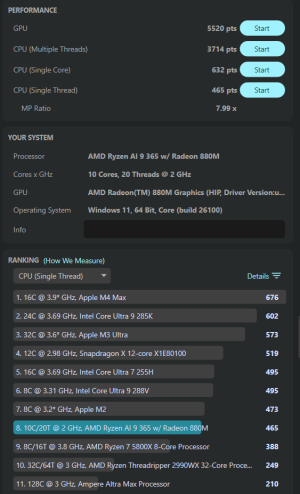
Finally, ST and SC scores are quite decent for a cheap laptop :)

CineR26 Ryzen 7 365 All.png
 
Last edited:

Hulk

Diamond Member
Oct 9, 1999
5,266
3,953
136
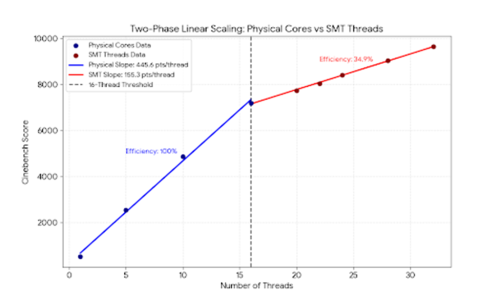
This is what the scaling looks like as you increase thread count in CB26. First it adds physical cores, then after the 16 physical cores it starts to add logical cores. Hence the two different scaling slopes. This is frequency normalized data. As you can see, you get about 35% from the logical cores in this bench.

1767141975696.png