• We’re currently investigating an issue related to the forum theme and styling that is impacting page layout and visual formatting. The problem has been identified, and we are actively working on a resolution. There is no impact to user data or functionality, this is strictly a front-end display issue. We’ll post an update once the fix has been deployed. Thanks for your patience while we get this sorted.

Discussion Cinebench 2026

Page 6 - Seeking answers? Join the AnandTech community: where nearly half-a-million members share solutions and discuss the latest tech.
Not sure that’s a good comparison.

The best would be a 9950X3D which I’ve seen go as high as 810 in SC(SMT), and I’m pretty sure that wasn’t stock. So 1072 would be a 32% increase from that. From the looks of it SMT is doing a lot of the heavy lifting because the ST score only increases by 15-16%, so I take it’s SMT efficiency must be a lot better in Zen 5 compared to Zen 4. But could it see such an improvement again with a Zen 6?

I guess I’ll amend my statement when looking at some of the 7950X(3D) results versus the 9950X(3D), and there is about a 30% or so increase in SC(SMT). So I guess it maybe* could be a top-end Zen 6, but still seems like it would be an engineering sample since we’re about nine months away from products in all likelihood.


This is another good comparison:
View attachment 136050
That 9955HX really stretches It’s legs after 100W in CB R23. But not in 2024.

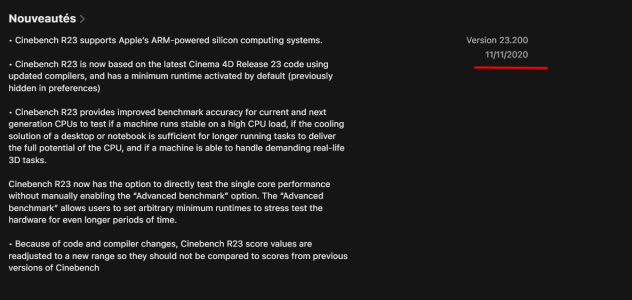
One thing to note as well is that the M-Series isn’t native in CB R23, so score comparisons with that aren’t apples-to-apples.
Zen5(R5 9600X) + DDR5 2x16GB 5600MT
~5.4GHz
ST 525p
SC(SMT) 719p (SMT +37%)

If that SC(SMT) result belongs to Zen6, then I must admit that the increase is very good, provided that ST increases more or less as well. LionCove(U9 285K) in ST gets about 602p(~5.7GHz?)
 
Last edited:
Not sure that’s a good comparison.

The best would be a 9950X3D which I’ve seen go as high as 810 in SC(SMT), and I’m pretty sure that wasn’t stock. So 1072 would be a 32% increase from that. From the looks of it SMT is doing a lot of the heavy lifting because the ST score only increases by 15-16%, so I take it’s SMT efficiency must be a lot better in Zen 5 compared to Zen 4. But could it see such an improvement again with a Zen 6?

I guess I’ll amend my statement when looking at some of the 7950X(3D) results versus the 9950X(3D), and there is about a 30% or so increase in SC(SMT). So I guess it maybe* could be a top-end Zen 6, but still seems like it would be an engineering sample since we’re about nine months away from products in all likelihood.


This is another good comparison:
View attachment 136050
That 9955HX really stretches It’s legs after 100W in CB R23. But not in 2024.

One thing to note as well is that the M-Series isn’t native in CB R23, so score comparisons with that aren’t apples-to-apples.

Zen 5 scale better than Zen 4 but we can see that from 100 to 115W power scale as a cube of frequency for the 9945HX, so the optimum is at 100W while the 7945HX reach its best efficiency point at 80W, it s just that the 7945HX scale so terribly at those powers that it falsely make the 9945HX looking good.

Beside CB R23 is just CB R20 optimised to support natively Apple CPUs, that s not by chance that it was released only one year after CB R20, so that s still a fair comparison.

Zen5(R5 9600X) + DDR5 2x16GB 5600MT
~5.4GHz
ST 525p
SC(SMT) 719p (SMT +37%)

If that SC(SMT) result belongs to Zen6, then I must admit that the increase is very good, provided that ST increases more or less as well. LionCove(U9 285K) in ST gets about 602p(~5.7GHz?)

You have all possible scores on almost all possible CPUs here :

 
Beside CB R23 is just CB R20 optimised to support natively Apple CPUs, that s not by chance that it was released only one year after CB R20, so that s still a fair comparison.
Not according to this:
1767397310771.png
 
Not according to this:
View attachment 136053
That s not emulation, it was recompiled to support natively Apple CPUs.

 
its not as simple to check only if its a native binary.

Look at amount of optimisations that R26 had for both x86 and ARM. I doubt R23 had the same of optimisations put in.

1767398515214.png
That s not emulation, it was recompiled to support natively Apple CPUs.

 
That s not emulation, it was recompiled to support natively Apple CPUs.

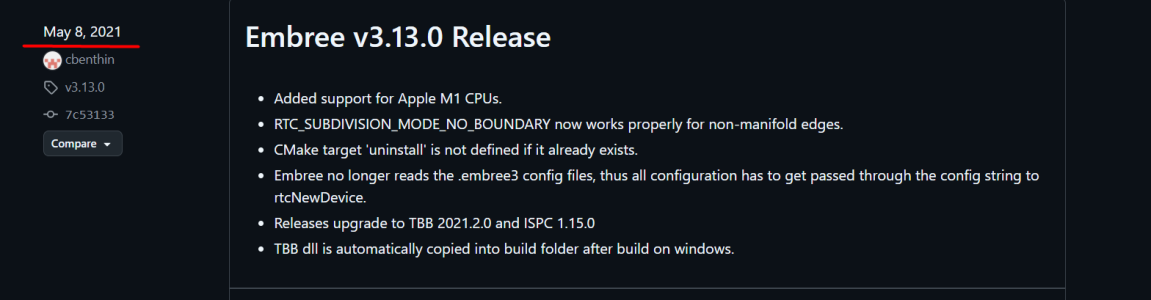
No. R23 is built on an older version of Embree, which does not support Apple Silicon. 1767398747479.png

1767398775253.png
 
its not as simple to check only if its a native binary.

Look at amount of optimisations that R26 had for both x86 and ARM. I doubt R23 had the same of optimisations put in.

View attachment 136056
At Computerbase the 9950X perform about 7% better than a M3 in CB 2026 ST, in CB R23 the M3 does 1968 pts while the 9950X does 2294, that s 16.5% better, so the differential is only 9%, noticeable but not that dramatic, if R23 wasnt optimised at all for the M3 the difference would be larger.
 
Last edited:
You have all possible scores on almost all possible CPUs here :

It doesn't matter. Most of the results in this ranking/results database (at the top) come from overclocked processors (at least RAM).

If the result was for Zen6, it meant the sample wasn't reaching its final clock speeds.
 
Exactly.

It should not be that difficult to get the apples to apples, Mac Min vs. Mini PC comparison between Apple and PCs - but for some reason it is. Maybe there is just no market for this type of comparison.
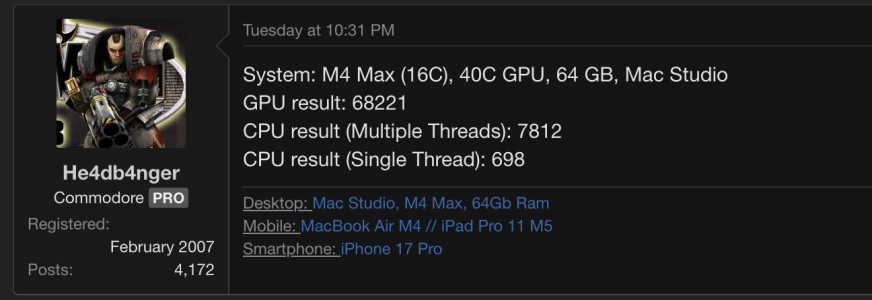
here is a proper SoC comparision using Cinebench 2026 LPDDR5 Apple and AMD systems

If we take the M4 Max CPU 12P+4E/16 threads (3.9GHz all core freq) at 80 watts for CPU power we get:

ST: 698
MT: 7812
1767399806260.png

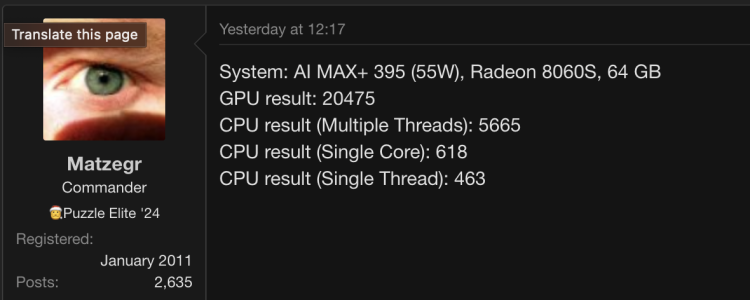
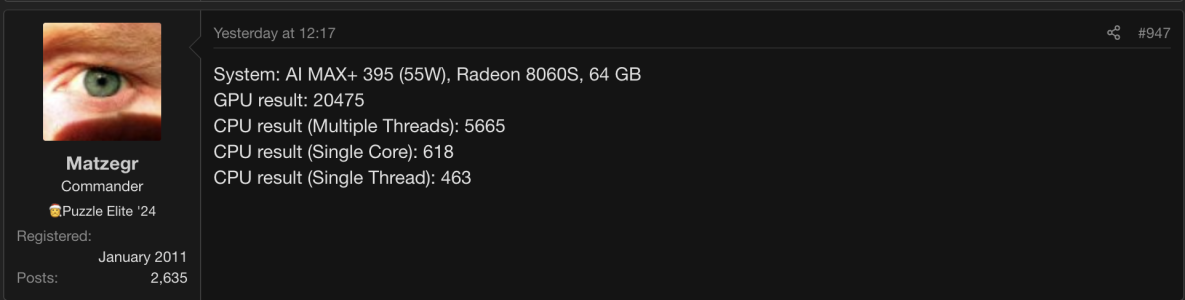
Now for the Strix Halo 16c/32threads at 55 watts:
ST: 463
SC: 618
MT: 5665
1767399870814.png

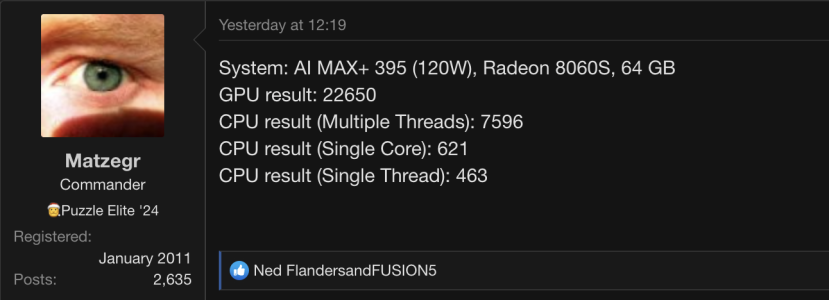
Strix Halo 16c/32threads at 120 watts:
ST: 463
SC: 621
MT: 7596
1767399911024.png


Attachments

  • 1767399848218.png
    1767399848218.png
    162.2 KB · Views: 13
here is a proper SoC comparision using Cinebench 2026 LPDDR5 Apple and AMD systems

If we take the M4 Max CPU 12P+4E/16 threads (3.9GHz all core freq) at 80 watts for CPU power we get:

ST: 698
MT: 7812
View attachment 136061

Now for the Strix Halo 16c/32threads at 55 watts:
ST: 463
SC: 618
MT: 5665
View attachment 136063

Strix Halo 16c/32threads at 120 watts:
ST: 463
SC: 621
MT: 7596
View attachment 136064


If you take M4 at 80W with MT score of 7812 that's 97.95 points per Watt
Strix Halo at 55 W with MT score of 5665 is 103 points per Watt
Strix Halo at 120W with MT score of 7596 is 63.3 points per Watt

M4 may be past its most efficient point to be performing less efficiently than Strix Halo, but the Strix Halo is also past its most efficient point at 120W.

Which is what you would expect. Apple to be ~20%-40% more efficient.

Claiming Apple is 300%, 400% or 700% more efficient is crack smoking territory.
 
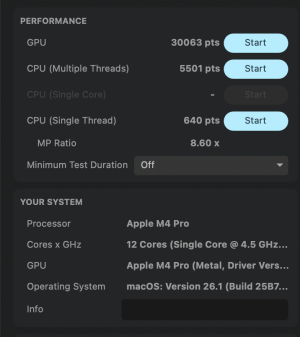
to get an idea heres a 55 watt 8p+4e m4 pro, 4 less P cores than M4 max. Simliar score to a 55 watt 16c strix halo.

View attachment 136068

So 2 variables changed between those M4s, less available power and 4 fewer cores.

It has similar efficiency, but maybe a 16 core M4 at 55W would be operating at even better efficiency.

Either way, the efficiency gap in MT between Apple M processors and Strix Halo is definitely not the size of Grand Canyon.
 
Back
Top