It really depends on the speed of the LPDDR5X modules. 8.5...9.6 Gbps are getting standard. 12.7 Gps is the ceiling. Strix Point mostly uses 7.5 Gbps modules and many notebooks also slow 5.6 Gbps modules.
- 8.5...9.6 Gbps = 1.14...1.28x bandwidth vs. 7.5 Gbps
- 10.7...12.7 Gbps = 1.43...1.69x bandwidth
The bigger L1 and L2 caches should be very effective. Compared to Strix Point without MALL it will be a very decent upgrade in bandwidth efficiency.
If then the universal compression comes into play, there should be another bandwidth amplification.
We do not know overall bandwidth efficiency upgrades. But summing all up together it could be on par with RDNA3 + 32 MByte MALL or at least close to it. AT4 could reach N44 performance levels.
- RX 9060 XT has 320 GB/s memory bandwith
- RX 9060 has 288 GB/s memory bandwith
- 128bit LPDDR5X with 8.5 Gbps yields in
171 GB/s 136 GB/s
- 128bit LPDDR5X with 9.6 Gbps yields in
192 GB/s 153 GB/s
- 128bit LPDDR5X with 10.7 Gbps yields in
214 GB/s 171 GB/s
- 128bit LPDDR5X with 12.7 Gbps yields in
254 GB/s 203 GB/s
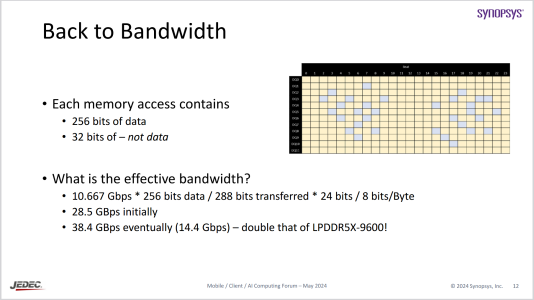
- 192bit LPDDR6 with 10.67 Gbps yields in
284 GB/s 228 GB/s (effective) --> probably enough bandwidth for a desktop grade part with high clock rates (AMD should have designed / dimensioned it that way)
- 192bit LPDDR6 with 12.8 Gbps yields in
340 GB/s 274 GB/s (effective)
9.6 Gbps bandwidth for a mobile part might be a little bit tight. That is true. But as I said, we simply do not know RDNA5's overall bandwidth efficiency. Maybe LPDDR6 bandwidth levels are plenty enough and LPDDR5X is then sufficient for mobile parts with restricted TDPs. If 12.7 Gbps LPDDR5X gets used (but this memory is probably too expensive and not used), there should be no big difference in bandwidth compared to 10.67 Gbps LPDDR6.
Edit: Corrected bandwidth numbers
https://forums.anandtech.com/threads/zen-6-speculation-thread.2619444/page-363#post-41571222