dense and non dense cores have different frequency so that would affect the results a Core running at higher Frequency will finish faster than the one running at lower Frequency albeit if not memory bound.Consider the example of a program's inner loop parallelized by e.g. OpenMP and executed on either a mix of dense and non-dense cores (hint: they all finish their parts of the loop body at about the same time) or on a mix of cores of different Core Microarchitectures (hint: they handle their parts of the loop different from each other because they have different instruction latencies and whatnot).
Which approach works? Both of them. Which works well? One of them.

-
We’re currently investigating an issue related to the forum theme and styling that is impacting page layout and visual formatting. The problem has been identified, and we are actively working on a resolution. There is no impact to user data or functionality, this is strictly a front-end display issue. We’ll post an update once the fix has been deployed. Thanks for your patience while we get this sorted.
You are using an out of date browser. It may not display this or other websites correctly.
You should upgrade or use an alternative browser.
You should upgrade or use an alternative browser.
Question Zen 6 Speculation Thread
Page 333 - Seeking answers? Join the AnandTech community: where nearly half-a-million members share solutions and discuss the latest tech.
They have different maximum frequency.dense and non dense cores have different frequency
When will people get it? It is not too hard. Cores running at variable frequency based on a bunch of factors is not that new anymore.
Fjodor2001
Diamond Member
A much better approach is to divide the complete work into smaller chunks. Once a core has completed a chunk it gets assigned a new chunk to work on. Some cores will complete more chunks than others (depending on how fast the core is, and how much work is required in practice per chunk). Problem solved.Consider the example of a program's inner loop parallelized by e.g. OpenMP and executed on either a mix of dense and non-dense cores (hint: they all finish their parts of the loop body at about the same time) or on a mix of cores of different Core Microarchitectures (hint: they handle their parts of the loop different from each other because they have different instruction latencies and whatnot).
Which approach works? Both of them. Which works well? One of them.
Of course there can be poorly designed SW, but that you cannot protect fully against. E.g, there could be SW that is hard coded to split up the work into exactly 4 chunks (even if it could be split up to many more) regardless on number of CPU cores available.
But we can argue back and forth endlessly about specific use cases. All said and done, everyone in the business is heading towards big.LITTLE style CPUs (and most have been there for a long time). So they must have concluded that the pros overrule the cons.
Last edited:
even under the same condition dense and non dense have different Physical Design so it's near impossible for them to operate at the same V/F curveThey have different maximum frequency.
When will people get it? It is not too hard. Cores running at variable frequency based on a bunch of factors is not that new anymore.
AMD users laughed at Intel ADL's big.LITTLE, yet AMD was just a gen or two late with big.LITTLE...
What AMD really needs to step up its game in mobile is to provide a top-noch SW/HW support and viable (complete) platforms to OEMs. OEMs juggling with 7 different SKU lines doesn't seem like it.
What AMD really needs to step up its game in mobile is to provide a top-noch SW/HW support and viable (complete) platforms to OEMs. OEMs juggling with 7 different SKU lines doesn't seem like it.
All problems are exactly like Cinebench's problem.Problem solved.
Therefore, all CPUs should have Cinebench accelerators built in.
Fjodor2001
Diamond Member
Again:All problems are exactly like Cinebench's problem.
Therefore, all CPUs should have Cinebench accelerators built in.
But we can argue back and forth endlessly about specific use cases. All said and done, everyone in the business is heading towards big.LITTLE style CPUs (and most have been there for a long time). So they must have concluded that the pros overrule the cons.
We can argue back and forth but AMD doesn't do big.LITTLE. Apparently their own conclusion was a different one.
They have similar enough v/f curves with the major exception that the curve of the non-dense cores has a longer tail.even under the same condition dense and non dense have different Physical Design so it's near impossible for them to operate at the same V/F curve
ofc notThey have similar enough v/f curves with the major exception that the curve of the non-dense cores has a longer tail.
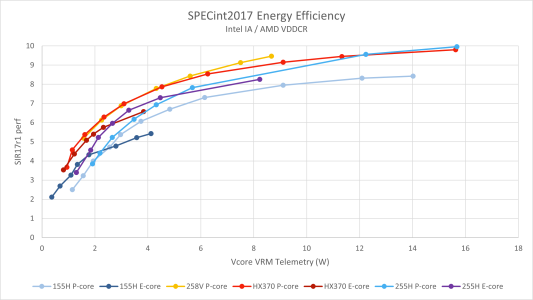

adroc_thurston
Diamond Member
This doesn't quite work since stx1 dense cluster has halved L3 access.

biostud
Lifer
I think it had something to do with the disabling of AVX512 to get consistent performance from their CPUs, which was considered to be quite a step back.AMD users laughed at Intel ADL's big.LITTLE, yet AMD was just a gen or two late with big.LITTLE...
Power is directly proportional to voltage and performance is directly proportional to Frequency for the same uArch ...When we discuss "core Voltage over core frequency" (and core frequency control while executing multithreaded programs) and then get to see a "SIR17r1 perf over Vcore VRM Telemetry (W)" graph...
Yeah but it's the best info I have for power performance characteristics.This doesn't quite work since stx1 dense cluster has halved L3 access.

fastandfurious6
Banned
AMD users laughed at Intel ADL's big.LITTLE, yet AMD was just a gen or two late with big.LITTLE...
No.
Strix Point (STX HX370, currently the flagship "AMD big.little") is a failure. I proved it here
In every single scenario, 9955HX is better than STX
(9955HX = literally 9950X on mobile, 16 full cores)
Right now they have one and the same core, but either physically optimized with a focus on peak frequency, or physically optimized with the focus more shifted towards area. (Besides different FP pipeline width in different markets.)
Ok dense c-cores save die area. This makes a lot of sense in server/EPYC where most want to pack max amount of cores in chip.
But... according to rumors here there's gonna be like 7 mobile chip families for zen6 and almost all gonna have the hybrid full+dense 4p+8c
Most of them, just zen6 4p+8c and really not much else (except Halo models w big iGPU)
Literally just 4p+8c in a 2nm generation where they can fit 12 full cores in CCD
The flagship will classically be 12+12 full cores and will have the #1 performance in all areas
The question is, what are they saving die area for?
On server/EPYC it's simple answer, they want to fit as many cores as possible.
But when just 4p+8c .... why not just full 12 cores CCD?
In a laptop form factor 9955HX is a failure cause it can't last for more than couple of hoursStrix Point (STX HX370, currently the flagship "AMD big.little") is a failure. I proved it here
In every single scenario, 9955HX is better than STX
(9955HX = literally 9950X on mobile, 16 full cores)
Cause profits? The die can't be bloated - its an expensive die using 2/3nm and think of all those things packed in - GPU, idiotic AI slop generators, IO, etc.But when just 4p+8c .... why not just full 12 cores CCD?


marees
Platinum Member
i believe it depends on the market segmentation of laptop customersThe flagship will classically be 12+12 full cores and will have the #1 performance in all areas
The question is, what are they saving die area for?
On server/EPYC it's simple answer, they want to fit as many cores as possible.
But when just 4p+8c .... why not just full 12 cores CCD?
the kind of customers who buy a MDS1 Hi with extra 12p ccd are also likely to choose a discrete nvidia laptop gpu, basically the whales
plus customers of medusa halo with optional 12p ccd would likely buy huge amount of RAM too — basically premium customers
all the others are unlikely to pony up the extra margin for a 12p core ccd. so they should be fine with 4p + 8c + 2lp (MDSP / MDSH base / Magnus) or 4p + 4c + 2lp (MDS1 base)
bumblebee (MDS3 2p + 2c + 2lp) required to replace krackan. It is there on leaked roadmaps as launching late 2027
adroc_thurston
Diamond Member
Brother semi-custom parts have no relation to any Medusa.so they should be fine with 4p + 8c + 2lp (MDSP / MDSH base / Magnus)
fastandfurious6
Banned
In a laptop form factor 9955HX is a failure cause it can't last for more than couple of hours
Halo (9955HX+gpu) can last 10+ hours.... how? because they couldn't wait some months for the new low-power interconnect to be ready for 9955HX
it's the not the CPUs fault. I bet Halo has better battery life than STX too lol.
STX is a failure 100%, would only work as replacement to Phoenix for same price but it's x2
the kind of customers who buy a MDS1 Hi with extra 12p ccd are also likely to choose a discrete nvidia laptop gpu, basically the whales
all of them, every single one will buy the flagship 10955HX3D or whatever they call it
24 full cores + 3D only. no reason to buy anything else really. no one will bother with "medusa premium" or medusa point or whatever
I'm actually worried there may not be a market for Medusa Halo even? if AMD plans to release 5 types of "medusa point high premium" then they intend to price the real Halo to high heavens, at which point it's not a viable purchase.... despite being literally the #1 chip in world
fastandfurious6
Banned
Cause profits? The die can't be bloated - its an expensive die using 2/3nm and think of all those things packed in - GPU, idiotic AI slop generators, IO, etc.
really AMD sees such profit opportunity in having 4p+8c rammed literally everywhere in 5 product families instead of classic 12 full cores ccd?
is profit the answer?
marees
Platinum Member
there will always be someone who is willing to pay $3000 to $4000I'm actually worried there may not be a market for Medusa Halo even? if AMD plans to release 5 types of "medusa point high premium" then they intend to price the real Halo to high heavens, at which point it's not a viable purchase.... despite being literally the #1 chip in world
imagine how much RAM 384bit lpddr6 can hold !!
there will always be someone who is willing to pay $3000 to $4000
And those people buy MBPs.

poke01
Diamond Member
There will always be buyers for high end SKUs especially in laptop world.I'm actually worried there may not be a market for Medusa Halo even? if AMD plans to release 5 types of "medusa point high premium" then they intend to price the real Halo to high heavens, at which point it's not a viable purchase.... despite being literally the #1 chip in world
2027 is so far away though.
Last edited:
The 4 classic + 8 dense configs are in monolothic chips, which are baked in N3. (And even if there were in N2, why waste that much area for something that is never needed in mobile? I.e. provide for an insane f_max in all cores, if only a couple of them are ever going to run at f_max? — Again, that's old, I can't believe it still gets brought up.)Literally just 4p+8c in a 2nm generation where they can fit 12 full cores in CCD
Nope.Power is directly proportional to voltage
Not quite.performance is directly proportional to Frequency for the same uArch
Last edited:
TRENDING THREADS
-
 Discussion Zen 5 Speculation (EPYC Turin and Strix Point/Granite Ridge - Ryzen 9000)
- Started by DisEnchantment
- Replies: 25K
-
Discussion Intel Meteor, Arrow, Lunar & Panther Lakes + WCL Discussion Threads
- Started by Tigerick
- Replies: 25K
-
 Discussion Intel current and future Lakes & Rapids thread
- Started by TheF34RChannel
- Replies: 24K
-

-
