• We’re currently investigating an issue related to the forum theme and styling that is impacting page layout and visual formatting. The problem has been identified, and we are actively working on a resolution. There is no impact to user data or functionality, this is strictly a front-end display issue. We’ll post an update once the fix has been deployed. Thanks for your patience while we get this sorted.

Question Zen 6 Speculation Thread

Page 279 - Seeking answers? Join the AnandTech community: where nearly half-a-million members share solutions and discuss the latest tech.
GPU core count matter too you know. Since several years AMD has been way behind Intel in iGPU perf on DT. Why do you think that will change with Zen6 / NVL-S?
Matters to whom? Are the AIBs asking for it.

It matters only for PC handhelds where medusa premium (on the strix point socket) should address it
 
Again, first time we have been able to clearly say approach 1 works better than approach 2 between AMD and Intel as there was always the process difference to consider. For decades, the advantage was in Intel's favor. Recently? Not so much.

Yeah, Intel had a lead for decades, then there was rough parity on
- N7 vs. Intel 7
- N5 vs. Intel 4 and still Intel 7

But currently, Intel's leading edge product in Intel Client (LNL+ARL) do have a node advantage. But in the future, on client, it looks like it will be mostly parity:
- NVL on N2 vs. Zen 6 desktop on N2
- PTL on 18A vs. Zen 6 mobile on N3P

In server, it looks like AMD will have an advantage:
- CWF + DMR on 18A vs. Zen 6 Venice on N2
 
I feel like the MT performance of NVL DT and Zen 6 DT will ultimately be limited by power. Intel can throw as many E cores as they want on the chip, but without drastically increasing power limits and/or making the chip that much more efficient, performance is ultimately capped by power.
Don't think it even matters. Not that many people care about multi thread. This thread has all sorts of people excited about multi thread performance for the biggest SKUs while the single ccd version is going to be far and away the biggest most important seller.
 
Don't think it even matters. Not that many people care about multi thread. This thread has all sorts of people excited about multi thread performance for the biggest SKUs while the single ccd version is going to be far and away the biggest most important seller.
Intel has 8+16 Single CCD as well both have 24T should be enough for MSDT for majority of users
 
MLID, Adhoc Thurstrap. Where have ye been man??

I mean, 6GHz+ is a given, otherwise, the whole AMD CPU division should be fired in the act. It's a double node jump and even if it would only use N3P or N3X, 6GHz is only a 5% increase.
The question here is not 6GHz+, but if it can clock to 6.5GHz or more. I think 6.5GHz will happen, i don't think much more than that, though, and I think 7GHz is a pipe dream.
 
We will see how much Zen 6 mobile overlaps with PTL vs. NVL...

Interesting about DMR being on 18AP. Then, it is probably very late 2026 at the earliest.
There's Strix Point "refresh" due at some point between now and the heat death of the universe that will bring a staggering increase in it's (dramatic pause to check notes) model number to compete against PTL for at least another product cycle.
 
MLID, Adhoc Thurstrap. Where have ye been man??
Summer is busy for me, I kind of wink out for a bit.

I won't believe 6+GHz until I see it. I mean like actually running on multiple cores on a workload for a few minutes at that speed. Not one cores jumping sporadically up and down. 6GHz has been a speed limit for out-of-the box processors for quite some time. Node jumps are more for area density and power efficiency these days.
 
I mean, 6GHz+ is a given, otherwise, the whole AMD CPU division should be fired in the act. It's a double node jump and even if it would only use N3P or N3X, 6GHz is only a 5% increase.
The question here is not 6GHz+, but if it can clock to 6.5GHz or more. I think 6.5GHz will happen, i don't think much more than that, though, and I think 7GHz is a pipe dream.
I hope so but I really doubt even 6.5GHz. You might have to change your name to "Zen Low."
 
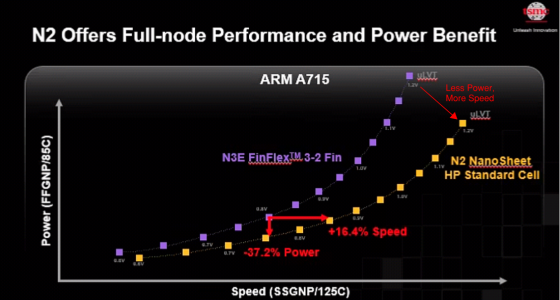
Why not? They'll be able to leverage NanoFlex and choose the type of transistor they need for each block in the chip.
Which will limited to very small sub block but AMD has been good at extracting perf out of smaller lib why choose bigger if 2-1 gets shit done.
 
I'm sure going from 2-1 on N4P to 2-1 on N2 will reap plenty of frequency uplift, enough to hit >6 GHz.
I mean Zen 3 on 7nm to Zen 4 on 5nm with the 5800X to 7700X was a 1.125x jump in boost clock speed. I mean a 20% boost in clock speed with two node jumps is 6.72Ghz assuming those Zen 5 X3D refresh CPUs are true. And if AMD is really pushing it then they'd need a 25% boost in clock speed. If they can achieve that without having to push wattage on Zen 6 X3D on N2P that'd be crazy.

But since TSMC N2(P/X) seem to be focusing on clock speed than density increase I suppose that's where a clock speed rumours for Zen 6 is coming from.
 
I mean Zen 3 on 7nm to Zen 4 on 5nm with the 5800X to 7700X was a 1.125x jump in boost clock speed. I mean a 20% boost in clock speed with two node jumps is 6.72Ghz assuming those Zen 5 X3D refresh CPUs are true. And if AMD is really pushing it then they'd need a 25% boost in clock speed. If they can achieve that without having to push wattage on Zen 6 X3D on N2P that'd be crazy.

But since TSMC N2(P/X) seem to be focusing on clock speed than density increase I suppose that's where a clock speed rumours for Zen 6 is coming from.
I think expectations regarding peak DT clocks should be tempered. These wild claims of >7 GHz are just asking for disappointment. Imo, >6 GHz and <7 GHz is a certainty; I wouldn't be surprised at a healthy and balanced 10% uplift when it's all said and done (~6.3 GHz).
 
Back
Top