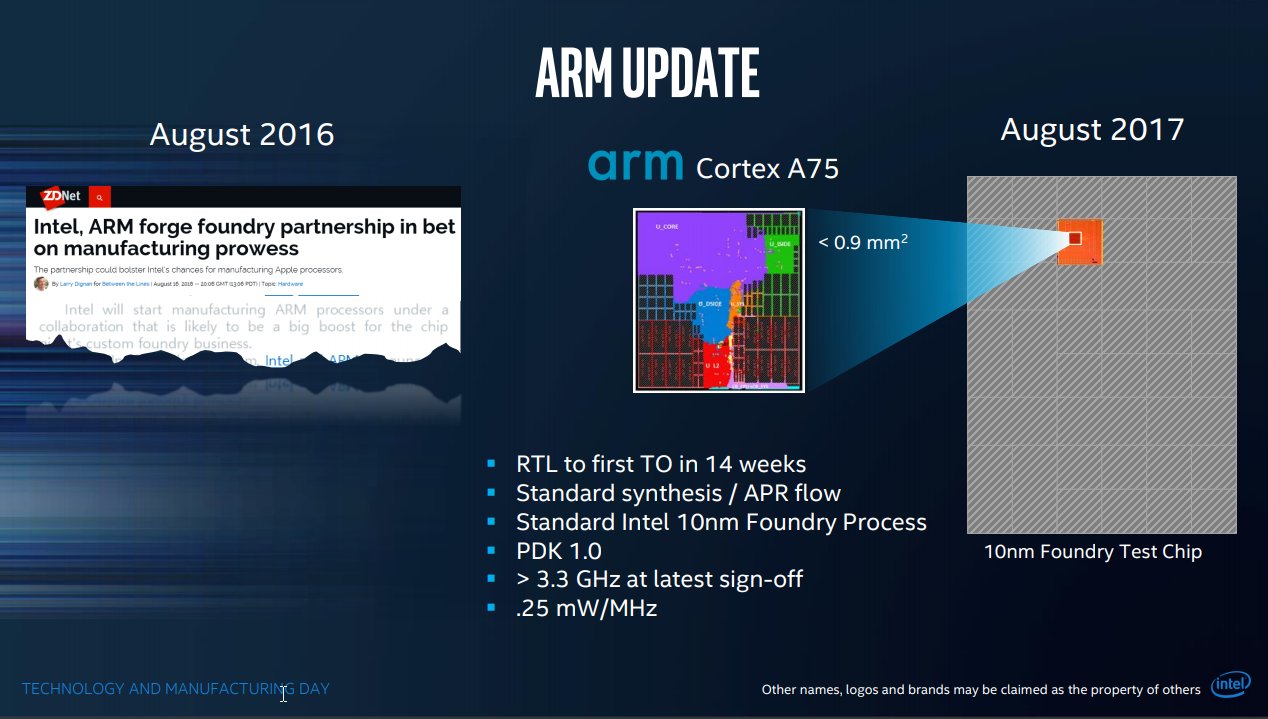
It could have helped Intel but for the industry and for the consumers its certainly better that we now also have ARM as options for PCs. Aside from server chips there are currently only low-power ARM SoCs available, because there was no market demand for higher performance tiers. This could potentially change. Imagine likes of a 90W TDP A11 🙂
I believe the architectures are too different if you think along the lines of sharing the back-end. Its not just the instructions, its the memory model, the exception model, how barriers work, what kind of atomics (e.g. load-linked-store-conditional) with what semantics (release or acquire), the virtualization architecture, the memory protection and security features etc. As conclusion if for some reason you need both ISAs in one device - supporting one ISA in HW and SW emulation of the other is a reasonable approach.
I agree. I actually wish Microsoft had been getting on that years ago, it might've made Win10 on phones and lower end tablets have a chance (which a shame we didn't get the Android porting/running native Android stuff either), plus it'd open up competition in the PC space. Absolutely, would be interesting. Quite a few, including people like John Carmack, have said that the issue with mobile chips is their thermal and power constraints. Its why I think an ARM CPU based chip is a very serious possibility for the next gen of consoles. The CPU could easily be an upgrade over even the CPU in the the PS4 Pro or One X, but wouldn't require a ton of development and they could own more of the IP. They could even ape Nintendo and make a portable hybrid (maybe even go with a discrete GPU in the dock, where they basically shut off the GPU next to the SoC to let the CPU have all the thermal headroom).
I figured it would be difficult (and not worth it, plus with AMD not having the resources and Intel not wanting to help ARM). I was going to make a comparison to x64 with Athlon 64 (enabling 64 and 32 bit), but know that's not nearly the level multiple architectures would require. Yeah emulation (which isn't that what Microsoft's ARM on Windows is doing?). I figured that the most likely would be pairing large powerful x86 with some medium/small ARM, where the ARM would be good enough for whatever you need (since assumption would be you're mobile or have some instances where you're operating under some constraint), while the x86 being the focus of the performance.
Ah, I guess I was mistaken with them stopping the mobile phone focused chips? I thought they had largely stopped developing the architecture itself too though? And that its basically them just building stuff to customers desire (so core count for instance, which is why we got the 8 core ones going in stuff like was it routers?).
He maybe reffers to the phone chips...
BTW... Intel lost the chance to get Power VR... Mediatek has the chance now.
Yeah. I thought there was a larger change in development though. Like Intel basically said they weren't really advancing Atom cores themselves any more. They still offer them but they're not pushing them and had basically said they weren't doing much more than producing them based on customer desire.
Yeah, but makes me wonder if they maybe should have looked at that as a way of staying in with Apple (even before they became aware of Apple ditching them).
Intel is probably going to use their own IP for GPU. At this point with Gen9.. they support ASTC and Vulkan/DX12.3/etc. Only thing Intel needs to do is reduce the power which a 10nm node would do anyway. 10nm HPM (Spreadtrum) => Risk production Q2 2018.
Yeah, I think they're recent changes make that more than probably. Kinda curious to see what they do short term. Probably not too much, just doing their own iGPU, and then maybe pairing with AMD on that compact mobile focused thing until Intel gets their own up and working (I still think that was likely targeting Apple, and then Apple probably wasn't impressed so then they released it as a chip, maybe they're hoping to see if that might develop a market in non Apple PCs, and then develop it more so that Apple would then consider it). My biggest wonder is if Raja might throw AMD/RTG a bit of a bone and develop things in line with where he was pushing them, so that there might be some shared development (by that I mean, the similarities make developing for either easier for the other for other developers; although maybe there would be some possibility for sharing development in a collaboration?), which would have benefits for Intel's GPU as well, and both would be looking to undo Nvidia's dominance, so they could both benefit, especially if they focus in different areas (mobile APU, while letting AMD have more desktop focused APU and maybe consoles; and then Intel pushes bigger for enterprise stuff, while leaving consumer dedicated GPU and even pro like the FirePro stuff), where they could kinda chase different things. I'm sure they'd still compete directly.