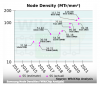
Discussion Leading Edge Foundry Node advances (TSMC, Samsung Foundry, Intel) - [2020 - 2025]

Page 154 - Seeking answers? Join the AnandTech community: where nearly half-a-million members share solutions and discuss the latest tech.

DisEnchantment

Golden Member
Mar 3, 2017
1,779
6,798
136
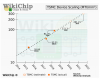
TSMC's N7 EUV is now in its second year of production and N5 is contributing to revenue for TSMC this quarter. N3 is scheduled for 2022 and I believe they have a good chance to reach that target.
1587737990547.png
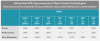
N7 performance is more or less understood.
1587739093721.png

This year and next year TSMC is mainly increasing capacity to meet demands.

For Samsung the nodes are basically the same from 7LPP to 4 LPE, they just add incremental scaling boosters while the bulk of the tech is the same.

Samsung is already shipping 7LPP and will ship 6LPP in H2. Hopefully they fix any issues if at all.
They have two more intermediate nodes in between before going to 3GAE, most likely 5LPE will ship next year but for 4LPE it will probably be back to back with 3GAA since 3GAA is a parallel development with 7LPP enhancements.


1587739615344.png

Samsung's 3GAA will go for HVM in 2022 most likely, similar timeframe to TSMC's N3.
There are major differences in how the transistor will be fabricated due to the GAA but density for sure Samsung will be behind N3.
But there might be advantages for Samsung with regards to power and performance, so it may be better suited for some applications.
But for now we don't know how much of this is true and we can only rely on the marketing material.

This year there should be a lot more available wafers due to lack of demand from Smartphone vendors and increased capacity from TSMC and Samsung.
Lots of SoCs which dont need to be top end will be fabbed with N7 or 7LPP/6LPP instead of N5, so there will be lots of wafers around.

Most of the current 7nm designs are far from the advertized density from TSMC and Samsung. There is still potential for density increase compared to currently shipping products.
N5 is going to be the leading foundry node for the next couple of years.

For a lot of fabless companies out there, the processes and capacity available are quite good.

---------------------------------------------------------------------------------------------------------------------------------------------------


FEEL FREE TO CREATE A NEW THREAD FOR 2025+ OUTLOOK, I WILL LINK IT HERE
 
Last edited:

jdubs03

Golden Member
Oct 1, 2013
1,450
1,024
136
@OneEng2 Clearwater Forest is delayed due to packaging issues. Either way, it doesn't look good, because delays make the product WORSE, never better. Delays happen because goals are missed and they are trying to un-miss it.

People around the Net are making an argument that tariffs and Chinese invasion will save Intel, but the reality is a serious war like that will plummet the demand for luxury goods such as computers, and will further the decline of Intel. It's an astonishing level of denial if you ask me. The world is at a precipice for potential end and somehow that is spun as positive.

If you think Intel's revenue level is bad, imagine when China blocks sales entirely. That alone will result in total revenue(not net) dropping 20% or so. This is assuming rest of the world is insulated in a vacuum, which won't be. Likely the total drop in revenue is going to be closer to 50%. That's bankruptcy in <3 years.
I think your premise depends on when a supposed Taiwanese invasion occurred and where Intel’s node competitiveness is with 18A. If Intel were to succeed in getting a foothold (being competitive with the current or n+1 TSMC node) prior to an invasion, and then one would occur, I think you could still see plenty of demand; then the issue is spinning up enough volume to match it. I could easily seeing a Defense Production Act authorization on National Security grounds on the order of a Manhattan Project to ensure leading edge semiconductor production continues. Also TSMC could possibly transfer their R&D to an American entity and follow on fabs could be supported. The demand for luxury goods would decline precipitously though, no doubt on that. Obviously that’s worse case, but in all likelihood, Intel would be the only one left standing. Maybe South Korea and Samsung can remain on the sidelines but that’s not a guarantee.
 

511

Diamond Member
Jul 12, 2024
5,340
4,754
106
I think your premise depends on when a supposed Taiwanese invasion occurred and where Intel’s node competitiveness is with 18A. If Intel were to succeed in getting a foothold (being competitive with the current or n+1 TSMC node) prior to an invasion, and then one would occur, I think you could still see plenty of demand; then the issue is spinning up enough volume to match it. I could easily seeing a Defense Production Act authorization on National Security grounds on the order of a Manhattan Project to ensure leading edge semiconductor production continues. Also TSMC could possibly transfer their R&D to an American entity and follow on fabs could be supported. The demand for luxury goods would decline precipitously though, no doubt on that. Obviously that’s worse case, but in all likelihood, Intel would be the only one left standing. Maybe South Korea and Samsung can remain on the sidelines but that’s not a guarantee.
This is too much to swallow Defense mainly needs legacy nodes like 14nm.

Intel/GF has enough capacity btw GF is 80% Saudi... Intel 16 is Industry standard same with 3 and 18A and N4 is in Arizona so we are good but we need to migrate supply chain from TW to Back to US/Europe
 

NostaSeronx

Diamond Member
Sep 18, 2011
3,815
1,294
136
Does AMD plan on using GF's advanced packaging facilities?
Probably not. It is more likely for RISC-V chips to go GF than AMD's chips.

The large volume market is hitting the energy efficiency wall again. It takes literally forever for AMD to react to a strategy doomed to fail.

When all players are on the same node/foundry. Only the best one on software wins the big bucks. That is sadly not AMD64, it is ARM64 currently.
btw GF is 80% Saudi...
81.63% Emirati...
 
Last edited:

jdubs03

Golden Member
Oct 1, 2013
1,450
1,024
136
This is too much to swallow Defense mainly needs legacy nodes like 14nm.

Intel/GF has enough capacity btw GF is 80% Saudi... Intel 16 is Industry standard same with 3 and 18A and N4 is in Arizona so we are good but we need to migrate supply chain from TW to Back to US/Europe
AI alone would be a motivating factor. My point is if leading edge stops with TSMC because of something bad, I suspect and would expect Intel to be there as a backstop for Apple, nVidia, etc. would take some time though for the ramp.

No way the govt doesn’t bring in loads of support.
And that could include ferrying equipment and technicians out of harms way. Though in a hot war, that’s fraught with risk. It would have to be pretty much preemptive, and good luck with that.
 
  • Like
Reactions: OneEng2

511

Diamond Member
Jul 12, 2024
5,340
4,754
106
Probably not. It is more likely for RISC-V chips to go GF than AMD's chips.

The large volume market is hitting the energy efficiency wall again. It takes literally forever for AMD to react to a strategy doomed to fail.

When all players are on the same node/foundry. Only the best one on software wins the big bucks. That is sadly not AMD64, it is ARM64 currently.
ARM was never superior against x86 in Software for HPC or even AI Intel has been dishing out so many AVX-512/AMX Optimization for AI
81.63% Emirati...
Yeah
 

NostaSeronx

Diamond Member
Sep 18, 2011
3,815
1,294
136
ARM was never superior against x86 in Software for HPC or even AI Intel has been dishing out so many AVX-512/AMX Optimization for AI
They are the go to platform. AMX isn't used as general purpose isn't used, it is instead specific to AI accelerators.

ARM + AI Accelerators are more developed than AMD/Intel + AI Accelerators.

Microsoft Cobalt (ARM processor) + Maia (AI Accelerator), for example. There is a bunch to list. However, the big thing is that most if not all new designs on bleeding edge nodes are ARM-only.

Samsung N2 = ARM-first
Rapidus N2 = ARM-first
Intel 18A = ARM-first (Intel is dead last (speed/power/cost/time-to-market) at their own fab) {Intel 18A Neoverse N3/V3 CPUs = 1H25, prior x86-64 CPU 18A target = 2H25}
TSMC N2 = ARM-first
SMIC N+2 Plus/N+3 (Huawei's ARMv9 Kunpeng(ARM has excluded Huawei from bans) + Ascend) = ARM-first

Even on the Steam-side of things. Supporting ARM processors with their weird Android+Linux (SteamOS-Next) thing is more important. Than supporting legacy to x86-64.

ARM will just take huge chunks of Intel and AMD marketshare starting 2H25. Exclusively yoinking bleeding edge capacity. With RISC-V yoinking the more mature nodes 12nm-3nm. Mark my words: 2028 ~ 60% ARM, >39% RISC-V, <1% x86-64/AMD64.
 
Last edited:

Doug S

Diamond Member
Feb 8, 2020
3,797
6,726
136
Why not fix and maintain used computers? Many are way better than Stoney Ridge generation.

That would be your only choice. Even if you can make CPUs in the US, where are the motherboards made? Where are many of the components on them made? Where are the cases made, the power supplies made, where is everything assembled?

If a war totally cuts us off from both China and Taiwan, I don't see anyone able to ship new PCs in anything but token volume at vastly inflated prices. Rather than making CPUs a decade out of date, we'll keep the ones we have going longer. I suppose the tinkerers here who build themselves a new PC on a yearly basis, or at least are rebuilding with many new components that often will make out like bandits if they have been keeping all those parts lying around and are able to build and sell a half dozen fairly recent model PCs.
 
  • Like
Reactions: smalM and moinmoin

DZero

Platinum Member
Jun 20, 2024
2,073
769
96
They are the go to platform. AMX isn't used as general purpose isn't used, it is instead specific to AI accelerators.

ARM + AI Accelerators are more developed than AMD/Intel + AI Accelerators.

Microsoft Cobalt (ARM processor) + Maia (AI Accelerator), for example. There is a bunch to list. However, the big thing is that most if not all new designs on bleeding edge nodes are ARM-only.

Samsung N2 = ARM-first
Rapidus N2 = ARM-first
Intel 18A = ARM-first (Intel is dead last (speed/power/cost/time-to-market) at their own fab) {Intel 18A Neoverse N3/V3 CPUs = 1H25, prior x86-64 CPU 18A target = 2H25}
TSMC N2 = ARM-first
SMIC N+2 Plus/N+3 (Huawei's ARMv9 Kunpeng(ARM has excluded Huawei from bans) + Ascend) = ARM-first

Even on the Steam-side of things. Supporting ARM processors with their weird Android+Linux (SteamOS-Next) thing is more important. Than supporting legacy to x86-64.

ARM will just take huge chunks of Intel and AMD marketshare starting 2H25. Exclusively yoinking bleeding edge capacity. With RISC-V yoinking the more mature nodes 12nm-3nm. Mark my words: 2028 ~ 60% ARM, >39% RISC-V, <1% x86-64/AMD64.
As long AMD delivers decent GPU performance it will be hard to take flight for ARM. Still if AMD and Intel screw up the next generation like the moment of Broadwell/Carrizo, definately ARM will get the boost they need.
 

NostaSeronx

Diamond Member
Sep 18, 2011
3,815
1,294
136
If you take the rest of the ARM CPUs, their total volume wouldn't even be a fraction of x86 total.
ARM dominates Hyperscalers, it is over for Intel/AMD.

Cloud;
Google Axion = ARM, >10% share
Microsoft Cobalt = ARM, >20% share
Amazon Graviton = ARM, >30% share

30+20+10 = More than 60% of the market has switched to ARM.

AI;
Dominated largely by Nvidia's solutions...
OpenAI(30%) -> Microsoft(30%) -> AWS(8%) -> Google(7%)
The above is also JUST ARM.

On the generic gaming device side.
Mobile-usage ~58% = ARM
Desktop-usage ~41% = x86-64
ARM-centric gaming revenue in shortest time span = ~$10B in 5 years.
x86-64-centric gaming revenue in shortest time span = ~$9B in 10 years.

The train of "I want that mobile money":
Final Fantasy 14 mobile
World of Warcraft mobile
Destiny mobile
Warframe mobile
so on...

ARM is the profit booster, x86-64 is the profit sinker.

ARM is the one that will have a seamless introduction to bleeding edge GAA nodes. x86-64 will crash and burn.
 
  • Haha
Reactions: DKR

Hitman928

Diamond Member
Apr 15, 2012
6,752
12,486
136
ARM dominates Hyperscalers, it is over for Intel/AMD.

Cloud;
Google Axion = ARM, >10% share
Microsoft Cobalt = ARM, >20% share
Amazon Graviton = ARM, >30% share

30+20+10 = More than 60% of the market has switched to ARM.

AI;
Dominated largely by Nvidia's solutions...
OpenAI(30%) -> Microsoft(30%) -> AWS(8%) -> Google(7%)
The above is also JUST ARM.

On the generic gaming device side.
Mobile-usage ~58% = ARM
Desktop-usage ~41% = x86-64
ARM-centric gaming revenue in shortest time span = ~$10B in 5 years.
x86-64-centric gaming revenue in shortest time span = ~$9B in 10 years.

The train of "I want that mobile money":
Final Fantasy 14 mobile
World of Warcraft mobile
Destiny mobile
Warframe mobile
so on...

ARM is the profit booster, x86-64 is the profit sinker.

ARM is the one that will have a seamless introduction to bleeding edge GAA nodes. x86-64 will crash and burn.

That’s not at all how percentages work.
 
  • Like
Reactions: rosetta

Hitman928

Diamond Member
Apr 15, 2012
6,752
12,486
136
0.34+0.21+0.13 of a total of 1.0 = 0.68, which is greater than/more than 60% of the total market.

Pretty sure the percentages are working fine. Across the whole post.

So if half of AMD CPUs sold are Zen 4 and half of Intel CPUs sold are Raptorlake, does that mean Zen 4 + Raptorlake make up 100% of the x86 market?
 
  • Haha
Reactions: Tlh97 and DavidC1

NostaSeronx

Diamond Member
Sep 18, 2011
3,815
1,294
136
So if half of AMD CPUs sold are Zen 4 and half of Intel CPUs sold are Raptorlake, does that mean Zen 4 + Raptorlake make up 100% of the x86 market?
100% of the x86 market being actively shipped and sold. In the context of that question.

Hyperscalers tend to toss out old products. UltraSPARC, PowerPC, and MIPS that got eaten by Xeon/Opteron are not in active circulation. Past events are repeatable quests.

Amazon, Google, Microsoft each have their own product. Well it is time to depreciate/retire/end-of-life some old instances. Bump some older customers to newer instances. Since, new capacity of Intel/AMD is reducing not gaining.

ARM products take majority, prior-Intel/AMD products are replaced with ARM. Means inactive/old capacity does not matter in these large-scale workloads.

Projected total (active) capacity going from 2H25 to end of 2028. Is in favor of ARM taking Cloud, AI, Gaming. Where ARM is quicker to launching products on bleeding edge.

Axion, Cobalt, Graviton take up 100% of the demand thus take 100% of their share at each company. ARM in Cloud between those are 68% for ARM and only ARM.
Dell = ARM-focus
HP = ARM-focus
Lenevo = ARM-focus
Lenevo/HP/Dell all want >60% out-going shipments in three years for Qualcomm. With an additional ARM supplier by five years to take the <40% rest.

ONLY ARM will exist. So, the total market share for x86-64 platforms is 100% ARM. No one is on MIPS64, no one is on PPC64, no one is on AXP64, no one is on UltraSPARC, because the CHEAPEST option won. In a duke-out between AMD64 and ARM64, ARM wins.

Axion is cheaper than the rest = 100% ARM
Cobalt is cheaper than the rest = 100% ARM
Graviton is cheaper than the rest = 100% ARM
Of new instances of hyperscalers, which is the only thing that matters. As no one is going to bother with an EPYC-ly slow, expensive, several nodes behind instance.

--- Rahul Kulkarni, AWS's director of compute and AI/ML, told Business Insider that more than 90% of the 1,000 largest elastic-compute-cloud, or EC2, customers were running Graviton chips.
--- “And recently, we have reached a significant milestone,” Brown went on to say. “Over the last two years, more than 50 percent of all the CPU capacity landed in our datacenters was on AWS Graviton. Think about that. That’s more Graviton processors than all the other processor types combined.”

Google for their software stack will want the above, Microsoft the same. With Amazon further pushing out competitors in their own vertical slice. The rest following in Amazon's footsteps.

"The Cobalt CPU is all about Microsoft offering cloud-optimized silicon and being able to offer Arm-based instances to Azure customers much the way AWS [Graviton, sic] is with EC2," Newman said.

“We’re making it easy for customers to bring their existing workloads to Arm,” said Mark Lohmeyer, Google Cloud’s vice president and general manager of compute and machine learning infrastructure. “Axion is built on open foundations but customers using Arm anywhere can easily adopt Axion without re-architecting or re-writing their apps.”

Everyone else will be Dell PowerEdge XE9712/GB200 NVL72, Supermicro/Nvidia versions. As NVIDIA has total domination of the exclusive hyperscalers (not Amazon, Google, Microsoft). When they say 50%, it is 50% their own ARM + 50% of Nvidia's ARM.
 
Last edited:

Hitman928

Diamond Member
Apr 15, 2012
6,752
12,486
136
100% of the x86 market being actively shipped and sold. In the context of that question.

Hyperscalers tend to toss out old products. UltraSPARC, PowerPC, and MIPS that got eaten by Xeon/Opteron are not in active circulation. Past events are repeatable quests.

Amazon, Google, Microsoft each have their own product. Well it is time to depreciate/retire/end-of-life some old instances. Bump some older customers to newer instances. Since, new capacity of Intel/AMD is reducing not gaining.

ARM products take majority, prior-Intel/AMD products are replaced with ARM. Means inactive/old capacity does not matter in these large-scale workloads.

Projected total (active) capacity going from 2H25 to end of 2028. Is in favor of ARM taking Cloud, AI, Gaming. Where ARM is quicker to launching products on bleeding edge.

I'll try again.

In your scenario, say the ARM share grows at each provider and gets to the following:

Google Axion = ARM, >50% share
Microsoft Cobalt = ARM, >50% share
Amazon Graviton = ARM, >60% share

What percent of the total market does ARM have in this scenario?
 

jdubs03

Golden Member
Oct 1, 2013
1,450
1,024
136
That would be your only choice. Even if you can make CPUs in the US, where are the motherboards made? Where are many of the components on them made? Where are the cases made, the power supplies made, where is everything assembled?

If a war totally cuts us off from both China and Taiwan, I don't see anyone able to ship new PCs in anything but token volume at vastly inflated prices. Rather than making CPUs a decade out of date, we'll keep the ones we have going longer. I suppose the tinkerers here who build themselves a new PC on a yearly basis, or at least are rebuilding with many new components that often will make out like bandits if they have been keeping all those parts lying around and are able to build and sell a half dozen fairly recent model PCs.
Totally on point. It would require years of geographical shift/off-shoring for each component manufacturer for there to be a less painful outcome. And I don’t see that happening. We basically have to hold out hope that Xi doesn’t do anything stupid. I’ve made this comment elsewhere, but he has to realize how economically deleterious an invasion would be.
 

511

Diamond Member
Jul 12, 2024
5,340
4,754
106
Totally on point. It would require years of geographical shift/off-shoring for each component manufacturer for there to be a less painful outcome. And I don’t see that happening. We basically have to hold out hope that Xi doesn’t do anything stupid. I’ve made this comment elsewhere, but he has to realize how economically deleterious an invasion would be.
Well this is true MB/PCB are a critical part as well but if they do anything US has itself to blame and funnily Andy Grove predicted this scenario in 2010


LightningZ71

Platinum Member
Mar 10, 2017
2,665
3,361
136
They all need to hyper-focus on getting an entire supply chain for their most essential products in the next 48 months. In the most aggressive estimates that I've seen elsewhere, 2027 is their earliest possible "go" timeline to have a reasonable chance of success.

For SMALL throughput scenarios, that's doable. For high volume products, I just don't see it happening by then.
 
  • Like
Reactions: OneEng2

Doug S

Diamond Member
Feb 8, 2020
3,797
6,726
136
Totally on point. It would require years of geographical shift/off-shoring for each component manufacturer for there to be a less painful outcome. And I don’t see that happening. We basically have to hold out hope that Xi doesn’t do anything stupid. I’ve made this comment elsewhere, but he has to realize how economically deleterious an invasion would be.

Well if it hurts everyone he doesn't care as much as he would if it hurts China the most. Its about relative impacts.

China's big problem wouldn't be stuff like PCs and consumer goods, it would be energy and food. I don't think they will be in a position where they can be assured of suitable supplies of both in a war that goes on for much longer than the overly optimistic yes-men in the military say it will (see Ukraine) Because if they aren't, and people start freezing or starving, Xi's dictatorship could topple. So I'm still of the opinion there is basically no chance this happens in the next decade, if ever.
 

DavidC1

Platinum Member
Dec 29, 2023
2,106
3,227
106
What percent of the total market does ARM have in this scenario?
Somebody apparently lost most of the little leftover credibility through these arguments!

If one is failing at such basic concepts then there's no way they can grab a more complex one such as processes and architectures.
I think your premise depends on when a supposed Taiwanese invasion occurred and where Intel’s node competitiveness is with 18A. If Intel were to succeed in getting a foothold (being competitive with the current or n+1 TSMC node) prior to an invasion, and then one would occur, I think you could still see plenty of demand; then the issue is spinning up enough volume to match it.
Let me repeat this again. There's NO WORLD in where a potential mass war would result in overall INCREASE in demand, none.

Also a reminder:
-Two Koreas
-Taiwan
-Israel
-Russia/Ukraine

And the alliances between all the four potential above conflicts match, meaning a Taiwan invasion would drastically increase the chances of the other 3 wars intensifying.

It would no longer be a war where most of us are looking at it through a screen or on a computer. It would become real.

Computers will be the LAST thing on anyone's minds. Sorry, but hoping on Intel stocks going up because half of the world would be basically forced to use Intel foundry when a war happens lists as among the most grandest of delusions.

I'm pretty sure Intel investors will be very happy when client/server/networking revenue drops by 80% but they start getting foundry deals!
 
Last edited:

511

Diamond Member
Jul 12, 2024
5,340
4,754
106
Somebody apparently lost most of the little leftover credibility through these arguments!

If one is failing at such basic concepts then there's no way they can grab a more complex one such as processes and architectures.

Let me repeat this again. There's NO WORLD in where a potential mass war would result in overall INCREASE in demand, none.

Also a reminder:
-Two Koreas
-Taiwan
-Israel
-Russia/Ukraine

And the alliances between all the four potential above conflicts match, meaning a Taiwan invasion would drastically increase the chances of the other 3 wars intensifying.

It would no longer be a war where most of us are looking at it through a screen or on a computer. It would become real.

Computers will be the LAST thing on anyone's minds. Sorry, but hoping on Intel stocks going up because half of the world would be basically forced to use Intel foundry when a war happens lists as among the most grandest of delusions.

I'm pretty sure Intel investors will be very happy when client/server/networking revenue drops by 80% but they start getting foundry deals!
Earthquakes are a more serious issues than war tbf they just lost nearly 60K wafers of N5/3 combined last earthquake
 

cannedlake240

Senior member
Jul 4, 2024
247
138
76
I'm genuinely curious, if 18A-P is clearly a superior node vs N2, why do you think Intel would be using what is very likely N2 for the compute tiles in NVL?
Powervia imposed thermal limitations, which N2/P isn't affected by, making it not suitable for desktop CPUs? Curious what happens with A16...
 

jpiniero

Lifer
Oct 1, 2010
17,122
7,516
136
No, they are very actively working with potential customers and trying to sell space on the node, they just haven’t been able to convince any major customers yet. That’s why they paused their fab buildouts, they didn’t get the customer interest they were expecting.

But they don't have enough next gen capacity for their own products. It looks like they are going to have to use TSMC for a large part of their products for the forseeable future because they simply don't have enough.

Not to mention selling Raptor Lake until they can't.
 

Hitman928

Diamond Member
Apr 15, 2012
6,752
12,486
136
But they don't have enough next gen capacity for their own products. It looks like they are going to have to use TSMC for a large part of their products for the forseeable future because they simply don't have enough.

Not to mention selling Raptor Lake until they can't.

That’s the story, not sure I buy it given the amount of money they’ve spent on equipment and fab space for next gen production.