Discussion Intel Meteor, Arrow, Lunar & Panther Lakes + WCL Discussion Threads

Page 932 - Seeking answers? Join the AnandTech community: where nearly half-a-million members share solutions and discuss the latest tech.

Tigerick

Senior member
Apr 1, 2022
935
848
106
Wildcat Lake (WCL) Specs

Intel Wildcat Lake (WCL) is upcoming mobile SoC replacing Raptor Lake-U. WCL consists of 2 tiles: compute tile and PCD tile. It is true single die consists of CPU, GPU and NPU that is fabbed by 18-A process. Last time I checked, PCD tile is fabbed by TSMC N6 process. They are connected through UCIe, not D2D; a first from Intel. Expecting launching in Q1 2026.
Intel Raptor Lake UIntel Wildcat Lake 15W?Intel Lunar LakeIntel Panther Lake 4+4+4
Launch DateQ1-2024Q2-2026Q3-2024Q1-2026
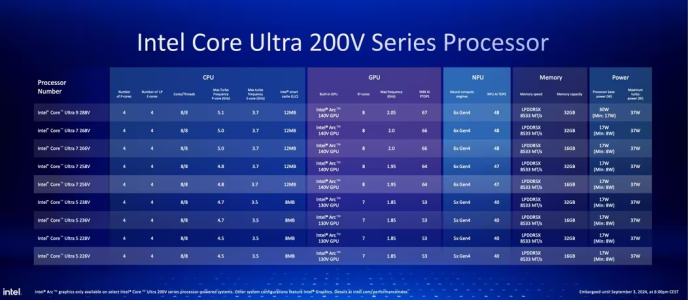
ModelIntel 150UIntel Core 7Core Ultra 7 268VCore Ultra 7 365
Dies2223
NodeIntel 7 + ?Intel 18-A + TSMC N6TSMC N3B + N6Intel 18-A + Intel 3 + TSMC N6
CPU2 P-core + 8 E-cores2 P-core + 4 LP E-cores4 P-core + 4 LP E-cores4 P-core + 4 LP E-cores
Threads12688
Max Clock5.4 GHz?5 GHz4.8 GHz
L3 Cache12 MB12 MB12 MB
TDP15 - 55 W15 W ?17 - 37 W25 - 55 W
Memory128-bit LPDDR5-520064-bit LPDDR5128-bit LPDDR5x-8533128-bit LPDDR5x-7467
Size96 GB32 GB128 GB
Bandwidth136 GB/s
GPUIntel GraphicsIntel GraphicsArc 140VIntel Graphics
RTNoNoYESYES
EU / Xe96 EU2 Xe8 Xe4 Xe
Max Clock1.3 GHz?2 GHz2.5 GHz
NPUGNA 3.018 TOPS48 TOPS49 TOPS


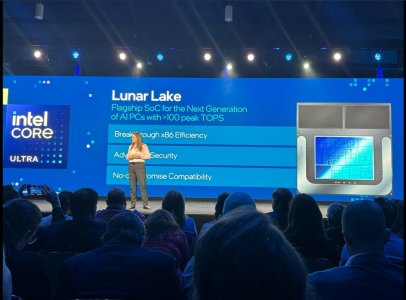
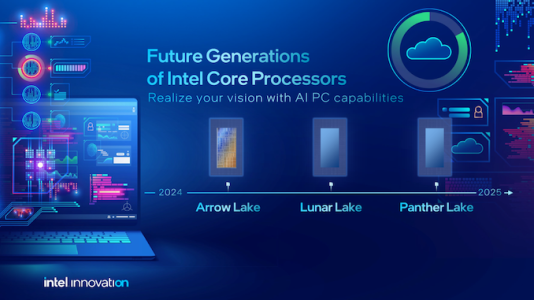
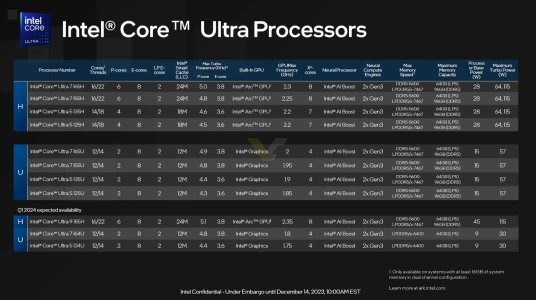
PPT1.jpg
PPT2.jpg
PPT3.jpg


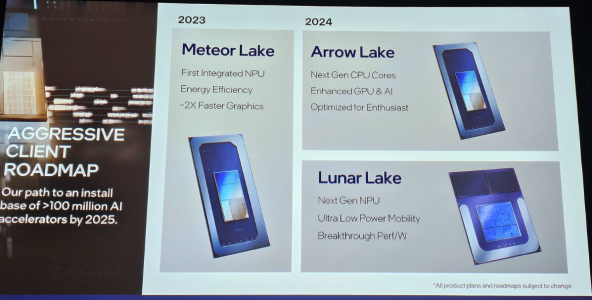
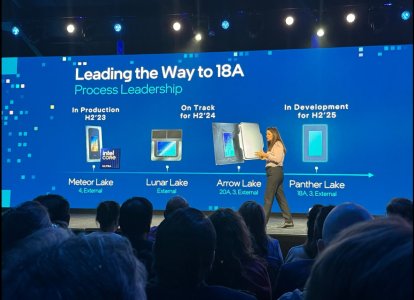
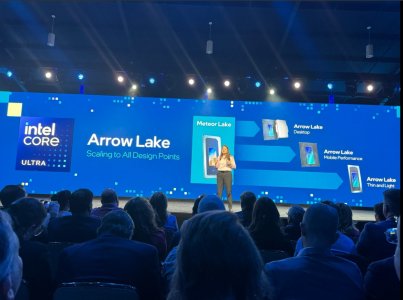
As Hot Chips 34 starting this week, Intel will unveil technical information of upcoming Meteor Lake (MTL) and Arrow Lake (ARL), new generation platform after Raptor Lake. Both MTL and ARL represent new direction which Intel will move to multiple chiplets and combine as one SoC platform.

MTL also represents new compute tile that based on Intel 4 process which is based on EUV lithography, a first from Intel. Intel expects to ship MTL mobile SoC in 2023.

ARL will come after MTL so Intel should be shipping it in 2024, that is what Intel roadmap is telling us. ARL compute tile will be manufactured by Intel 20A process, a first from Intel to use GAA transistors called RibbonFET.


LNL-MX.png
 

Attachments

  • PantherLake.png
    PantherLake.png
    283.5 KB · Views: 24,040
  • LNL.png
    LNL.png
    881.8 KB · Views: 25,528
  • INTEL-CORE-100-ULTRA-METEOR-LAKE-OFFCIAL-SLIDE-2.jpg
    INTEL-CORE-100-ULTRA-METEOR-LAKE-OFFCIAL-SLIDE-2.jpg
    181.4 KB · Views: 72,436
  • Clockspeed.png
    Clockspeed.png
    611.8 KB · Views: 72,323
Last edited:

511

Diamond Member
Jul 12, 2024
5,257
4,699
106
Which would be ok(ish) if the product is released on time, mid 2026, and then, if it is followed up with Medusa 1.5, with RDNA5 and LPDDR6 a year+ later.

That would be a signal that AMD is taking the notebook market seriously, and the 40% market share goal from the client market has some real plan behind it.
AMD is taking 50% market share in server CPU For sure but I don't see the client 40% also Medusa Premium is a bit later iirc cause NVL iGPU is a decentish upgrade based on the arch detail's we have.
 

clemsyn

Senior member
Aug 21, 2005
535
205
116
OLED still has the negative of affecting battery life depending on what you do soo also PTL Independent testing


SOTR - 2880*1800 50FPS Native
CP2077 - same res XeSS Balanced no FG - 48 FPS
F12025 - Same Res - Native - Australia - 53 FPS
Battery vs Non Battery same
59-60W System Power
Impressive...so this is under Pat's watch, right?
 

regen1

Senior member
Aug 28, 2025
294
372
96
nice link.

i think 450mm wafer is over stated now, the problem is EUV scaner power. so bigger wafer just means more time per step.
It could have made sense if 18inch/450mm wafer materialized back then.

Later on (not discounting other issues) esp. for ASML which was already on its path for R&D and production(also shackled with producing enough of EUV machines) of EUV and subsequently high-NA machines for 300mm wafers, it would've been kinda an unprecedented engineering and financial challenge to design new machines for 450mm.

Funnily, Intel's 2012 agreement/investment with ASML had two-thirds of the money towards 18inch/450mm wafer R&D and a third for EUV lithography. Then there were the turn of events around G450C and ASML's constraints plus other stuff which meant 450mm standardization not being feasible on those timelines.

PLP(Panel-Level Packaging) might have a much better chance of going forward.


gdansk

Diamond Member
Feb 8, 2011
4,714
7,980
136
it's clear this kills StxH from a GPU perspective
why pay for so much more silicon for so little extra performance?

But that CPU slideware is... seriously underwhelming.
 

regen1

Senior member
Aug 28, 2025
294
372
96
AMD is taking 50% market share in server CPU For sure
Intel's decisions(or ability ?) to not ramp GNR in larger volume more than 5 Quarters after its launch and cancelling mainstream DMR(DMR-SP) could help AMD accelerate their server share increase.

Yes and NVL is also under Pat for the most part LBTs changes affect RZL and other stuff
Node and product selections for RZL and Titan Lake series(Titan's CPU seems to be kinda RZL's notebook version with some modifications) will be under LBT's tenure but I think Griffin Cove and Golden Eagle architecture were majorly under Pat's stint.

There was a theory from name "Griffin"(mythical beast with body of lion and wings and head of an eagle) that it was a work of both P-core and E-core team which is kinda true as some work on Griffin is done by E-core team.
 

Joe NYC

Diamond Member
Jun 26, 2021
4,081
5,619
136
AMD is taking 50% market share in server CPU For sure but I don't see the client 40% also Medusa Premium is a bit later iirc cause NVL iGPU is a decentish upgrade based on the arch detail's we have.

Certainly, with a 2-year cadence, treating mobile market as a 2nd class citizen, 40% market share in client is not happening.

I don't think AMD would be dumb enough to make such a bold prediction of 40% market share goal in mobile based on nothing. It's not exactly AMD style to go out on the limb just BSing. And nobody pressed AMD management about client market share. AMD initiated it, with this claim / goal.

Which makes me believe that there may be some substance down the road (AMD's internal roadmap), even though we only see the glimpses of it from various leaks.

Big question, for both Intel and AMD, is if they are able to monetize the bigger, more expensive iGPUs that will be replacing low end dGPUs. The evidence for this being successful is so far quite poor, judging by Strix Halo penetration.

Maybe Intel approach, of no effort to OEMs, using the same socket will make the OEMs want to adopt it. The only question is if they are willing to pay for it.
 

Hulk

Diamond Member
Oct 9, 1999
5,277
3,968
136
Impressive...so this is under Pat's watch, right?
I'm starting to see a slightly disconcerting trend here from Intel. All of the slides tend to shade CPU performance through the lens of iGPU performance.

Now in this mini review Intel explicitly states no CPU tests. Only games that can again shield CPU performance.

Why won't they allow Panther Lake CPU to be in the light of day? It's coming one way or another. Is there another Arrow Lake "glitch" where the benchmarks won't be "what Intel was expecting?"

It's strange. Almost like they are scrambling behind the scenes to fix something with the CPU before it is exposed.

Of course this is all in my head and I'm sure everything is amazing with the PL CPU performance as Intel has been telling us for the past 2 years.
 
  • Like
Reactions: Joe NYC

Geddagod

Golden Member
Dec 28, 2021
1,649
1,683
136
Well it will last for a year plus they need to work on CPU their Int performance is lacking big time at least the are fixing the ISA Mess next gen.
FP as well. Intel has usually had a lead or tied AMD in specfp2017 but there's like a 15% gap between zen 5 and lnc now for desktop vs desktop.
CPU in general needs to be improved.
Certainly, with a 2-year cadence, treating mobile market as a 2nd class citizen, 40% market share in client is not happening.
I believe they are talking about revenue share, and I think if they expect NVL BLLC to not hurt them at all, then they will be on a good path to achieving it, even with relatively low mobile presence.
 

Joe NYC

Diamond Member
Jun 26, 2021
4,081
5,619
136
Intel's decisions(or ability ?) to not ramp GNR in larger volume more than 5 Quarters after its launch and cancelling mainstream DMR(DMR-SP) could help AMD accelerate their server share increase.

You are overlooking the biggest variable: Customer demand / uptake of the new gen server CPU, new socket.

What used to be automatic for Intel, customers waiting for new Intel CPU and adopting it right away is no longer the case. Especially with hyperscalers (target market) where AMD is more of an incumbent than Intel now, and AMD has established socket with Genoa and Turin.
 

poke01

Diamond Member
Mar 8, 2022
4,701
6,049
106
I'm starting to see a slightly disconcerting trend here from Intel. All of the slides tend to shade CPU performance through the lens of iGPU performance.

Now in this mini review Intel explicitly states no CPU tests. Only games that can again shield CPU performance.

Why won't they allow Panther Lake CPU to be in the light of day? It's coming one way or another. Is there another Arrow Lake "glitch" where the benchmarks won't be "what Intel was expecting?"

It's strange. Almost like they are scrambling behind the scenes to fix something with the CPU before it is exposed.

Of course this is all in my head and I'm sure everything is amazing with the PL CPU performance as Intel has been telling us for the past 2 years.
Because the CPU sucks. Completely
 

Joe NYC

Diamond Member
Jun 26, 2021
4,081
5,619
136
I believe they are talking about revenue share, and I think if they expect NVL BLLC to not hurt them at all, then they will be on a good path to achieving it, even with relatively low mobile presence.

Yes, they are talking about revenue share. And current share for AMD is ~28%.

But AMD may be near its full potential in desktop and will need to gain market share in mobile market (to go North from 28%) where Intel is a lot more competitive.
 

regen1

Senior member
Aug 28, 2025
294
372
96
You are overlooking the biggest variable: Customer demand / uptake of the new gen server CPU, new socket.

What used to be automatic for Intel, customers waiting for new Intel CPU and adopting it right away is no longer the case. Especially with hyperscalers (target market) where AMD is more of an incumbent than Intel now, and AMD has established socket with Genoa and Turin.
There's no denying AMD's prowess in Server CPUs but abandoning/not ramping your mainstream platforms/8-Ch(abandoning that also means no latest stuff for many Enterprise segments) helps the competitor immensely, not to ignore that Intel is still the largest shareholder of Server CPUs.
 
Last edited:
  • Like
Reactions: 511

511

Diamond Member
Jul 12, 2024
5,257
4,699
106
Intel's decisions(or ability ?) to not ramp GNR in larger volume more than 5 Quarters after its launch and cancelling mainstream DMR(DMR-SP) could help AMD accelerate their server share increase.
Most likely
Because the CPU sucks. Completely
It performs where a copy pasted core from previous gen would perform just better perf/watt
FP as well. Intel has usually had a lead or tied AMD in specfp2017 but there's like a 15% gap between zen 5 and lnc now for desktop vs desktop.
CPU in general needs to be improved
Yeah the core needs improvement in PPA as a whole
 

Geddagod

Golden Member
Dec 28, 2021
1,649
1,683
136
It performs where a copy pasted core from previous gen would perform just better perf/watt
I mean... we will see. We haven't gotten core power/frequency curves yet, just package.
But AMD may be near its full potential in desktop
They are at 40% revenue share in DT so far, I think that's decently far from its full potential. Esp if they are able to fix uncore power in DT.
For laptops, I think strix halo and successors may get more success if Intel tries with Razor Lake - AX.
 
  • Like
Reactions: Tlh97 and Joe NYC

poke01

Diamond Member
Mar 8, 2022
4,701
6,049
106

DavidC1

Platinum Member
Dec 29, 2023
2,062
3,208
106
HD and FHD+ displays are poor for productivity and creative tasks after getting used to 1440p+ displays.
But they are great for low end gaming.

OLED has improved this year with LTPO displays and tandem OLED. We would obviously have to see how that impacts battery life when compared to previous models.
I'm talking about the burn-in.

The CPU is likely 5-10% faster per clock, but hindered by lower clocks, reminiscent of Icelake.
 
  • Like
Reactions: MoogleW

Fjodor2001

Diamond Member
Feb 6, 2010
4,499
708
126
It performs where a copy pasted core from previous gen would perform just better perf/watt
We'll have to await benchmark results. Could perform somewhat better.

Also, better perf/watt is not "just" especially on mobile/laptop where this is one of the most important parameters.
 
  • Like
Reactions: MoogleW

Doug S

Diamond Member
Feb 8, 2020
3,781
6,700
136
If 18A is performing so swimmingly can we expect Intel to start taking those lucrative Blackwell B200 and Rubin contracts? Or even for 5000 series parts in general? Does this mean Intel 18A can be a cutting edge foundry?

What I'm getting at is that this would be good both for Intel and for (us) consumers if AI hardware had more supply to satiate demand. While this might help with GPU's I think it's more Samsung that is fabbing HBM, which more profitable than DDR5, and thus causing shortages?

18A could be the best process for area, performance, power, yield and cost and it wouldn't make much difference at the moment, because Intel doesn't have the foundry capacity to deliver all that many wafers.

Typically when Intel has a new node wafers are coming out of one of their development fabs in Oregon, and only later do they have it up and running in a full production fab. I don't know how many fabs they have planned for 18A production - it may be only one production fab and 18AP will be the target for more expansion. At least the rumors about customers for 18AP would indicate they will need / have more capacity for it.

Intel is in a chicken and egg situation right now. They need to prove that they can deliver a good process at good yields to get customers interested, but they can't afford to have a ton of capacity ready in future nodes without customers already signed up. The AI bubble may be just what the doctor ordered to get them out of this jam - you have customers desperate for more capacity who themselves have deep pocketed customers willing to pay insane prices so even if Intel has yield issues getting expensive wafers their customers can still sell at a big profit is better than having orders they can't fulfill.
 

DavidC1

Platinum Member
Dec 29, 2023
2,062
3,208
106
If 18A is performing so swimmingly can we expect Intel to start taking those lucrative Blackwell B200 and Rubin contracts? Or even for 5000 series parts in general? Does this mean Intel 18A can be a cutting edge foundry?
Big contracts are always about Trust. To break that barrier you need a huge advantage. Can you deliver, can you be trusted with our design, can you execute for years, can you support us after purchasing.

This is a quote by JP Morgan:
The first thing [in credit] is character … before money or anything else. Money cannot buy it.… A man I do not trust could not get money from me on all the bonds in Christendom. I think that is the fundamental basis of business.
 

Doug S

Diamond Member
Feb 8, 2020
3,781
6,700
136
It could have made sense if 18inch/450mm wafer materialized back then.

Later on (not discounting other issues) esp. for ASML which was already on its path for R&D and production(also shackled with producing enough of EUV machines) of EUV and subsequently high-NA machines for 300mm wafers, it would've been kinda an unprecedented engineering and financial challenge to design new machines for 450mm.

Funnily, Intel's 2012 agreement/investment with ASML had two-thirds of the money towards 18inch/450mm wafer R&D and a third for EUV lithography. Then there were the turn of events around G450C and ASML's constraints plus other stuff which meant 450mm standardization not being feasible on those timelines.

PLP(Panel-Level Packaging) might have a much better chance of going forward.

I never understood why Intel tried to push 450mm in the first place. At the time (i.e. 2012) Intel had four full scale production fabs at any given time. If they had 450 mm they'd get more than twice as many chips per wafer so assuming the same number of wafers processed they'd need half the fabs - or only two. That would create logistical headaches for them.

It wouldn't have helped much in the end, because EUV has become one of the big cost drivers and if you double your wafer area you halve the throughput of your EUV steps since the power of the light source is its main limitation. Yes you get the same throughput in wafer wide steps like depo and etch so you benefit costwise there but I'm not sure if gaining nothing in litho cost per chip would have made the whole 450mm effort worth it in hindsight.
 

Geddagod

Golden Member
Dec 28, 2021
1,649
1,683
136
18A could be the best process for area, performance, power, yield and cost and it wouldn't make much difference at the moment, because Intel doesn't have the foundry capacity to deliver all that many wafers.
They deff have the ability to be able to fab a bunch more volume if they get customers.
1767818184957.png
I don't know how many fabs they have planned for 18A production
The problem is, is that decision was already made years ago by Gelsinger. The fact is that they are sitting empty rn, though the fact that they aren't fully tooled is prob why it's not actively burning them a bunch of money.
but they can't afford to have a ton of capacity ready in future nodes without customers already signed up.
This is kinda already the case...
. The AI bubble may be just what the doctor ordered to get them out of this jam -
I mean that's what's being repeated for a while now, and yet nothing is materializing.
Even if we put aside Intel, Samsung has only gotten that token Tesla deal too. The deal doesn't seem especially large at least.