Discussion Intel Meteor, Arrow, Lunar & Panther Lakes + WCL Discussion Threads

Page 938 - Seeking answers? Join the AnandTech community: where nearly half-a-million members share solutions and discuss the latest tech.

Tigerick

Senior member
Apr 1, 2022
939
850
106
Wildcat Lake (WCL) Specs

Intel Wildcat Lake (WCL) is upcoming mobile SoC replacing Raptor Lake-U. WCL consists of 2 tiles: compute tile and PCD tile. It is true single die consists of CPU, GPU and NPU that is fabbed by 18-A process. Last time I checked, PCD tile is fabbed by TSMC N6 process. They are connected through UCIe, not D2D; a first from Intel. Expecting launching in Q1 2026.
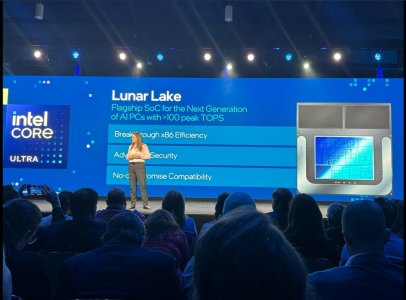
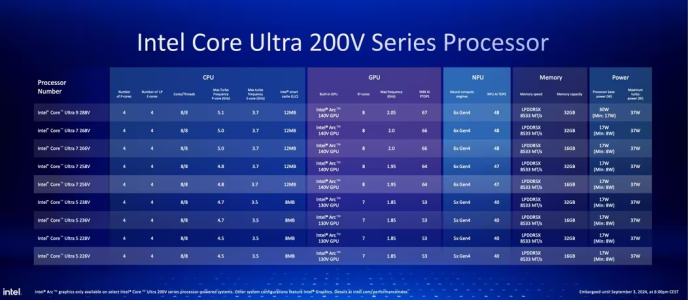
Intel Raptor Lake UIntel Wildcat Lake 15W?Intel Lunar LakeIntel Panther Lake 4+4+4
Launch DateQ1-2024Q2-2026Q3-2024Q1-2026
ModelIntel 150UIntel Core 7Core Ultra 7 268VCore Ultra 7 365
Dies2223
NodeIntel 7 + ?Intel 18-A + TSMC N6TSMC N3B + N6Intel 18-A + Intel 3 + TSMC N6
CPU2 P-core + 8 E-cores2 P-core + 4 LP E-cores4 P-core + 4 LP E-cores4 P-core + 4 LP E-cores
Threads12688
Max Clock5.4 GHz?5 GHz4.8 GHz
L3 Cache12 MB12 MB12 MB
TDP15 - 55 W15 W ?17 - 37 W25 - 55 W
Memory128-bit LPDDR5-520064-bit LPDDR5128-bit LPDDR5x-8533128-bit LPDDR5x-7467
Size96 GB32 GB128 GB
Bandwidth136 GB/s
GPUIntel GraphicsIntel GraphicsArc 140VIntel Graphics
RTNoNoYESYES
EU / Xe96 EU2 Xe8 Xe4 Xe
Max Clock1.3 GHz?2 GHz2.5 GHz
NPUGNA 3.018 TOPS48 TOPS49 TOPS


PPT1.jpg
PPT2.jpg
PPT3.jpg


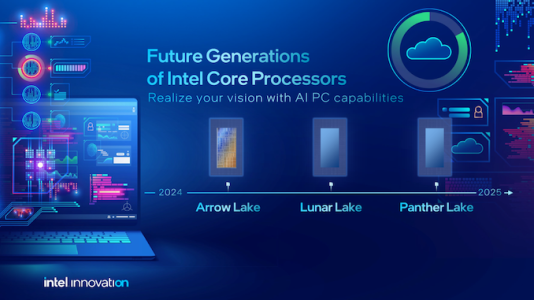
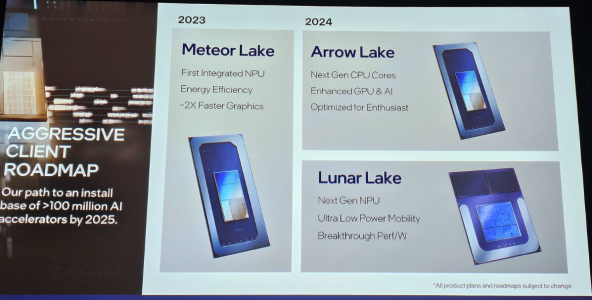
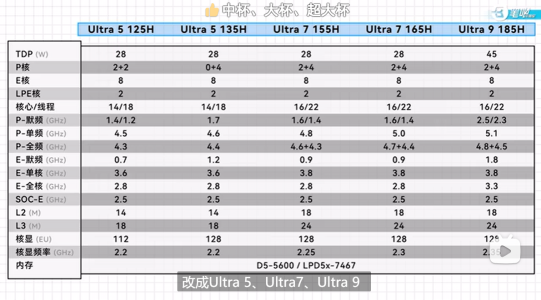
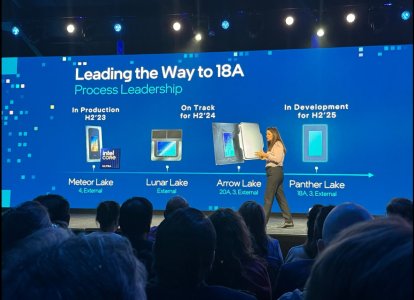
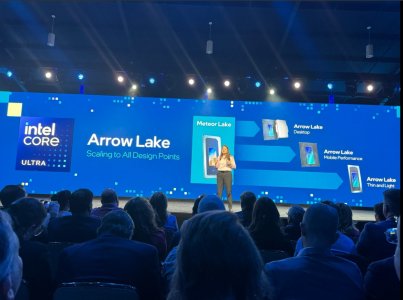
As Hot Chips 34 starting this week, Intel will unveil technical information of upcoming Meteor Lake (MTL) and Arrow Lake (ARL), new generation platform after Raptor Lake. Both MTL and ARL represent new direction which Intel will move to multiple chiplets and combine as one SoC platform.

MTL also represents new compute tile that based on Intel 4 process which is based on EUV lithography, a first from Intel. Intel expects to ship MTL mobile SoC in 2023.

ARL will come after MTL so Intel should be shipping it in 2024, that is what Intel roadmap is telling us. ARL compute tile will be manufactured by Intel 20A process, a first from Intel to use GAA transistors called RibbonFET.


LNL-MX.png
 

Attachments

  • PantherLake.png
    PantherLake.png
    283.5 KB · Views: 24,041
  • LNL.png
    LNL.png
    881.8 KB · Views: 25,529
  • INTEL-CORE-100-ULTRA-METEOR-LAKE-OFFCIAL-SLIDE-2.jpg
    INTEL-CORE-100-ULTRA-METEOR-LAKE-OFFCIAL-SLIDE-2.jpg
    181.4 KB · Views: 72,437
  • Clockspeed.png
    Clockspeed.png
    611.8 KB · Views: 72,324
Last edited:

Tup3x

Golden Member
Dec 31, 2016
1,299
1,438
136
GPU performance is nice but unfortunately for full-stack web dev 18 core X2 Elite seems like a much better option.
 

adroc_thurston

Diamond Member
Jul 2, 2023
8,201
10,942
106
it's 15% ish which is a normal tock
Yeah mid-low teens is where it hangs. Area's ok for once.
but Fmax have to See cause Intel take ages to confirm Fmax
It's really really really really struggling to clock.
idk if their logic or physdes teams suck or they just can't read TSM design rules but this is the second TSM cutting edge node they're getting no juice from.
 

511

Diamond Member
Jul 12, 2024
5,312
4,730
106
Yeah mid-low teens is where it hangs. Area's ok for once.
i wonder will e core gain another 20 this time lol
It's really really really really struggling to clock.
idk if their logic or physdes teams suck or they just can't read TSM design rules but this is the second TSM cutting edge node they're getting no juice from.
like i said they wait till the end to get the juice from
 

adroc_thurston

Diamond Member
Jul 2, 2023
8,201
10,942
106
i wonder will e core gain another 20 this time lol
Gonna bet on 15-20% given ARL has, let's say, less than optimal memory subsystem for a skinny core like Atom.
like i said they wait till the end to get the juice from
The juice is evident after the first lot characterisation (LNC's been like that too. You probably know what happened there).
None found.
 

Hulk

Diamond Member
Oct 9, 1999
5,305
3,984
136
there is near 0 peak CPU Performance improvement vs ARL all you get is same performance at lower power
Yes, but Intel claimed 5 to 10% better IPC over Lion Cove.

In addition, power and thermal constraints are a big deal in laptops. If the core has better IPC as Intel has claimed, and the node is better as well, then in thermally constrained situations (like mobile) both of these improvements should lead to massive MT performance increases. Each clock is doing more and clocks can be higher due to less power/heat.

I'm just really curious to see how it does and I'm super curious as to why Intel is holding that data back, that's all.

Unless something CPU-wise is going to change between now and the expiration of the NDA why hold CPU benchmarks back?

Here's what I think. The CPU data will be fine, maybe even good, but not super impressive compared to the competition and if released with the very good iGPU data it would put a wet blanket over the iGPU performance.

The execs and marketing people sat around a bit table and it went like this.

"We have a big winner here vs AMD with our mobile graphics.

That's great, how about CPU?

We'll we caught up and passed them a bit...

A bit? We're competing against their tech from like 2 years ago?

Yeah, like a said we're a bit ahead.

Okay, let's focus on the iGPU hype for now. Let's allow review of the reference designs but no CPU benches. Let's just push our iGPU win as long as possible and hold back the CPU benches because we don't want to hear any "the gaming performance is good BUT... nonsense!

Uh, but that might seem a little strange, like we're up to our old "this isn't the result we were expecting" word salad answers from Arrow Lake?

Shut up and make it so!"
 

511

Diamond Member
Jul 12, 2024
5,312
4,730
106
Yes, but Intel claimed 5 to 10% better IPC over Lion Cove.
they didn't claim any IPC Improvements ... it was perf/watt improvement
I'm just really curious to see how it does and I'm super curious as to why Intel is holding that data back, that's all.
well i am more interested in weather the perf/watt claims are true cause if true that is better anyway for this one has to wait till David Huang or Geekerwan does their testing
 

mikk

Diamond Member
May 15, 2012
4,327
2,409
136
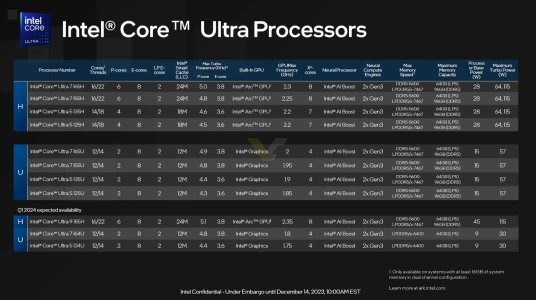
it's 15% ish which is a normal tock but Fmax have to See cause Intel take ages to confirm Fmax


With PTL on 18A they lost 300 Mhz 1T compared to ARL-H on N3B. If NVL-H is on N2 I would expect at least ARL-H level of Fmax and even on 18A-P it should regain some of the lost Fmax.
 

fastandfurious6

Senior member
Jun 1, 2024
895
1,033
96
"In a first short test on site, the performance was also at almost the same level in games, regardless of whether the notebook was connected to the power or on the road in battery mode."


This is very hard to believe

Is there a clear Halo vs PTL comparison anywhere?
 

Hulk

Diamond Member
Oct 9, 1999
5,305
3,984
136
they didn't claim any IPC Improvements ... it was perf/watt improvement

well i am more interested in weather the perf/watt claims are true cause if true that is better anyway for this one has to wait till David Huang or Geekerwan does their testing
"Together these adjustments yield roughly five to ten percent higher performance per clock at the same frequency."


511

Diamond Member
Jul 12, 2024
5,312
4,730
106
"Together these adjustments yield roughly five to ten percent higher performance per clock at the same frequency."

Well that's not true otherwise it would have been in Intel slide deck but it ain't they never mention IPC improvement all PTL did was fix the uncore in ARL.
 

Hulk

Diamond Member
Oct 9, 1999
5,305
3,984
136
Well that's not true otherwise it would have been in Intel slide deck but it ain't they never mention IPC improvement all PTL did was fix the uncore in ARL.
I hear you. That's where I read it and TechReport is generally very reliable and they did specify quite a few architectural improvements so I thought 5% sounded plausible. I mean all of the changes below should amount to some IPC improvement, right? It seems as though they identified and corrected some Lion Cove bottlenecks. I'm very curious for Lion Cove vs. Cougar Cove Iso-Frequency testing.

"The Cougar Cove performance core succeeds Lion Cove and brings a series of targeted refinements focused on efficiency rather than higher peak clocks. The front end has been reworked to deliver a steadier instruction flow, while the scheduler issues work to the execution units with fewer stalls. Internal structures such as the dispatch and allocation queues have been slightly widened to balance throughput and energy use. Together these adjustments yield roughly five to ten percent higher performance per clock at the same frequency. The result is a core tuned for Intel 18A and PowerVia that maintains throughput under sustained load while using less power. Key cache sizes: 256 KB L1 per core and 3 MB private L2 per Cougar Cove core.

Cougar Cove keeps the same pipeline depth as Lion Cove but is more efficient at keeping its execution units busy. The branch predictor and instruction fusion logic have been refined, and prefetch behavior is more adaptive to mixed workloads. Engineers explained that the design team relied on performance data gathered from earlier client chips to identify where short, bursty workloads were leaving execution units idle. These small refinements make the new P-core more consistent in real-world client workloads, without changing its overall structure.

The reorder buffer and allocation windows have been resized to improve balance between integer and vector operations. The front end is now better at sustaining fetch and decode bandwidth in small instruction loops, reducing wasted cycles in everyday tasks such as web rendering or office applications. Intel described these changes as incremental but meaningful, designed to cut down on "wasted wakeups" and improve the core's steady-state efficiency."
 
  • Like
Reactions: 511

Hulk

Diamond Member
Oct 9, 1999
5,305
3,984
136
I think TechReport saw the slide showing >10% IPC over Lion Cove at Iso-Power and didn't make the connection that Iso-Power is NOT Iso-Frequency.

It is probably more reasonable to assume 2 or 3% improvement in IPC due to architecture and the rest due to increased frequency at Iso-Power due to 18A.

As I keep writing. Like most of us here I follow this tech with gusto and am excited for full disclosure!

I am sooooo happy 18A seems to be working out and Panther Lake looks like a winner for Intel!

Perhaps I should have waited 6 months before buying my Asus ProArtPX13 with HX370/4050! But my Surface 2 was on life support with all of the glitches.. broken track pad, cracked screen, depleted battery, random wifi disconnects requiring a restart.. plus Skylake performance in 2025 was rough. I couldn't hold out any longer.

The HX270/4050 based PX13 is a nice thin/light "near" mobile workstation but I'm just really curious as to how Panther Lake will stack up in terms of CPU/GPU performance and efficiency in applications other than gaming. I WANT it to kick @SS! A fast Panther Lake doesn't make my current rig any slower but it does provide upgrade options;)
 
  • Like
Reactions: 511

poke01

Diamond Member
Mar 8, 2022
4,740
6,076
106
IPC was improved but clock was lowered. So ST is stagnant.

Make no mistake, the CPU is a flop. It’s everything else that is great.
 

Hulk

Diamond Member
Oct 9, 1999
5,305
3,984
136
If you had to pick 3 application tests and/or benchmarks to get a rough indication of ST IPC (throughput) of a CPU, what would they be?

I know, I know, impossible with only 3. Just saying for a very rough indicator to compare architectures.

For me it would be something like video encoding, probably AV1 or x265, rendering, perhaps Cinebench, and the third I can't think of off the top of my head right now.

The reason I bring this up is because it would be great to create an IPC table we could use for discussion. If we could agree on the metrics and some people could even submit scores for 1 CPU, we could create such a table in short order.
 

misuspita

Senior member
Jul 15, 2006
780
950
136
For me it would be a DAW test. As real world as it gets. 10 heavy plug-ins per track, 24 bit/44.1kHz, same wave copied on each track, insert as many tracks as possible, set a reasonable buffer (say 256) and add tracks until it crackles. Subtract plug-ins from last track, and the number of plug-ins that work, that's the score :))
 

Hulk

Diamond Member
Oct 9, 1999
5,305
3,984
136
For me it would be a DAW test. As real world as it gets. 10 heavy plug-ins per track, 24 bit/44.1kHz, same wave copied on each track, insert as many tracks as possible, set a reasonable buffer (say 256) and add tracks until it crackles. Subtract plug-ins from last track, and the number of plug-ins that work, that's the score :))
That would be a MT test and tough to complete "distributively." It requires the wav files, the DAW application, and the plugins.

It's a good one though. I do a lot of DAW work in Studio One. Recently started using Relab 176 compressor. It's great but a bear on CPU!

Ideally we're looking for free/portable app/benches, or ones that pretty much everyone has installed already.

Cinebench and Handbrake are 2 easy one. Free and portable and easy to replicate settings.
 

misuspita

Senior member
Jul 15, 2006
780
950
136
Yes, but very used and probably already optimized for. A DAW would be a non standard bench, and with a good nvme drive, the wav part would not influence the score, could be a 10 second loop and the plugins could be a free suite comprising from an eq, compressor, etc... I mean, an installer could put all the needed files where they should.