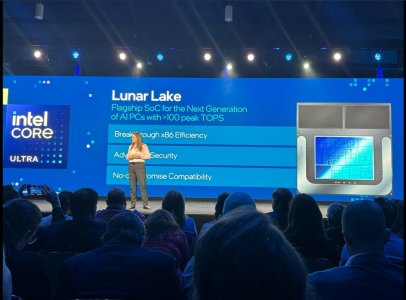
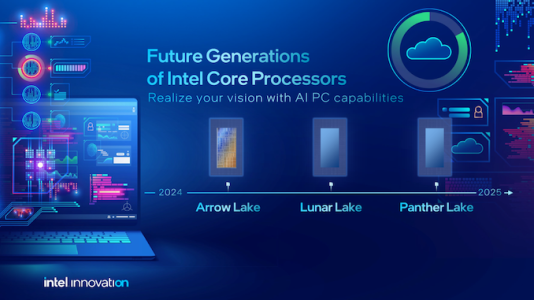
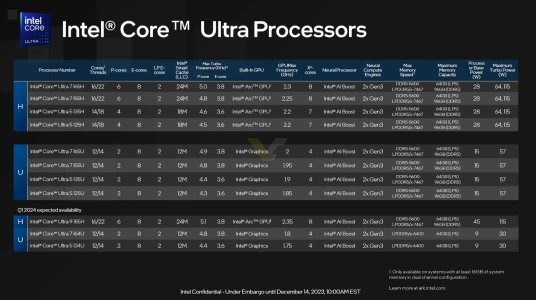
Discussion Intel Meteor, Arrow, Lunar & Panther Lakes + WCL Discussion Threads

Page 933 - Seeking answers? Join the AnandTech community: where nearly half-a-million members share solutions and discuss the latest tech.

Tigerick

Senior member
Apr 1, 2022
933
848
106
Wildcat Lake (WCL) Specs

Intel Wildcat Lake (WCL) is upcoming mobile SoC replacing Raptor Lake-U. WCL consists of 2 tiles: compute tile and PCD tile. It is true single die consists of CPU, GPU and NPU that is fabbed by 18-A process. Last time I checked, PCD tile is fabbed by TSMC N6 process. They are connected through UCIe, not D2D; a first from Intel. Expecting launching in Q1 2026.
Intel Raptor Lake UIntel Wildcat Lake 15W?Intel Lunar LakeIntel Panther Lake 4+4+4
Launch DateQ1-2024Q2-2026Q3-2024Q1-2026
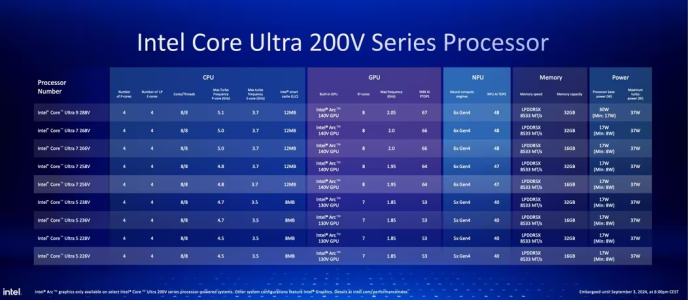
ModelIntel 150UIntel Core 7Core Ultra 7 268VCore Ultra 7 365
Dies2223
NodeIntel 7 + ?Intel 18-A + TSMC N6TSMC N3B + N6Intel 18-A + Intel 3 + TSMC N6
CPU2 P-core + 8 E-cores2 P-core + 4 LP E-cores4 P-core + 4 LP E-cores4 P-core + 4 LP E-cores
Threads12688
Max Clock5.4 GHz?5 GHz4.8 GHz
L3 Cache12 MB12 MB12 MB
TDP15 - 55 W15 W ?17 - 37 W25 - 55 W
Memory128-bit LPDDR5-520064-bit LPDDR5128-bit LPDDR5x-8533128-bit LPDDR5x-7467
Size96 GB32 GB128 GB
Bandwidth136 GB/s
GPUIntel GraphicsIntel GraphicsArc 140VIntel Graphics
RTNoNoYESYES
EU / Xe96 EU2 Xe8 Xe4 Xe
Max Clock1.3 GHz?2 GHz2.5 GHz
NPUGNA 3.018 TOPS48 TOPS49 TOPS


PPT1.jpg
PPT2.jpg
PPT3.jpg


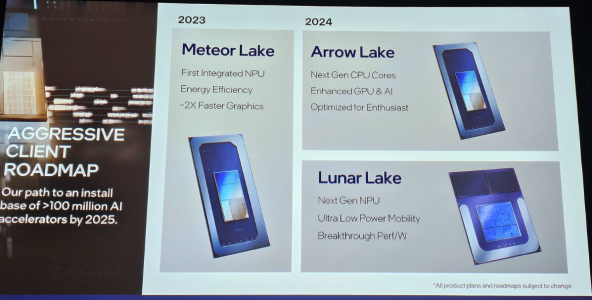
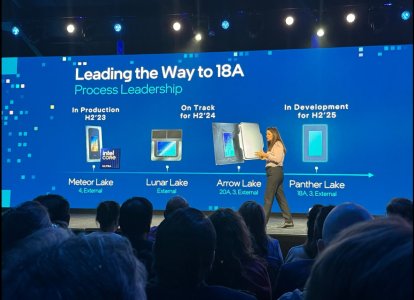
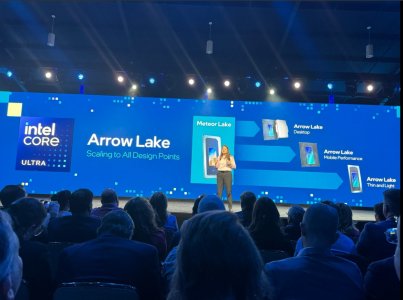
As Hot Chips 34 starting this week, Intel will unveil technical information of upcoming Meteor Lake (MTL) and Arrow Lake (ARL), new generation platform after Raptor Lake. Both MTL and ARL represent new direction which Intel will move to multiple chiplets and combine as one SoC platform.

MTL also represents new compute tile that based on Intel 4 process which is based on EUV lithography, a first from Intel. Intel expects to ship MTL mobile SoC in 2023.

ARL will come after MTL so Intel should be shipping it in 2024, that is what Intel roadmap is telling us. ARL compute tile will be manufactured by Intel 20A process, a first from Intel to use GAA transistors called RibbonFET.


LNL-MX.png
 

Attachments

  • PantherLake.png
    PantherLake.png
    283.5 KB · Views: 24,040
  • LNL.png
    LNL.png
    881.8 KB · Views: 25,528
  • INTEL-CORE-100-ULTRA-METEOR-LAKE-OFFCIAL-SLIDE-2.jpg
    INTEL-CORE-100-ULTRA-METEOR-LAKE-OFFCIAL-SLIDE-2.jpg
    181.4 KB · Views: 72,436
  • Clockspeed.png
    Clockspeed.png
    611.8 KB · Views: 72,323
Last edited:

Hulk

Diamond Member
Oct 9, 1999
5,270
3,955
136
18A could be the best process for area, performance, power, yield and cost and it wouldn't make much difference at the moment, because Intel doesn't have the foundry capacity to deliver all that many wafers.

Typically when Intel has a new node wafers are coming out of one of their development fabs in Oregon, and only later do they have it up and running in a full production fab. I don't know how many fabs they have planned for 18A production - it may be only one production fab and 18AP will be the target for more expansion. At least the rumors about customers for 18AP would indicate they will need / have more capacity for it.

Intel is in a chicken and egg situation right now. They need to prove that they can deliver a good process at good yields to get customers interested, but they can't afford to have a ton of capacity ready in future nodes without customers already signed up. The AI bubble may be just what the doctor ordered to get them out of this jam - you have customers desperate for more capacity who themselves have deep pocketed customers willing to pay insane prices so even if Intel has yield issues getting expensive wafers their customers can still sell at a big profit is better than having orders they can't fulfill.
One they have a process up and yielding at one facility, it is just a matter of "turning the knob" on the same machinery in another location to get the process going?
I'm thinking it's not that easy, but it's also not like starting from scratch since you do have a good starting point to get things going?
 

Joe NYC

Diamond Member
Jun 26, 2021
4,046
5,591
136
18A could be the best process for area, performance, power, yield and cost and it wouldn't make much difference at the moment, because Intel doesn't have the foundry capacity to deliver all that many wafers.

100%

Intel is nowhere near meeting its own demand. There is massive percentage (70%+ is still on Intel 7 / Intel 10). All of that capacity is to be transitioned to 18A. Additionally, capacity outsourced to TSMC, intel wants to bring back

Typically when Intel has a new node wafers are coming out of one of their development fabs in Oregon, and only later do they have it up and running in a full production fab. I don't know how many fabs they have planned for 18A production - it may be only one production fab and 18AP will be the target for more expansion. At least the rumors about customers for 18AP would indicate they will need / have more capacity for it.

Intel has 1 Fab, Fab 52 in Arizona, that is ramping 18A. It may take 2-3 years to fully ramp it and that one fab may still not meet Intel's own demand.

Intel is very far from having capacity from other fabs.
- Fab 62 construction has been slowed down to slowest speed
- Ohio Fab paused
- Magdeburg Fab cancelled.

All 3 would need cash, quite a lot of it.

When Fab 52 is fully ramped and is making some money, Intel has send half of the profits to Private Equity partner. Same with Ireland fab.

Intel is in a chicken and egg situation right now. They need to prove that they can deliver a good process at good yields to get customers interested, but they can't afford to have a ton of capacity ready in future nodes without customers already signed up. The AI bubble may be just what the doctor ordered to get them out of this jam - you have customers desperate for more capacity who themselves have deep pocketed customers willing to pay insane prices so even if Intel has yield issues getting expensive wafers their customers can still sell at a big profit is better than having orders they can't fulfill.
 

Joe NYC

Diamond Member
Jun 26, 2021
4,046
5,591
136
One they have a process up and yielding at one facility, it is just a matter of "turning the knob" on the same machinery in another location to get the process going?
I'm thinking it's not that easy, but it's also not like starting from scratch since you do have a good starting point to get things going?

All of the additional capacity will need EUV machines, which Intel will need to purchase first, then wait for them to get delivered, installed, brought up.

Intel is making it more difficult for itself by buying High NA machines for 2x price, to future proof them, but still has to pay 2x in cash, which is in short supply.
 

Doug S

Diamond Member
Feb 8, 2020
3,778
6,688
136
One they have a process up and yielding at one facility, it is just a matter of "turning the knob" on the same machinery in another location to get the process going?
I'm thinking it's not that easy, but it's also not like starting from scratch since you do have a good starting point to get things going?

It is that easy. OK calling anything in an industry that complex "easy" isn't doing it justice, but Intel pioneered the "copy exactly" strategy that TSMC has since turned into an art form. You have the exact same tooling, process workflow, etc. in every fab for the same process. Before Intel started doing that very obvious thing that wasn't the case, and every fab was unique.

It might take you two years from the first test wafers to reach mass production yields in your development fab, but you'll be up and running at the same mass production yields in a tiny fraction of that time when you implement it in a new fab. Because you've already solved all the problems and tuned all the "knobs" in one fab and don't have to do any of that over again in the next.
 
  • Like
Reactions: Elfear

Hulk

Diamond Member
Oct 9, 1999
5,270
3,955
136
It is that easy. OK calling anything in an industry that complex "easy" isn't doing it justice, but Intel pioneered the "copy exactly" strategy that TSMC has since turned into an art form. You have the exact same tooling, process workflow, etc. in every fab for the same process. Before Intel started doing that very obvious thing that wasn't the case, and every fab was unique.

It might take you two years from the first test wafers to reach mass production yields in your development fab, but you'll be up and running at the same mass production yields in a tiny fraction of that time when you implement it in a new fab. Because you've already solved all the problems and tuned all the "knobs" in one fab and don't have to do any of that over again in the next.
Interesting. I would assume the hardest part is getting the machines calibrated exactly the same. There are probably hundreds if not thousands of specs to adjust and they are most likely quite dependent upon one another.
 

DavidC1

Platinum Member
Dec 29, 2023
2,056
3,195
106
Today, some of the groundwork has been laid, such as Microsoft enabling a unified full-screen interface for the gaming market.
No, Microsoft sucks at their own job, that's why Valve had to push it.

Regardless performance isn't why Steam Deck is 80% of the market. It's because it's low priced, it has excellent battery life, with Zen 2 being up there with Strix Point in perf/W, it has excellent controls, and SteamOS is awesome with ability to wake up and sleep during the middle of the gaming session, come back 4 days later with almost no battery drain and continue as you left it with 1 sec wake up time, and the UI is super responsive. And Valve is actually consumer friendly unlike 95% of companies.

If they really want to penetrate the handheld market, they should support more Open Source and also court Valve better for a potential Steam Deck 2.
 

poke01

Diamond Member
Mar 8, 2022
4,688
6,023
106
No, Microsoft sucks at their own job, that's why Valve had to push it.

Regardless performance isn't why Steam Deck is 80% of the market. It's because it's low priced, it has excellent battery life, with Zen 2 being up there with Strix Point in perf/W, it has excellent controls, and SteamOS is awesome with ability to wake up and sleep during the middle of the gaming session, come back 4 days later with almost no battery drain and continue as you left it with 1 sec wake up time, and the UI is super responsive. And Valve is actually consumer friendly unlike 95% of companies.

If they really want to penetrate the handheld market, they should support more Open Source and also court Valve better for a potential Steam Deck 2.
Pretty much every OS does what you described except Windows.

Really shows how behind Microsoft is.
 

DavidC1

Platinum Member
Dec 29, 2023
2,056
3,195
106
Pretty much every OS does what you described except Windows.

Really shows how behind Microsoft is.
What OS? Android? MacOS? Not really a thing for PCs.

I tried Bazzite on my system and it was quite buggy. This is the reason I'm rooting for SteamOS to eventually come officially to Desktops. Though, Ubuntu worked better and actually idled my 1080. I've yet to try games on it, but that part was promising. I'm still on the fence for moving away from Win10 from my main system despite it. Windows 10 is also not too bad on regular sleep mode. Some productivity applications I use like Excel doesn't work on anything except the actual Excel. Excel online has problems, so does Libre and OpenOffice.

Really there is a reason Windows is still the way to go especially for gaming systems. Although Proton and Valve's work did pave the way to a future without Microsoft.
 
  • Like
Reactions: ToTTenTranz

511

Diamond Member
Jul 12, 2024
5,231
4,688
106
  • Like
Reactions: DKR

Schmide

Diamond Member
Mar 7, 2002
5,761
1,058
126
It's different class of device lmao also better compare device in the same price range
They are both in a different class. If Panther Lake has LPDDR5x-9600 RAM, that's in a different class than Strix Point and puts it between Strix Halo and Strix Point.

LPDDR5x
dual channel 5600 = ~90 GB/s
dual channel 9600 = ~150 GB/s
quad channel 8000 = ~250 GB/s

Though in terms of compute Panther Lake 12 xe and Strix Point 16 cu are more similar.

FP32 (Arrow Lake / RDNA 3.5)
8 xe = 16 cu = ~ 5 TFLOPS
12 xe = ~ 7.5 TFLOPS
40 cu = ~ 15 TFLOPS

Correct my figures if I'm off but I needed to see the numbers to understand it.
 
Last edited:
  • Like
Reactions: Elfear and 511

Saylick

Diamond Member
Sep 10, 2012
4,105
9,592
136
  • Like
Reactions: Racan

511

Diamond Member
Jul 12, 2024
5,231
4,688
106
Probably doesn’t help Intel right now that RAM is ungodly expensive. If very few consumers are upgrading their computers, it doesn’t matter if they have the better chip and have the volume to pump them out.
This affects the entire Industry so not unique to Intel everyone is getting rekt even Apple is feeling the pressure.
They are both in a different class. If Panther Lake has LPDDR5x-9600 RAM, that's in a different class than Strix Point and puts it between Strix Halo and Strix Point.

LPDDR5x
dual channel 5600 = ~90 GB/s
dual channel 9600 = ~150 GB/s
quad channel 8000 = ~250 GB/s

Though in terms of compute Panther Lake 12 xe and Strix Point 16 cu are more similar.

FP32 (Arrow Lake / RDNA 3.5)
8 xe = 16 cu = ~ 5 TFLOPS
12 xe = ~ 7.5 TFLOPS
40 cu = ~ 15 TFLOPS

Correct my figures if I'm off but I needed to see the numbers to understand it.
Gorgon Point has LPDDR5X-8533 = 133 GB/s so it's way closer to gorgon than it is to Halo like 12% more bandwidth for PTL vs Gorgon for like 70% vs Strix Halo your number seems correct.
 

ToTTenTranz

Senior member
Feb 4, 2021
858
1,431
136
It's different class of device lmao also better compare device in the same price range
Perhaps AMD is planning to sell the 388 and 392 for a price closer to Panther Lake's.

Otherwise, the statement is ridiculous especially when talking about laptops, because if the price delta is high enough then OEMs will simply prefer to put a Nvidia GPU in there (like most of them did throughout 2025).
In the case of PTL, laptops wirh nvidia dGPUs can even afford to use the non-H variants that are cheaper and have more PCIe lanes available.

AMD really put themselves in the corner here.


Probably doesn’t help Intel right now that RAM is ungodly expensive. If very few consumers are upgrading their computers, it doesn’t matter if they have the better chip and have the volume to pump them out.
Laptops coming with e.g. 32 to 48GB aren't getting that much more expensive, as OEMs use longer term supply contracts.
People who were paying $1100 now have to pay $1200. That sucls, but if they need a new laptop then most will pay the extra.


It's mostly desktop DIY'ers who are getting royally screwed.
 

fastandfurious6

Senior member
Jun 1, 2024
861
1,018
96
there are very good reasons they don't compare it to Halo ;)

AMD should have prepared a GPU-MAX product with intentionally nerfed CPU

just for handhelds, like Intel is targetting here


bad planning on AMD's side
 
  • Haha
Reactions: Joe NYC

DZero

Platinum Member
Jun 20, 2024
2,002
759
96
Probably doesn’t help Intel right now that RAM is ungodly expensive. If very few consumers are upgrading their computers, it doesn’t matter if they have the better chip and have the volume to pump them out.
Literally everyone are screwed by insane RAM prices.
 

mikk

Diamond Member
May 15, 2012
4,325
2,405
136
They are both in a different class. If Panther Lake has LPDDR5x-9600 RAM, that's in a different class than Strix Point and puts it between Strix Halo and Strix Point.

Nonsense, LP5x 8000 vs 9600 is not a different class.
 

LightningZ71

Platinum Member
Mar 10, 2017
2,656
3,340
136
Perhaps AMD is planning to sell the 388 and 392 for a price closer to Panther Lake's.

Otherwise, the statement is ridiculous especially when talking about laptops, because if the price delta is high enough then OEMs will simply prefer to put a Nvidia GPU in there (like most of them did throughout 2025).
In the case of PTL, laptops wirh nvidia dGPUs can even afford to use the non-H variants that are cheaper and have more PCIe lanes available.

AMD really put themselves in the corner here.


Laptops coming with e.g. 32 to 48GB aren't getting that much more expensive, as OEMs use longer term supply contracts.
People who were paying $1100 now have to pay $1200. That sucls, but if they need a new laptop then most will pay the extra.


It's mostly desktop DIY'ers who are getting royally screwed.
Channels are currently still stuffed for laptops. As inventory draws down and new orders are placed, retail pricing will be rising. We're already seeing words to that effect from OEMs as they will either reduce base configurations to hit price points, or let retail prices rise as needed for target margin.
 

DavidC1

Platinum Member
Dec 29, 2023
2,056
3,195
106
Channels are currently still stuffed for laptops. As inventory draws down and new orders are placed, retail pricing will be rising. We're already seeing words to that effect from OEMs as they will either reduce base configurations to hit price points, or let retail prices rise as needed for target margin.
The reborn XPS laptops are quite expensive.

The whole deal about who's better may not matter as they may all be priced into the stratosphere.
 

OneEng2

Senior member
Sep 19, 2022
965
1,178
106
advertises 18A on live as "the most advanced silicon manufacturing process in the world"
I think that this is likely true at this time. Until TSMC also implements BSPD it will technically remain true.

The better question is "Is 18A the 'Best' production node in the world"? I suspect it is the most expensive one.
Notebook segment is Intel's best (most competitive) segment.
Agree. I think it is also fairly low margin.
One of the reasons Intel is improving its competitiveness (vs. its own Lunar Lake) is by just throwing more die resources at the problem, the other part is just increased refinement. Both in CPU and GPU, and also by maintaining good cadence of releases.

AMD, instead of keeping up, decided to mail it in with Gorgon Point. So, it's Intel's Day in the Sun until AMD gets around to the next REAL product cycle.
I think Intel has thrown profitability out the window in an effort to "get back in the game" before it's too late. Expensive process development, risky node transitions, multiple architecture changes, etc.

It's always possible (just like any low probability bet) that you get the big payoff. Generally, it is more likely you don't though.

I can't fault AMD's strategy. Focus on DC where the profits are high and you don't need a metric crap ton of wafers to fulfill the market. Trickle down the tech and process to the lower margin markets as it becomes cost effective to do so.
AMD is taking 50% market share in server CPU For sure but I don't see the client 40% also Medusa Premium is a bit later iirc cause NVL iGPU is a decentish upgrade based on the arch detail's we have.
Intel is also losing MOST of the high margin client business (gaming, HDT) to AMD.

If you look at the past few quarterly reports, it isn't hard to see which strategy has been working best so far.
 
  • Like
Reactions: Farfle