Discussion Intel Meteor, Arrow, Lunar & Panther Lakes + WCL Discussion Threads

Page 906 - Seeking answers? Join the AnandTech community: where nearly half-a-million members share solutions and discuss the latest tech.

Tigerick

Senior member
Apr 1, 2022
911
829
106
Wildcat Lake (WCL) Preliminary Specs

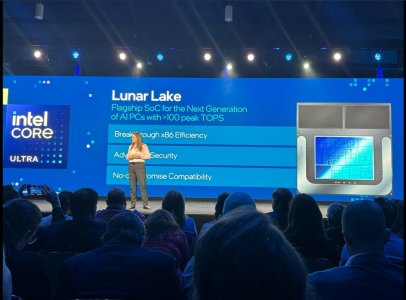
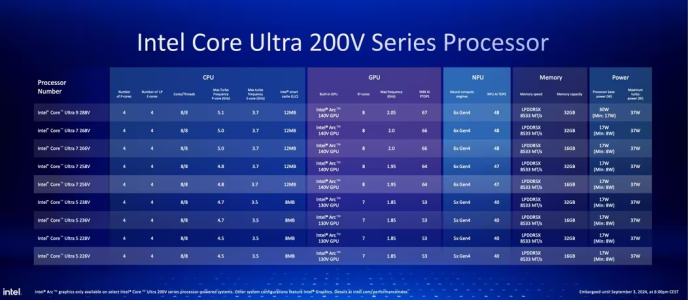
Intel Wildcat Lake (WCL) is upcoming mobile SoC replacing ADL-N. WCL consists of 2 tiles: compute tile and PCD tile. It is true single die consists of CPU, GPU and NPU that is fabbed by 18-A process. Last time I checked, PCD tile is fabbed by TSMC N6 process. They are connected through UCIe, not D2D; a first from Intel. Expecting launching in Q2/Computex 2026. In case people don't remember AlderLake-N, I have created a table below to compare the detail specs of ADL-N and WCL. Just for fun, I am throwing LNL and upcoming Mediatek D9500 SoC.

Intel Alder Lake - NIntel Wildcat LakeIntel Lunar LakeMediatek D9500
Launch DateQ1-2023Q2-2026 ?Q3-2024Q3-2025
ModelIntel N300?Core Ultra 7 268VDimensity 9500 5G
Dies2221
NodeIntel 7 + ?Intel 18-A + TSMC N6TSMC N3B + N6TSMC N3P
CPU8 E-cores2 P-core + 4 LP E-cores4 P-core + 4 LP E-coresC1 1+3+4
Threads8688
Max Clock3.8 GHz?5 GHz
L3 Cache6 MB?12 MB
TDP7 WFanless ?17 WFanless
Memory64-bit LPDDR5-480064-bit LPDDR5-6800 ?128-bit LPDDR5X-853364-bit LPDDR5X-10667
Size16 GB?32 GB24 GB ?
Bandwidth~ 55 GB/s136 GB/s85.6 GB/s
GPUUHD GraphicsArc 140VG1 Ultra
EU / Xe32 EU2 Xe8 Xe12
Max Clock1.25 GHz2 GHz
NPUNA18 TOPS48 TOPS100 TOPS ?


PPT1.jpg
PPT2.jpg
PPT3.jpg


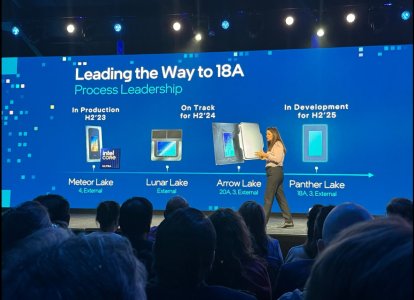
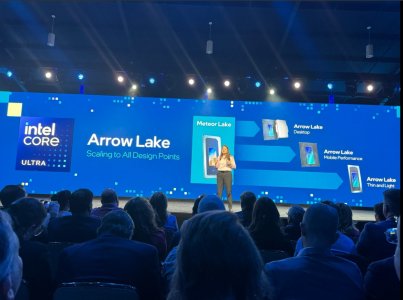
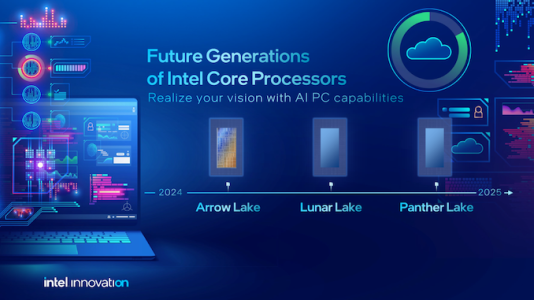
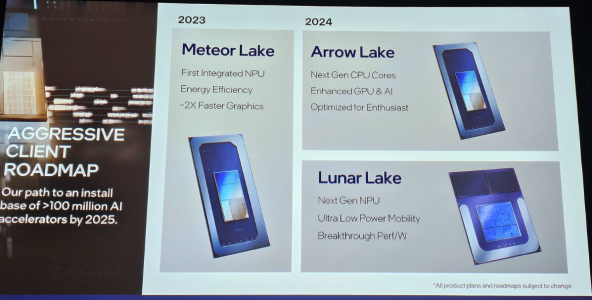
As Hot Chips 34 starting this week, Intel will unveil technical information of upcoming Meteor Lake (MTL) and Arrow Lake (ARL), new generation platform after Raptor Lake. Both MTL and ARL represent new direction which Intel will move to multiple chiplets and combine as one SoC platform.

MTL also represents new compute tile that based on Intel 4 process which is based on EUV lithography, a first from Intel. Intel expects to ship MTL mobile SoC in 2023.

ARL will come after MTL so Intel should be shipping it in 2024, that is what Intel roadmap is telling us. ARL compute tile will be manufactured by Intel 20A process, a first from Intel to use GAA transistors called RibbonFET.


LNL-MX.png
 

Attachments

  • PantherLake.png
    PantherLake.png
    283.5 KB · Views: 24,034
  • LNL.png
    LNL.png
    881.8 KB · Views: 25,527
  • INTEL-CORE-100-ULTRA-METEOR-LAKE-OFFCIAL-SLIDE-2.jpg
    INTEL-CORE-100-ULTRA-METEOR-LAKE-OFFCIAL-SLIDE-2.jpg
    181.4 KB · Views: 72,435
  • Clockspeed.png
    Clockspeed.png
    611.8 KB · Views: 72,321
Last edited:

DavidC1

Platinum Member
Dec 29, 2023
2,003
3,152
96
The E core team did start from a clean sheet and I think it shows based on their rapid iteration and improvement. The advantage of a clean sheet is that every part of the design has someone on the team who is fully responsible for it. Whereas if you have an old design you're tweaking to make wider, improve branch predictors, etc. there are parts of the design where the people who know it best are no longer on the team. The more of the core that's true for, the more difficult any major improvements become.
Clean sheet or not, every new uarch changes were much greater. In Gracemont, they abandoned the feature that has been in existence since at least Goldmont successfully without regression. Clustered decode is very novel, and that was introduced just a gen before that. Goldmont Plus didn't change the front end, but increased the backend greatly. And Skymont does unusual things for efficiency, breaking away from conventional wisdom. Only stumble was really with original Bonnell. Silvermont was straight up better in every area. They delivered all that without additional power, area or losses in clocks.

The P core designs are much more reluctant to bigger changes, nevermind introducing something else entirely to replace it. It was pain to see it sometimes. It sounded like they were moving heaven and earth to get their 15-20%(resulting in a 50% larger core, or a typical square root gain), and it sounded impressive. Some generations like Nehalem got mere single digit % improvements. Until I saw the changes in the E core. The gains are also linear with transistor investment. They talk much less, they just deliver.
If you're spending $1k+ for a graphics card then by all means, get the X3D processor to match it. Same if you care about performance on one of the games that disproportionately benefit from the increased cache. Otherwise? Good luck noticing a difference in processor performance when you're GPU bound.
Our senses can be quite sensitive. It's just that we can also adjust. Yes I believe people that say they can see differences with 288Hz monitors. But if they were willing to put up with it, they'd be able to do it with stable 30 fps. Just like those that complain the most about the situation they are living in are the ones in the most richest, and privileged areas.

For me I'm willing to put up with 20-30 fps so I don't have to spend more than $150 on any component in the system. It's not like I can't. I just believe there are better uses for the money.
 
  • Like
Reactions: Joe NYC

DavidC1

Platinum Member
Dec 29, 2023
2,003
3,152
96
“We expect to release the 1.0 PDK for Intel 18A this quarter. Furthermore, our lead products, Clearwater Forest and Panther Lake are already in fab and we expect to begin production ramp of the Intel 18A in these products in the first-half of '25 for product release in the middle of next year.”
The only thing that got really delayed was CWF. I never believed Pantherlake could be earlier than October in any shape or form. It just doesn't work in laptops. Arrow/Lunar is Q4 2024, so earliest for Panther is Q4 2025.

I keep telling people that they need to think as a laptop vendor. You need at least 1 year to sell, first to recoup your investment, and second to make money on it. If the next one is coming in 6 months, what will you do? How many people here looking for the latest tech will settle for Lunar/Arrow in 2026, instead of Panther?

Even Intel said this. They said you can have a product refresh cycle of 6 months to 18 months. Which is optimal? They said 12 months. 6 months is not optimal for profit because it's taken up too much by upfront costs. 18 months is not optimal for profit because it's too long. And they were saying that in regards to process, basically telling us that they could release new process in 12 months if they wanted to instead of typical 24 months.
 
  • Like
Reactions: Joe NYC and DKR

jpiniero

Lifer
Oct 1, 2010
16,987
7,385
136
OEMs sell more than one laptop brand of course. I think of the point of Panther Lake this year was to encourage "Investors" on the Foundry... and they couldn't do it.
 
  • Like
Reactions: OneEng2

LightningZ71

Platinum Member
Mar 10, 2017
2,623
3,308
136
You also must keep in mind, for laptops, it's "platform" generations. AMD has often used the same platform for 2 to even 3 processor generations in mobile. Intel has the same option. All thatatters for the OEM is the socket plus the power/thermal envelope. As long as that stays similar, they only need to change the model number and maybe paint color.
 

511

Diamond Member
Jul 12, 2024
5,017
4,528
106
OEMs sell more than one laptop brand of course. I think of the point of Panther Lake this year was to encourage "Investors" on the Foundry... and they couldn't do it.
They are shipping PTL to customers.. also PTL is new Socket and Nvl Maintains socket compatibility.
 
  • Like
Reactions: DKR

Doug S

Diamond Member
Feb 8, 2020
3,727
6,588
136
Clean sheet or not, every new uarch changes were much greater. In Gracemont, they abandoned the feature that has been in existence since at least Goldmont successfully without regression. Clustered decode is very novel, and that was introduced just a gen before that. Goldmont Plus didn't change the front end, but increased the backend greatly. And Skymont does unusual things for efficiency, breaking away from conventional wisdom. Only stumble was really with original Bonnell. Silvermont was straight up better in every area. They delivered all that without additional power, area or losses in clocks.

The P core designs are much more reluctant to bigger changes, nevermind introducing something else entirely to replace it. It was pain to see it sometimes. It sounded like they were moving heaven and earth to get their 15-20%(resulting in a 50% larger core, or a typical square root gain), and it sounded impressive. Some generations like Nehalem got mere single digit % improvements. Until I saw the changes in the E core. The gains are also linear with transistor investment. They talk much less, they just deliver.

Well that's kind of my point. If you're iterating on a legacy design (and I'm not limiting this to CPU design, the same would be true for software or a jet engine) that has some bits that maybe are 20-30 years old and there's no one left on the team who was around back then and truly understands them you're going to be loathe to mess with that stuff, or anything that touches it, and if you do be overly conservative in your approach. That makes those big impactful changes more difficult to accomplish.

This would lead to exactly what you're saying here where the P core changes are cautious and limited and the E core changes are bold and expansive.

EDIT: I'll add that AMD's Zen architecture was almost certainly clean sheet (I doubt they wanted to keep anything from Bulldozer lol) so they're in a situation more similar to Intel's E core than their P core.
 
Last edited:
  • Like
Reactions: Tlh97 and 511

511

Diamond Member
Jul 12, 2024
5,017
4,528
106
How/Why are they shipping Panther if it's not launching until like late Q1 next year now?
you know you need to ship the CPU before the laptop launches cause laptop assembly and import export of materials take time. Intel said launch of first SKU so they would be shipping that SKU rn.
 

dullard

Elite Member
May 21, 2001
26,138
4,792
126
How/Why are they shipping Panther if it's not launching until like late Q1 next year now?
Intel repeatedly says in the last couple of weeks something along the lines of "ship later in 2025 and go on sale January 2026". Posted Oct 14, 2025:
https://newsroom.intel.com/client-computing/introducing-panther-lake-by-the-numbers

and "we are on track to launch our first Panther Lake SKU by year-end, followed by additional SKUs in the first half of next year". Posted Oct 23, 2025:
https://d1io3yog0oux5.cloudfront.ne...rks/3Q2025+Earnings+Call+Prepared+Remarks.pdf

So, you interpret that as late Q1 2026?
 
  • Like
Reactions: MoogleW

poke01

Diamond Member
Mar 8, 2022
4,558
5,855
106
1761633889617.png

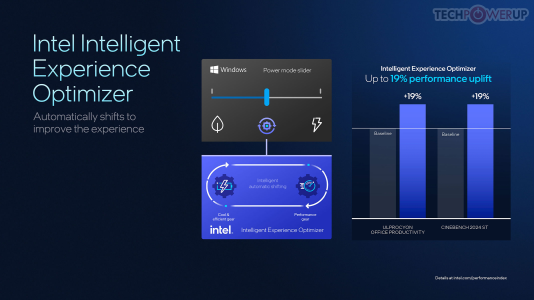
Going back to Cinebench 2024 for a bit, it looks like Intel made some improvements to Panther Lake where its "optimiser" contributes up to 19% perf uplift in CB2024. It would be intertesting to see how that fares against Lunar Lake and Arrow Lake.

I guess the baseline here means its using Windows power slider on balanced mode but on panther lake its done automatically resulting in an uplift.
 

511

Diamond Member
Jul 12, 2024
5,017
4,528
106
I am glad for once we don't need power slider for most people cause most people don't know how to change it it's better to have it do automatically also I think that is the difference between scheduled on E core vs P core.
 

DrMrLordX

Lifer
Apr 27, 2000
23,060
13,163
136
Why? How many server gens did Xeon go where it was essentially just a VERY slightly tweaked version of the original SkyLake core with eventually a tacked on AVX512 unit? Kaby, Coffee and Comet Lake were similar scale or smaller changes, outside of the AVX512 unit, than what Golden Cove is getting along the way.
Skylake-SP and Cascade Lake-SP/AP. There was also Cooper Lake but nobody really cares about Cooper Lake (not to the extent that Intel wants people to care about Granite Rapids and Diamond Rapids anyway). Also the AVX-512 unit wasn't "eventually" tacked on to server Skylake. It was there from day 1.
 
  • Like
Reactions: 511

LightningZ71

Platinum Member
Mar 10, 2017
2,623
3,308
136
I stand corrected. I thought the SkyLake family of cores started out in it's first Xeon appearance without it, but I was mistaken.
 

DrMrLordX

Lifer
Apr 27, 2000
23,060
13,163
136
It's all good, Intel schlepped those cores for far longer than they should have, so it's not hard to forget their origins or anything that came before them. Who here even discusses Broadwell anymore?
 

DavidC1

Platinum Member
Dec 29, 2023
2,003
3,152
96
So I found something interesting the other day. I guess I always knew it but really experienced it fully.

I have a Pentium G6400, GTX 1080 system with 16GB DDR4 and WD SATA SSD. The CPU idles at 6-7W and the GPU goes down to 10-12W. I wondered how low I could go, so I enabled all CPU power management in BIOS. Then the CPU went to 2W levels. I think it idled at 1.5W or so at the lowest level. The system idles at 45W including the 27-inch Acer 1440p monitor which is at 9% brightness since that's more than bright enough for me and I want to save my eyes plus save a bit of power. It's a mATX motherboard which probably saves few W. At default 50% it hurt my eyes a bit. Used to the Lenovo Yoga 11 at about 25% brightness. The monitor at that setting uses about 12W. This means my system idles somewhere just under 35W. With the power management settings in BIOS, if I remember correctly it enables package C7 state, whereas without it, it just uses core C7 states. So they have to throttle the uncore/IO down to get the idle down to 2W, which is why it's unresponsive.

Except, I would not do this for regular use. It was quite a bit less responsive. Now I really understand why my 2011 2600K system is just as responsive as a laptop 10 years or more younger. Everything just felt sluggish, from opening up applications, to typing to just moving my mouse cursor. Something felt off.

I could take further steps to lower this, without sacrificing the responsiveness.
-150-200W PicoPSU with CPU limited to 25W/35W PL1/PL2. This will probably be able to get it down to 25W idle. Which equals 7W CPU and 11W GPU, and 7W for everything else. A downclocked+undervolted RX 9060XT should be roughly equal to the 1080 at 60-70W is my guess, which means 150W PSU is more than fine.
-DDR4 undervolting to 1V. It may need underclocking to 2133 or even 1866MT/s to do this though. Maybe 1.5W savings.
-Selective enabling of unused ports such as USB and LAN.
-Disconnect the dGPU as needed. That's 10-12W system idle. 25W including the monitor.

This means a fully upgradeable desktop is capable of 4-6W idle if all the power management settings are turned on. If you don't need it to be portable then you don't need to worry too much about power. Actually I think 10-12W idle is fine, just hook it up to a powerbank when sleep is needed so you don't suffer data corruption. A guy on Youtube got a Cyberpunk 2077 playable desktop that used only 65W using the RX 6400.
 
Last edited:

DavidC1

Platinum Member
Dec 29, 2023
2,003
3,152
96
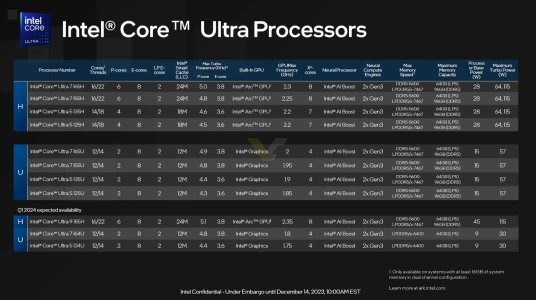
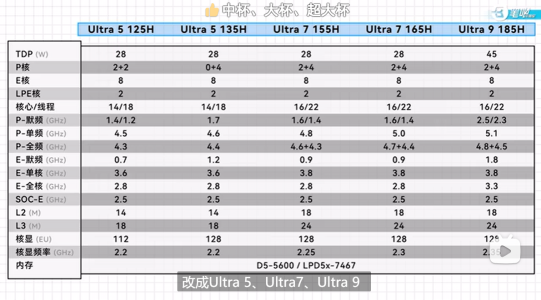
4+8+2 vs 4+4+4 and at 60W .. I doubt it has scales to that cause maximum pl leaked was around 45W PL1
The +2 is effectively useless, so it's 4+8 versus 4P + 4E + 4LPE. We shall see.

Either that, or Intel straight up lied in the presentation. Guess it won't be a big surprise if that's the case.
 
Last edited:

511

Diamond Member
Jul 12, 2024
5,017
4,528
106
The +2 is effectively useless, so it's 4+8 versus 4P + 4E + 4LPE. We shall see.

Either that, or Intel straight up lied in the presentation. Guess it won't be a big surprise if that's the case.
Intel compared 6+8+(2) vs 4+8+4
 

coercitiv

Diamond Member
Jan 24, 2014
7,443
17,731
136
Intel compared 6+8+(2) vs 4+8+4
It's not just the core counts, it's also the bins. This leak is about Ultra 5, so the lower tier. We've seen this happen before with Ice Lake, the i5 line had considerably worse quality because Intel was aggressively binning i7 to save face. We'll have to wait and see.
 
  • Like
Reactions: 511