Discussion Intel Meteor, Arrow, Lunar & Panther Lakes + WCL Discussion Threads

Page 975 - Seeking answers? Join the AnandTech community: where nearly half-a-million members share solutions and discuss the latest tech.

Tigerick

Senior member
Apr 1, 2022
942
857
106
Wildcat Lake (WCL) Specs

Intel Wildcat Lake (WCL) is upcoming mobile SoC replacing Raptor Lake-U. WCL consists of 2 tiles: compute tile and PCD tile. It is true single die consists of CPU, GPU and NPU that is fabbed by 18-A process. Last time I checked, PCD tile is fabbed by TSMC N6 process. They are connected through UCIe, not D2D; a first from Intel. Expecting launching in Q1 2026.
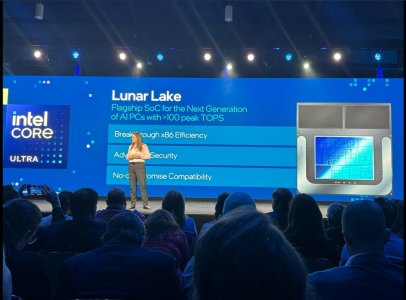
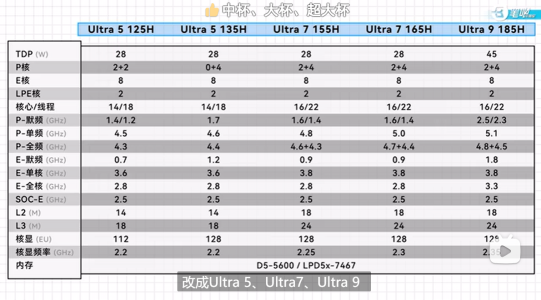
Intel Raptor Lake UIntel Wildcat Lake 15W?Intel Lunar LakeIntel Panther Lake 4+0+4
Launch DateQ1-2024Q2-2026Q3-2024Q1-2026
ModelIntel 150UIntel Core 7Core Ultra 7 268VCore Ultra 7 365
Dies2223
NodeIntel 7 + ?Intel 18-A + TSMC N6TSMC N3B + N6Intel 18-A + Intel 3 + TSMC N6
CPU2 P-core + 8 E-cores2 P-core + 4 LP E-cores4 P-core + 4 LP E-cores4 P-core + 4 LP E-cores
Threads12688
Max Clock5.4 GHz?5 GHz4.8 GHz
L3 Cache12 MB12 MB12 MB
TDP15 - 55 W15 W ?17 - 37 W25 - 55 W
Memory128-bit LPDDR5-520064-bit LPDDR5128-bit LPDDR5x-8533128-bit LPDDR5x-7467
Size96 GB32 GB128 GB
Bandwidth136 GB/s
GPUIntel GraphicsIntel GraphicsArc 140VIntel Graphics
RTNoNoYESYES
EU / Xe96 EU2 Xe8 Xe4 Xe
Max Clock1.3 GHz?2 GHz2.5 GHz
NPUGNA 3.018 TOPS48 TOPS49 TOPS


PPT1.jpg
PPT2.jpg
PPT3.jpg


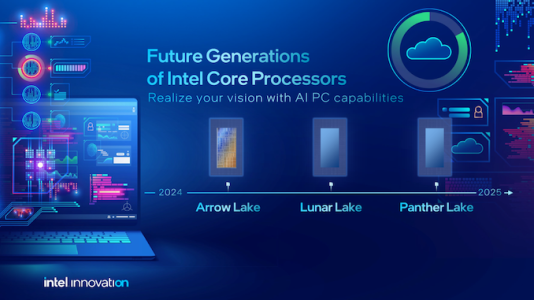
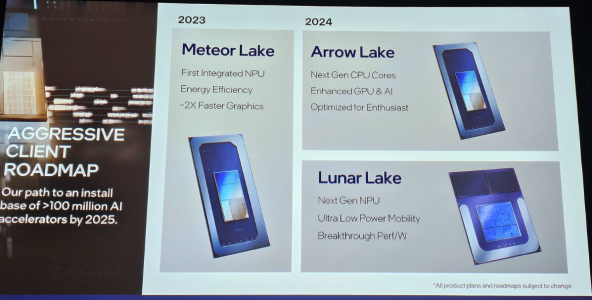
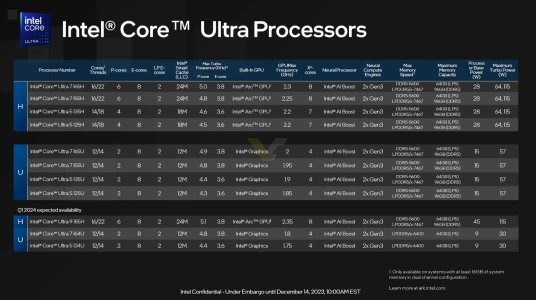
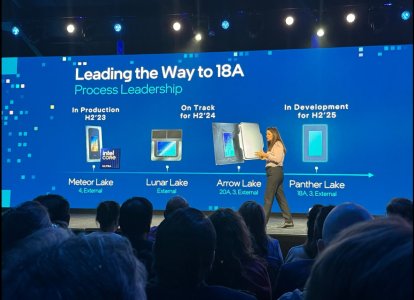
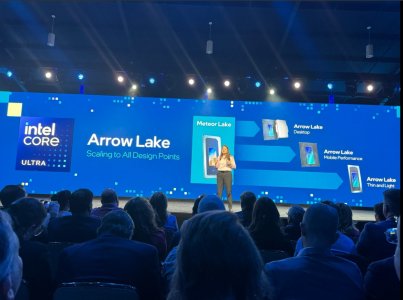
As Hot Chips 34 starting this week, Intel will unveil technical information of upcoming Meteor Lake (MTL) and Arrow Lake (ARL), new generation platform after Raptor Lake. Both MTL and ARL represent new direction which Intel will move to multiple chiplets and combine as one SoC platform.

MTL also represents new compute tile that based on Intel 4 process which is based on EUV lithography, a first from Intel. Intel expects to ship MTL mobile SoC in 2023.

ARL will come after MTL so Intel should be shipping it in 2024, that is what Intel roadmap is telling us. ARL compute tile will be manufactured by Intel 20A process, a first from Intel to use GAA transistors called RibbonFET.
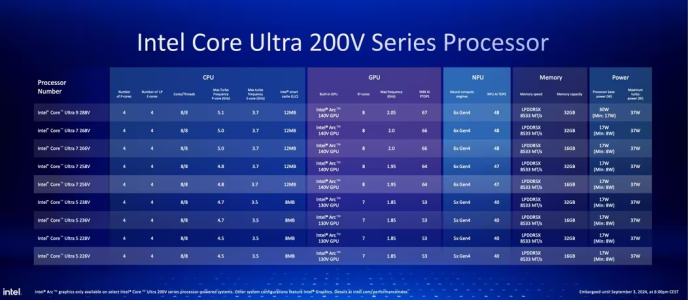


LNL-MX.png
 

Attachments

  • PantherLake.png
    PantherLake.png
    283.5 KB · Views: 24,044
  • LNL.png
    LNL.png
    881.8 KB · Views: 25,531
  • INTEL-CORE-100-ULTRA-METEOR-LAKE-OFFCIAL-SLIDE-2.jpg
    INTEL-CORE-100-ULTRA-METEOR-LAKE-OFFCIAL-SLIDE-2.jpg
    181.4 KB · Views: 72,440
  • Clockspeed.png
    Clockspeed.png
    611.8 KB · Views: 72,327
Last edited:

Thunder 57

Diamond Member
Aug 19, 2007
4,294
7,099
136
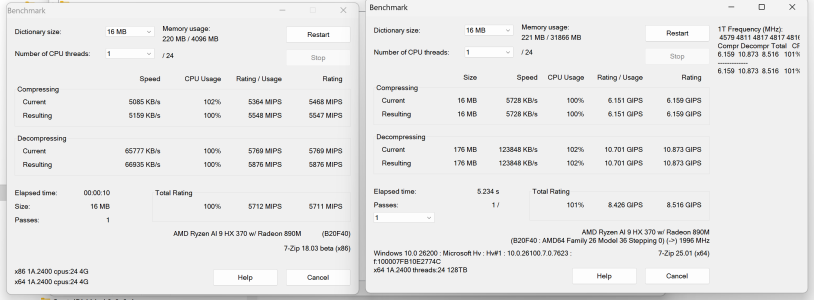
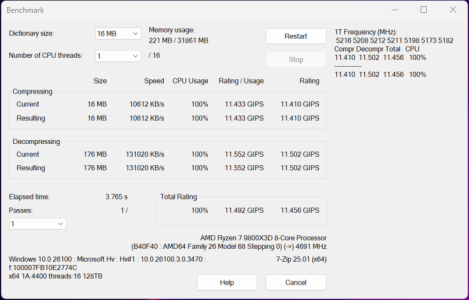
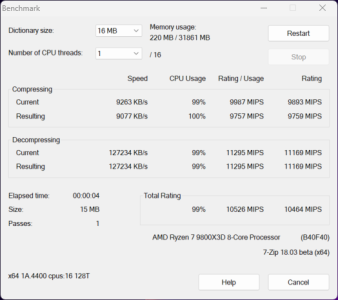
Keep in mind the bench on 7-Zip varies among versions. I just tested the latest against 18.03 Beta and the newer one produces much higher scores. I don't know if the algorithms are better, the compression index is less, or a combination of both, but something is different.

Based on what they say it sounds very version dependant:

The LZMA benchmark shows a rating in MIPS (million instructions per second). The rating value is calculated from the measured speed, and it is normalized with results of Intel Core 2 CPU with multi-threading option switched off, and measured with old version of 7-Zip.
 

Abwx

Lifer
Apr 2, 2011
12,024
4,986
136
its not that big of a difference between versions on the same OS. Its Linux that produces a higher score likely due to better complier and optimisation.

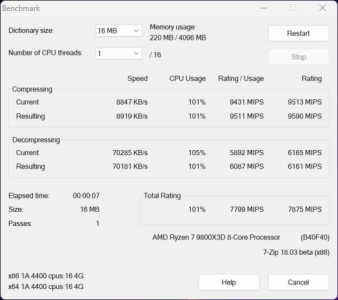
v25.01 is 8708 MIPS in my testing on Windows 11
v18.03 is 8484 according to NBC on windows 11


View attachment 138024
You have likely faster RAM than NBC s stock 5600, there s only 2.6% difference though.
 
Last edited:

Abwx

Lifer
Apr 2, 2011
12,024
4,986
136
Based on what they say it sounds very version dependant:

I tested with the 9.2 version wich is very old and the 18.03 one doesnt make a big difference, what is sure is that with 7-Zip all those IPC improvements claimed for the last 15 years fall litteraly flat, as i pointed it Haswell has 65% better IPC than C2D in Cinebench but in 7-zip it s barely 13%, the same for AMD with only 25% better IPC for Zen vs FX8350 despite 60% in CB.

No wonder that 10-15 years old PCs still work relatively well nowadays for basic usages despite quite slower RAM, best progress here was mainly brought by higher CPUs frequencies.
 
Last edited:

DavidC1

Platinum Member
Dec 29, 2023
2,184
3,331
106
I tested with the 9.2 version wich is very old and the 18.03 one doesnt make a big difference, what is sure is that with 7-Zip all those IPC improvements claimed for the last 15 years fall litteraly flat, as i pointed it Haswell has 65% better IPC than C2D in Cinebench but in 7-zip it s barely 13%, the same for AMD with only 25% better IPC for Zen vs FX8350 despite 60% in CB.

No wonder that 10-15 years old PCs still work relatively well nowadays for basic usages despite quite slower RAM, best progress here was mainly brought by higher CPUs frequencies.
Where is Haswell 60% faster than Core 2 in Cinebench? You are including Hyperthreading in there. Haswell is 25-30% better. 7-zip is also underestimating Haswell gain, and likely Zen as well. 7-zip itself is too memory bandwidth bound, also not a realistic benchmark.

Cinebench is BETTER overall. It's barely affected by memory which is true for vast majority of lightly threaded applications, you can't boost significantly by bigger caches despite that, and it really doesn't care about anything other than basic FP, meaning SSE/AVX is useless. This is for ST by the way. In MT it has bigger flaws, but still better than vast majority of other tests. THE single most important metric today is still the scalar integer performance. Both Cinebench and Spec does pretty good job at it. Now I said it's not perfect. It comes close enough to the overall average.
 
Last edited:

Abwx

Lifer
Apr 2, 2011
12,024
4,986
136
Where is Haswell 60% faster than Core 2 in Cinebench? You are including Hyperthreading in there. Haswell is 25-30% better. 7-zip is also underestimating Haswell gain, and likely Zen as well. 7-zip itself is too memory bandwidth bound, also not a realistic benchmark.

Cinebench is BETTER overall. It's barely affected by memory which is true for vast majority of lightly threaded applications, you can't boost significantly by bigger caches despite that, and it really doesn't care about anything other than basic FP, meaning SSE/AVX is useless. This is for ST by the way. In MT it has bigger flaws, but still better than vast majority of other tests. THE single most important metric today is still the scalar integer performance. Both Cinebench and Spec does pretty good job at it. Now I said it's not perfect. It comes close enough to the overall average.

Cinebench is not better, tell me wich are the consumers apps that rely on FP rather than on INT, you wont find a single one.

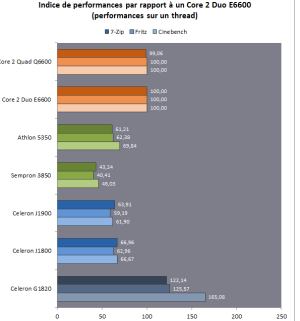
As for comparison of HW and C2D in ST here its is, beside there s Fritzchess in the comparison wich is also INT and is heavy for branching, if you take account of the frequency difference between the G1820 and the C2D you end with quite low numbers for the INT apps.
 

Attachments

  • Screenshot 2026-02-08 at 14-55-00 vs Core 2 Duo E6600 et Core 2 Quad Q6600 - x86 basse consomm...png
    Screenshot 2026-02-08 at 14-55-00 vs Core 2 Duo E6600 et Core 2 Quad Q6600 - x86 basse consomm...png
    27.9 KB · Views: 15
Last edited: