Discussion Intel Meteor, Arrow, Lunar & Panther Lakes + WCL Discussion Threads

Page 974 - Seeking answers? Join the AnandTech community: where nearly half-a-million members share solutions and discuss the latest tech.

Tigerick

Senior member
Apr 1, 2022
942
857
106
Wildcat Lake (WCL) Specs

Intel Wildcat Lake (WCL) is upcoming mobile SoC replacing Raptor Lake-U. WCL consists of 2 tiles: compute tile and PCD tile. It is true single die consists of CPU, GPU and NPU that is fabbed by 18-A process. Last time I checked, PCD tile is fabbed by TSMC N6 process. They are connected through UCIe, not D2D; a first from Intel. Expecting launching in Q1 2026.
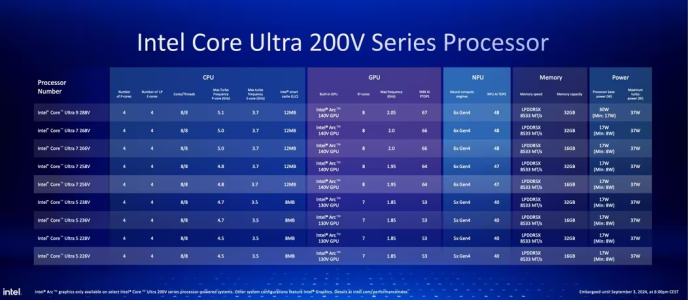
Intel Raptor Lake UIntel Wildcat Lake 15W?Intel Lunar LakeIntel Panther Lake 4+0+4
Launch DateQ1-2024Q2-2026Q3-2024Q1-2026
ModelIntel 150UIntel Core 7Core Ultra 7 268VCore Ultra 7 365
Dies2223
NodeIntel 7 + ?Intel 18-A + TSMC N6TSMC N3B + N6Intel 18-A + Intel 3 + TSMC N6
CPU2 P-core + 8 E-cores2 P-core + 4 LP E-cores4 P-core + 4 LP E-cores4 P-core + 4 LP E-cores
Threads12688
Max Clock5.4 GHz?5 GHz4.8 GHz
L3 Cache12 MB12 MB12 MB
TDP15 - 55 W15 W ?17 - 37 W25 - 55 W
Memory128-bit LPDDR5-520064-bit LPDDR5128-bit LPDDR5x-8533128-bit LPDDR5x-7467
Size96 GB32 GB128 GB
Bandwidth136 GB/s
GPUIntel GraphicsIntel GraphicsArc 140VIntel Graphics
RTNoNoYESYES
EU / Xe96 EU2 Xe8 Xe4 Xe
Max Clock1.3 GHz?2 GHz2.5 GHz
NPUGNA 3.018 TOPS48 TOPS49 TOPS


PPT1.jpg
PPT2.jpg
PPT3.jpg


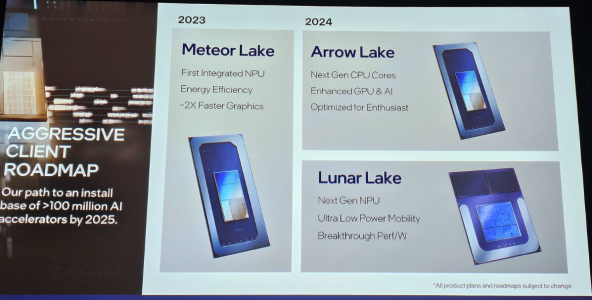
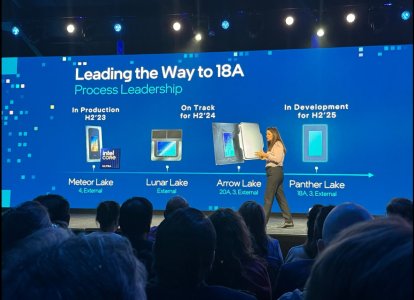
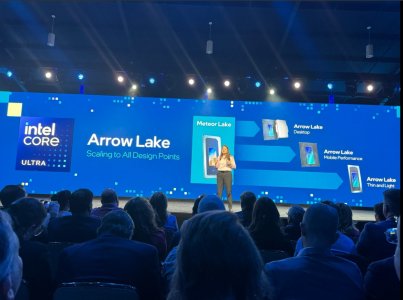
As Hot Chips 34 starting this week, Intel will unveil technical information of upcoming Meteor Lake (MTL) and Arrow Lake (ARL), new generation platform after Raptor Lake. Both MTL and ARL represent new direction which Intel will move to multiple chiplets and combine as one SoC platform.

MTL also represents new compute tile that based on Intel 4 process which is based on EUV lithography, a first from Intel. Intel expects to ship MTL mobile SoC in 2023.

ARL will come after MTL so Intel should be shipping it in 2024, that is what Intel roadmap is telling us. ARL compute tile will be manufactured by Intel 20A process, a first from Intel to use GAA transistors called RibbonFET.


LNL-MX.png
 

Attachments

  • PantherLake.png
    PantherLake.png
    283.5 KB · Views: 24,044
  • LNL.png
    LNL.png
    881.8 KB · Views: 25,531
  • INTEL-CORE-100-ULTRA-METEOR-LAKE-OFFCIAL-SLIDE-2.jpg
    INTEL-CORE-100-ULTRA-METEOR-LAKE-OFFCIAL-SLIDE-2.jpg
    181.4 KB · Views: 72,440
  • Clockspeed.png
    Clockspeed.png
    611.8 KB · Views: 72,327
Last edited:

Hulk

Diamond Member
Oct 9, 1999
5,401
4,110
136
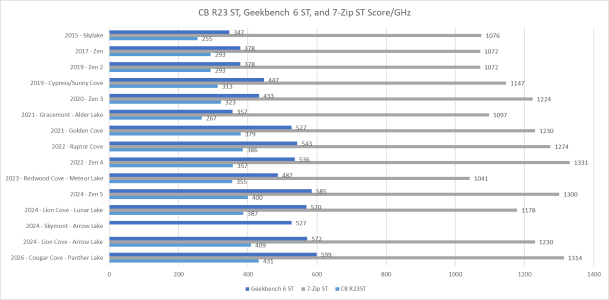
Quick update.
I was able to break out Golden and Raptor Cove scores.
Also Igor tested his Skymont GK6. Waiting on a CB R23 ST score from him.
Amazingly his Skymont GK6 score/cycle lined up exactly with the average I got for Golden Cove.

I don't think I'm going to be able to add 7-Zip scores from outside of Notebookcheck.com to the table because I don't know exactly how they are obtaining their score from the benchmark. I think they are doing some math on it...

1770471635512.png
 

Hulk

Diamond Member
Oct 9, 1999
5,401
4,110
136
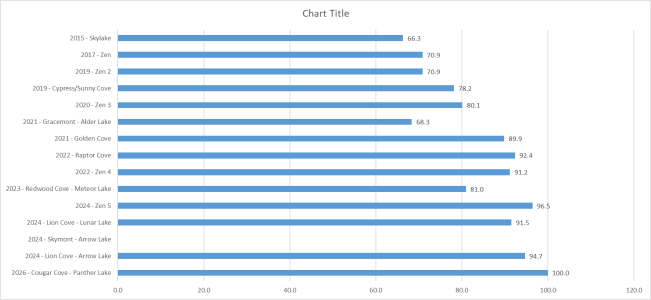
The "overall" throughput/cycle chart looks like this if you combine all three scores and give them equal weight.

1770471907702.png
 

Abwx

Lifer
Apr 2, 2011
12,024
4,986
136
I don't think I'm going to be able to add 7-Zip scores from outside of Notebookcheck.com to the table because I don't know exactly how they are obtaining their score from the benchmark. I think they are doing some math on it...

They use the built in benchmark that is included in 7-Zip, you can bench compression, decompression and the average comp/decomp in both ST and MT.
 

dttprofessor

Member
Jun 16, 2022
165
45
71
Gamers are the main force behind DIY projects; they only care about game frame rates. As mentioned in a previous interview with an Intel architect, for CPUs, game performance is very similar to database performance. IPC is a comprehensive factor, and database use cases are just one aspect.
 

Hulk

Diamond Member
Oct 9, 1999
5,401
4,110
136
They use the built in benchmark that is included in 7-Zip, you can bench compression, decompression and the average comp/decomp in both ST and MT.
Yes, so here's the issue I'm having trying to replicate it.

I have an average 7-Zip score from Notebookcheck.com of 1271 for Zen 5. No units or anything that I can find on their site.

When I test my 9950x I get a combined score of 10.706 GIPS, multiplying that number by 1052 gives 1271. 1052 would be a strange multiplier, just too random.

Now it would seem more logical that they'd use a multiplier of "1000," which would give a result of 1071 for my 9950x. But that's almost 19% low. I wouldn't expect my system be right on the average, but within 5% seems reasonable? 19% seems way out of bounds.

Not sure what is going on with this?
 

Hulk

Diamond Member
Oct 9, 1999
5,401
4,110
136
Yes, so here's the issue I'm having trying to replicate it.

I have an average 7-Zip score from Notebookcheck.com of 1271 for Zen 5. No units or anything that I can find on their site.

When I test my 9950x I get a combined score of 10.706 GIPS, multiplying that number by 1052 gives 1271. 1052 would be a strange multiplier, just too random.

Now it would seem more logical that they'd use a multiplier of "1000," which would give a result of 1071 for my 9950x. But that's almost 19% low. I wouldn't expect my system be right on the average, but within 5% seems reasonable? 19% seems way out of bounds.

Not sure what is going on with this?
Figured it out. They are using a different revision. Version 18.03. Still can't replicate their numbers though.
 

Abwx

Lifer
Apr 2, 2011
12,024
4,986
136
Yes, so here's the issue I'm having trying to replicate it.

I have an average 7-Zip score from Notebookcheck.com of 1271 for Zen 5. No units or anything that I can find on their site.

When I test my 9950x I get a combined score of 10.706 GIPS, multiplying that number by 1052 gives 1271. 1052 would be a strange multiplier, just too random.

Now it would seem more logical that they'd use a multiplier of "1000," which would give a result of 1071 for my 9950x. But that's almost 19% low. I wouldn't expect my system be right on the average, but within 5% seems reasonable? 19% seems way out of bounds.

Not sure what is going on with this?
NBC have 1377 MIPS/GHz for the 9950X, 1467MIPS/GHz for the 7950X and 1631 MIPS/GHz for the 9800X3D, 285K does 1278 MIPS/GHz and 14900K 1295 MIPS/GHz.

7-ZIP is sensitive to IPC of course but also to RAM speed and latency, the L2/L3 cache latency is also very important, obviously the X3D cache is a big plus since it hide all RAM speeds and latencies while the 14900K better cache latency make it faster/clock than the 285K despite supposed lower IPC, but INT is not FP.

I ll add that in ST Zen had only 25% better MIPS/GHz than a FX8350 wich is at 859 MIPS/GHz, far from the 60% in Cinebench, also there s a surprisingly good score for the 5950X that is surely due to DDR4 lower latency but Zen 3 also had very good INT IPC to begin with.

7-Zip ST numbers for all those CPUs are compiled in this review :

 
Last edited:
  • Like
Reactions: Tlh97

LightningZ71

Platinum Member
Mar 10, 2017
2,694
3,394
136
On a tangent, given 7Zip's cache sensitivity, I'm interested in seeing how badly the performance of individual e cores deteriorates in 7Zip as additional threads hit a cluster. If someone can run it with 1, 2, 3 and 4 threads against a single crestmont, skymont and darkmont cluster, it would be a very interesting academic exercise.
 

Hulk

Diamond Member
Oct 9, 1999
5,401
4,110
136
NBC have 1377 MIPS/GHz for the 9950X, 1467MIPS/GHz for the 7950X and 1631 MIPS/GHz for the 9800X3D, 285K does 1278 MIPS/GHz and 14900K 1295 MIPS/GHz.

7-ZIP is sensitive to IPC of course but also to RAM speed and latency, the L2/L3 cache latency is also very important, obviously the X3D cache is a big plus since it hide all RAM speeds and latencies while the 14900K better cache latency make it faster/clock than the 285K despite supposed lower IPC, but INT is not FP.

I ll add that in ST Zen had only 25% better MIPS/GHz than a FX8350 wich is at 859 MIPS/GHz, far from the 60% in Cinebench, also there s a surprisingly good score for the 5950X that is surely due to DDR4 lower latency but Zen 3 also had very good INT IPC to begin with.

7-Zip ST numbers for all those CPUs are compiled in this review :

Did you make those calcs? What frequencies did you use? Top ST as advertised?
 

Abwx

Lifer
Apr 2, 2011
12,024
4,986
136
On a tangent, given 7Zip's cache sensitivity, I'm interested in seeing how badly the performance of individual e cores deteriorates in 7Zip as additional threads hit a cluster. If someone can run it with 1, 2, 3 and 4 threads against a single crestmont, skymont and darkmont cluster, it would be a very interesting academic exercise.
That wont happen because 7-Zip send only one thread per core or two with SMT, that s why it scale quite well with core count.
Did you make those calcs? What frequencies did you use? Top ST as advertised?
I divided the ST score by the supposed max frequency of the CPU, so 5.7GHz for the 9950X/7950X/285K, 6GHz for the 14900K and 5.2GHz for the 9800X3D.

That being said it look like 7-Zip load a core much more than CB, in my 2500U i get 79°C with Cinebench MT but on 7-Zip MT it reach 90°C, so it s unlikely that max frequencies are exceeded, eventualy that even top frequencies are hardly sustained if the bench duration is long enough since NBC use 4 passes.
 
Last edited:
  • Like
Reactions: Tlh97 and Hulk

OneEng2

Golden Member
Sep 19, 2022
1,011
1,211
106
No, because the factors surrounding the costs of future nodes, like 14A, etc. don't impact the cost competitiveness of PTL.

The point being is that Intel has years of chips and production for which to amortize 18A NRE costs across. If a client SoC years from now is using 18A as its SoC chiplet, then a portion of 18A's development costs would be added to the price of that chiplet too. 18A does not need to pay itself off within a year or two. Intel has an amortization timeline in mind, and it extends past PTL and DMR
I disagree for a number of reasons; however, I agree to disagree about the cost Intel will pay to continue its current business strategy.
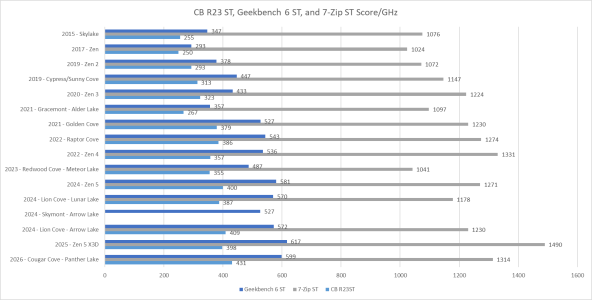
Regarding Zen 5, Cougar Cove, and Lion Cove "IPC."

My current thoughts are that Zen 5 is +1.8% over Lion Cove.
Cougar Cove is +3.8% over Zen 5.

Those numbers might be putting too much weight on CB. Meaning Zen 5 is really holding up well against the newcomers.
Nice analysis. That really brings the situation into a strong focus IMO. A Cougar Cove on N2 might prove to be a potent competitor to Zen 6; however, only if NVL clocks higher than Zen 6 IMO. Of course, it wouldn't be the first time Intel has out-clocked AMD.
considering Zen5 is on N4, it’s doing really well.

I don’t think Intel can hold up against AMD when AMD has node parity. NVL vs Zen6 should be an easy prediction on who will win 1T at least for me.
Whoop. There it is!

I agree. I think the N2 analysis head to head will be very interesting. It will be the first time I am aware of that both Intel and AMD were on level playing ground with respect to foundry.
 

DKR

Junior Member
Nov 19, 2024
22
34
51
Delays basically Killed Clearwater Forest as for 18A volume they still have NVL/PTL/WCL/DMR-AP for the next 2 Years Coral is likely 28 product
Is it confirmed that CWF is canned? I don't think CWF is dead if we are just extrapolating that from what Lip Bu said in the ER call.
1770506750023.png
 

poke01

Diamond Member
Mar 8, 2022
4,872
6,202
106
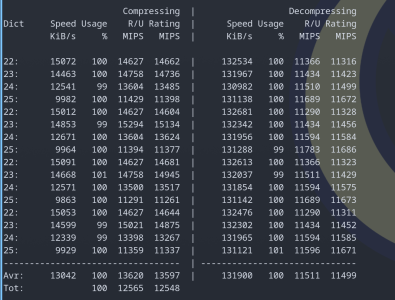
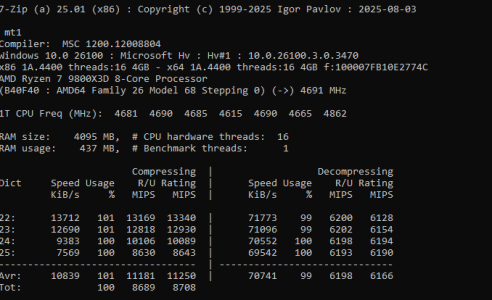
12548 MIPS quite good at 5.2GHz. I've tested on a 9800X3D 1T 7zip bench on Linux with perf mode.

8708 MIPS at 5.2Ghz on windows 11. Big difference here
❯ ./7zz b 4 -mmt1

7-Zip (z) 25.01 (x64) : Copyright (c) 1999-2025 Igor Pavlov : 2025-08-03
64-bit locale=en_AU.UTF-8 Threads:16 OPEN_MAX:1024, ASM

mt1
Compiler: ver:9.4.0 GCC 9.4.0 : SSE2
Linux : 6.18.8-3-cachyos : #1 SMP PREEMPT_DYNAMIC Sat, 31 Jan 2026 18:09:45 +0000 : x86_64
PageSize:4KB THP:always hwcap:2 hwcap2:2
AMD Ryzen 7 9800X3D 8-Core Processor
(B40F40)

1T CPU Freq (MHz): 5207 5210 5216 5219 5218 5218 5208

RAM size: 31189 MB, # CPU hardware threads: 16
RAM usage: 437 MB, # Benchmark threads: 1

1770514635023.png


1770515592431.png
 
Last edited:

Hulk

Diamond Member
Oct 9, 1999
5,401
4,110
136
12548 MIPS quite good at 5.2GHz. I've tested on a 9800X3D 1T 7zip bench on Linux with perf mode.

8708 MIPS at 5.2Ghz on windows 11. Big difference here
Keep in mind the bench on 7-Zip varies among versions. I just tested the latest against 18.03 Beta and the newer one produces much higher scores. I don't know if the algorithms are better, the compression index is less, or a combination of both, but something is different.
 

poke01

Diamond Member
Mar 8, 2022
4,872
6,202
106
Keep in mind the bench on 7-Zip varies among versions. I just tested the latest against 18.03 Beta and the newer one produces much higher scores. I don't know if the algorithms are better, the compression index is less, or a combination of both, but something is different.
its not that big of a difference between versions on the same OS. Its Linux that produces a higher score likely due to better complier and optimisation.

v25.01 is 8708 MIPS in my testing on Windows 11
v18.03 is 8484 according to NBC on windows 11


1770523033531.png
 

LightningZ71

Platinum Member
Mar 10, 2017
2,694
3,394
136
That wont happen because 7-Zip send only one thread per core or two with SMT, that s why it scale quite well with core count.
But that's... Not an issue? Each CLUSTER has 4 cores. Disable everything but one cluster and a P core, cripple that P core, then run tests with 1, 2, 3 and 4 threads to see how the shared L2 hurts performance.
 

Hulk

Diamond Member
Oct 9, 1999
5,401
4,110
136
its not that big of a difference between versions on the same OS. Its Linux that produces a higher score likely due to better complier and optimisation.

v25.01 is 8708 MIPS in my testing on Windows 11
v18.03 is 8484 according to NBC on windows 11


View attachment 138024
I have double check. I thought it was a much larger (significant) difference. I must have missed something.