• We’re currently investigating an issue related to the forum theme and styling that is impacting page layout and visual formatting. The problem has been identified, and we are actively working on a resolution. There is no impact to user data or functionality, this is strictly a front-end display issue. We’ll post an update once the fix has been deployed. Thanks for your patience while we get this sorted.

Discussion Intel Meteor, Arrow, Lunar & Panther Lakes + WCL Discussion Threads

Page 860 - Seeking answers? Join the AnandTech community: where nearly half-a-million members share solutions and discuss the latest tech.

Tigerick

Senior member
Wildcat Lake (WCL) Specs

Intel Wildcat Lake (WCL) is upcoming mobile SoC replacing Raptor Lake-U. WCL consists of 2 tiles: compute tile and PCD tile. It is true single die consists of CPU, GPU and NPU that is fabbed by 18-A process. Last time I checked, PCD tile is fabbed by TSMC N6 process. They are connected through UCIe, not D2D; a first from Intel. Expecting launching in Q1 2026.
Intel Raptor Lake UIntel Wildcat Lake 15WIntel Lunar LakeIntel Panther Lake 4+0+4
Launch DateQ1-2024Q2-2026Q3-2024Q1-2026
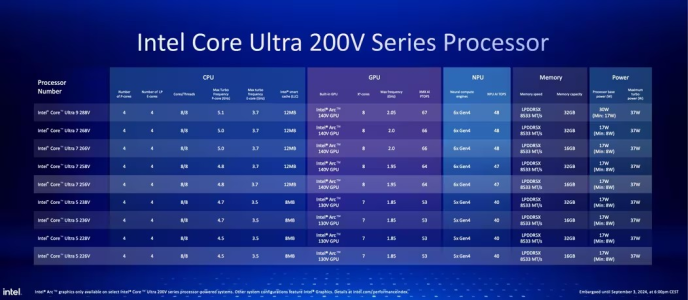
ModelIntel 150UIntel Core 7 360Core Ultra 7 268VCore Ultra 7 365
Dies2223
NodeIntel 7 + ?Intel 18-A + TSMC N6TSMC N3B + N6Intel 18-A + Intel 3 + TSMC N6
CPU2 P-core + 8 E-cores2 P-core + 4 LP E-cores4 P-core + 4 LP E-cores4 P-core + 4 LP E-cores
Threads12688
Max Clock5.4 GHz4.8 GHz5 GHz4.8 GHz
L3 Cache12 MB6 MB12 MB12 MB
TDP15 - 55 W15 - 35 W17 - 37 W25 - 55 W
Memory128-bit LPDDR5-520064-bit LPDDR5x-7467128-bit LPDDR5x-8533128-bit LPDDR5x-7467
Size96 GB48 GB32 GB128 GB
Bandwidth83 GB/s60 GB/s136 GB/s120 GB/s
GPUIntel GraphicsIntel GraphicsArc 140VIntel Graphics
RTNoNoYESYES
EU / Xe96 EU2 Xe8 Xe4 Xe
Max Clock1.3 GHz2.6 GHz2 GHz2.5 GHz
NPUGNA 3.017 TOPS48 TOPS49 TOPS


PPT1.jpg
PPT2.jpg
PPT3.jpg


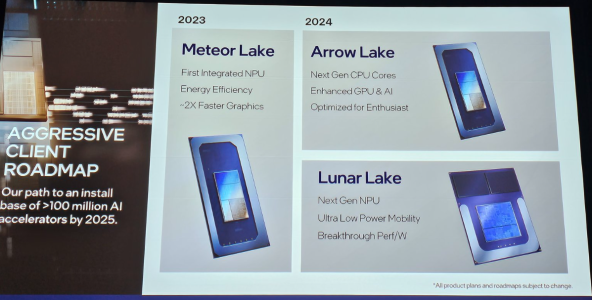
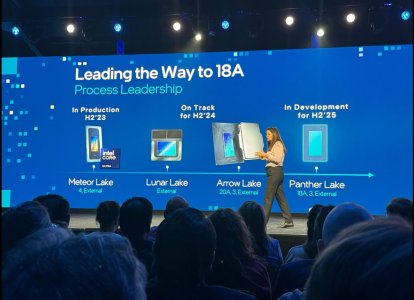
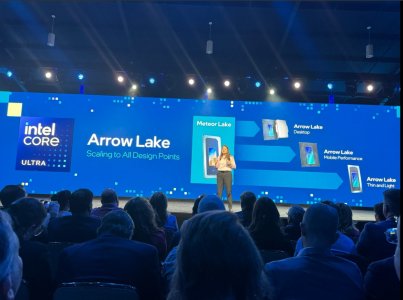
As Hot Chips 34 starting this week, Intel will unveil technical information of upcoming Meteor Lake (MTL) and Arrow Lake (ARL), new generation platform after Raptor Lake. Both MTL and ARL represent new direction which Intel will move to multiple chiplets and combine as one SoC platform.

MTL also represents new compute tile that based on Intel 4 process which is based on EUV lithography, a first from Intel. Intel expects to ship MTL mobile SoC in 2023.

ARL will come after MTL so Intel should be shipping it in 2024, that is what Intel roadmap is telling us. ARL compute tile will be manufactured by Intel 20A process, a first from Intel to use GAA transistors called RibbonFET.


LNL-MX.png
 

Attachments

  • PantherLake.png
    PantherLake.png
    283.5 KB · Views: 24,049
  • LNL.png
    LNL.png
    881.8 KB · Views: 25,534
  • INTEL-CORE-100-ULTRA-METEOR-LAKE-OFFCIAL-SLIDE-2.jpg
    INTEL-CORE-100-ULTRA-METEOR-LAKE-OFFCIAL-SLIDE-2.jpg
    181.4 KB · Views: 72,443
  • Clockspeed.png
    Clockspeed.png
    611.8 KB · Views: 72,329
Last edited:
When a brand new architecture based test chip comes back, how do they know that the bugs it is experiencing are from the architecture design flaws or the process?

You're getting pretty far into proprietary knowledge territory, though it should be pretty obvious. Defects often prevent the die from being functional at all, which is vastly different than having a design flaw/bug that may cause unexpected behavior. Parametric yield problems are probably caught during binning. It's appropriate to use a new design as a pipecleaner, and the practice is actually fairly common. Also look at Intel 3 (which admittedly, wasn't far off process-wise from Intel 4): Intel's first product on Intel 3 was Sierra Forest, not Arrow Lake-U (which was a direct port of Meteor Lake to Intel 3). A lot of that had to do with Intel needing to meet the specific demand of a valued customer, but even still, pushing you Arrow Lake-U early as a test chip would have made sense if the practice had any particular merit.
 
Also look at Intel 3 (which admittedly, wasn't far off process-wise from Intel 4): Intel's first product on Intel 3 was Sierra Forest, not Arrow Lake-U (which was a direct port of Meteor Lake to Intel 3). A lot of that had to do with Intel needing to meet the specific demand of a valued customer, but even still, pushing you Arrow Lake-U early as a test chip would have made sense if the practice had any particular merit.
Whose to say that ARL-U wasn't used to refine Intel 3 first and then put on the backburner while they turned their full attention to Sierra Forest?
 
Whose to say that ARL-U wasn't used to refine Intel 3 first and then put on the backburner while they turned their full attention to Sierra Forest?
It wasn't. Arrow Lake-U was on the backburner. It was launched later. Sierra Forest was a must-complete that had to be available to select customers by ~Apr 2024. Even Granite Rapids was officially launched before Arrow Lake-U.
 
The point is to refine and improve 18A until it's ready for HVM (in other words, able to replace Intel 7, 4 and 3). Using a tried and tested older design helps them get there faster. Tick/tock cadence worked for them before because they tried not to chew too much by putting a new untested design on a brand new process. And now they are doing exactly that and the yields are in the gutter.
Completely different equipment used. Intel has DUV machines and needs usecases for them. It's just not financially feasible to shift your entire fab over to the last node - especially not when the latest node uses completely different lithography machines. TSMC certainly doesn't - you need to maintain volume on lower cost, legacy nodes. And until (if) Intel gets Intel 16 customers, Bartlett Lake on Intel 7 keeps those lines active that would otherwise sit idle. Intel 3 will also stay around for a while as well for non-leading edge use-cases. An external fabrication company needs to offer various nodes.
 
  • Like
Reactions: 511

List of games:
 
It's funny how I have so little expectations for PTL on the CPU side, but am still really excited about that 12 Xe³ SKU. Here's hoping that it's not limited to a few absurdly expensive designs and that it does well in reasonable thin and light TDPs.
 
It's funny how I have so little expectations for PTL on the CPU side, but am still really excited about that 12 Xe³ SKU. Here's hoping that it's not limited to a few absurdly expensive designs and that it does well in reasonable thin and light TDPs.
The CPU Part is interesting as well just not as Graphics it's just a node shrink of SKT/LNC with different core config so Efficiency is the only thing that improved for CPU.
 
The CPU Part is interesting as well just not as Graphics it's just a node shrink of SKT/LNC with different core config so Efficiency is the only thing that improved for CPU.

I mean low expectations as to performance improvements on the CPU side vs ARL. It seems like at best it will be a minimal improvement on that front, since it's the same core arch (basically) and clocks won't be much higher (if they even match ARL).

A 12Xe³ iGPU on the other hand is a very exciting prospect considering how well 8Xe²s already performed on LNL. Hopefully that doesn't end up bottlenecked by LPDDR5X bandwidth too much.
 
I mean low expectations as to performance improvements on the CPU side vs ARL. It seems like at best it will be a minimal improvement on that front, since it's the same core arch (basically) and clocks won't be much higher (if they even match ARL).
For peak performance yeah expect minimal gains but at lower power the gains should be pretty good.
A 12Xe³ iGPU on the other hand is a very exciting prospect considering how well 8Xe²s already performed on LNL. Hopefully that doesn't end up bottlenecked by LPDDR5X bandwidth too much.
It is though the memory speed is LPDDR5X 9600 max supported and it won't be enough to feed 12Xe3 and Xe3 is a major architecture change expect as big improvement as Xe2 was over Xe1.
 
Last edited:
It is though the memory speed is LPDDR5X 9600 max supported and it won't be enough to feed 12Xe3 and Xe3 is a major architecture change expect as big improvement as Xe2 was over Xe1.

Too bad LPDDR6 took a bit longer than initially expected to be ready. Would have been a boon for that iGPU.
 
A 12Xe³ iGPU on the other hand is a very exciting prospect considering how well 8Xe²s already performed on LNL. Hopefully that doesn't end up bottlenecked by LPDDR5X bandwidth too much.
It is though the memory speed is LPDDR5X 9600 max supported and it won't be enough to feed 12Xe3 and Xe3 is a major architecture change.


Unlike the iGPUs in Lunar Lake and Arrow Lake, Panther Lake's iGPU is a client to the SoC's L3 cache with 18MB. The CPU cores also have plenty of L2, so if Intel plays this right, the iGPU should have plenty of effective memory bandwidth at lower resolutions.
 
Unlike the iGPUs in Lunar Lake and Arrow Lake, Panther Lake's iGPU is a client to the SoC's L3 cache with 18MB. The CPU cores also have plenty of L2, so if Intel plays this right, the iGPU should have plenty of effective memory bandwidth at lower resolutions.
First L3 is not shared with the CPU L3 afaik also the L2 is 16MB for 12Xe3 Cores.
 
Too bad LPDDR6 took a bit longer than initially expected to be ready. Would have been a boon for that iGPU.
12Xe3P(? or whatever they name it) IGPU in NVL series should be a decent upgrade over 12Xe3 of PTL but again would be limited by LPDDR5X speeds of the time.
 
12Xe3P(? or whatever they name it) IGPU in NVL series should be a decent upgrade over 12Xe3 of PTL but again would be limited by LPDDR5X speeds of the time.
These GPUs are low on the performance ladder and aren't that much affected by the bandwidth available. It's enough for them. It's the halo iGPUs like Iris and Strix Halo that matters. The architectural advancements that come new generation is enough to mitigate bottlenecks. Also for Intel they are in catchup mode since they are significantly behind in GPUs.
First L3 is not shared with the CPU L3 afaik also the L2 is 16MB for 12Xe3 Cores.
He's saying in PTL the CPU L3 is also shared by the GPU.
 
Last edited:
When a brand new architecture based test chip comes back, how do they know that the bugs it is experiencing are from the architecture design flaws or the process? Using an older design that they know hasn't got any design flaws helps them weed out the process issues much quicker.

As an analogy, does a person who changes one overclocking parameter at a time, extensively tests that and only moves to changing the next parameter find more success than someone who messes with multiple parameters in a single go? Obviously yes.
They test ~100+ chips from a wafer, if all of them have the same bug, its most likely to be architectural. They then run the problem code in software that emulates the transistor logic blocks that handle the code and go from there.
 
They test ~100+ chips from a wafer, if all of them have the same bug, its most likely to be architectural. They then run the problem code in software that emulates the transistor logic blocks that handle the code and go from there.
And then they find out from the software that no, it's the equipment. Some calibration issue. If they use the optical shrink though, they don't waste time checking the software because they know it has to be the process and it needs some tweaks etc.
 
These GPUs are low on the performance ladder and aren't that much affected by the bandwidth available. It's enough for them. It's the halo iGPUs like Iris and Strix Halo that matters. The architectural advancements that come new generation is enough to mitigate bottlenecks. Also for Intel they are in catchup mode since they are significantly behind in GPUs.

Well the various enhancements especially in compression techniques and increased L2 cache and B/W should certainly help but they would still likely be, in a number of scenarios, somewhat bottle-necked by bandwidth in gaming and compute
 
don' matter, it's gonna get roadkilled by the gfx13 blob either way.
Panther Lake H is releasing a year before Medusa Halo and Halo Mini / Premium.
With AMD pricing Strix Halo into no-one-picks-it-up oblivion, Strix Point is the one getting roadkilled by PTL-H.

And to be honest, Strix Point is already becoming a hard sell in iGPU territory. The 140V and 140T show similar performance in most games but get access to XeSS that allows for lower base render resolution for same IQ compared to FSR3. Panther Lake with larger Xe3 and access to L3 will seal the deal here.


The GFX13 line will have to compete with Nova Lake instead.
 
Panther Lake H is releasing a year before Medusa Halo and Halo Mini / Premium.
With AMD pricing Strix Halo into no-one-picks-it-up oblivion, Strix Point is the one getting roadkilled by PTL-H

And if Medusa Halo and Halo mini are positioned like Stryx Halo (so practically nothing uses them) and Medusa Point is the one that has to compete with PTL/NVL-H, then that's great for Intel iGPU wise considering Medusa Point will apparently stick with RDNA 3.5.

Battlemage is already competitive with that so if Celestial is a significant upgrade (or gets a new XeSS to compete with FSR4) then those 12Xe3 are going to make a meal out of anything RDNA 3.5.
 
And if Medusa Halo and Halo mini are positioned like Stryx Halo (so practically nothing uses them) and Medusa Point is the one that has to compete with PTL/NVL-H, then that's great for Intel iGPU wise considering Medusa Point will apparently stick with RDNA 3.5.

Battlemage is already competitive with that so if Celestial is a significant upgrade (or gets a new XeSS to compete with FSR4) then those 12Xe3 are going to make a meal out of anything RDNA 3.5.

The iGPU on Medusa Point won't matter for the majority of people buying it.
 
Back
Top