• We’re currently investigating an issue related to the forum theme and styling that is impacting page layout and visual formatting. The problem has been identified, and we are actively working on a resolution. There is no impact to user data or functionality, this is strictly a front-end display issue. We’ll post an update once the fix has been deployed. Thanks for your patience while we get this sorted.

Discussion Intel Meteor, Arrow, Lunar & Panther Lakes + WCL Discussion Threads

Page 520 - Seeking answers? Join the AnandTech community: where nearly half-a-million members share solutions and discuss the latest tech.

Tigerick

Senior member
Wildcat Lake (WCL) Specs

Intel Wildcat Lake (WCL) is upcoming mobile SoC replacing Raptor Lake-U. WCL consists of 2 tiles: compute tile and PCD tile. It is true single die consists of CPU, GPU and NPU that is fabbed by 18-A process. Last time I checked, PCD tile is fabbed by TSMC N6 process. They are connected through UCIe, not D2D; a first from Intel. Expecting launching in Q1 2026.
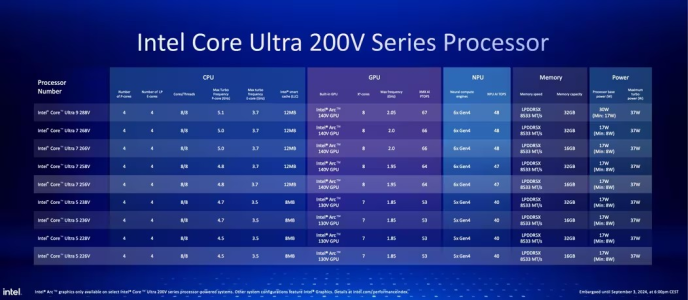
Intel Raptor Lake UIntel Wildcat Lake 15WIntel Lunar LakeIntel Panther Lake 4+0+4
Launch DateQ1-2024Q2-2026Q3-2024Q1-2026
ModelIntel 150UIntel Core 7 360Core Ultra 7 268VCore Ultra 7 365
Dies2223
NodeIntel 7 + ?Intel 18-A + TSMC N6TSMC N3B + N6Intel 18-A + Intel 3 + TSMC N6
CPU2 P-core + 8 E-cores2 P-core + 4 LP E-cores4 P-core + 4 LP E-cores4 P-core + 4 LP E-cores
Threads12688
Max Clock5.4 GHz4.8 GHz5 GHz4.8 GHz
L3 Cache12 MB6 MB12 MB12 MB
TDP15 - 55 W15 - 35 W17 - 37 W25 - 55 W
Memory128-bit LPDDR5-520064-bit LPDDR5x-7467128-bit LPDDR5x-8533128-bit LPDDR5x-7467
Size96 GB48 GB32 GB128 GB
Bandwidth83 GB/s60 GB/s136 GB/s120 GB/s
GPUIntel GraphicsIntel GraphicsArc 140VIntel Graphics
RTNoNoYESYES
EU / Xe96 EU2 Xe8 Xe4 Xe
Max Clock1.3 GHz2.6 GHz2 GHz2.5 GHz
NPUGNA 3.017 TOPS48 TOPS49 TOPS


PPT1.jpg
PPT2.jpg
PPT3.jpg


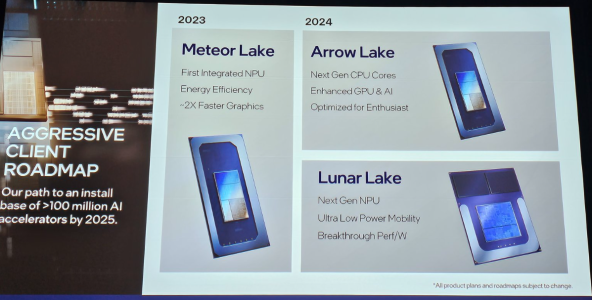
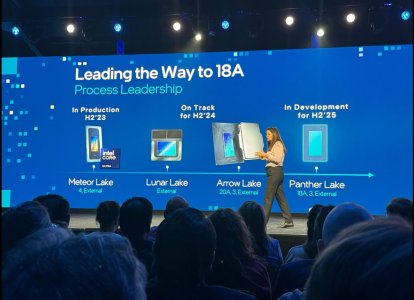
As Hot Chips 34 starting this week, Intel will unveil technical information of upcoming Meteor Lake (MTL) and Arrow Lake (ARL), new generation platform after Raptor Lake. Both MTL and ARL represent new direction which Intel will move to multiple chiplets and combine as one SoC platform.

MTL also represents new compute tile that based on Intel 4 process which is based on EUV lithography, a first from Intel. Intel expects to ship MTL mobile SoC in 2023.

ARL will come after MTL so Intel should be shipping it in 2024, that is what Intel roadmap is telling us. ARL compute tile will be manufactured by Intel 20A process, a first from Intel to use GAA transistors called RibbonFET.


LNL-MX.png
 

Attachments

  • PantherLake.png
    PantherLake.png
    283.5 KB · Views: 24,049
  • LNL.png
    LNL.png
    881.8 KB · Views: 25,534
  • INTEL-CORE-100-ULTRA-METEOR-LAKE-OFFCIAL-SLIDE-2.jpg
    INTEL-CORE-100-ULTRA-METEOR-LAKE-OFFCIAL-SLIDE-2.jpg
    181.4 KB · Views: 72,443
  • Clockspeed.png
    Clockspeed.png
    611.8 KB · Views: 72,329
Last edited:
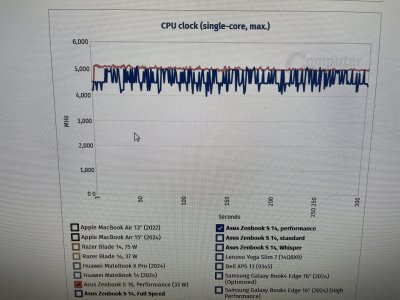
@poke01 That graph tells us LNC is able to occasionally hit 5.1Ghz within 15W, but does not prove the core can sustain 5.1Ghz @ 15W.
It's a mobile part, it's very difficult to get a core to sustain it's fmax without dips.

The overall point should be that ComputerBase data shows that in CB R24 1T it achieves a higher score while also drawing less power than Strix.
 
Why is there a big hang up on the frequency? The score is 12% higher while using less power 15-20% less power.
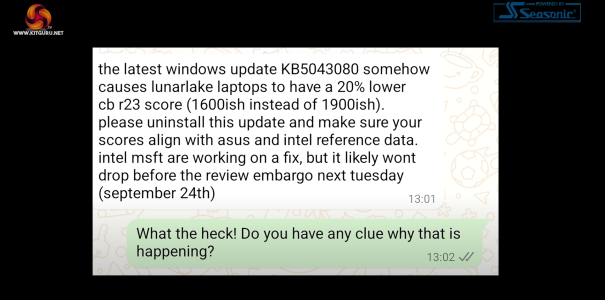
Theres no big hangup, its just not accurate to say its drawing 15W @ 5.1GHz. The score is indeed 12% higher, in R24. But its also 7% lower in R23 and 23% lower in R20.
 
Theres no big hangup, its just not accurate to say its drawing 15W @ 5.1GHz. The score is indeed 12% higher, in R24. But its also 7% lower in R23 and 23% lower in R20.
Is there data available for frequency and power draw in the R23 and R20 benchmarks? That seems like pretty wild swings in performance.
 
Is there data available for frequency and power draw in the R23 and R20 benchmarks? That seems like pretty wild swings in performance.
Actually, where are you seeing +12% in R24 for 258V? Im not seeing that. Im seeing +8% for 258V against the most thermally limited HX 370 (Zenbook S16), +11% for 288V.
 
ComputerBase, they tested the 288V. They got a score of 127 for LNL and got a score of 112 for Strix.
111-112 is only when Strix is thermally limited as seen on the Zenbook S16 When not, its more like 116. So if you are going to take the highest LNL score available, you need to compare to the highest Strix score available. Heres a 116 run below.

 
Arrow Lake would be a better disappointment than degrading Raptor Lakes 🙂

At least users won't have to worry anymore. TSMC doesn't have a history of bad process issues. Yet.

As long as it trades blows or slightly ahead of welll tuned Raptor Lake across all gaming.

If it is a regression in gaming that would be very bad.

But on par with RPL and 7800X3D in gaming (if/when games become more Core heavy it will age better than 8 core 7800X3D) and using much less power, its fine.

All indications seem to be it will be slightly ahead of RPL in gaming and on par with 7800X3D/9800X3D but not beat them which means its a good get as more cores that are high performing on one node more future proof for future GPU upgrades,

What do you think?
 
111-112 is only when Strix is thermally limited as seen on the Zenbook S16 When not, its more like 116. So if you are going to take the highest LNL score available, you need to compare to the highest Strix score available. Heres a 116 run below.

It's not cherry picking, I chose ComputerBase since that’s the only review outlet with this quality of data on frequency and power usage. It's also what everybody was talking about in this thread. If we said that 116 is the median Strix score, that doesn't change the overall point.
 
It's not cherry picking, I chose ComputerBase since that’s the only review outlet with this quality of data on frequency and power usage. It's also what everybody was talking about in this thread. If we said that 116 is the median Strix score, that doesn't change the overall point.
Yea, 112 or 116 doesn’t matter at all, if 288v can run 5.1ghz all time the r24 st will be 135 already. It’s not even the same level.
 
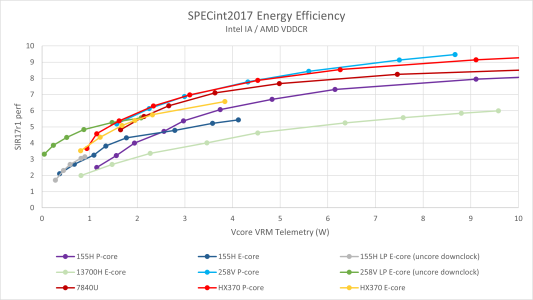
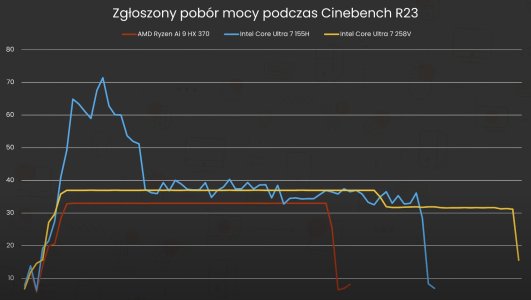
An exemple of race to idling and a good exemple of actual efficency in MT.

In the graph below the CPU that get the job done the faster is the more efficient assuming that it s at same power, here it is the 370 by far, but the 155H is not less efficent than the 258V, because the excess power it use at the start of the run is about equal to the power used in excess by the 258V because of its longer rendering time.

It will be that way for whatever could heavily load the chip, not only it will consume as much but it will also do less work/joule, against a 30-35W limited H155 it would be less efficient overall in this test, as 75% more cores, with SMT for 6C, cant be compensated by a better process even with substancialy higher IPC for both e and P cores.
 

Attachments

  • GYSAF_PW8AED3hY.jpg
    GYSAF_PW8AED3hY.jpg
    100.1 KB · Views: 32
I agree but the lead will be totally workload dependent now instead of outright domination
customer have to be very picky now when choosing between Intel and AMD cause they will need to understand geometry of their workloads even more cause GNR has Memory Bandwidth advantage AMD doesn't have Multiplexer DIMM AMD will have superior Per core performance
We will se on 10 October but i can comfortably say AMD will not get easy wins anymore goes to show how important Fabrication Process is lol
Agree; however, in the case of the laptop and desktop market, Intel's new architecture will need to do more than pull even with AMD as Intel has a higher cost to produce each chip than does AMD.

Of course, in the all important server market, things are looking better for Intel, but still looks dicey to me:

Processor core:
Intel: Redwood Cove 128
AMD: Zen 5c 192

Process Node:
Intel: Intel 3
AMD: TSMC N3P

I agree, it no longer looks like a complete "blow out" by AMD; however ......

AMD has more cores.
AMD has a higher IPC core (Not sure on this one I admit, but I did see a detailed article of RC vs Zen 4 ... and it wasn't painting a pretty picture)
AMD is on a better process node (higher density, lower power, etc)

Now, I'm not entirely sure what all of this will mean when the real world testing starts, but it looks to me like AMD Turin might reasonably exceed the performance of Granite Rapids by a good deal considering the efficiency difference between the two overall (both CPU arch and process arch).
 
Agree; however, in the case of the laptop and desktop market, Intel's new architecture will need to do more than pull even with AMD as Intel has a higher cost to produce each chip than does AMD.

Of course, in the all important server market, things are looking better for Intel, but still looks dicey to me:

Processor core:
Intel: Redwood Cove 128
AMD: Zen 5c 192

Process Node:
Intel: Intel 3
AMD: TSMC N3P
It's N4P N3P won't be out until next year N3E for 5C iirc
I agree, it no longer looks like a complete "blow out" by AMD; however ......

AMD has more cores.
AMD has a higher IPC core (Not sure on this one I admit, but I did see a detailed article of RC vs Zen 4 ... and it wasn't painting a pretty picture)
AMD is on a better process node (higher density, lower power, etc)
You are wrong on the process this time Intel 3 is not a joke of process it's the RWC that sucks like Intel P core design Sierra Forest is pretty efficient and good for it's Market
AMD MOAR cores Turin dense 192C/384Tvs 288C/T core SRF
For P core the core counts are matched i am expecting 40% uplift compared to Genoa for AMD

Now, I'm not entirely sure what all of this will mean when the real world testing starts, but it looks to me like AMD Turin might reasonably exceed the performance of Granite Rapids by a good deal considering the efficiency difference between the two overall (both CPU arch and process arch).
This will not be the case everywhere this time we have to wait 15 days for it 🤣
 
Lunarlake looks pretty good.

I'm reading the loss in ST performance under battery is immature software issues.
SKT's efficiency at very low power is impressive. Big improvement over Crestmont in MTL.

View attachment 108188
Interestingly it's only showing 16% gain over Crestmont, but the efficiency gain is quite substantial.

I have a feeling it'll get 30% as it seems the subtests it's weak in is where Crestmont LP is weak in.
AMD has more cores.
AMD has a higher IPC core (Not sure on this one I admit, but I did see a detailed article of RC vs Zen 4 ... and it wasn't painting a pretty picture)
AMD is on a better process node (higher density, lower power, etc)
It's 128 vs 128, since the regular Turin is 128 cores at 500W, same as Granite Rapids.

Also they aren't using the same RWC core on GNR.
 
Lunarlake: https://www.laptopmag.com/laptops/w...s-with-an-astounding-18-hours-of-battery-life

Versus competing chips:
LaptopBattery life (web surfing hh:mm)UL Procyon Office Productivity Battery LIfe
Dell XPS 13 9345 (Snapdragon X Elite)19:01Not tested
Dell XPS 13 9350 (Intel Core Ultra 7 258V)18:3423:38
Apple MacBook Pro 14 M317:16Not tested

Why I wouldn't get an OLED display:
LaptopBattery life (web surfing hh:mm)UL Procyon Office Productivity Battery LIfe
Dell XPS 13 9350 (Intel Core Ultra 7 258V)18:3423:38
Dell XPS 13 9350 OLED (Intel Core Ultra 7 258V)08:4012:48

Versus other Lunarlake device:
LaptopBattery life (web surfing hh:mm)UL Procyon Office Productivity Battery LIfe
Asus Zenbook S 14 (Intel Core Ultra 7 258V)13:5116:21
Dell XPS 13 9350 OLED (Intel Core Ultra 7 258V)08:4012:48
 
For P core the core counts are matched i am expecting 40% uplift compared to Genoa for AMD

The 128C Xeon has a 11.8% advantage at 39% more power than a 96C Zen 4, that put things in perspective, at same 500W power the 96C Epyc would outmatch the 128C Xeon.

With 33% more cores the Zen 5 based Epyc will have 1.33 x 1.16 = 54% higher throughput than the 96C Genoa if TDP is increased to 500W up from the curent 360W,
and enough to outmatch the Xeon by 35% at same power or eventualy have the same perfs but then at 0.5x the power.

And there s the dense version that wil add 18% perf/wat on top of the numbers above, that is to ay that Intel wil stil be late by a full, if not two, gens.


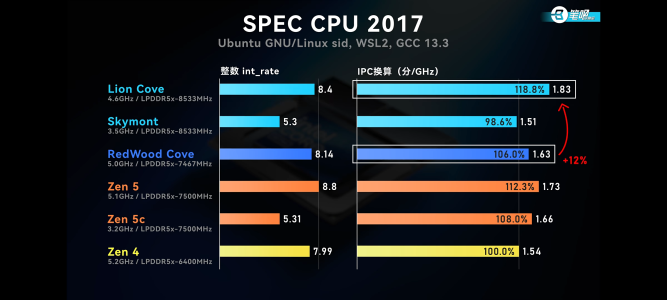
He better use a more recent version of GCC because his numbers for Zen 4 and 5 do not make sense at all, per clock his Zen 5 score is lower than the one of a Zen 4 and his Zen 4 is just slightly better than a Zen 2, but the score of the 155H for sure is not underestimated...

spec2017_estimated_scores.png


Back
Top