Discussion Intel Meteor, Arrow, Lunar & Panther Lakes + WCL Discussion Threads

Page 822 - Seeking answers? Join the AnandTech community: where nearly half-a-million members share solutions and discuss the latest tech.

Tigerick

Senior member
Apr 1, 2022
942
857
106
Wildcat Lake (WCL) Specs

Intel Wildcat Lake (WCL) is upcoming mobile SoC replacing Raptor Lake-U. WCL consists of 2 tiles: compute tile and PCD tile. It is true single die consists of CPU, GPU and NPU that is fabbed by 18-A process. Last time I checked, PCD tile is fabbed by TSMC N6 process. They are connected through UCIe, not D2D; a first from Intel. Expecting launching in Q1 2026.
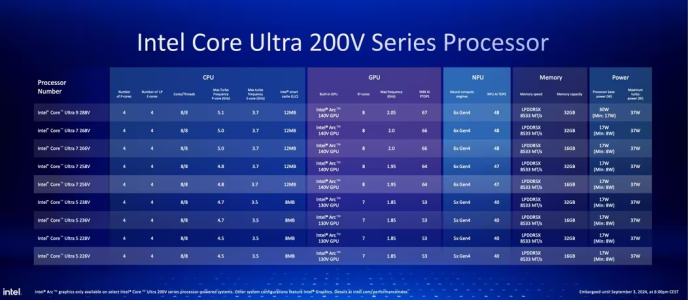
Intel Raptor Lake UIntel Wildcat Lake 15W?Intel Lunar LakeIntel Panther Lake 4+0+4
Launch DateQ1-2024Q2-2026Q3-2024Q1-2026
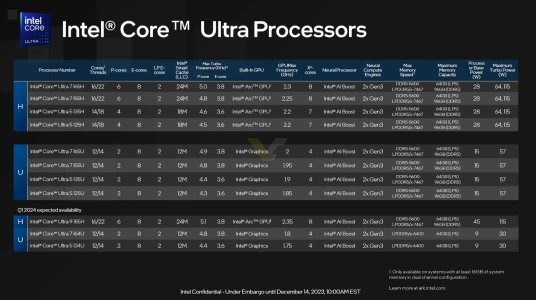
ModelIntel 150UIntel Core 7Core Ultra 7 268VCore Ultra 7 365
Dies2223
NodeIntel 7 + ?Intel 18-A + TSMC N6TSMC N3B + N6Intel 18-A + Intel 3 + TSMC N6
CPU2 P-core + 8 E-cores2 P-core + 4 LP E-cores4 P-core + 4 LP E-cores4 P-core + 4 LP E-cores
Threads12688
Max Clock5.4 GHz?5 GHz4.8 GHz
L3 Cache12 MB12 MB12 MB
TDP15 - 55 W15 W ?17 - 37 W25 - 55 W
Memory128-bit LPDDR5-520064-bit LPDDR5128-bit LPDDR5x-8533128-bit LPDDR5x-7467
Size96 GB32 GB128 GB
Bandwidth136 GB/s
GPUIntel GraphicsIntel GraphicsArc 140VIntel Graphics
RTNoNoYESYES
EU / Xe96 EU2 Xe8 Xe4 Xe
Max Clock1.3 GHz?2 GHz2.5 GHz
NPUGNA 3.018 TOPS48 TOPS49 TOPS


PPT1.jpg
PPT2.jpg
PPT3.jpg


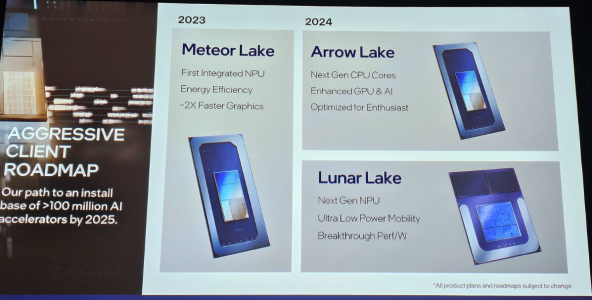
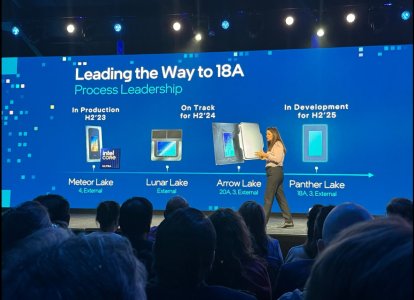
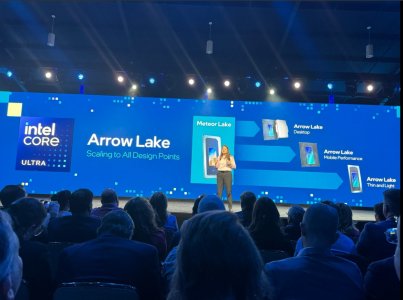
As Hot Chips 34 starting this week, Intel will unveil technical information of upcoming Meteor Lake (MTL) and Arrow Lake (ARL), new generation platform after Raptor Lake. Both MTL and ARL represent new direction which Intel will move to multiple chiplets and combine as one SoC platform.

MTL also represents new compute tile that based on Intel 4 process which is based on EUV lithography, a first from Intel. Intel expects to ship MTL mobile SoC in 2023.

ARL will come after MTL so Intel should be shipping it in 2024, that is what Intel roadmap is telling us. ARL compute tile will be manufactured by Intel 20A process, a first from Intel to use GAA transistors called RibbonFET.


LNL-MX.png
 

Attachments

  • PantherLake.png
    PantherLake.png
    283.5 KB · Views: 24,044
  • LNL.png
    LNL.png
    881.8 KB · Views: 25,531
  • INTEL-CORE-100-ULTRA-METEOR-LAKE-OFFCIAL-SLIDE-2.jpg
    INTEL-CORE-100-ULTRA-METEOR-LAKE-OFFCIAL-SLIDE-2.jpg
    181.4 KB · Views: 72,439
  • Clockspeed.png
    Clockspeed.png
    611.8 KB · Views: 72,326
Last edited:

DavidC1

Platinum Member
Dec 29, 2023
2,182
3,328
106
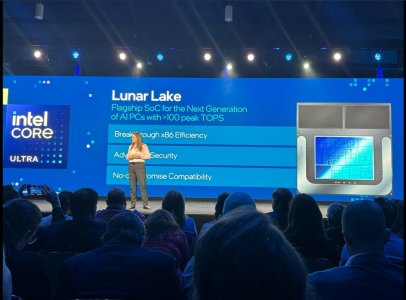
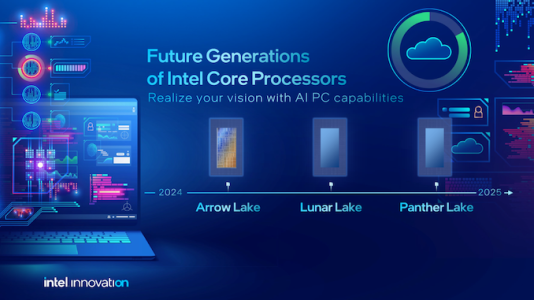
PMIC/MoP with optimized PHY For Power are the only difference between Lunar and Panther Panther is a derivative of Lunar.
What you said are feature checkboxes. It tells us NOTHING about how it will actually do.

If it was a direct successor to Lunarlake, they would have shouted it. Modern Intel rubs it in your face if they actually have a good product. They were being very coy about Pantherlake and Lunarlake successor, so does their roadmaps.

And even if they were the only difference, the reduced PHY is a BIG deal. It allows 1W savings in certain cases, which is 30% difference on a 50WHr battery and 1080p screen. I'm pretty sure people will notice the difference between 12 hours and 15 hours battery.
Now do I think PTL is as efficient as LNL in every way? No. But do I think the ways it will be more efficient (I believe 18A will be a measurably better node than N3B, arch refinements, media engine refinements, ...) will make it overall as efficient or more? I do actually believe that. But we won't know for sure until it launches of course.
Process does almost nothing for battery life on modern processors. Otherwise you'd see significant battery life advancement with a new process. Only design matters.

And on a laptop you need the whole ecosystem to be focused on it.
 

poke01

Diamond Member
Mar 8, 2022
4,865
6,194
106
And even if they were the only difference, the reduced PHY is a BIG deal. It allows 1W savings in certain cases, which is 30% difference on a 50WHr battery and 1080p screen. I'm pretty sure people will notice the difference between 12 hours and 15 hours battery.
not using PMIC for PTL will also decrease battery life
 

511

Diamond Member
Jul 12, 2024
5,448
4,874
106
What you said are feature checkboxes. It tells us NOTHING about how it will actually do.
It's just he only difference I am aware of between LNL/PTL and these affect battery life
If it was a direct successor to Lunarlake, they would have shouted it. Modern Intel rubs it in your face if they actually have a good product. They were being very coy about Pantherlake and Lunarlake successor, so does their roadmaps.

And even if they were the only difference, the reduced PHY is a BIG deal. It allows 1W savings in certain cases, which is 30% difference on a 50WHr battery and 1080p screen. I'm pretty sure people will notice the difference between 12 hours and 15 hours battery.

Process does almost nothing for battery life on modern processors. Otherwise you'd see significant battery life advancement with a new process. Only design matters.

And on a laptop you need the whole ecosystem to be focused on it.
Yeah
 
  • Like
Reactions: Io Magnesso

Doug S

Diamond Member
Feb 8, 2020
3,835
6,775
136
There is a reason why Intel made fun of Qualcomm last time. They are a threat to Intel, not Apple.

Exactly. Apple has done its damage to Intel, and can't hurt them any further. Apple might even help Intel in the future, if they ends up throwing some fab business Intel's way.

Qualcomm hasn't hurt Intel yet but could if Windows/ARM gains enough traction that developers start paying attention. Though I have to wonder if a successful Qualcomm PC wouldn't end up hurting AMD more than Intel, because of their relative positions in the corporate market (which is conservative by nature and is a lot more pro-Intel than people on this forum, and the least likely to adopt ARM PCs)
 

511

Diamond Member
Jul 12, 2024
5,448
4,874
106
  • Like
Reactions: Tlh97

Magio

Senior member
May 13, 2024
207
246
76
Process does almost nothing for battery life on modern processors. Otherwise you'd see significant battery life advancement with a new process. Only design matters.

And on a laptop you need the whole ecosystem to be focused on it.

First off, it depends on what sort of battery life you're talking about. Battery life at idle, for sure, has little to nothing to do with process. Battery life at light loads will also only be marginally affected. But once you get to medium and heavy loads, process nodes advancements help make it possible to attain certain levels of performance at lower power, thereby de facto allowing a computer to accomplish the same tasks without expending the same power. If we're talking about efficiency in general, all of these scenarios matter.

Now, again, I do agree PTL won't match LNL in its laser focus on efficiency in every aspect. But it can make up some of what it loses with general technological advancements, and it can absolutely be more efficient in certain scenarios.
 
  • Like
Reactions: Io Magnesso

coercitiv

Diamond Member
Jan 24, 2014
7,485
17,884
136
process nodes advancements help make it possible to attain certain levels of performance at lower power, thereby de facto allowing a computer to accomplish the same tasks without expending the same power.
That's a very long way to say it helps custom configs last longer. For the average user a process bump mostly translates into more performance available for the same battery life.
 

Io Magnesso

Senior member
Jun 12, 2025
578
165
71
The x86 platform supports a lot of hardware, has compatibility etc goes out the window with Windows on ARM. As it is now, Qualcomm will release a much better CPU later this year and all those points become invalid.
It's a little naive to think...
I don't understand how difficult it is to overturn the ecosystem…
 

511

Diamond Member
Jul 12, 2024
5,448
4,874
106
The x86 platform supports a lot of hardware, has compatibility etc goes out the window with Windows on ARM. As it is now, Qualcomm will release a much better CPU later this year and all those points become invalid.
also on the new SoC you should buy a Strix Halo instead of that iirc it is a 18C cpu with a beefier GPU with 192 bit Memory Bus but it will fall short of strix halo.
 
  • Like
Reactions: Io Magnesso

511

Diamond Member
Jul 12, 2024
5,448
4,874
106
Well, you may have the option of using or not using PMIC.
I think you can probably choose according to your purpose.
well you can't it has to be during design phase and all of QCOM/Apples chips are designed with PMIC while AMD/intel uses traditional PD except for select few
 
  • Like
Reactions: Io Magnesso

Io Magnesso

Senior member
Jun 12, 2025
578
165
71
well you can't it has to be during design phase and all of QCOM/Apples chips are designed with PMIC while AMD/intel uses traditional PD except for select few
Well, I think the PTL itself is designed with the assumption that PMIC will be used.
Not to say that the use of PMIC is absolutely necessary. I think that the use of PMIC is also taken into account.
 

DavidC1

Platinum Member
Dec 29, 2023
2,182
3,328
106
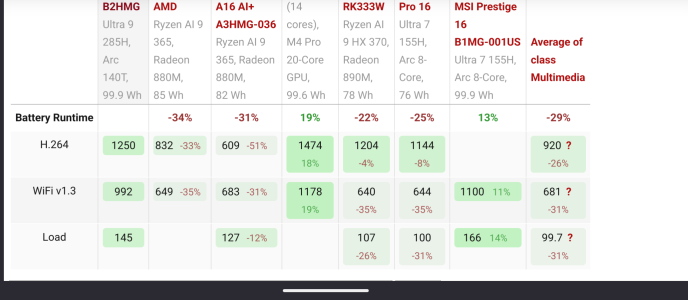
But ARL-H is very good already without PMIC.

https://www.notebookcheck.net/MSI-P...ake-CPU-and-impressive-runtimes.958869.0.html
PTL should still have better battery life than ARL-H just not LNL and I think for most thats fine.
Except...
At 99.9 Wh, MSI has installed the largest possible battery in its Prestige 16.
20.5 hours with 55WHr versus 16 hours on 99WHr. Of course it's not an ISO-comparison, but the differences are humongous.
First off, it depends on what sort of battery life you're talking about. Battery life at idle, for sure, has little to nothing to do with process. Battery life at light loads will also only be marginally affected. But once you get to medium and heavy loads, process nodes advancements help make it possible to attain certain levels of performance at lower power, thereby de facto allowing a computer to accomplish the same tasks without expending the same power. If we're talking about efficiency in general, all of these scenarios matter.
If you want better battery life on load, you just set TDP lower. That's it. That's what handheld gamers do. And ~20% difference with new process isn't much, considering at load you are getting 1-1.5 hours, 2 hours if you are lucky.
 
Last edited:

Io Magnesso

Senior member
Jun 12, 2025
578
165
71
Except...
At 99.9 Wh, MSI has installed the largest possible battery in its Prestige 16.
20.5 hours with 55WHr versus 16 hours on 99WHr. Of course it's not an ISO-comparison, but the differences are humongous.

If you want better battery life on load, you just set TDP lower. That's it. That's what handheld gamers do. And ~20% difference with new process isn't much, considering at load you are getting 1-1.5 hours, 2 hours if you are lucky.
No matter how much the process change is not a big deal, The more it grows, the more, I think it's a good thing
 

mikk

Diamond Member
May 15, 2012
4,333
2,413
136
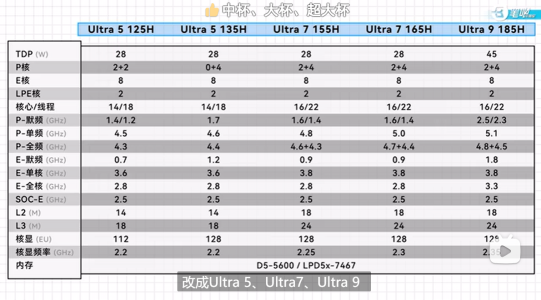
That is probably the Ultra 7 SKU


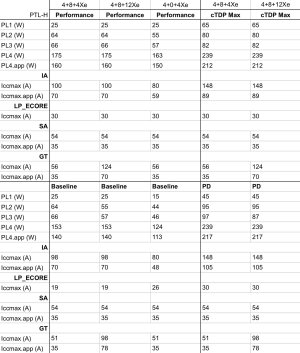
I don't think so. Ultra 9 and 7 most likely 12 Xe cores and Ultra 5 10 Xe cores. Not sure about all Ultra 5 though. On ARL-H only the lowest Ultra 5 came with a partially disabled iGPU.

PTL-H 45W only has 4 Xe cores also.
 
  • Like
Reactions: poke01

511

Diamond Member
Jul 12, 2024
5,448
4,874
106
I don't think so. Ultra 9 and 7 most likely 12 Xe cores and Ultra 5 10 Xe cores. Not sure about all Ultra 5 though. On ARL-H only the lowest Ultra 5 came with a partially disabled iGPU.

PTL-H 45W only has 4 Xe cores also.
PTl-H is 25W for the base and performance profile

Gjvx8vLWUAEV-N_(2).jpg
 

Io Magnesso

Senior member
Jun 12, 2025
578
165
71
I don't think so. Ultra 9 and 7 most likely 12 Xe cores and Ultra 5 10 Xe cores. Not sure about all Ultra 5 though. On ARL-H only the lowest Ultra 5 came with a partially disabled iGPU.

PTL-H 45W only has 4 Xe cores also.
Perhaps the PTL-H Xe 4 core version is for combining with the dgpu.