Discussion Intel Meteor, Arrow, Lunar & Panther Lakes + WCL Discussion Threads

Page 401 - Seeking answers? Join the AnandTech community: where nearly half-a-million members share solutions and discuss the latest tech.

Tigerick

Senior member
Apr 1, 2022
911
829
106
Wildcat Lake (WCL) Preliminary Specs

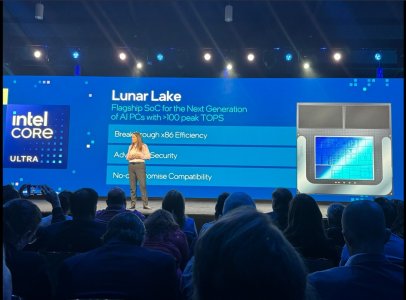
Intel Wildcat Lake (WCL) is upcoming mobile SoC replacing ADL-N. WCL consists of 2 tiles: compute tile and PCD tile. It is true single die consists of CPU, GPU and NPU that is fabbed by 18-A process. Last time I checked, PCD tile is fabbed by TSMC N6 process. They are connected through UCIe, not D2D; a first from Intel. Expecting launching in Q2/Computex 2026. In case people don't remember AlderLake-N, I have created a table below to compare the detail specs of ADL-N and WCL. Just for fun, I am throwing LNL and upcoming Mediatek D9500 SoC.

Intel Alder Lake - NIntel Wildcat LakeIntel Lunar LakeMediatek D9500
Launch DateQ1-2023Q2-2026 ?Q3-2024Q3-2025
ModelIntel N300?Core Ultra 7 268VDimensity 9500 5G
Dies2221
NodeIntel 7 + ?Intel 18-A + TSMC N6TSMC N3B + N6TSMC N3P
CPU8 E-cores2 P-core + 4 LP E-cores4 P-core + 4 LP E-coresC1 1+3+4
Threads8688
Max Clock3.8 GHz?5 GHz
L3 Cache6 MB?12 MB
TDP7 WFanless ?17 WFanless
Memory64-bit LPDDR5-480064-bit LPDDR5-6800 ?128-bit LPDDR5X-853364-bit LPDDR5X-10667
Size16 GB?32 GB24 GB ?
Bandwidth~ 55 GB/s136 GB/s85.6 GB/s
GPUUHD GraphicsArc 140VG1 Ultra
EU / Xe32 EU2 Xe8 Xe12
Max Clock1.25 GHz2 GHz
NPUNA18 TOPS48 TOPS100 TOPS ?


PPT1.jpg
PPT2.jpg
PPT3.jpg


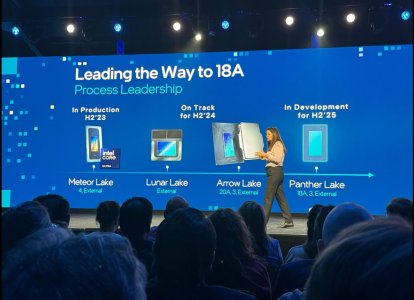
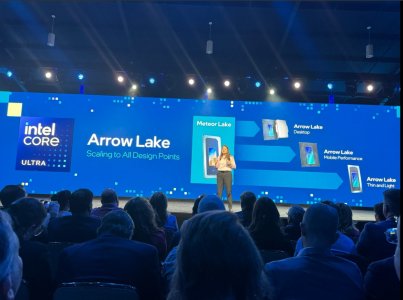
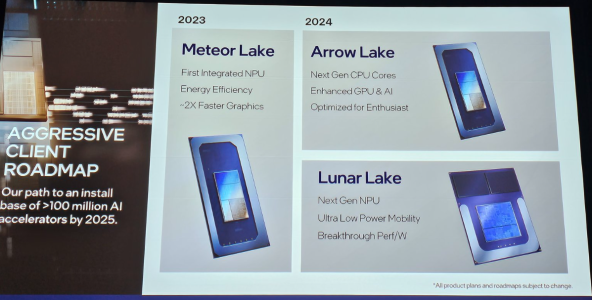
As Hot Chips 34 starting this week, Intel will unveil technical information of upcoming Meteor Lake (MTL) and Arrow Lake (ARL), new generation platform after Raptor Lake. Both MTL and ARL represent new direction which Intel will move to multiple chiplets and combine as one SoC platform.

MTL also represents new compute tile that based on Intel 4 process which is based on EUV lithography, a first from Intel. Intel expects to ship MTL mobile SoC in 2023.

ARL will come after MTL so Intel should be shipping it in 2024, that is what Intel roadmap is telling us. ARL compute tile will be manufactured by Intel 20A process, a first from Intel to use GAA transistors called RibbonFET.
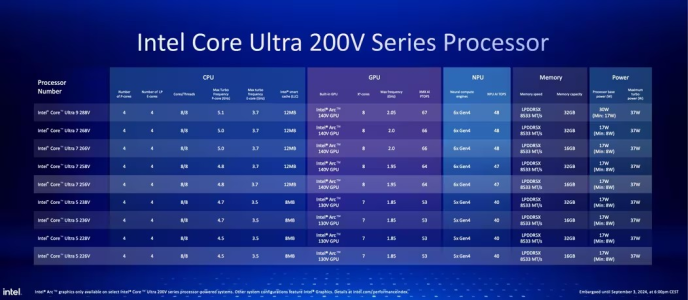


LNL-MX.png
 

Attachments

  • PantherLake.png
    PantherLake.png
    283.5 KB · Views: 24,034
  • LNL.png
    LNL.png
    881.8 KB · Views: 25,527
  • INTEL-CORE-100-ULTRA-METEOR-LAKE-OFFCIAL-SLIDE-2.jpg
    INTEL-CORE-100-ULTRA-METEOR-LAKE-OFFCIAL-SLIDE-2.jpg
    181.4 KB · Views: 72,435
  • Clockspeed.png
    Clockspeed.png
    611.8 KB · Views: 72,321
Last edited:

Det0x

Golden Member
Sep 11, 2014
1,476
5,046
136
W1zzard from TPU said Arrowlake will be faster than both zen 5 and Zen 4x3d:

Where does he say that ?
I can only find this:
AMD Ryzen 9000 series CPU core counts range between 6-core and 16-core, something that hasn't changed for AMD since the Ryzen 3000 Zen 2. AMD needs to work on this, because Intel Arrow Lake is about to hit AMD with not just those high-IPC Lion Cove cores, but also the Skymont E-cores where Intel has managed to pull off a miracle, with a 50% IPC increase over the previous E-core. Whatever core-count Intel may come up with for Arrow Lake may prove competitive against Granite Ridge. Sooner or later, AMD needs to reconsider core counts.
 
  • Like
Reactions: lightmanek

Goop_reformed

Senior member
Sep 23, 2023
316
341
96
Where does he say that ?
I can only find this:
"We're really happy with what we're seeing with the Ryzen AI 300 series mobile processors. The Ryzen 9000 desktop processors are exciting, too, but we really wish it came with an NPU and beat the 7800X3D, because Arrow Lake-S will probably do both, at unknown power levels though."

This has been edited. The original was without "at unknown power levels though".
 

ryanjagtap

Member
Sep 25, 2021
146
214
126
ARL-S tops up at 8P+16E/24T, right? Does that mean the Ryzen 9 9950X with 16C/32T will dominate the nT benchmarks, or will the uplift from Lion Cove and Skymont make up for the loss of thread counts (HT threads)?
 

vanplayer

Member
May 9, 2024
75
118
66
ARL-S tops up at 8P+16E/24T, right? Does that mean the Ryzen 9 9950X with 16C/32T will dominate the nT benchmarks, or will the uplift from Lion Cove and Skymont make up for the loss of thread counts (HT threads)?
For Skymont maybe, but for LionCove I'm afraid is just beyond its limit. ES2 ARL LionCove is a thing like Geekbench6 ST 3100ish thing, internal data. You might be able to see 3300ish when it comes out if lucky. Without HT ARL might lose 30% performance from Pcore side and LionCove cannot boost that higher to mitigate the HT loss and IPC is not optimistic at the meanwhile. All the bet just put on E core currently.
 

mikk

Diamond Member
May 15, 2012
4,311
2,395
136
Interesting, where is this info from?


What exactly? Integrated IMC and LPE? Can't remember all sources but here you go


Some common sense also helps. Because LPE cluster moves into the compute tile they can go down from 6 to 4 P-cores at the same time, because 4 LPE like on LNL can be used properly for real workloads and overall will be 15-20% faster than ARL-H with a 6+8 configuration. PTL is made from the LNL team, it's using the second tile generation unlike ARL which uses the MTL layout with all its flaws. ARL-H is a failure in many ways, they need PTL badly. LNL and PTL is the real deal for Intel.
 
  • Like
Reactions: Gideon

Henry swagger

Senior member
Feb 9, 2022
513
313
106
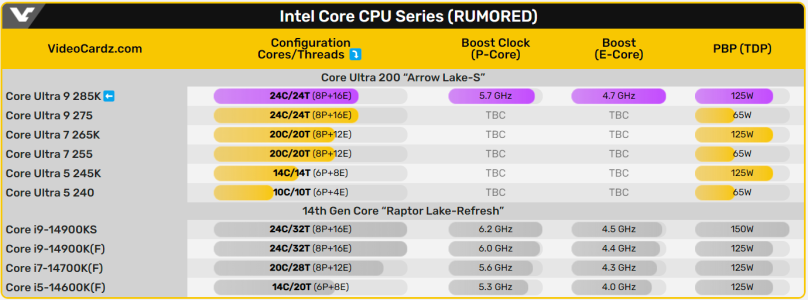
Lion cove 5.7ghz boost . Skymont 4.7ghz boost and 4.6 all core 😁🤔.. 285k will have the multi core crown with ease
 

mikk

Diamond Member
May 15, 2012
4,311
2,395
136
2 passive dies for PTL. Looks like Intel is converging on a typical configuration for their tiled architectures now, where one die is for CPU compute, another die is for the GPU, and the last die is basically IO and everything else. Oh, and a base tile.

PCD only 3mm² bigger than on LNL. There is no room for the NPU or LPE CLuster in this (if someone doubted it) , they need a little more size for more PCIe lanes or upgraded wireless/wired connectivity or security engines. Same tile layout as on LNL, only that the GPU goes into a separate tile this time.
 
  • Like
Reactions: Ghostsonplanets

Ghostsonplanets

Senior member
Mar 1, 2024
774
1,228
96
To confirm my understanding:
Given the similarity of the platform controller to Lunar Lake's, the compute tile has the LP E cores (software can directly use them?) and memory controller, not like in Meteor Lake. But, Arrow Lake still has the old style.
Correct. Arrow Lake inherits the MTL tile layout. But without the Crestmont LPE cores on Desktop while they are retained on Mobile H.
 

Det0x

Golden Member
Sep 11, 2014
1,476
5,046
136
1721140956554.png
So we're back to:
Thats a 9% or 13% clockspeed deficit depending on if you compare against 14900K or the KS, that you need to overcome with purely IPC
  • ..then it need a IPC increase of ~26% to reach the 14900K +20%
  • ...then it need a IPC increase of ~30% to reach the 14900KS +20%
14900K +20% ST performance which some speculated earlier not gonna happen
 
Last edited:

Josh128

Golden Member
Oct 14, 2022
1,505
2,255
106
Lion cove 5.7ghz boost .
Just like I called it a few days ago. This seems to be TSMCs current frequency limit for high perf designs. N3B does seem to have seen much if any frequency gains compared to N4P/N4X.
 

dullard

Elite Member
May 21, 2001
26,145
4,805
126
So we're back to:

14900K +20% ST performance which some speculated earlier not gonna happen
We very well might not get 20% ST performance gain over the 14900K (unless that July 2 leak was not faked). At this point, I think you are correct with that statement.

But, it seems like each time you post you move the goalposts a little further. The original post you quoted was not 20% and was not comparing to the 14900K or 14900KS. (1) It was a range of 15 % up to 20%, (2) it was against Raptor Lake not Raptor Lake Refresh chips, and (3) it mentioned Raptor Lake in general and in no way was that quote solely based on the top two Raptor Lake chips. Here is what you originally quoted:
I am expecting a good 15-20% total single core uplift (ipc + clocks) over Raptor Lake.

15% to 20% ST over a randomly chosen Raptor Lake chip seems quite doable.
 
Last edited:

Abwx

Lifer
Apr 2, 2011
11,912
4,890
136
5.7Ghz x 1.15x (IPC) / 6.2Ghz ~= 1.057 or roughly 6% higher ST performance.

The guy on Xwitter was apparently right, that s 3% better ST perf at 5.7 than the 14900K.

Maths is 1.14 x 57/60 x 0.955 = 3%.

The 1.14 is the announced improvement, 57/60 the frequency ratio and 0.955 MTL s loss of IPC relatively to RPL, because the 14% improvement is in respect of MTL, not RPL.
 
Last edited:

Elfear

Diamond Member
May 30, 2004
7,167
824
126
We very well might not get 20% ST performance gain over the 14900K (unless that July 2 leak was not faked). At this point, I think you are correct with that statement.

But, it seems like each time you post you move the goalposts a little further. The original post you quoted was not 20% and was not comparing to the 14900K or 14900KS. (1) It was a range of 15 % up to 20%, (2) it was against Raptor Lake not Raptor Lake Refresh chips, and (3) it mentioned Raptor Lake in general and in no way was that quote solely based on the top two Raptor Lake chips. Here is what you originally quoted:


15% to 20% ST over a randomly chosen Raptor Lake chip seems quite doable.
Technically you're right but don't you think the vast majority of desktop users will compare Arrow Lake with the current best available Intel desktop chips (rather than chips launched almost 21 months ago)?
 

dullard

Elite Member
May 21, 2001
26,145
4,805
126
Technically you're right but don't you think the vast majority of desktop users will compare Arrow Lake with the current best available Intel desktop chips (rather than chips launched almost 21 months ago)?
I think most would compare i9 to i9, i7 to i7, i5 to i5. I haven't yet seen i7 and i5 rumored speeds. So, not much to go on there at this point in time to know if 15% to 20% is wildly over optimistic or achievable.

You are right that comparing to Raptor Lake Refresh would be a better comparison. But, the 20% number that has been subject to a series of rants wasn't involving the Refresh line.
 
  • Like
Reactions: Elfear

Henry swagger

Senior member
Feb 9, 2022
513
313
106
Just like I called it a few days ago. This seems to be TSMCs current frequency limit for high perf designs. N3B does seem to have seen much if any frequency gains compared to N4P/N4X.
N3B has more mask layers and has less performance than n3E.. intel will use n3E for arrow refresh i think 🤔
 

coercitiv

Diamond Member
Jan 24, 2014
7,443
17,731
136
Technically you're right but don't you think the vast majority of desktop users will compare Arrow Lake with the current best available Intel desktop chips (rather than chips launched almost 21 months ago)?
The original reply by @eek2121 was about ST performance uplift over Raptor Lake, but in the context of whether AMD can have a shot at leading in single core performance. It was clearly aimed at the flagship parts, so I think a comparison with 13900K(S)/14900K(S) is warranted.

That being said, the exact value is irrelevant at this point, the important part is we should probably adjust expectations from healthy double digit to high single digit at best. The 15-20% guess is more likely to be 10% or lower. Whether the frequency curve favors lower SKUs such as the i5 remains to be seen, there are a lot of factor involved here, some of which may favor such a resolution.
 
Jul 13, 2024
70
75
46
Geekbench 6 average ST score for 13/14900K = 3100 at 5.7 GHz

Lunar Lake ES Geekbench 6 ST score = 2700 at 4.9 GHz

Geekbench 6 ST PPC uplift on Lion Cove vs Raptor Cove based on ES silicon = 1% or within margin of error.

Add 200 pts ST to the ES score for the final product = 2900 ST, and recalculate PPC uplift = 9% higher PPC for Lion Cove in Lunar Lake.

Normalize clock speeds, then at 5.7 GHz, assuming linear sclaing, Lion Cove in ARL-S would be 16 - 25% faster PPC than Raptor Cove in 13900K.

16% - being conservative, if there is little change between ES and final silicon.
25% - being cautiously optimistic.

Incidentally, this seems to be right in line with what MLID speculated.

The naysayers are in for a surprise.
 

mikk

Diamond Member
May 15, 2012
4,311
2,395
136
Geekbench 6 average ST score for 13/14900K = 3100 at 5.7 GHz

Lunar Lake ES Geekbench 6 ST score = 2700 at 4.9 GHz

Geekbench 6 ST PPC uplift on Lion Cove vs Raptor Cove based on ES silicon = 1% or within margin of error.

Add 200 pts ST to the ES score for the final product = 2900 ST, and recalculate PPC uplift = 9% higher PPC for Lion Cove in Lunar Lake.

You shouldn't compare a desktop with a mobile chip, IPC won't be comparable even if it's from the same architecture.
 

dullard

Elite Member
May 21, 2001
26,145
4,805
126
You shouldn't compare a desktop with a mobile chip, IPC won't be comparable even if it's from the same architecture.
Also, are those comparing Geekbench 6.0 to Geekbench 6.3? We just went over this, they aren't comparable. https://www.geekbench.com/blog/2023/06/geekbench-61/
Thanks to these changes, Geekbench 6.1 single-core scores are up to 5% higher, and multi-core scores are up to 10% higher than Geekbench 6.0 scores. As a result of these methodological differences, which have a non-trivial impact on scores, we recommend users not compare Geekbench 6.1 scores against Geekbench 6.0 scores.
 
  • Like
Reactions: controlflow
Jul 13, 2024
70
75
46
You shouldn't compare a desktop with a mobile chip, IPC won't be comparable even if it's from the same architecture.
Okay then compare against the Strix scores which should be near-final silicon.

Lion Cove in LNL = Zen 5 in Strix, with Lion cove better at integer workloads than in fp workloads.
 
  • Like
Reactions: Henry swagger

Abwx

Lifer
Apr 2, 2011
11,912
4,890
136
Also, are those comparing Geekbench 6.0 to Geekbench 6.3? We just went over this, they aren't comparable. https://www.geekbench.com/blog/2023/06/geekbench-61/

That s precisely GB 6.3.0.


The 185H score 2522 pts at 5.087Ghz, while this LNL score 2713-39 at 4.887Ghz, do the maths, that s close to 14%.
Okay then compare against the Strix scores which should be near-final silicon.

Lion Cove in LNL = Zen 5 in Strix, with Lion cove better at integer workloads than in fp workloads.
LNL is better at none, Zen 5 is 7% faster per clock in Geekbench and 5% faster per clock as well in Cinebench wich is FP, if it was weaker in INT then it would be less than 5% difference in GB since this test include both INT and FP.
 
  • Like
Reactions: lightmanek
Jul 13, 2024
70
75
46
LNL is better at none, Zen 5 is 7% faster per clock in Geekbench and 5% faster per clock as well in Cinebench wich is FP, if it was weaker in INT then it would be less than 5% difference in GB since this test iclude both INT and FP.
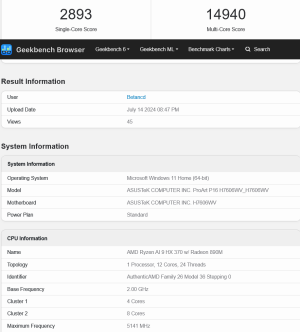
Entry with Highest ST score for Zen 5 Strix =

1721149922152.png

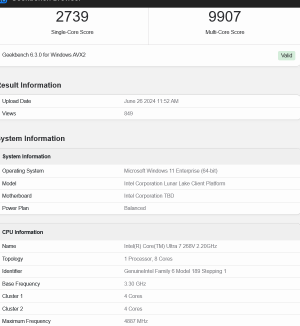
Entry with Highest ST score for LNL ES:

1721149990697.png

Do the math.

Perf/clock is within margin of error even on an ES sample in which the LNC core-only power is consuming perhaps 0.5x-0.6x power of a single Zen 5 core in Strix running ST Geekbench 6.