• We’re currently investigating an issue related to the forum theme and styling that is impacting page layout and visual formatting. The problem has been identified, and we are actively working on a resolution. There is no impact to user data or functionality, this is strictly a front-end display issue. We’ll post an update once the fix has been deployed. Thanks for your patience while we get this sorted.

Question Zen 6 Speculation Thread

Page 289 - Seeking answers? Join the AnandTech community: where nearly half-a-million members share solutions and discuss the latest tech.
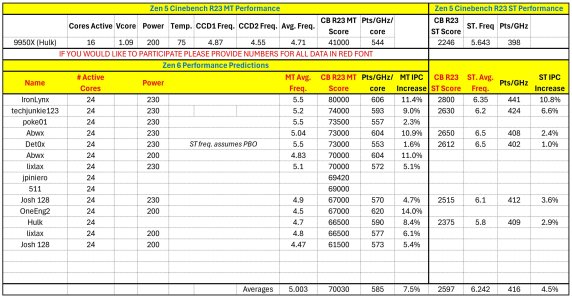
I'm still looking at this from a power per core perspective as it seems obvious that the result will be power limited.

My previous guess of 4.5Ghz and 200W is incorrect if you factor in a 30% power efficiency (it will be more like 192W). So perhaps they will reach 4.6Ghz within the same 200W window. I would keep my score the same as I am already saying a very high IPC boost compared to the rest of you. I was originally thinking the IOD would make a big difference, but after some research, seems like CB23 is basically immune to bandwidth and latency changes.
 
I'm still looking at this from a power per core perspective as it seems obvious that the result will be power limited.
This is why theres no way they wont use the full 230W PPT when its available to them. On a 16 core Zen 4, it got an extra 1000 points or so in R23 nT vs 200W. On a 24 core 2nm SKU, that extra 30W will likely get you 5000-7000 more nT. With Intel likely winning the nT crown regardless, theres no way that they would choose to leave that kind of perf on the table for no reason. It would just be bad optics if nothing else.
 
This is why theres no way they wont use the full 230W PPT when its available to them. On a 16 core Zen 4, it got an extra 1000 points or so in R23 nT vs 200W. On a 24 core 2nm SKU, that extra 30W will likely get you 5000-7000 more nT. With Intel likely winning the nT crown regardless, theres no way that they would choose to leave that kind of perf on the table for no reason. It would just be bad optics if nothing else.

AMD: 230W / 24C = 9.583 W per core
Intel: 230W / 48C = 4.792 W per core

Intel’s P cores are also power hungry, and their e cores don’t clock high.

The results won’t be what you expect.

EDIT: I am expecting AMD to be faster in nT unless Intel sets absurd power limits for their chips.

My justification for this is that the 32 e cores in the Intel chip won’t hit 5 ghz, while the 16 P cores will likely be power limited and may struggle to hit 5.5 GHz.
 
Last edited:
It's a new socket, so why not?

Let's see, that's 320 watts at the CPU, potentially over 500 watts for a high end GPU at full chirp, another 80 watts for the rest of the system. That's 900+ watts for the computer as a whole. With PSU efficiency overhead, that's going to push nearly 10 amps at the wall in the US and need at 1200+ watt PSU for reserve.
 
NVL is like 320w doe.
TDP is 150W according to this:

1753344140958-png.127637

I know max power consumption will be higher than that, but from where did you get the 320W number?
 
Atoms also have goop power doe, they're just not ass on PA of the PPA triangle.


We get closer and closer to caveman speak every day. Out of curiosity, I ran this gem through MS Co-Pilot to see if it could decipher what it means.

It came back with:


Possible Overall Interpretation:

The speaker is saying that atoms have a kind of chaotic or messy power ("goop power"), but they’re not weak or ineffective in terms of a specific attribute (PA) within a broader conceptual framework (PPA triangle). It could be a humorous or creative way to talk about atomic energy, physics, or even a fictional power system.

Would you happen to know what “PPA triangle” refers to in this context? That could help clarify things a lot.

Once I clarified what "Atoms" and "PPA" refer to, it came back with this:

Overall Meaning:​


Intel’s Atom cores may not be high-performance beasts, but they still contribute meaningful compute power ("goop power") and are efficient in terms of silicon real estate—they’re not bad when you look at performance per area, which makes them valuable in certain workloads or designs.
 
Last edited:
Also, when comparing to Zen6, are we talking about max power consumption there too, or TDP, or whatever?
We don't know but it's at least the same platform and it has never gone over 232W power limit. They could but it's less likely.
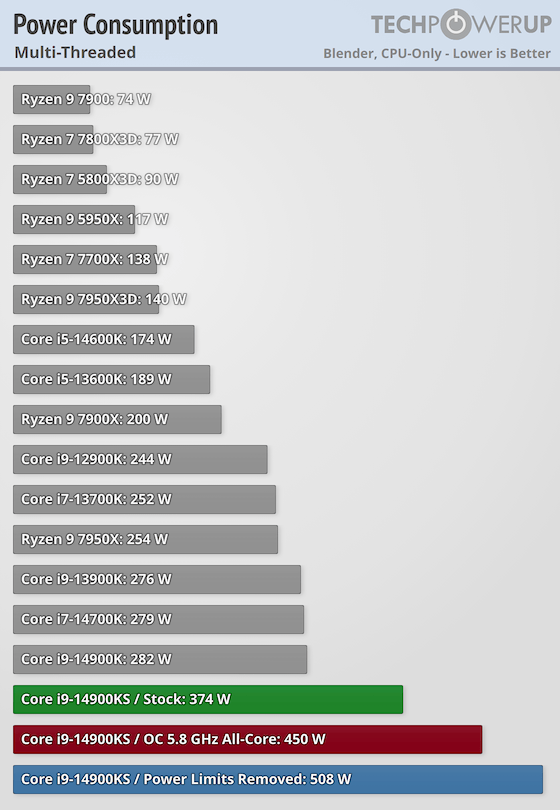
Regarding Intel TDP to PL2 correction factor. Their current "125W" chips are ~250W for a number of generations. Their current "150W" chips look like this
power-multithread.png

About 120W more than the 125W 12900K.
 
It's TSMC.
TSMC had screwups in the past as well ...
We don't know but it's at least the same platform and it has never gone over 232W power limit. They could but it's less likely.
Regarding Intel TDP to PL2 correction factor. Their current "125W" chips are ~250W for a number of generations. Their current "150W" chips look like this
power-multithread.png

About 120W more than the 125W 12900K.
It's entirely dependent on PL1/PL2 and the 14900KS Stock is not very stockish here
 
It's entirely dependent on PL1/PL2 and the 14900KS Stock is not very stockish here
Guess what was out of the box behavior on most high-end boards? Well, until the post-ignition firmware this was stock on many Zx90 boards.
Regarding NVL, it shouldn't need a high power limit. But it's Intel so it will have a high PL2 anyway.
 
Back
Top