DisEnchantment
Golden Member
Speculate at will
Last edited:


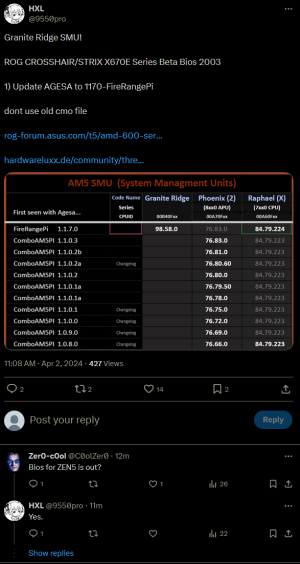
Source? I see some bioses with 1.1.0.3 but nothing about Zen 5 support.Starting to see beta firmware releases with Zen 5 support trickling out.

17-30 watts is different, how?Different part for different segment.
AMD has most definitely decided. They are just holding their cards close to their vest. Almost all of these decisions/changes occur internally a year a two b/4 they are leaked. Even board partners are getting specs far later than they did 10 years ago. Such is the state of a very competitive market.AFAIK AMD has not yet decided if Zen6 will be on AM5 or a new platform.

It's an MoP tablet part that was juiced a bit too high for its own good.17-30 watts is different, how?
Nope.AMD has most definitely decided
Wrong, they keep a lot of design decisions afloat for a while.lmost all of these decisions/changes occur internally a year a two b/4 they are leaked.
Twitter, having an issue attaching images right now.Source? I see some bioses with 1.1.0.3 but nothing about Zen 5 support.
You guys are talking about AMD killing off AM5 and AM4 isn’t even dead yet. AMD has unreleased Zen 3 stuff on AM4 still.AMD has most definitely decided. They are just holding their cards close to their vest. Almost all of these decisions/changes occur internally a year a two b/4 they are leaked. Even board partners are getting specs far later than they did 10 years ago. Such is the state of a very competitive market.
I found where asus posted beta bioses with agesa 1.1.7.0, no notes about zen 5 support on that post though.Twitter, having an issue attaching images right now.
That's dead, yes.AMD has unreleased Zen 3 stuff on AM4 still.
Strix Point's sweet point is around 35W TDP. The direct competition is upcoming Panther Lake-H which supposedly come out in Q4-2025...17-30 watts is different, how?
Middling at best. MTL Arc already does that at elevated power levels.
Doesn't Arc literally cheats in by replacing the programs shader with custom hand optimized shaders in the popular graphics benchmarks? And such results don't reflect the performance in games. So much that Intel had to add a option in their Graphics Panel to disable these?Arc's excellence in benchmarks means nothing if certain games outright do not work with it, or require some fiddling to get them to work.
No it's just good at timespy.Doesn't Arc literally cheats in by replacing the programs shader with custom hand optimized shaders in the popular graphics benchmarks
Yes, even with 33% more CUs Strix Point is still scoring barely enough in TS to beat juiced up MTL. And Xe2 is supposedly twice as fast as MTL (8 Xe2 cores vs 4 Xe-LPG cores).It's an MoP tablet part that was juiced a bit too high for its own good.
Strix is bigger meaner mobile.
That's literally what driver optimizations are. NVIDIA and AMD do it with games - the fact that they are ahead is because they have decades of head start.Doesn't Arc literally cheats in by replacing the programs shader with custom hand optimized shaders in the popular graphics benchmarks? And such results don't reflect the performance in games. So much that Intel had to add a option in their Graphics Panel to disable these?

???You're forgetting about Lunar Lake.
have you seen iteven with 33% more CUs Strix Point is still scoring barely enough in TS to beat juiced up MTL
I admire your optimism.And Xe2 is supposedly twice as fast as MTL (8 Xe2 cores vs 4 Xe-LPG cores).

LNL is the same perf as MTL but in smaller(lower) thermal envelope on iGPU.Yes, even with 33% more CUs Strix Point is still scoring barely enough in TS to beat juiced up MTL. And Xe2 is supposedly twice as fast as MTL (8 Xe2 cores vs 4 Xe-LPG cores).
Well not quite, SIMDs are twice the size (PVC-style) too.What LNL does is it increases the amount of ALUs per cluster
Pssttt...if you can get the word to them, suggest to them to do both AM5 and AM6 😛AFAIK AMD has not yet decided if Zen6 will be on AM5 or a new platform.
So you have a source in AMD - really???Nope.
let's just say having friends helpsSo you have a source in AMD - really???
Well, yes. What I mean to say is that Arc Alchemist is an uArch that does exceptional well in benchmarks but these results don't reflect into real game performance. Intel literally had to add a "Disable performance optimizations" into their control panel due to Arc benchmark not reflecting real world performance and being called out for it.That's literally what driver optimizations are. NVIDIA and AMD do it with games - the fact that they are ahead is because they have decades of head start.

 videocardz.com
LNL is the same perf as MTL but in smaller(lower) thermal envelope on iGPU.
What LNL does is it increases the amount of ALUs per cluster. Thats it. In terms of performance, it will still be 1024 ALUs vs 1024 ALUs between MTL and LNL. Yes, LNL will be more efficient, but will not mean it will be TWICE AS FAST. It means it will be the same perf. at lower power.
So it's a fatter GPU per Xe Core? I always thought Intel GPU arch subdivision to be too high and leading to occupancy problems and others bottleneck, not too different from past Mali GPUs(I might be totally off base here).Well not quite, SIMDs are twice the size (PVC-style) too.
MTL has 8 Xe-LPG cores, not 4!Yes, even with 33% more CUs Strix Point is still scoring barely enough in TS to beat juiced up MTL. And Xe2 is supposedly twice as fast as MTL (8 Xe2 cores vs 4 Xe-LPG cores).
It's just a cheaper strix.maybe Kraken Point
Not a tablet part with lobotomized uncore and MoP.4+4 and 8CU looks pretty similar.