StinkyPinky
Diamond Member
I mean they're clearly naming the SKU's over core counts and not frequency, which is not unusual. Intel and AMD do the same thing. Apple are the odd one out.


That normalizes to 13 hours? That's not even an increase over what my crappy 1250U laptop can do on a 51WHr battery while browsing the web and watching videos.He said that while watching the Apple keynote and doing web work, the battery went from 90% to 75% in 2 hours. Very promising.
At max (likely 400) nits brightness with a 2.8-3K OLED display and speakers on?That normalizes to 13 hours? That's not even an increase over what my crappy 1250U laptop can do on a 51WHr battery while browsing the web and watching videos.
Speaker on but no OLED and it's at a normal brightness. Still eh. I was expecting better given they claim double the battery life for that device but it is merely matching my $700 XPS 13 9315 with a 1.5 year worn battery.At max (likely 400) nits brightness with a 2.8-3K OLED display and speakers on?
Pretty great result in context lmao.

Heh. We'll wait for full reviews to find out on June 18th.Speaker on but no OLED and it's at a normal brightness. Still eh. I was expecting better given they claim double the battery life for that device but it is merely matching my $700 XPS 13 9315 with a 1.5 year worn battery.
I guess we know why it hasn't appeared in any fanless devices yet.
Nvidia, Qualcomm, AMD, others are considering raising prices due to the tight supply of TSMC 3nm manufacturing technology for their AI chips, media report, adding 7 major chip designers in all (Intel, Apple, MediaTek, Google) are vying for TSMC’s 3nm capacity. The report says yield issues at Samsung have hampered its 3nm efforts, leaving customers with nowhere else to go but TSMC.
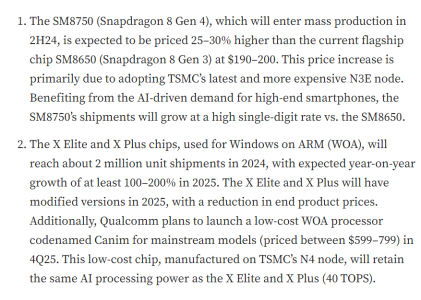
Oof.Rumor: Qualcomm will raise the price of its flagship Snapdragon 8 Gen 4 chips to over US$250 each due to higher production costs with TSMC’s 3nm process, media report, citing supply chain rumors, compared to the $200 for Snapdragon 8 Gen 3 chips last year, which were made on 5nm process. 3nm wafers are said to be around 25% more expensive than 5nm.
This dude's saying his Galaxy Book4 Edge gets 31 hours of battery life...

That’s not point. Multi-day battery life is a good thing.Next time I travel to Mercury, which has a 1,408 hour day, or Venus, which has 5,832 hour day, I will make sure I take a Snapdragon laptop with me.
No Earth, we tend to go to sleep after ~16 hours, so any battery life past that is not relevant to Earth's inhabitants.
Yeah, that's one of my favourite aspects of ASi Macs. The whole you can use it for 2 days thing is nice. I'm guessing battery improvements themselves will be the only thing to meaningfully extend that, but for now it's quite nice.That’s not point. Multi-day battery life is a good thing.

Not really. Lunar Lake is it's own swimlane and has no proper successor for now.Intel's next generation Panther Lake is rumoured to continue using on-package memory, that Lunar Lake is debuting.
Considering this, I think it makes sense for Qualcomm to also pursue on-package memory for X Elite G2.

These companies are not your friends.View attachment 101079
Imagine a marble like this...
But with the Snapdragon logo inside...
Would make for nice fan merchandise🙂


I'm not sure any company now gives any detail about branch prediction except some vague terms such as TAGE. I don't think even BTB sizes are known (but I might be wrong on this). This has become so tricky that it looks like black magic with a lots of secret sauce, some covered by patents, some not. Giving too many details, might break some competitive advantage and open the door to patent trolls.Looks like a large and capable core. I wish there were some more details on branch prediction.
Homework for you. Compare and contrast with Zen4/4c.Okay so I just finished reading the architectural deep dive, and I am very very impressed, especially with regards to the Oryon CPU.