
HomerJS
Lifer
In Russia they let their babies play with wild animals. We are pussies.Learn to be Russian and just launch anyway.

In Russia they let their babies play with wild animals. We are pussies.Learn to be Russian and just launch anyway.

Certain types of clouds at certain altitudes in the flight path with certain characteristics (I'd wager static electricity).Every article I read says the launch was scrubbed due to "bad weather." Can anyone describe what that means in this context? Was it partially cloudy? Too hot? Too cold?
Certain types of clouds at certain altitudes in the flight path with certain characteristics (I'd wager static electricity).
Requires a lot of engineering and technology development that is very expensive, and as of right now we launch rarely enough that it's more expensive to develop that stuff rather than just wait another few days. If we as a species were depending on it as much as we depended on things like sea travel, there'd absolutely be some advancements in that area and we could probably launch in anything short of an actual thunderstorm.Yeah I would guess it had something to do with clouds. Not a storm or truly inclement weather. Sigh. For space travel to ever become even semi-routine, it can't be reliant on perfect weather conditions. This is not meant to criticize anyone. I'm just bemoaning the fact that after 60 years of space travel, the technology is still so limited as to require perfect weather conditions and all the stars aligned. Among other things, it makes space travel that much more expensive.
Requires a lot of engineering and technology development that is very expensive, and as of right now we launch rarely enough that it's more expensive to develop that stuff rather than just wait another few days. If we as a species were depending on it as much as we depended on things like sea travel, there'd absolutely be some advancements in that area and we could probably launch in anything short of an actual thunderstorm.

Flight rules do generally limit launches to certain temperature ranges and wind speeds both at the launch site and at abort landing sites. But in this case it was due to the potential for lightning in the area. Rocket launches can actually trigger a lightning strike by providing a ground path through their exhaust from the clouds to the ground.Every article I read says the launch was scrubbed due to "bad weather." Can anyone describe what that means in this context? Was it partially cloudy? Too hot? Too cold?
Flight rules do generally limit launches to certain temperature ranges and wind speeds both at the launch site and at abort landing sites. But in this case it was due to the potential for lightning in the area. Rocket launches can actually trigger a lightning strike by providing a ground path through their exhaust from the clouds to the ground.
Apollo 12 which was mentioned on the last page. A bunch of other rockets have been hit.Ah yes, I seem to recall reading somewhere that this happened to one of the Apollo missions, that it was struck by lightning that wasn't naturally occurring. Though the mission was somehow successful in spite of it.
Apollo 12 which was mentioned on the last page. A bunch of other rockets have been hit.
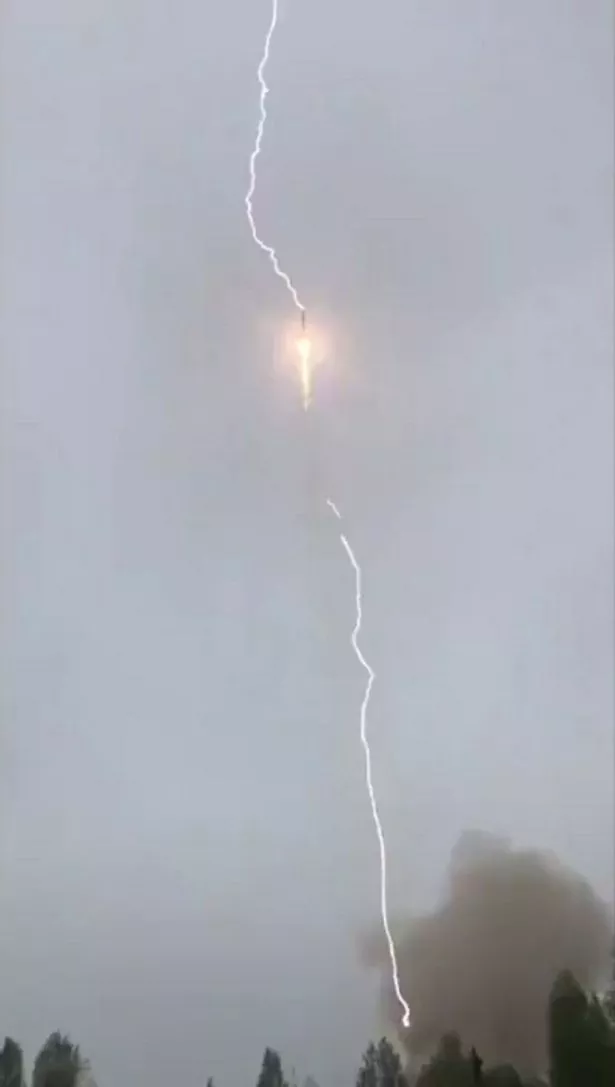
Here’s an unmanned Soyuz that was hit:

Actual lightning within 12 miles of the pad was one of the nogo hits.Every article I read says the launch was scrubbed due to "bad weather." Can anyone describe what that means in this context? Was it partially cloudy? Too hot? Too cold?
You can stimulate lighting with a small rocket. They actually do this to study lightning. The exhaust plume creates a lower resistant path. So you do not want to launch when the potential to set it off are all around you.Apollo 12 which was mentioned on the last page. A bunch of other rockets have been hit.
Here’s an unmanned Soyuz that was hit but survived:
Dang.Next Launch attempt 5/30 @3:22PM EDT
Weather is forecasted to be poor.
So, does NASA send up weather balloons or something to gauge electrostatic potential?Next Launch attempt 5/30 @3:22PM EDT
Weather is forecasted to be poor.

I know they send up a ton of weather balloons.. to finer detail I dont know..So, does NASA send up weather balloons or something to gauge electrostatic potential?
They entered last time, that doesn't mean they will launch. It's entirely dependent upon everything being checked that they are ready along with the weather being in optimal conditions for launch.So is this going ahead? They are entering the rocket now.
Just with what we know about the stuff in common domain, walk the planning back , it has got to be a nightmare of planning ...They entered last time, that doesn't mean they will launch. It's entirely dependent upon everything being checked that they are ready along with the weather being in optimal conditions for launch.
Which to be honest, you gotta wonder how much this costs us to get all ready, suited up, rockets fueled, tons of employees across the states, etc .. all to have it scrapped on weather reasons that we knew well in advance weren't optimal.
Just with what we know about the stuff in common domain, walk the planning back , it has got to be a nightmare of planning ...
Weather service and balloons on site as far as I recall.So, does NASA send up weather balloons or something to gauge electrostatic potential?


