• We’re currently investigating an issue related to the forum theme and styling that is impacting page layout and visual formatting. The problem has been identified, and we are actively working on a resolution. There is no impact to user data or functionality, this is strictly a front-end display issue. We’ll post an update once the fix has been deployed. Thanks for your patience while we get this sorted.

Discussion Mediatek SoC thread

Page 13 - Seeking answers? Join the AnandTech community: where nearly half-a-million members share solutions and discuss the latest tech.
Ahem...

The maximum amount of L2 cache the Cortex A725 can be configured with is 1 MB.

Even Dimensity 9400 only has a total of 7 MB of L2 private caches across it's 8 cores.
Is 1 MB per core or per cluster? If is per core, it fits since the A725 on the big cores only uses 1 MB and on the "small ones" just 512 kb.
If is per cluster, well, time to use the L3 cache then.
 
Is 1 MB per core or per cluster? If is per core, it fits since the A725 on the big cores only uses 1 MB and on the "small ones" just 512 kb.
If is per cluster, well, time to use the L3 cache then.
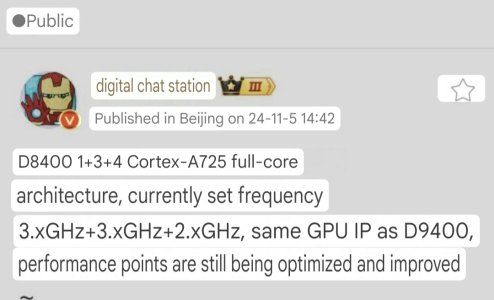
ARM cores cannot be put in a cluster with shared L2.

That's why Apple/Qualcomm's CPU is special.
 
Are you sure of that? The private (but coherent) L2 is mandatory IIRC.
https://docs.amd.com/r/en-US/ug1085-zynq-ultrascale-trm/Arm-v8-Architecture hopefully the link points to the correct place. https://docs.amd.com/viewer/attachment/dqE2tE0k~iMhpEDoQwXIKg/DH_fGSDkzyH4lTKZ0NNiBg
The Cortex-A53 MPCore processor’s L2 memory system size is 1 MB. It contains the L2 cache pipeline and all logic required to maintain memory coherence between the cores of the cluster.
Anyway there are up to 4 cores in the cluster. Unless there is something that evades me, I think it is fair to say the cores in the cluster share the L2 cache.

AMD/Xilinx Versal should be similar but with A72 cores. Versal Gen2 is using A78 cores and indeed has L2 private caches and then L3.
 
https://docs.amd.com/r/en-US/ug1085-zynq-ultrascale-trm/Arm-v8-Architecture hopefully the link points to the correct place. https://docs.amd.com/viewer/attachment/dqE2tE0k~iMhpEDoQwXIKg/DH_fGSDkzyH4lTKZ0NNiBg

Anyway there are up to 4 cores in the cluster. Unless there is something that evades me, I think it is fair to say the cores in the cluster share the L2 cache.

AMD/Xilinx Versal should be similar but with A72 cores. Versal Gen2 is using A78 cores and indeed has L2 private caches and then L3.
Sorry I wasn't clear: I was talking about A72 not A53.
 
I want to see how efficient will be the first A725 all core processor. Maybe the champ of efficiency would be there.
 
Now SD 7 should be all Out of Order cores too in order to not be left behind.

PS: There is a clarification. Indicates that there are 2 clusters... one with A725 and another with A720
 
Last edited:
Now SD 7 should be all Out of Order cores too in order to not be left behind.

PS: There is a clarification. Indicates that there are 2 clusters... one with A725 and another with A720
7+ and 8s use Cortex X so perfomance wise they won't be left behind, especially if they use Phoenix-L or X925. But efficiency wise I won't be suprised if D8400 to be better than even D9400.
 
7+ and 8s use Cortex X so perfomance wise they won't be left behind, especially if they use Phoenix-L or X925. But efficiency wise I won't be suprised if D8400 to be better than even D9400.
D8100 all over again. Seems that my next phone will use that processor.
 
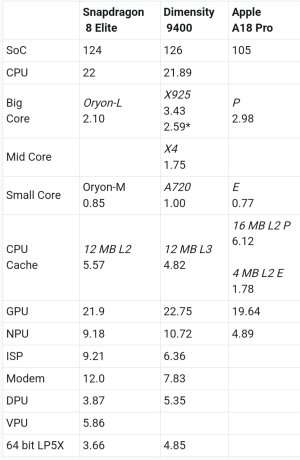
Comparison of die areas of latest smartphone SoCs.

All 3 SoCs are fabbed on TSMC N3E, which it makes it an iso-node comparison.

All numbers are in mm².

Vchrome56.jpg

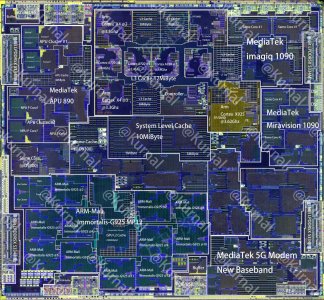
• D9400, 8E dieshots from Kurnal. A18 Pro dieshot by Chipwise and annotation by High Yield.
• For Dimensity 9400, all core areas include the private L2 cache, except for the one with the asterisk. Measuring the Cortex X925 area without L2 was a pain, and I cannot vouch that the figure is accurate.

Edit: Forgot to add;

A18 Pro
P Cluster = 12.00 mm²
E cluster = 4.82 mm²
 
Last edited:
Oryon-L is the smallest core out of all the P-cores (See above chart). Whereas Cortex X925 is the biggest (if you include the private L2). Without it Cortex X925 is still larger than Oryon-L, but smaller than A18-P.
I thought Oryon-L was around 2.55mm^2?
 
That is the original Oryon core in X Elite (N4P).

8 Elite (N3E) has Oryon-L (2.1 mm²) and Oryon-M (0.85 mm²).
Ah right, I have the image of the various recent chip offerings (from Reddit that I know you’ve seen). That has it a 2.2 mm².
 
Oryon-L is the smallest core out of all the P-cores (See above chart). Whereas Cortex X925 is the biggest (if you include the private L2). Without it Cortex X925 is still larger than Oryon-L, but smaller than A18-P.
Blows my mind that all the CPU manufacturers don't pool money into research for SRAM replacements.

It's such an area hog, and you know that adds up over a whole wafer.
 
Comparison of die areas of latest smartphone SoCs.

All 3 SoCs are fabbed on TSMC N3E, which it makes it an iso-node comparison.

All numbers are in mm².

View attachment 111166

• D9400, 8E dieshots from Kurnal. A18 Pro dieshot by Chipwise and annotation by High Yield.
• For Dimensity 9400, all core areas include the private L2 cache, except for the one with the asterisk. Measuring the Cortex X925 area without L2 was a pain, and I cannot vouch that the figure is accurate.

Edit: Forgot to add;

A18 Pro
P Cluster = 12.00 mm²
E cluster = 4.82 mm²
oh. 3.43 on N3e with only 2M L2 is pretty chungus.
 
DRAM is an even worse problem. alas.
A worse problem, but not the problem of the CPU manufacturers who aren't footing that bill for their wafers (at least for those not using eDRAM anyway).

Hopefully future multilayered 3D DRAM will begin to address it.

This recent breakthrough is likely to take a long time to commercialise, but it's interesting none the less, at 5000 seconds retention it is even better than the capacitorless DRAM designs which are >400 seconds retention.

 
Kurnal's video about Dimensity 9400;


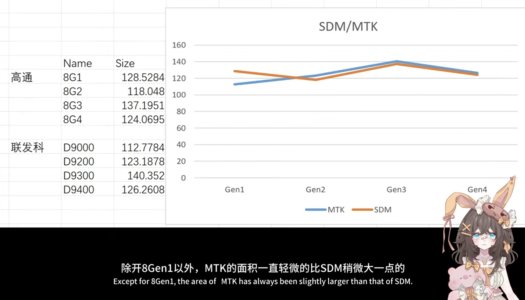
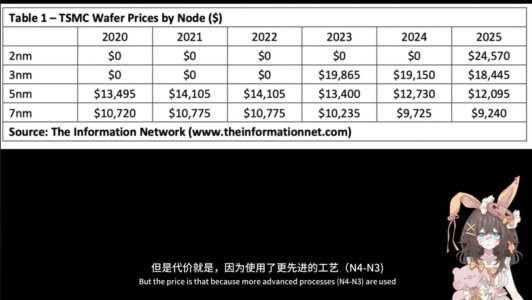
Some screenshots:
Screenshot_20241108_145804_YouTube.jpgScreenshot_20241108_145824_YouTube.jpg
Pretty remarkable video consisting of core area comparisons, cache area comparisons, density calculations, cost calculations, etc...
 
Back
Top