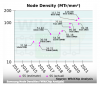
Discussion Leading Edge Foundry Node advances (TSMC, Samsung Foundry, Intel) - [2020 - 2025]

Page 195 - Seeking answers? Join the AnandTech community: where nearly half-a-million members share solutions and discuss the latest tech.

DisEnchantment

Golden Member
Mar 3, 2017
1,779
6,798
136
TSMC's N7 EUV is now in its second year of production and N5 is contributing to revenue for TSMC this quarter. N3 is scheduled for 2022 and I believe they have a good chance to reach that target.
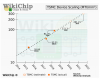
1587737990547.png
N7 performance is more or less understood.
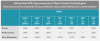
1587739093721.png

This year and next year TSMC is mainly increasing capacity to meet demands.

For Samsung the nodes are basically the same from 7LPP to 4 LPE, they just add incremental scaling boosters while the bulk of the tech is the same.

Samsung is already shipping 7LPP and will ship 6LPP in H2. Hopefully they fix any issues if at all.
They have two more intermediate nodes in between before going to 3GAE, most likely 5LPE will ship next year but for 4LPE it will probably be back to back with 3GAA since 3GAA is a parallel development with 7LPP enhancements.


1587739615344.png

Samsung's 3GAA will go for HVM in 2022 most likely, similar timeframe to TSMC's N3.
There are major differences in how the transistor will be fabricated due to the GAA but density for sure Samsung will be behind N3.
But there might be advantages for Samsung with regards to power and performance, so it may be better suited for some applications.
But for now we don't know how much of this is true and we can only rely on the marketing material.

This year there should be a lot more available wafers due to lack of demand from Smartphone vendors and increased capacity from TSMC and Samsung.
Lots of SoCs which dont need to be top end will be fabbed with N7 or 7LPP/6LPP instead of N5, so there will be lots of wafers around.

Most of the current 7nm designs are far from the advertized density from TSMC and Samsung. There is still potential for density increase compared to currently shipping products.
N5 is going to be the leading foundry node for the next couple of years.

For a lot of fabless companies out there, the processes and capacity available are quite good.

---------------------------------------------------------------------------------------------------------------------------------------------------


FEEL FREE TO CREATE A NEW THREAD FOR 2025+ OUTLOOK, I WILL LINK IT HERE
 
Last edited:

511

Diamond Member
Jul 12, 2024
5,429
4,845
106
Nah, it's patented so 20 years. Doesn't really matter is stuff like AVX is still covered.
ok so you are right but than again there must be some copyright going on otherwise people are free to do SSE on their ISA
 

Thunder 57

Diamond Member
Aug 19, 2007
4,258
7,055
136
ok so you are right but than again there must be some copyright going on otherwise people are free to do SSE on their ISA

There is not. I suggest you look up copyright vs patent. The thing is AMD & Intel patent things all of the time, so it is not really viable for someone else to try to do x86.
 
  • Haha
Reactions: Io Magnesso

511

Diamond Member
Jul 12, 2024
5,429
4,845
106
There is not. I suggest you look up copyright vs patent. The thing is AMD & Intel patent things all of the time, so it is not really viable for someone else to try to do x86.
Well they can't do x86 but they can emulate x86 instructions that are not patented
 
  • Like
Reactions: Io Magnesso

DavidC1

Platinum Member
Dec 29, 2023
2,166
3,307
106
Isn't that what Transmeta tried to do? Anyway off topic so I will stop.
They did. After Transmeta went kaput, they made a deal with Intel that they won't do that again.

It's oppressive really. It would benefit x86 to have more competition.
 

Io Magnesso

Senior member
Jun 12, 2025
578
165
71
Isn't that what Transmeta tried to do? Anyway off topic so I will stop.
Well, I'll stop with this
Personally, I feel that the X86 Rights Relationship is a hassle, or rather, I can't grasp the whole picture
Well, if you partner with a license, There's nothing you can't do
 

Io Magnesso

Senior member
Jun 12, 2025
578
165
71
They did. After Transmeta went kaput, they made a deal with Intel that they won't do that again.

It's oppressive really. It would benefit x86 to have more competition.
It would be fun if the X86 processors from various manufacturers were released like the early days of PCs.
 

johnsonwax

Senior member
Jun 27, 2024
472
676
96
Basically, you can't get an ARM ISA license easily. The number of companies that own the license is generally few.

To be honest, if I give you an ARM ISA license...
The ecosystem may expand…
However, for the IP business shop ARM, earning money is not so good.
The license contract system is also different from the ISA license and IP.
I don't think it's that hard to get an ISA license (doesn't apply to Apple as they're a founder, though). How many companies need one though? Jumping up from ARMs designs to your own is a pretty damn big lift, and Apple is the only company that has demonstrated they can get a return off of it. It's not that it's proven to be hard to get, it's that ARMs own designs are quite good and the opportunity to improve quite small.
 

johnsonwax

Senior member
Jun 27, 2024
472
676
96
Even better than ARM if you are a new comer, RISC-V.
Maybe. There are real benefits to RISC-V, but there is also a lack of concrete infrastructure. Apple wasn't some backbencher when the iPhone came out and didn't go straight to Apple Silicon. They relied on an existing market of OTS ARM hardware through the iPod era and early iPhone, then increasingly bespoke variations out of Samsung, and then they started doing their own thing. I mean, look at how long a path it's been for Microsoft to get Windows/ARM to be anything more than a curiosity because they don't really have control over their developer community. They can't pivot x86 Windows software to ARM the way Apple can. If anyone wanted RISC-V in the Windows space, that's a decades-long project that will lose money every year given the current market dynamics. Even RISC-V Linux for the datacenter isn't going to be fast. Someone is going to need to bleed cash for quite a while to get there. Again, Apple is the only player that has the market control to make a fast architectural pivot. RISC-Vs market is going to be stuck around hardware/software codesign for quite a while, or any market where there is no platform effect. Those aren't markets that throw off a ton of cash, which puts you back to the problem of how do you afford to get on leading nodes, so you're likely to be performance uncompetitive because you're going to have to go discount foundry.
 
  • Haha
Reactions: Io Magnesso

johnsonwax

Senior member
Jun 27, 2024
472
676
96
I forgot there's another way out of Moore's law economic trap for a player like Intel. They can buy ASML, or enough of the upstream drivers of those fixed costs that even if they are a minority player on volume, their fixed costs are subsidized by the majority player. Just runs into a different regulatory hurdle. And it presumes that if they clear that hurdle that the majority player won't buy even more of the upstream drivers as presumably they can clear the same hurdle and have more cash to do so. This is effectively what Apple/Samsung have down by also owning the downstream consumers of the volume because they capture all of the value that the consumer is paying for and can use that as a subsidy.
 

DavidC1

Platinum Member
Dec 29, 2023
2,166
3,307
106
I forgot there's another way out of Moore's law economic trap for a player like Intel. They can buy ASML, or enough of the upstream drivers of those fixed costs that even if they are a minority player on volume, their fixed costs are subsidized by the majority player.
When they were really doing well in fabrication some were speculating Intel would participate more in the space including involving in the tool making chain.

Right now what you are suggesting would cause in death of ASML. Historically acquisitions are failures, and even more true for Intel.
 

Josh128

Golden Member
Oct 14, 2022
1,530
2,286
106
I forgot there's another way out of Moore's law economic trap for a player like Intel. They can buy ASML, or enough of the upstream drivers of those fixed costs that even if they are a minority player on volume, their fixed costs are subsidized by the majority player. Just runs into a different regulatory hurdle. And it presumes that if they clear that hurdle that the majority player won't buy even more of the upstream drivers as presumably they can clear the same hurdle and have more cash to do so. This is effectively what Apple/Samsung have down by also owning the downstream consumers of the volume because they capture all of the value that the consumer is paying for and can use that as a subsidy.
Intel cant afford ASML, but even if they could, it would do nothing for them. Lithography machines 100% do not equal process quality. Everybody uses ASML machines, but Intel has struggled enormously while TSMC has plowed through quite well.
 
  • Like
Reactions: Io Magnesso

johnsonwax

Senior member
Jun 27, 2024
472
676
96
Intel cant afford ASML, but even if they could, it would do nothing for them. Lithography machines 100% do not equal process quality. Everybody uses ASML machines, but Intel has struggled enormously while TSMC has plowed through quite well.
Didn't suggest any of those things as we're not discussing Moores law in practical terms - but in the abstract. I was just noting that any player can overcome a minority volume position by doing this. And It doesn't matter if Intel struggles with ASML or not - what matters is that TSMC would be paying Intel for it, Intel would be keeping those margins from TSMC and not having to pay themselves, and could use that to square their part of the economic problem - which would include overcoming their struggles. Whatever is dominating those upfront costs can be captured and used to operate from a minority position on volume.
 
  • Haha
Reactions: Io Magnesso

Doug S

Diamond Member
Feb 8, 2020
3,820
6,755
136
ok so you are right but than again there must be some copyright going on otherwise people are free to do SSE on their ISA

They are to use SSE. But what's the market for an x86 chip that's only caught up to 2005 ISA wise? SSE3 patents JUST expired a few months ago and it introduced some instructions that were required by Windows 8.1. Wouldn't be shocked if there are some ISA features required by Windows 11 that are still covered under patent. Even if there aren't, what's the market for an x86 compatible CPU that's 20 years behind? No SSE4, let alone AVX, AVX2 and AVX512? Even if it was just as fast as Intel/AMD's best in that 20 year old code, it would get killed in benchmarks that use AVX etc. as well as in real world software that uses it. Many games probably assume at least the existence of AVX2 by now.

So you probably couldn't sell it into the PC market. What good is an x86 chip without the PC market to sell into? Who is clamoring for x86 compatibility in a market where you aren't running Windows, i.e. you are running Linux? x86 compatibility is totally irrelevant there, why design something 20 years old when you can use ARM or RISC-V?
 

511

Diamond Member
Jul 12, 2024
5,429
4,845
106
They are to use SSE. But what's the market for an x86 chip that's only caught up to 2005 ISA wise? SSE3 patents JUST expired a few months ago and it introduced some instructions that were required by Windows 8.1. Wouldn't be shocked if there are some ISA features required by Windows 11 that are still covered under patent. Even if there aren't, what's the market for an x86 compatible CPU that's 20 years behind? No SSE4, let alone AVX, AVX2 and AVX512? Even if it was just as fast as Intel/AMD's best in that 20 year old code, it would get killed in benchmarks that use AVX etc. as well as in real world software that uses it. Many games probably assume at least the existence of AVX2 by now.

So you probably couldn't sell it into the PC market. What good is an x86 chip without the PC market to sell into? Who is clamoring for x86 compatibility in a market where you aren't running Windows, i.e. you are running Linux? x86 compatibility is totally irrelevant there, why design something 20 years old when you can use ARM or RISC-V?
For Linux you have x86 options as well lol and latest one to boot
 

Doug S

Diamond Member
Feb 8, 2020
3,820
6,755
136
For Linux you have x86 options as well lol and latest one to boot

But an x86 CPU that only does up to SSE3 is not going to perform as well as one that is up to date with the latest ISA features, even if it was equally fast in executing non-SIMD code. So who would want it?
 

Io Magnesso

Senior member
Jun 12, 2025
578
165
71
I don't think it's that hard to get an ISA license (doesn't apply to Apple as they're a founder, though). How many companies need one though? Jumping up from ARMs designs to your own is a pretty damn big lift, and Apple is the only company that has demonstrated they can get a return off of it. It's not that it's proven to be hard to get, it's that ARMs own designs are quite good and the opportunity to improve quite small.
Now, please list the companies that have an ARM ISA license?
Because it's small, I've said that it's the only few people who have an ARM ISA license and can design an ARM-compatible processor.
 

Io Magnesso

Senior member
Jun 12, 2025
578
165
71
Maybe. There are real benefits to RISC-V, but there is also a lack of concrete infrastructure. Apple wasn't some backbencher when the iPhone came out and didn't go straight to Apple Silicon. They relied on an existing market of OTS ARM hardware through the iPod era and early iPhone, then increasingly bespoke variations out of Samsung, and then they started doing their own thing. I mean, look at how long a path it's been for Microsoft to get Windows/ARM to be anything more than a curiosity because they don't really have control over their developer community. They can't pivot x86 Windows software to ARM the way Apple can. If anyone wanted RISC-V in the Windows space, that's a decades-long project that will lose money every year given the current market dynamics. Even RISC-V Linux for the datacenter isn't going to be fast. Someone is going to need to bleed cash for quite a while to get there. Again, Apple is the only player that has the market control to make a fast architectural pivot. RISC-Vs market is going to be stuck around hardware/software codesign for quite a while, or any market where there is no platform effect. Those aren't markets that throw off a ton of cash, which puts you back to the problem of how do you afford to get on leading nodes, so you're likely to be performance uncompetitive because you're going to have to go discount foundry.

Well, if you have a rotten attitude, RISC-V may spread at an unexpectedly fast speed.
In fact, in the field of microcontroller and embedding, which is the original field of ARM
You can see the breakthrough of RISC-V