Discussion Intel Nova Lake in H2-2026: Discussion Threads

Page 52 - Seeking answers? Join the AnandTech community: where nearly half-a-million members share solutions and discuss the latest tech.

DrMrLordX

Lifer
Apr 27, 2000
23,060
13,163
136
So this is where fast cores are better than more cores?

Yeah, basically.

The first test was from 2018. So the MT implementation in Handbrake and the underlying codec libraries may have improved since then.

Not really, if you look at much later tests (such as a 9950X/9900X review) the scaling issue is still there.

Then regarding 9950X vs 9900X (and for the first test too), could the power constraint also not explain why performance does not scale linearly with core count in this case? I’m thinking that the 9950X cores will run at lower frequency than on 9900X, due to same TDP constraint and the former CPU having more cores so less power/core.

See below:

The 9900x has a much lower power limit than the 9950x and is just as power constrained. Video encoding just quickly hits diminishing returns once you get past 24t or so and that’s with high res (4K), modern formats. The vast majority of people will see even less benefit because they aren’t encoding that high res and are probably still using x264.

Yup, the Tom's 9950X/9900X review actually benchmarked x265 and x264 with PBO on and off, and the 9900X gained more from PBO on, showing the effect of power limits hurting the 9900X more than the 9950X:


Could it be that such video encoding is inherently MP limited (I have no knowledge of the underlying algorithms so this might just be plain stupid)?

Anyway this shows expecting nice MT speedups even for a task that looks highly parallel is a fallacy.
Yes, and sort of. There are some benchmarks, such as 3D rendering, that can be "embarassingly parallel". But video encoding does crap out at a certain thread count.

@Fjodor2001 theoretically you could splice one long video into multiple pieces and launch multiple instances of handbrake simultaneously, but that's not very common among the hobbyists that still do so.
 

Fjodor2001

Diamond Member
Feb 6, 2010
4,377
651
126
@Fjodor2001 theoretically you could splice one long video into multiple pieces and launch multiple instances of handbrake simultaneously, but that's not very common among the hobbyists that still do so.
The idea is that Handbrake can do this automatically internally. I'd be surprised if it doesn't do this already actually. E.g. for 16T, it will process 16 small video sections in parallel at the same time, where each section is e.g. 10 seconds each or whatever.

I don't know why it for x265 currently does not scale ideally beyond a certain number of threads, but I think this is something that should be possible to improve upon going forward with necessary implementation changes.
 

MS_AT

Senior member
Jul 15, 2024
902
1,805
96
The idea is that Handbrake can do this automatically internally. I'd be surprised if it doesn't do this already actually. E.g. for 16T, it will process 16 small video sections in parallel at the same time, where each section is e.g. 10 seconds each or whatever.
x265 has some internal parallelism opportunities, so first I guess it's more efficient to use those. You can read about them here https://x265.readthedocs.io/en/master/threading.html it also goes into some of the limitations from what I remember. (I never was really heavy user and I stopped some years ago, so I would need to reread this myself). They also link from there to nice visualisation here https://parabolaresearch.com/blog/2013-12-01-hevc-wavefront-animation.html. Since Handbrake is just glorified front-end I guess they trust the users will simply split the video on their own if they find they exhausted all inherent threading opportunities within the encoder.
 

Fjodor2001

Diamond Member
Feb 6, 2010
4,377
651
126
x265 has some internal parallelism opportunities, so first I guess it's more efficient to use those. You can read about them here https://x265.readthedocs.io/en/master/threading.html it also goes into some of the limitations from what I remember. (I never was really heavy user and I stopped some years ago, so I would need to reread this myself). They also link from there to nice visualisation here https://parabolaresearch.com/blog/2013-12-01-hevc-wavefront-animation.html. Since Handbrake is just glorified front-end I guess they trust the users will simply split the video on their own if they find they exhausted all inherent threading opportunities within the encoder.
If you implement the x265 codec like I described, i.e. split the video into small sections of e.g. 5-10 seconds, and transcode X such sections in parallel when using X threads, then what would stop it from scaling linearly with thread count? (Up to a certain point of course, but much higher than 32T or so.)

Are you saying some data needs to be shared between those X video sections when transcoding them (which would lead to not 100% parallelizable code), and if so what? Possibly e.g. some overall statistics which is common for the whole movie (e.g. Max Frame Average Light Level / MaxFALL for the whole movie), but that should be very limited.

The thing is that we still don't know the root cause(s) of why Handbrake with x265 does not scale ideally beyond a certain amount of threads in the tests posted in this thread. It could be lots of reasons, such as poor threading implementation in Handbrake and/or the x265 codec, resource bottleneck(s) (e.g. memory speed or slow HDD), the cores not running at same frequency when comparing X vs Y number of cores, the caches being used differently, some specific x265 codec options used, etc.
 
Last edited:

itsmydamnation

Diamond Member
Feb 6, 2011
3,091
3,931
136
If you implement the x265 codec like I described, i.e. split the video into small sections of e.g. 5-10 seconds, and transcode X such sections in parallel when using X threads, then what would stop it from scaling linearly with thread count? (Up to a certain point of course, but much higher than 32T or so.)

Are you saying some data needs to be shared between those X video sections when transcoding them (which would lead to not 100% parallelizable code), and if so what? Possibly e.g. some overall statistics which is common for the whole movie (e.g. Max Frame Average Light Level / MaxFALL for the whole movie), but that should be very limited.

The thing is that we still don't know the root cause(s) of why Handbrake with x265 does not scale ideally beyond a certain amount of threads in the tests posted in this thread. It could be lots of reasons, such as poor threading implementation in Handbrake and/or the x265 codec, resource bottleneck(s) (e.g. memory speed or slow HDD), the cores not running at same frequency when comparing X vs Y number of cores, the caches being used differently, some specific x265 codec options used, etc.
yeah no one wants to make their encode quality / bitrate worse so you can find a use case for your flock of chickens.........
 

dullard

Elite Member
May 21, 2001
26,135
4,792
126
If you implement the x265 codec like I described, i.e. split the video into small sections of e.g. 5-10 seconds, and transcode X such sections in parallel when using X threads, then what would stop it from scaling linearly with thread count? (Up to a certain point of course, but much higher than 32T or so.)
Multi-threading is just so, so much harder than you make it out to be. Suppose you have 32 employees. If they all do the exact same thing, and are all always equally efficient, then what you say is correct. Just divide your work load into 32 equal parts and divvy it up to everyone. They'll all end their tasks together at exactly 5 PM and you repeat the process tomorrow. This is great for simple things like stuffing envelopes. Just give every employee 5000 envelopes a day to stuff and have them all stuffed by 5 PM.

But, workloads usually aren't like that. You'll need one person printing addresses on the envelopes. A group of people writing the document to stuff into the envelope. A person printing the document. A group of people stuffing envelopes. Someone applying stamps. Someone else ordering paper, loading the printers, repairing the broken printers. Etc. If the raw paper order doesn't come in on time then you have 31 employees sitting around doing nothing while the 32nd is shouting on the phone at the paper supplier.

Then what happens when they aren't all equally efficient? What if the document writer has writer's block (a particular video frame is slow to process)? Then it all comes screeching to a halt (it is hard to stuff a document into an envelope if the document hasn't been written yet). What if the envelope addresser kid gets sick and needs to do other things (user moves mouse and starts doing other tasks)? What if half of your printers randomly stop functioning (Windows decides to install an update in the background)? What if half of your intended employees go part time (E cores vs P cores) and some of your employees go on vacation/return from vacation (hyperthreading is random in resource availability). Your perfectly balanced 32 tasks suddenly are out of balance and many employees just sit idle.
Are you saying some data needs to be shared between those X video sections when transcoding them (which would lead to not 100% parallelizable code), and if so what? Possibly e.g. some overall statistics which is common for the whole movie (e.g. Max Frame Average Light Level / MaxFALL for the whole movie), but that should be very limited.
Yes and it is not even close to limited--the whole transcoding of all frames depends on the whole movie. Frames are processed one at a time and the compression method depends on complexity of ALL frames. A 5 second section of all-black (Sopranos goes all black on final episode) will be quick to process and a 5 second section of intense activity will be very slow. And the way the all black section is processed depends on the content of the action scene. Meaning, they have to be done together even if one section is fast and one section is slow.
 
Last edited:

Khato

Golden Member
Jul 15, 2001
1,319
391
136
Proper allocation of bitrate is best handled by multi-pass encoding - first pass runs a light/fast analysis on the entire video to estimate scene complexity/motion which can then be used on the actual encoding pass to allocate bitrate accordingly and hit a final target bitrate across the entire video.

Breaking up the transcode into discrete blocks can certainly be done, but it would result in a minor hit to the quality at a given bitrate since each discrete block has to exist in isolation. I don't believe it would be a particularly large effect, especially if you go with larger block sizes. Basically, start of each block would require a reference frame, whereas in normal encode that could have been just a delta compared to the last frame. Now theoretically with multi-pass encoding the 'break points' between blocks could be identified where there's scene transitions that require a new reference frame regardless, at which point I don't believe there would be a downside.

Edit: I only have a basic understanding of the encode algorithms from an overview training on the media encode blocks roughly a decade ago... which I only half followed because there was a lot of annoying math that I didn't actually need to understand.
 

MangoX

Senior member
Feb 13, 2001
624
169
116
I wanted to chime in on this video encoding debate. I know I am a extreme minority here; It really interests me since it's something I hold dear, and I've been doing for a very long time, from ripping VHS tapes using a ATI All-in-wonder, to various Matrox gear, then DVD ripping and Bluray, to the modern day ripping 4K stream.

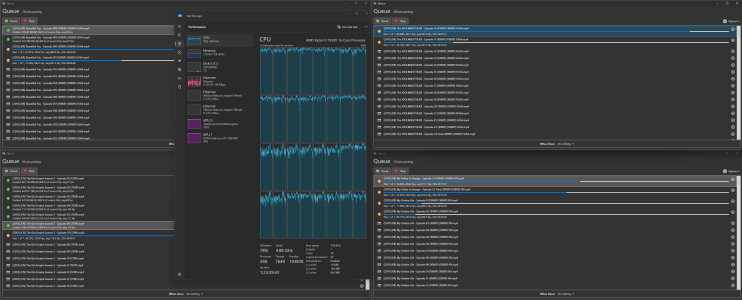
Handbrake can do multiple encodes within a single instance easily, so if you need MT maxed out, there you go. It can do whatever you want to do, just depends on your encode profile. You can mix and match CPU/GPU encoding if you so wish, with certain limitations. If you want to do mass encoding on a single machine, you're going to need a lot of RAM, surely for 4K you'll need that. A single 4K encode you're going to need something like 12-16GB per instance. Clock speed matters too (I think). I only say that because I never tested on anything higher than a 7950X. As evidenced by this thread, there are diminishing returns the more cores are added. Let me tell you cache also matters too. A 7950X3D machine I've got encodes some 15-20% faster FPS than a regular 7950X, despite a 200mhz or so clockspeed deficit. So to answer some questions, you don't need to run multiple Handbrake instances if you want to max out MT, just run more parallel encodes in the same instance. Handbrake allows you to do that.

Next comes my pure opinion. Anyone doing pure CPU video encoding is (mostly) out of their mind. We've come a long way with HW-based encoders. You can get amazing quality with GPU-based encoders. The only thing is the larger file size/bitrates. But still, it depends on your application and your intended uses. Are you doing VOD streaming and need the lowest bitrates and smallest filesizes? Maybe 5 or even 10 years ago. But these days when bandwidth and storage is so cheap, the disadvantages are non-existential. So what if I can encode a H264 to a VMAF of 93 @ 4000kbps, while a QSV can do the same at @ 6500kbps, what's the big deal? Speed is everything now. If I need to encode 4000 hours of video playback per day, guess what I'm going to choose? Definitely not the CPU. Back 20 years ago when the largest drives were 1TB, and most people had 10mbit, yeah, CPU meant a lot. Not anymore.

Now I want to end with a caveat. I still use CPU to encode all 480P/720P videos. GPUs are great, but they fail at lower resolutions. They're much more effecient at high res, like 1080P and 4K and that's what I use them for. I'll end by saying I only use Intel QSV and Nvidia NVENC. AMD is terrible, so if you're considering them, DON'T.

Just one machine with a 7950X and a Arc and NV GPU.

1764664548773.png
 
Last edited:

DrMrLordX

Lifer
Apr 27, 2000
23,060
13,163
136
How do you know this?
I ran it on my 3900X and it didn't push the CPU to 100%, which is what would have happened had it split the source file into two parts, encoded, and then merged. And it should be obvious from any benchmark that it's not doing that.