Discussion Intel Meteor, Arrow, Lunar & Panther Lakes + WCL Discussion Threads

Page 903 - Seeking answers? Join the AnandTech community: where nearly half-a-million members share solutions and discuss the latest tech.

Tigerick

Senior member
Apr 1, 2022
942
857
106
Wildcat Lake (WCL) Specs

Intel Wildcat Lake (WCL) is upcoming mobile SoC replacing Raptor Lake-U. WCL consists of 2 tiles: compute tile and PCD tile. It is true single die consists of CPU, GPU and NPU that is fabbed by 18-A process. Last time I checked, PCD tile is fabbed by TSMC N6 process. They are connected through UCIe, not D2D; a first from Intel. Expecting launching in Q1 2026.
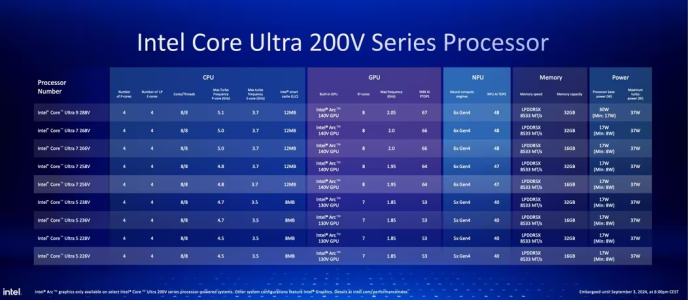
Intel Raptor Lake UIntel Wildcat Lake 15W?Intel Lunar LakeIntel Panther Lake 4+0+4
Launch DateQ1-2024Q2-2026Q3-2024Q1-2026
ModelIntel 150UIntel Core 7Core Ultra 7 268VCore Ultra 7 365
Dies2223
NodeIntel 7 + ?Intel 18-A + TSMC N6TSMC N3B + N6Intel 18-A + Intel 3 + TSMC N6
CPU2 P-core + 8 E-cores2 P-core + 4 LP E-cores4 P-core + 4 LP E-cores4 P-core + 4 LP E-cores
Threads12688
Max Clock5.4 GHz?5 GHz4.8 GHz
L3 Cache12 MB12 MB12 MB
TDP15 - 55 W15 W ?17 - 37 W25 - 55 W
Memory128-bit LPDDR5-520064-bit LPDDR5128-bit LPDDR5x-8533128-bit LPDDR5x-7467
Size96 GB32 GB128 GB
Bandwidth136 GB/s
GPUIntel GraphicsIntel GraphicsArc 140VIntel Graphics
RTNoNoYESYES
EU / Xe96 EU2 Xe8 Xe4 Xe
Max Clock1.3 GHz?2 GHz2.5 GHz
NPUGNA 3.018 TOPS48 TOPS49 TOPS


PPT1.jpg
PPT2.jpg
PPT3.jpg


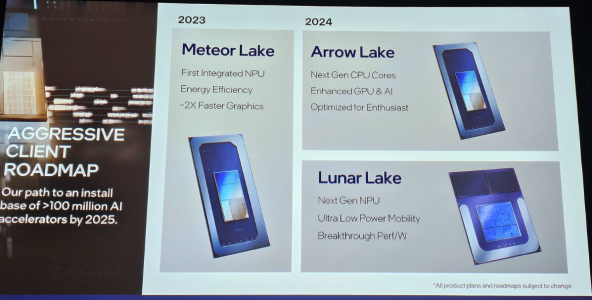
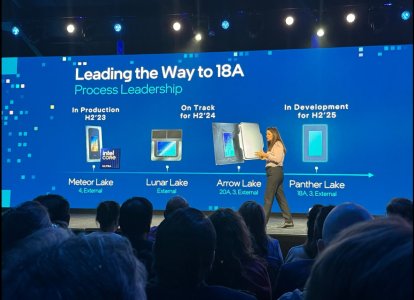
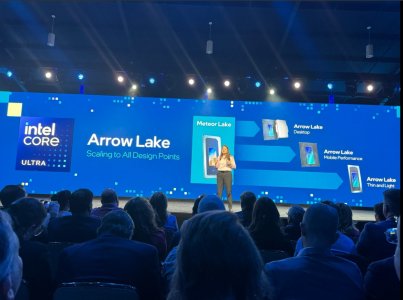
As Hot Chips 34 starting this week, Intel will unveil technical information of upcoming Meteor Lake (MTL) and Arrow Lake (ARL), new generation platform after Raptor Lake. Both MTL and ARL represent new direction which Intel will move to multiple chiplets and combine as one SoC platform.

MTL also represents new compute tile that based on Intel 4 process which is based on EUV lithography, a first from Intel. Intel expects to ship MTL mobile SoC in 2023.

ARL will come after MTL so Intel should be shipping it in 2024, that is what Intel roadmap is telling us. ARL compute tile will be manufactured by Intel 20A process, a first from Intel to use GAA transistors called RibbonFET.


LNL-MX.png
 

Attachments

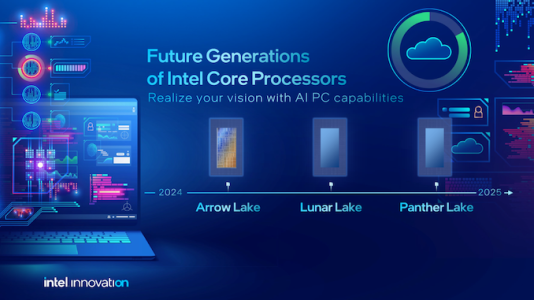
  • PantherLake.png
    PantherLake.png
    283.5 KB · Views: 24,044
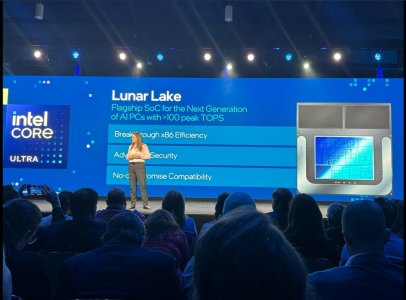
  • LNL.png
    LNL.png
    881.8 KB · Views: 25,531
  • INTEL-CORE-100-ULTRA-METEOR-LAKE-OFFCIAL-SLIDE-2.jpg
    INTEL-CORE-100-ULTRA-METEOR-LAKE-OFFCIAL-SLIDE-2.jpg
    181.4 KB · Views: 72,440
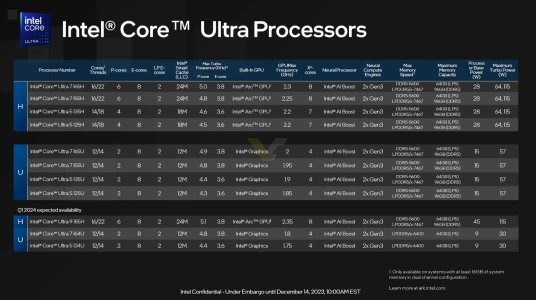
  • Clockspeed.png
    Clockspeed.png
    611.8 KB · Views: 72,327
Last edited:

poke01

Diamond Member
Mar 8, 2022
4,872
6,202
106
That's still not what emulation is. As I said we can discuss optimization but it was still native code
It wasn’t native code? Like I said M1 support wasn’t added to Intel Embree until v3.13.0.

Cinebench R23 was running on an ARM binary and that’s were the optimisation ended as it only released with v3.11 and hasn’t been updated since.
 

poke01

Diamond Member
Mar 8, 2022
4,872
6,202
106
Apple is a Trillion$ Company sure they could afford few big fixes in EMBREE also EMBREE has Better kernels for AVX2/AVX-512 the biggest it's complied using ISPC.
As far I know no one else from AMD or ARM works on Intel Embree but Intel devs.
 

Hulk

Diamond Member
Oct 9, 1999
5,401
4,110
136
Without the iPod to generate cash flow Apple never could have made the investments required to develop the iPhone. Without the iPhone driving massive economies of scale for developing their own silicon, ARM Macs wouldn't exist so yes we wouldn't be discussing those.

Without IBM making their ill-fated deal with Bill Gates you wouldn't be talking about Windows because Microsoft would be a footnote in computing history like Broderbund. You can play the "what if" game any number of ways. In one maybe Acorn ends up as the dominant PC and Intel dropped out of CPU manufacturing to focus exclusively on DRAM.
True but you missed my point.

IBM making the deal with Bill Gates was for an OS and that original OS evolved into Windows on its own merit.

Apple computers have been artificially resuscitated by the iPod/iPhone.

But in the end you are right. "Coulda, shoulda, woulda is for children."

As I have stated many times here I root for Apple even though they aren't for me. Additional competition is always good for the market.
 

poke01

Diamond Member
Mar 8, 2022
4,872
6,202
106
Let’s be honest we wouldn’t even talking about ARM Macs if Intel took the iPhone deal, kept on increasing IPC during the 2014-2020 era and didn’t stagnate.

Most people here seem hell bent on living in their bubble and accepting whatever few % you get from Intel. Wasn’t till AMD kicked Intels ass that we got Alder lake and it wasn’t till M1 came out we got Lunar Lake.

So don’t do the stupid, what if nonsense and pretend computers and chips comparisons are only for x86.

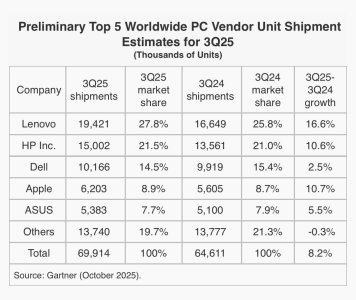
Wendel said, people and organisations are switching over to Mac and it’s obvious when you look at shipment rates.


IMG_2889.jpeg

@Hulk , good that your pixel is cheaper than iPhones but you can buy much better Chinese Android phones with much better hardware than a Pixel for much cheaper than a Pixel.

Googles heavily marks down the price of pixels because they don’t sell and come with crappy SoCs with weak video pipelines that can’t do 4K60 HDR.
 
Last edited:

Doug S

Diamond Member
Feb 8, 2020
3,837
6,788
136
Apple computers have been artificially resuscitated by the iPod/iPhone.

You're arguing that Apple's x86 Macs were helped by the iPod/iPhone? The iPhone didn't exist when Apple began doing the "I'm a Mac / I'm a PC" ads, and IMHO those were FAR more effective in selling Macs than the existence of the iPod was. It wasn't really until the iPhone 4 in 2010 that iPhone really became a hit, people forget how meager its sales were those first couple years compared to Nokia, Blackberry, and even Windows Mobile. The Mac had already been "resuscitated" by the time the iPhone took the smartphone from its techie nerd PHB niche to the mainstream.

Arguably the most effective thing Apple did back then to help the Mac gain market share was switching to Intel, which allowed people to dual boot Windows and later (when VM technology was more mature) to run Windows apps in a window on macOS. It also solved their supply issues with getting PPC chips that met their needs, and the performance gap between those and x86, which were the biggest threats to the continued existence of the Mac as a product.
 

DrMrLordX

Lifer
Apr 27, 2000
23,223
13,302
136
You're arguing that Apple's x86 Macs were helped by the iPod/iPhone?
Not speaking for anyone else, but it's more like that the fusion of CPU/SoC development for iPhone and Mac brought Mac to the next level and finally enabled Apple to become their own walled-off silo with dependency only on ARM (for now). x86 did save the Mac, but if you look at Mac sales volume and revenue, it was inevitable that eventually Apple would want to bring their entire computer ecosystem under the same ARM umbrella. And they did.
 

poke01

Diamond Member
Mar 8, 2022
4,872
6,202
106
Not speaking for anyone else, but it's more like that the fusion of CPU/SoC development for iPhone and Mac brought Mac to the next level and finally enabled Apple to become their own walled-off silo with dependency only on ARM (for now). x86 did save the Mac, but if you look at Mac sales volume and revenue, it was inevitable that eventually Apple would want to bring their entire computer ecosystem under the same ARM umbrella. And they did.
the problem here is people defending Intel medioricty in CPUs, I would much prefer and like the x86 ecosystem since its very open. Intel just doesn't care about about CPU perf anymore and its sad.
I hope Robinson can make class leading x86 cores again and Skymont is just the right step. The fact that people make excuses on why Apple is ahead rather accepting that they are good and Intel is very much behind would be a good start.
 

DavidC1

Platinum Member
Dec 29, 2023
2,184
3,331
106
You're arguing that Apple's x86 Macs were helped by the iPod/iPhone? The iPhone didn't exist when Apple began doing the "I'm a Mac / I'm a PC" ads, and IMHO those were FAR more effective in selling Macs than the existence of the iPod was. It wasn't really until the iPhone 4 in 2010 that iPhone really became a hit, people forget how meager its sales were those first couple years compared to Nokia, Blackberry, and even Windows Mobile. The Mac had already been "resuscitated" by the time the iPhone took the smartphone from its techie nerd PHB niche to the mainstream.
The iPhone sold way over a million units on it's first year. It's was a huge success, considering how new it was. You are heavily downplaying it's success.

People who were at Apple's launch, including competitors have remarked in disbelief what it was capable of. Some said they were 3-5 years ahead of then-cutting edge. And I was a kid at that time. Me and my friends who were all into computers were flabbergasted at what it was capable of doing. Onboard GPS, responsive touchscreen, accelerometer, camera, cellular, WiFi, texts, phone calls, and most importantly, it could install applications and surf the web! They imported it from the USA to get their hands on it. It took more than a year for the iPhone to start shipping to countries outside of US.

Smartphones are so ubiquitous nowadays, that applications are developed on them FIRST before PCs, and some do little more than token support.
GPU is still better on Panther lake for gaming, although for productivity M5 GPU takes a huge lead
Right now Intel is behind AMD/Nvidia architecture-wise. Lunarlake is doing ok because their hyper-focus on iGPUs and overall system integration might be better than AMD(like with being able to share L3 since Sandy Bridge days).

GPU isn't something that is like an insurmountable wall they can't overcome. Not like Netburst vs Nehalem. Because ultimately if you can fit enough shaders and put enough transistors it'll be better. An RTX 5090 is always faster than the RTX 5050. A 9 series CPU isn't necessarily better than a 3 series. If the clocks are close enough then they are same for most people.
 
Last edited:
  • Like
Reactions: Tlh97

Doug S

Diamond Member
Feb 8, 2020
3,837
6,788
136
Not speaking for anyone else, but it's more like that the fusion of CPU/SoC development for iPhone and Mac brought Mac to the next level and finally enabled Apple to become their own walled-off silo with dependency only on ARM (for now). x86 did save the Mac, but if you look at Mac sales volume and revenue, it was inevitable that eventually Apple would want to bring their entire computer ecosystem under the same ARM umbrella. And they did.

That's what I originally said then he said I missed his point, so I responded again to what (I think) he's saying his point was.
 

Khato

Golden Member
Jul 15, 2001
1,381
491
136
the problem here is people defending Intel medioricty in CPUs, I would much prefer and like the x86 ecosystem since its very open. Intel just doesn't care about about CPU perf anymore and its sad.
Sure, Intel's first priority is the stock price. But that doesn't mean that they don't care about CPU performance, they've just been failing on the execution side.

The many years of Skylake weren't what Intel intended... It's just that the process issues kept Cannon Lake from even making an appearance and resulted in only the mobile variants of Ice Lake and Tiger Lake being viable. That came with other repercussions in the forms of less prior-gen silicon feedback for the next iteration and talent bleed due to the general mess.

Royal core is a great example of Intel failing at execution despite pouring on the resources. It was a third CPU core design team on top of the P-core and E-core teams. It had goals of trouncing Apple. But after a few years of development they had nothing to show for it and what amounted to an academic research project was rightly dismantled.

I'm certainly hopeful that consolidation of resources down to a single converged core combined with cutting out the underperformers will result in a return to competent core design. But I wouldn't count on it, especially if the CEO doesn't let the engineers do what they're paid to.
 
  • Like
Reactions: Tlh97 and msj10

Hulk

Diamond Member
Oct 9, 1999
5,401
4,110
136
the problem here is people defending Intel medioricty in CPUs, I would much prefer and like the x86 ecosystem since its very open. Intel just doesn't care about about CPU perf anymore and its sad.
I hope Robinson can make class leading x86 cores again and Skymont is just the right step. The fact that people make excuses on why Apple is ahead rather accepting that they are good and Intel is very much behind would be a good start.
I think Intel does care about CPU performance. The issue is they are, and have been for quite some, struggling to compete with AMD. The last 5 or 6 years have been a desperate effort to catch up right up to the ridiculous factory overclocking and resulting degradation of Raptor Lake and its refresh. Fab issues have of course been at the root of the problem because while Intel has always had solid architecture, their fab lead ensured their products would remain ahead of AMD. AMD made a number of leaps through the Zen generations. When you couple that with TMSC's advanced nodes, the result is AMD being on par, and then ahead of Intel in many performance metrics. I would say the tide started to turn around Zen 3 and shifted in Intel's favor by Zen 4.

Also I should mention that in addition to solid architecture and TMSC's fabs, AMD put together a great product stack with 8, 12, and 16 core parts and followed this theme right up to current day. AMD was showing up 16 core for the desktop while Intel was still pushing 8 cores at their high end. Three strikes and your out. Gotta say, looking back, AMD has executed perfectly and Intels fab woes couldn't have come at a worse time.

Arrow Lake I would argue was somewhat of a comeback for Intel. Outside of gaming, Arrow Lake is a very competitive product and truth be told Arrow Lake is acceptable for gaming, it's just that AMD is demonstrably better.

I'm very much looking forward to Nova Lake and Zen 6. Hopefully they will both be successful and we can look forward to these tech giants going head-to-head for a couple more generations before some new paradigm changes the playing field.
 
  • Like
Reactions: Tlh97

511

Diamond Member
Jul 12, 2024
5,455
4,881
106
the problem here is people defending Intel medioricty in CPUs, I would much prefer and like the x86 ecosystem since its very open. Intel just doesn't care about about CPU perf anymore and its sad.
I hope Robinson can make class leading x86 cores again and Skymont is just the right step. The fact that people make excuses on why Apple is ahead rather accepting that they are good and Intel is very much behind would be a good start.
Well we tend to forget AMD/Intel spends validation time on x86_64 Apple or other ARM Vendors don't but it's precious design resource that can be spent somewhere else Apple would just cut the problem and write software about it.

Intel's main problem is that they sucked balls during 10nm debacle cause their CPUs were tied to nodes and since it took years to come out so did their designs.
It's difficult to get back your botched fab back to how it was used to which they are only starting to get together
 

Doug S

Diamond Member
Feb 8, 2020
3,837
6,788
136
Royal core is a great example of Intel failing at execution despite pouring on the resources. It was a third CPU core design team on top of the P-core and E-core teams. It had goals of trouncing Apple. But after a few years of development they had nothing to show for it and what amounted to an academic research project was rightly dismantled.

From what I read about it, it was a shoot for the moon high risk high reward endeavor. Just because they tried and failed doesn't mean they failed at execution. They may have failed at the project approval stage - trying something that just isn't possible. If so axing the project was the right call.
 

coercitiv

Diamond Member
Jan 24, 2014
7,486
17,891
136
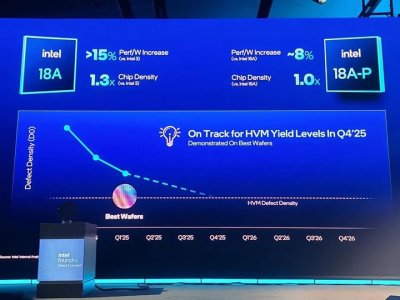
So did Intel admit that 18A yields are bad or not?
Yes. No. Yes. No. It's Intel, it's complicated inside.

They did admit it, but in a convoluted way that requires us to connect the dots. Here's two different interpretations from two news outlets:

Now, based solely on this data, we could argue that both takes have some merit. But in this forum we have the power of Internet hindsight... so let's see what Intel was saying back in April 2025:
As for the processes themselves, Intel made plenty of encouraging claims. 18A has already achieved 95%+ of its targets and the optimization areas have already been identified to tweak the process to hit or exceed 100% of those targets next quarter.
direct-connect-18A.jpg

So they were set to exceed 100% of it's targets by the second half of 2025.

Now compare this with the recent statement of their CFO on yields:
Yields are adequate to address supply, but they are not where we need them to be in order to drive the appropriate level of margins. [...] By the end of next year we will probably be in that space, and certainly the year after that they will be at what would be an industry-acceptable level.

Personally, I can only conclude that that Intel's internal targets were nowhere near what would be considered and industry-acceptable level. And that's fine, it's their targets, their internal plans. We just need to remember that when Intel says they're on track with their plans for a node, that means absolutely nothing in terms of industry standards.
 

DavidC1

Platinum Member
Dec 29, 2023
2,184
3,331
106
Sure, Intel's first priority is the stock price. But that doesn't mean that they don't care about CPU performance, they've just been failing on the execution side.

The many years of Skylake weren't what Intel intended... It's just that the process issues kept Cannon Lake from even making an appearance and resulted in only the mobile variants of Ice Lake and Tiger Lake being viable. That came with other repercussions in the forms of less prior-gen silicon feedback for the next iteration and talent bleed due to the general mess.
Intel's problems didn't happen overnight, and not just because of 10nm. 10nm failures isn't the culprit, but the consequence of problems festering in the company over decades finally coming home.

Pat should have replaced Otellini, after Sean Maloney couldn't because of his sickness(stroke).

Otellini made two fundamental mistakes, 1) Ignoring the vision of Jobs 2) Firing Pat over Larrabbee

I agree that Larrabbee was a failure. But, he should have been reprimanded instead, because it ignores his decades of contribution and achievements. I'm reminded again and again of the IBM marketer who was brilliant in her job, but got to be a manager and underperformed, so she got fired. What logic is what? Why not put her back into her original position? This is the same with Otellini firing Pat.

While Otellini for his background was a decent CEO, his background was likely also why it prevented him from seeing the big picture. At least someone with engineering at the background would have kept their solid engineering status.

(Regarding Kraznich, there's also something with fab people becoming CEOs. It seems that they are fit for roles that are exactly for that role, but fall apart when it comes to general management such as a CEO. Barrett wasn't a good CEO either. He was basically a sane Kraznich)
Personally, I can only conclude that that Intel's internal targets were nowhere near what would be considered and industry-acceptable level. And that's fine, it's their targets, their internal plans. We just need to remember that when Intel says they're on track with their plans for a node, that means absolutely nothing in terms of industry standards.
Intel used to be the standard. They were considered legendary for process yields, and what standards they held themselves against. Their transistors even looked cleaner and neater compared to everyone else. Pride is really before a fall.
 
Last edited:
  • Like
Reactions: Win2012R2

DavidC1

Platinum Member
Dec 29, 2023
2,184
3,331
106
From what I read about it, it was a shoot for the moon high risk high reward endeavor. Just because they tried and failed doesn't mean they failed at execution. They may have failed at the project approval stage - trying something that just isn't possible. If so axing the project was the right call.
Their history is basically relying on one project to save themselves. What they need is more stability. Pat Gelsinger became famous over his roles on 486, which saved Intel from their radical project, I forgot the name, iAP6 or whatever. That was their 80's Itanium. Then in the 90's, it was Itanium, and in the 2000's, it was Netburst, which had to be saved by the Israeli team's design, Conroe/Merom. Now, it seems they have to rely on the E core team, because it's the Israeli team that's failing. However, that overlooks the fact that Kraznich fired a lot of important people that brought success to Intel using Conroe. Remember Mooly Eden? David "Dadi" Perlmutter?

The reason I cheer on the E core team is because they are able to make big changes and new ideas while delivering. I know some will roll their eyes again, but it's plain simple. Look at the evolution of the E core. It's not following the big core. The amount of things they "break" and change is at multiples of what the P core did. I know this, because ever since I started reading about CPUs, I wanted them to bring something bigger. When I was younger I even sent an email to Intel saying "Why is Northwood just a cache increase?".

I speculate one reason that they keep having these cycles is because they change their CEOs too much. They'd be much better off with a good CEO that stays there for decades, like Jensen.
 
Last edited:
  • Like
Reactions: Win2012R2