Discussion Intel Meteor, Arrow, Lunar & Panther Lakes + WCL Discussion Threads

Page 237 - Seeking answers? Join the AnandTech community: where nearly half-a-million members share solutions and discuss the latest tech.

Tigerick

Senior member
Apr 1, 2022
910
828
106
Wildcat Lake (WCL) Preliminary Specs

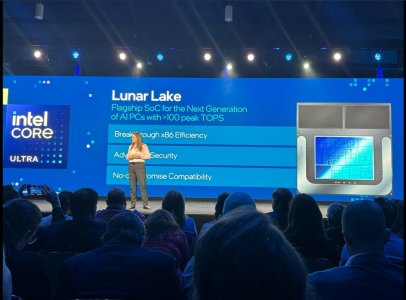
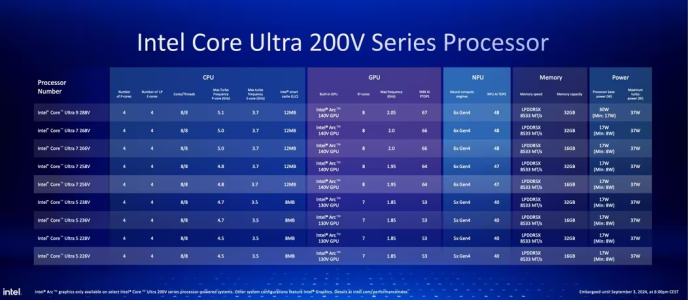
Intel Wildcat Lake (WCL) is upcoming mobile SoC replacing ADL-N. WCL consists of 2 tiles: compute tile and PCD tile. It is true single die consists of CPU, GPU and NPU that is fabbed by 18-A process. Last time I checked, PCD tile is fabbed by TSMC N6 process. They are connected through UCIe, not D2D; a first from Intel. Expecting launching in Q2/Computex 2026. In case people don't remember AlderLake-N, I have created a table below to compare the detail specs of ADL-N and WCL. Just for fun, I am throwing LNL and upcoming Mediatek D9500 SoC.

Intel Alder Lake - NIntel Wildcat LakeIntel Lunar LakeMediatek D9500
Launch DateQ1-2023Q2-2026 ?Q3-2024Q3-2025
ModelIntel N300?Core Ultra 7 268VDimensity 9500 5G
Dies2221
NodeIntel 7 + ?Intel 18-A + TSMC N6TSMC N3B + N6TSMC N3P
CPU8 E-cores2 P-core + 4 LP E-cores4 P-core + 4 LP E-coresC1 1+3+4
Threads8688
Max Clock3.8 GHz?5 GHz
L3 Cache6 MB?12 MB
TDP7 WFanless ?17 WFanless
Memory64-bit LPDDR5-480064-bit LPDDR5-6800 ?128-bit LPDDR5X-853364-bit LPDDR5X-10667
Size16 GB?32 GB24 GB ?
Bandwidth~ 55 GB/s136 GB/s85.6 GB/s
GPUUHD GraphicsArc 140VG1 Ultra
EU / Xe32 EU2 Xe8 Xe12
Max Clock1.25 GHz2 GHz
NPUNA18 TOPS48 TOPS100 TOPS ?


PPT1.jpg
PPT2.jpg
PPT3.jpg


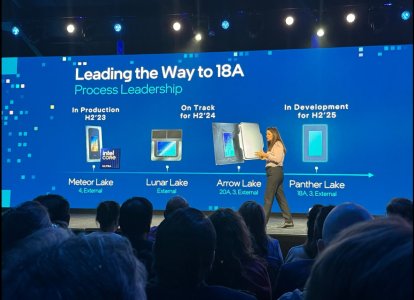
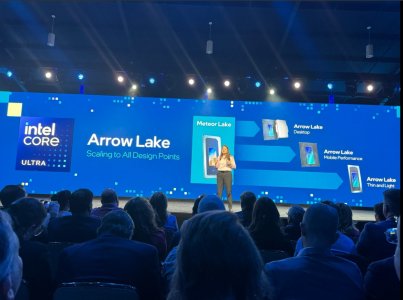
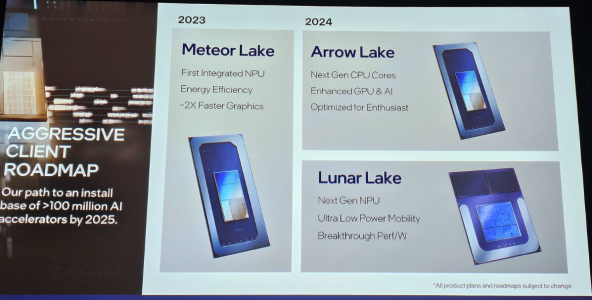
As Hot Chips 34 starting this week, Intel will unveil technical information of upcoming Meteor Lake (MTL) and Arrow Lake (ARL), new generation platform after Raptor Lake. Both MTL and ARL represent new direction which Intel will move to multiple chiplets and combine as one SoC platform.

MTL also represents new compute tile that based on Intel 4 process which is based on EUV lithography, a first from Intel. Intel expects to ship MTL mobile SoC in 2023.

ARL will come after MTL so Intel should be shipping it in 2024, that is what Intel roadmap is telling us. ARL compute tile will be manufactured by Intel 20A process, a first from Intel to use GAA transistors called RibbonFET.


LNL-MX.png
 

Attachments

  • PantherLake.png
    PantherLake.png
    283.5 KB · Views: 24,034
  • LNL.png
    LNL.png
    881.8 KB · Views: 25,527
  • INTEL-CORE-100-ULTRA-METEOR-LAKE-OFFCIAL-SLIDE-2.jpg
    INTEL-CORE-100-ULTRA-METEOR-LAKE-OFFCIAL-SLIDE-2.jpg
    181.4 KB · Views: 72,435
  • Clockspeed.png
    Clockspeed.png
    611.8 KB · Views: 72,321
Last edited:

H433x0n

Golden Member
Mar 15, 2023
1,224
1,606
106
No, even if they made a reticle limit DG2-1024 at 450W they'd still be behind the 7900 XTX in raytracing performance. So-called architectural advantage does not exist if you can't build bigger. It doesn't exist so they're not number 2. Same thing with AMD saying one of the advantages of their multi-chip architecture is that they could build a supermassive 400mm + 8 MCD RDNA3 chip to match the 4090. OK cool, but they didn't so it's whiteboard cope & dreams and they stay #2.

To summarize: if your raster performance is 0.5x RDNA3 per area on iso process it doesn't matter that you have -23% RT performance and they have -45% you're still 0.7x RT performance per area on iso process. Their raster is just really, really bad.
Let's setup a hypothetical:

RDNA4 improves RT performance drastically and enabling RT incurs a 30% performance hit. However, the 7900 XTX still outperforms it because it has a higher raster perf baseline. Would you consider RDNA4 RT perf to be a regression in that case? If you do, I can understand it, but I would disagree.

To me in that example scenario, I would still say RDNA4 has improved RT performance.
 

Khato

Golden Member
Jul 15, 2001
1,318
391
136
With respect to Intel's graphics, the better comparison at current is between Meteor Lake and Phoenix/Hawk Point. GPU die size is comparable despite the process node advantage for AMD. Intel may well be a bit slower and less efficient, but it's close. It'll be interesting to see what kind of improvements Intel brings with Arrow Lake and Lunar Lake compared to AMD's Strix Point. The additional CUs will almost certainly best the minor gains on Arrow Lake, but how it fares against the larger Xe2 based Lunar Lake will be most interesting.
 

gdansk

Diamond Member
Feb 8, 2011
4,680
7,906
136
To me in that example scenario, I would still say RDNA4 has improved RT performance.
It has improved RT performance but would have done nothing to become #1 in raytracing. Which was my problem with Igor's claim of Intel being #2.
 
  • Like
Reactions: Tlh97

gdansk

Diamond Member
Feb 8, 2011
4,680
7,906
136
With respect to Intel's graphics, the better comparison at current is between Meteor Lake and Phoenix/Hawk Point.
While it would be most relevant to this thread we can't normalize for the rest of the test configuration.
 

Khato

Golden Member
Jul 15, 2001
1,318
391
136
While it would be most relevant to this thread we can't normalize for the rest of the test configuration.
I take it you're referring to memory bandwidth? Or power consumption?

Regardless, the interesting point to keep in mind with Intel's graphics is that DG2 was effectively Intel's first serious attempt at a large, high performance part. Which was pretty obvious with the resulting poor PPA. Meteor Lake fixed some of the issues with the design, Xe2 will fix even more. I'm still surprised that Meteor Lake is pretty much on par with RDNA3.
 
  • Like
Reactions: igor_kavinski

gdansk

Diamond Member
Feb 8, 2011
4,680
7,906
136
I take it you're referring to memory bandwidth? Or power consumption?

Regardless, the interesting point to keep in mind with Intel's graphics is that DG2 was effectively Intel's first serious attempt at a large, high performance part. Which was pretty obvious with the resulting poor PPA. Meteor Lake fixed some of the issues with the design, Xe2 will fix even more. I'm still surprised that Meteor Lake is pretty much on par with RDNA3.
Yes to both. Even CPU performance differences and sustained cooling.

MTL seems much closer but since they're both in the realm of "RT performance is useless" it doesn't support Igor's claim either. But it bodes well for BM.
 
  • Like
Reactions: Tlh97 and moinmoin

DrMrLordX

Lifer
Apr 27, 2000
23,058
13,162
136
RDNA4 improves RT performance drastically and enabling RT incurs a 30% performance hit. However, the 7900 XTX still outperforms it because it has a higher raster perf baseline. Would you consider RDNA4 RT perf to be a regression in that case?
Yes. It would be a total regression in performance by every metric.
 

DavidC1

Platinum Member
Dec 29, 2023
2,003
3,150
96
Compared to MTL-H's iGPU, below is the major changes in ARL's iGPU:

  • Doubled L2 cache.
  • Doubled RT throughput.
  • XMX cores added.
Are you going to address my questions I asked earlier Tigerick?
To me in that example scenario, I would still say RDNA4 has improved RT performance.
Yes, but that would be a very unbalanced architecture. If the die sizes are same, it means this hypothetical RDNA4 has dedicated too much to improving RT performance when it has to be balanced for all workloads, including raster.

It's equal to if Zen 5/Lion Cove reduces CPU performance by 20% but improves AI performance by 20x. Yay?
 

DavidC1

Platinum Member
Dec 29, 2023
2,003
3,150
96
Latest advanced 3D packaging technologies like foveros are very interesting when compared to old and outdated substrate based 2.5D tech like in Zen5.
Ok, but Meteorlake sometimes underperforms the predecessor at the same clock, while Zen series was faster in every way, and competitive with monolithic Raptorlake.

You say fancy things, you dress it up fancy, but it ends up being plane jane. How many people outside of Intel fans will see it otherwise?

They used to lead in DDR implementation, memory controller performance, and caches. Ah, but it's just the fault of the "process" right? RIGHT?
 
  • Like
Reactions: Thibsie and Tlh97
Jul 27, 2020
28,173
19,203
146
Which was my problem with Igor's claim of Intel being #2.
They have better RT cores, do they not? Regardless of whether they are using more die area for that. I like the fact that if I suddenly developed an RT fetish, I could get an A770 or the Battlemage A870 and satisfy that urge without making Jensen richer.
 

coercitiv

Diamond Member
Jan 24, 2014
7,443
17,731
136
Foveros is top tier packaging, it just happens to hang around with some very shady core types. I fear some day we'll find it face down in some organic substrate, a victim of circumstance. Such awesome potential, such a sad story.
 
Jul 27, 2020
28,173
19,203
146
It's equal to if Zen 5/Lion Cove reduces CPU performance by 20% but improves AI performance by 20x. Yay?
AMD would love that for bragging rights. Some previously infeasible AI applications would become a reality. So yeah, that would be a YAY!
 

FlameTail

Diamond Member
Dec 15, 2021
4,384
2,762
106
Foveros is top tier packaging, it just happens to hang around with some very shady core types. I fear some day we'll find it face down in some organic substrate, a victim of circumstance. Such awesome potential, such a sad story.
Foveros, Lion Cove and Alchemist walk into a bar...
 
  • Haha
Reactions: lightmanek

Hulk

Diamond Member
Oct 9, 1999
5,206
3,838
136
Ok, but Meteorlake sometimes underperforms the predecessor at the same clock, while Zen series was faster in every way, and competitive with monolithic Raptorlake.

You say fancy things, you dress it up fancy, but it ends up being plane jane. How many people outside of Intel fans will see it otherwise?

They used to lead in DDR implementation, memory controller performance, and caches. Ah, but it's just the fault of the "process" right? RIGHT?

You have some good points here. I'll try to answer.

If Foveros is so great then why is there such a performance hit when moving from monolithic Raptor Cove to supposedly superior Redwood Cove and Foveros?

There will always be a performance loss/increase in latency when moving from monolithic to tiles. Intel slightly improved Redwood Cove to try and offset that in moving to Meteor Lake.

AMD made the move to tiles many generations ago so when moving through current generations they were on equal footing (all tiled).

But your original point is a good one. Tiled Zen 4 still had at least as good, probably better IPC than tiled Redwood Cove despite all this hype regarding Foveros. Why?

Couple of reasons. Zen 4 core is really good, better than we even thought as it "makes up for being tiled." Foveros isn't really doing anything special compared to AMD tiled solution.

AMD has had a couple of generation to get their tiled "act" together. This of course doesn't help Intel because you are right, they did a lot of talking and Meteor Lake is just "okay" in my opinion.
 
Last edited:

jpiniero

Lifer
Oct 1, 2010
16,984
7,384
136
You have some good points here. I'll try to answer.

If Foveros is so great then why is there such a performance hit when moving from monolithic Raptor Cove to supposedly superior Redwood Cove and Foveros?

Meteor Lake is better than Raptor Lake. Just not all that much. That more likely has to do with Intel 4 than Foveros.
 

FlameTail

Diamond Member
Dec 15, 2021
4,384
2,762
106
You have some good points here. I'll try to answer.

If Foveros is so great then why is there such a performance hit when moving from monolithic Raptor Cove to supposedly superior Redwood Cove and Foveros?

There will always be a performance loss/increase in latency when moving from monolithic to tiles. Intel slightly improved Redwood Cove to try and offset that in moving to Meteor Lake.

AMD made the move to tiles many generations ago so when moving through current generations they were on equal footing (all tiled).

But your original point is a good one. Tiled Zen 4 still had at least as good, probably better IPC than tiled Redwood Cove despite all this hype regarding Foveros. Why

Couple of reasons. Zen 4 core is really good, better than we even thought as it "makes up for being tiled." Foveros isn't really doing anything special compared to AMD tiled solution.

AMD has had a couple of generation to get their tiled "act" together. This of course doesn't help Intel because you are right, they did a lot of talking and Meteor Lake is just "okay" in my opinion.
Why are you calling AMD chiplets as 'tiles'?

its-treason-then-palestine.gif
 

Hulk

Diamond Member
Oct 9, 1999
5,206
3,838
136
Meteor Lake is better than Raptor Lake. Just not all that much. That more likely has to do with Intel 4 than Foveros.
Better in what ways?

Efficiency, then yes of course.

IPC? I don't think so but I could be wrong? I was under the impression that Raptor Lake does better than Meteor at iso frequency?
 

Hitman928

Diamond Member
Apr 15, 2012
6,746
12,466
136
Better in what ways?

Efficiency, then yes of course.

IPC? I don't think so but I could be wrong? I was under the impression that Raptor Lake does better than Meteor at iso frequency?

IPC I think is basically equal across a large testing suite. Loads that are really latency sensitive probably perform worse on MTL clock for clock.
 

adroc_thurston

Diamond Member
Jul 2, 2023
7,809
10,516
106
Latest advanced 3D packaging technologies like foveros
It's not 3D, the base is passive.
and outdated substrate based 2.5D tech like in Zen5.
That's 2D flipchip.
2.5D is passive slabs a-la MTL.
MTL has a brand new NOC.
It's IOSF. From 2012.
You can even like look for MTL hotchips slideware.
If Foveros is so great then why is there such a performance hit when moving from monolithic Raptor Cove to supposedly superior Redwood Cove and Foveros?
Because they moved the relevant bits (IMC and pretty much the rest of the uncore) from the ring to IOSF.