Discussion Intel Meteor, Arrow, Lunar & Panther Lakes + WCL Discussion Threads

Page 607 - Seeking answers? Join the AnandTech community: where nearly half-a-million members share solutions and discuss the latest tech.

Tigerick

Senior member
Apr 1, 2022
942
857
106
Wildcat Lake (WCL) Specs

Intel Wildcat Lake (WCL) is upcoming mobile SoC replacing Raptor Lake-U. WCL consists of 2 tiles: compute tile and PCD tile. It is true single die consists of CPU, GPU and NPU that is fabbed by 18-A process. Last time I checked, PCD tile is fabbed by TSMC N6 process. They are connected through UCIe, not D2D; a first from Intel. Expecting launching in Q1 2026.
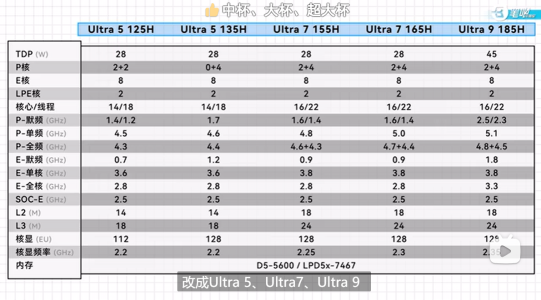
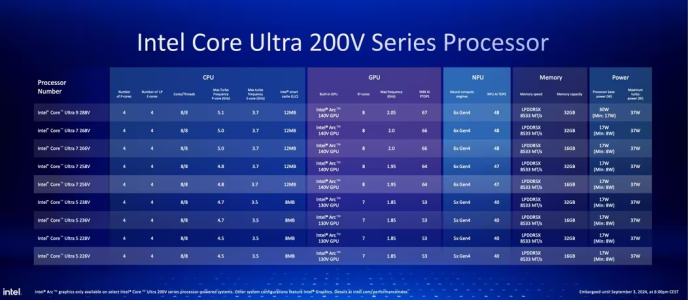
Intel Raptor Lake UIntel Wildcat Lake 15W?Intel Lunar LakeIntel Panther Lake 4+0+4
Launch DateQ1-2024Q2-2026Q3-2024Q1-2026
ModelIntel 150UIntel Core 7Core Ultra 7 268VCore Ultra 7 365
Dies2223
NodeIntel 7 + ?Intel 18-A + TSMC N6TSMC N3B + N6Intel 18-A + Intel 3 + TSMC N6
CPU2 P-core + 8 E-cores2 P-core + 4 LP E-cores4 P-core + 4 LP E-cores4 P-core + 4 LP E-cores
Threads12688
Max Clock5.4 GHz?5 GHz4.8 GHz
L3 Cache12 MB12 MB12 MB
TDP15 - 55 W15 W ?17 - 37 W25 - 55 W
Memory128-bit LPDDR5-520064-bit LPDDR5128-bit LPDDR5x-8533128-bit LPDDR5x-7467
Size96 GB32 GB128 GB
Bandwidth136 GB/s
GPUIntel GraphicsIntel GraphicsArc 140VIntel Graphics
RTNoNoYESYES
EU / Xe96 EU2 Xe8 Xe4 Xe
Max Clock1.3 GHz?2 GHz2.5 GHz
NPUGNA 3.018 TOPS48 TOPS49 TOPS


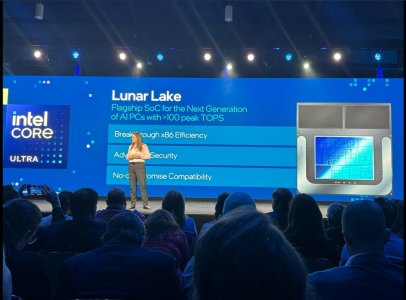
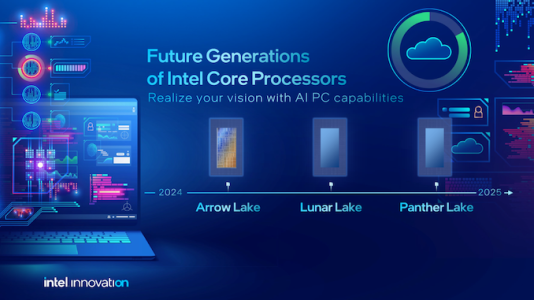
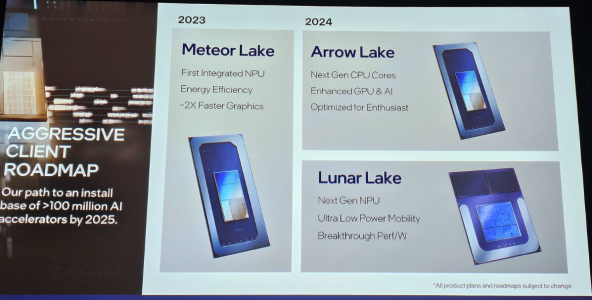
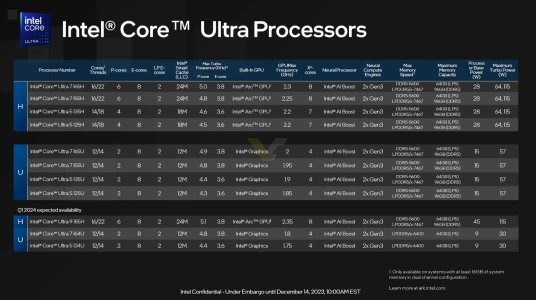
PPT1.jpg
PPT2.jpg
PPT3.jpg


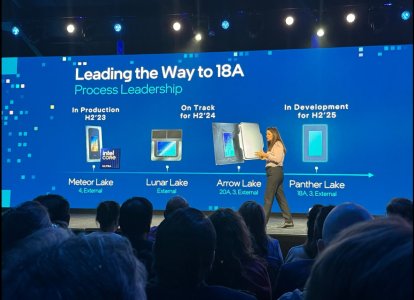
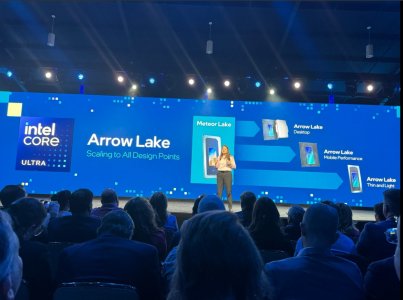
As Hot Chips 34 starting this week, Intel will unveil technical information of upcoming Meteor Lake (MTL) and Arrow Lake (ARL), new generation platform after Raptor Lake. Both MTL and ARL represent new direction which Intel will move to multiple chiplets and combine as one SoC platform.

MTL also represents new compute tile that based on Intel 4 process which is based on EUV lithography, a first from Intel. Intel expects to ship MTL mobile SoC in 2023.

ARL will come after MTL so Intel should be shipping it in 2024, that is what Intel roadmap is telling us. ARL compute tile will be manufactured by Intel 20A process, a first from Intel to use GAA transistors called RibbonFET.


LNL-MX.png
 

Attachments

  • PantherLake.png
    PantherLake.png
    283.5 KB · Views: 24,044
  • LNL.png
    LNL.png
    881.8 KB · Views: 25,531
  • INTEL-CORE-100-ULTRA-METEOR-LAKE-OFFCIAL-SLIDE-2.jpg
    INTEL-CORE-100-ULTRA-METEOR-LAKE-OFFCIAL-SLIDE-2.jpg
    181.4 KB · Views: 72,440
  • Clockspeed.png
    Clockspeed.png
    611.8 KB · Views: 72,327
Last edited:

AcrosTinus

Senior member
Jun 23, 2024
221
226
76
Wonder how many Intel employees have their parachutes at the ready...
I won't blame them, their tiles seem to be quite bad, higher latency than AMDs cheaper approach somehow....

No wonder they started reducing the complexity on the server parts, xeon 6 is in fact 3 monolithic dies and turin is really a chiplet design because the smallest part is a 8 core cluster not a 44 core one.
 

511

Diamond Member
Jul 12, 2024
5,464
4,890
106
I won't blame them, their tiles seem to be quite bad, higher latency than AMDs cheaper approach somehow....

No wonder they started reducing the complexity on the server parts, xeon 6 is in fact 3 monolithic dies and turin is really a chiplet design because the smallest part is a 8 core cluster not a 44 core one.
EMIB and Foveros are two different things it's not the tiles but the fabric the Ring and NOC dragging it down
 

511

Diamond Member
Jul 12, 2024
5,464
4,890
106
Tiles from an Actual Intel Engineer

I can answer some of that actually. ARL is an MTL successor and ARL-S belongs to the same family of chips as MTL-S. They share a lot of DNA, right down to how tiles were laid out.

The splitting of the CPU, SoC, I/O, and GPU was done on MTL to power down parts that don't need it. You also get to pick and choose process nodes at will to balance performance and cost for each subsystem. The tiny iGPU doesn't need the absolute best, so it gets 5nm. We're not exactly making some super APU here, just drive a couple monitors. The CPU needs to be on the bleeding edge, so it gets 3nm. SoC and I/O don't generally scale down that well, so they get even older nodes than the iGPU because there's not much point in using anything better.

LNL needs everything to be super localized as they can't afford interconnect losses in that power segment as MTL-U proves, so it gets to be basically monolithic with the APU tile and I/O tile split. The die is also small enough that the yields and cost of 3nm are still very reasonable. LNL's APU tile is similar in size to some upcoming Smartphone SoCs.

Building ARL like LNL would have been insanely expensive as that's a ton of 3nm silicon, so it got carved up. I suspect the reason for the GPU being split off is to reuse MTL stuff. Even if it isn't the exact same tile, they've done a 4 Xe core iGPU on its own tile before.

IMO, and I say this as a die packaging engineer, there should be 3 tiles (plus interposer) here. The CPU cores and memory controller can go together to give the latency-sensitive cores the fastest access possible. Foveros latency isn't completely atrocious, but it's never beating being on-die. Nothing on SoC needs super low latency so that's fine, and we can combine in the GPU here so it still gets a link to the tile that has the memory controller on it rather than needing to go through the SoC tile to the CPU tile for it. I/O can stay split off by itself. Nothing on the I/O tile scales down very well, nor is there any substantial benefit to combining it with other tiles, so it can stay as is.
 

511

Diamond Member
Jul 12, 2024
5,464
4,890
106
IMO, and I say this as a die packaging engineer, there should be 3 tiles (plus interposer) here. The CPU cores and memory controller can go together to give the latency-sensitive cores the fastest access possible. Foveros latency isn't completely atrocious, but it's never beating being on-die. Nothing on SoC needs super low latency so that's fine, and we can combine in the GPU here so it still gets a link to the tile that has the memory controller on it rather than needing to go through the SoC tile to the CPU tile for it. I/O can stay split off by itself. Nothing on the I/O tile scales down very well, nor is there any substantial benefit to combining it with other tiles, so it can stay as is.
Basically the design choices were wrong for desktop
Can someone delete this post as it is a duplicate post
Some Moderator 🙂
 
Last edited:

desrever

Senior member
Nov 6, 2021
341
832
136
If other reviewers show what the leaked review does (more or less) and it wasn't due to a bad motherboard or something, I am curious to see if outlets will publish multiple videos on how Intel was lying about performance in their pre-release marketing slides :unamused:
They will instead make videos on "we decided not to do gaming benchmarks", "the performance per dollar in cinebench r24 is unmatched" and "Give Intel a chance to release new bios, we need competition"
 
Jul 27, 2020
28,174
19,218
146
I don't know. Results are not very typical. I will wait for other tests. I expect it to do much better if the scheduler wakes up.
It was someone on this forum who not sure if he was joking or serious but I think I read that Microsoft has a special Win11 patch slated for release soon after Arrow Lake.