Discussion Intel Meteor, Arrow, Lunar & Panther Lakes + WCL Discussion Threads

Page 342 - Seeking answers? Join the AnandTech community: where nearly half-a-million members share solutions and discuss the latest tech.

Tigerick

Senior member
Apr 1, 2022
941
857
106
Wildcat Lake (WCL) Specs

Intel Wildcat Lake (WCL) is upcoming mobile SoC replacing Raptor Lake-U. WCL consists of 2 tiles: compute tile and PCD tile. It is true single die consists of CPU, GPU and NPU that is fabbed by 18-A process. Last time I checked, PCD tile is fabbed by TSMC N6 process. They are connected through UCIe, not D2D; a first from Intel. Expecting launching in Q1 2026.
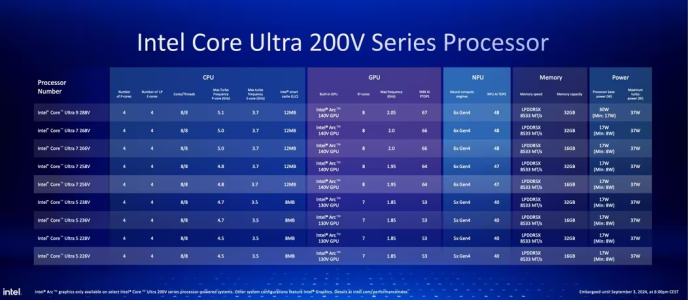
Intel Raptor Lake UIntel Wildcat Lake 15W?Intel Lunar LakeIntel Panther Lake 4+0+4
Launch DateQ1-2024Q2-2026Q3-2024Q1-2026
ModelIntel 150UIntel Core 7Core Ultra 7 268VCore Ultra 7 365
Dies2223
NodeIntel 7 + ?Intel 18-A + TSMC N6TSMC N3B + N6Intel 18-A + Intel 3 + TSMC N6
CPU2 P-core + 8 E-cores2 P-core + 4 LP E-cores4 P-core + 4 LP E-cores4 P-core + 4 LP E-cores
Threads12688
Max Clock5.4 GHz?5 GHz4.8 GHz
L3 Cache12 MB12 MB12 MB
TDP15 - 55 W15 W ?17 - 37 W25 - 55 W
Memory128-bit LPDDR5-520064-bit LPDDR5128-bit LPDDR5x-8533128-bit LPDDR5x-7467
Size96 GB32 GB128 GB
Bandwidth136 GB/s
GPUIntel GraphicsIntel GraphicsArc 140VIntel Graphics
RTNoNoYESYES
EU / Xe96 EU2 Xe8 Xe4 Xe
Max Clock1.3 GHz?2 GHz2.5 GHz
NPUGNA 3.018 TOPS48 TOPS49 TOPS


PPT1.jpg
PPT2.jpg
PPT3.jpg


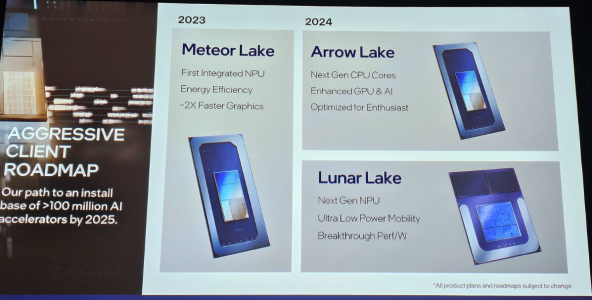
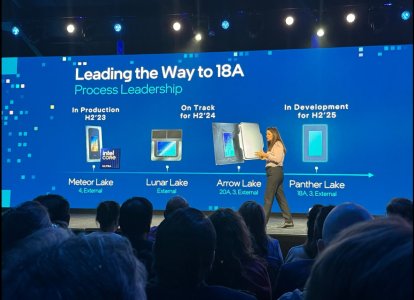
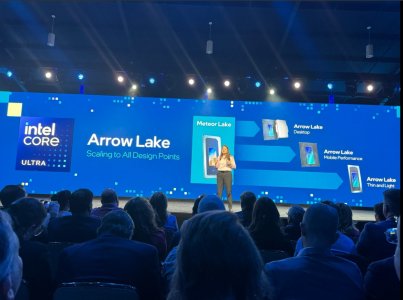
As Hot Chips 34 starting this week, Intel will unveil technical information of upcoming Meteor Lake (MTL) and Arrow Lake (ARL), new generation platform after Raptor Lake. Both MTL and ARL represent new direction which Intel will move to multiple chiplets and combine as one SoC platform.

MTL also represents new compute tile that based on Intel 4 process which is based on EUV lithography, a first from Intel. Intel expects to ship MTL mobile SoC in 2023.

ARL will come after MTL so Intel should be shipping it in 2024, that is what Intel roadmap is telling us. ARL compute tile will be manufactured by Intel 20A process, a first from Intel to use GAA transistors called RibbonFET.


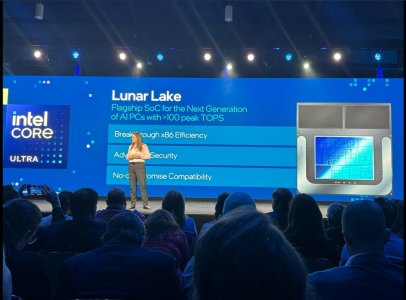
LNL-MX.png
 

Attachments

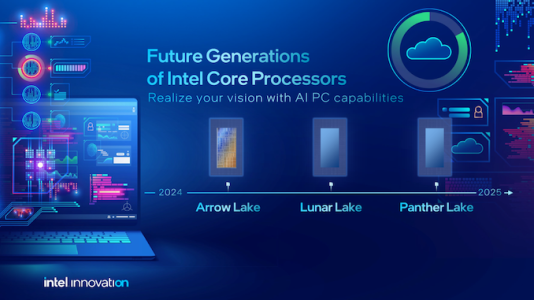
  • PantherLake.png
    PantherLake.png
    283.5 KB · Views: 24,042
  • LNL.png
    LNL.png
    881.8 KB · Views: 25,531
  • INTEL-CORE-100-ULTRA-METEOR-LAKE-OFFCIAL-SLIDE-2.jpg
    INTEL-CORE-100-ULTRA-METEOR-LAKE-OFFCIAL-SLIDE-2.jpg
    181.4 KB · Views: 72,439
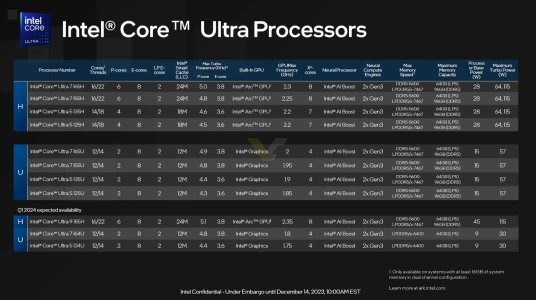
  • Clockspeed.png
    Clockspeed.png
    611.8 KB · Views: 72,325
Last edited:

Ghostsonplanets

Senior member
Mar 1, 2024
774
1,228
96

DavidC1

Platinum Member
Dec 29, 2023
2,154
3,293
106
This matches what Exist has said for years, including that P Core tried to kill E core team and also others Cores projects at Intel. And that they were very adversarial against Jim Keller while the E core team was very helpful and accepted his guidance.
Being able to admit that you are wrong and accept guidance with a willing spirit is what makes society advance.
 

FlameTail

Diamond Member
Dec 15, 2021
4,384
2,762
106
This matches what Exist has said for years, including that P Core tried to kill E core team and also others Cores projects at Intel. And that they were very adversarial against Jim Keller while the E core team was very helpful and accepted his guidance.
Interesting. I have some thoughts, but they best remain unspoken.
 

Hulk

Diamond Member
Oct 9, 1999
5,355
4,056
136
That was made to achieve better efficiency. In Lunar Lake, E-cores are always active. Having more E cores will increase the idle power consumption. Intel is planning to turn off the whole P-cluster when it's not used.
Watching that video with the Intel engineers, they also say the P cores can be completely shut down and the CPU can run off the E's, and vice-versa.
 
  • Like
Reactions: lightmanek

DavidC1

Platinum Member
Dec 29, 2023
2,154
3,293
106
I will predict the real highlight of the E core team will come with Arctic Wolf - the next big gain, with another 30% gain.

If the decline is to be expected, then it'll be after Arctic Wolf, just as Sandy Bridge was peak for IDC.

The fact that such a small core can perform that close to the P cores is a big suggestion that x64 cores have a long way to go. We will see if they manage to overcome ARM again.
 
  • Like
Reactions: Henry swagger

Ghostsonplanets

Senior member
Mar 1, 2024
774
1,228
96
Being able to admit that you are wrong and accept guidance with a willing spirit is what makes society advance.
Indeed.

Also, if Exist is right, Skymont is a direct result of Jim Keller pushing the E Core team. IIRC Keller pushed E Core team to make a core that maintain impressive PPA while aiming at matching or besting AMD Zen cores performance.

So the next E core might be a funny thing when compared to the P core (Perhaps the E core was the true Royal Core all along hahaha).

Question is if we'll see it on NVL or WCL.
 

Hulk

Diamond Member
Oct 9, 1999
5,355
4,056
136
Can someone explain further the from the Intel engineers video?

Extended scalability - IP agnostic and partition agnostic
 

SarahKerrigan

Senior member
Oct 12, 2014
735
2,036
136
Indeed.

Also, if Exist is right, Skymont is a direct result of Jim Keller pushing the E Core team. IIRC Keller pushed E Core team to make a core that maintain impressive PPA while aiming at matching or besting AMD Zen cores performance.

So the next E core might be a funny thing when compared to the P core (Perhaps the E core was the true Royal Core all along hahaha).

Question is if we'll see it on NVL or WCL.

The real Royal Core was the friends we made along the way.
 

Ghostsonplanets

Senior member
Mar 1, 2024
774
1,228
96
Can someone explain further the from the Intel engineers video?

Extended scalability - IP agnostic and partition agnostic
Chips and Cheese had a very short but good explanation. Basically Intel P core team finally got rid of the old design methodology "Sea of fubs" that was more hand designed and specific for each node, which limited portability to other nodes, needing significant rework to be ported and that was very expensive and time consuming to make small changes.

Intel new approach for P cores is more usage of computer assisted design with usage of big cells, which allows them to make finer changes to their cores without being as so time consuming and also be more node agnostic, which means easier portability between different nodes/foundries.
 

DavidC1

Platinum Member
Dec 29, 2023
2,154
3,293
106

FlameTail

Diamond Member
Dec 15, 2021
4,384
2,762
106
I will predict the real highlight of the E core team will come with Arctic Wolf - the next big gain, with another 30% gain.

If the decline is to be expected, then it'll be after Arctic Wolf, just as Sandy Bridge was peak for IDC.
What is Arctic Wolf? Darkmont successor?
The fact that such a small core can perform that close to the P cores is a big suggestion that x64 cores have a long way to go. We will see if they manage to overcome ARM again.
x86 needs wide, high-IPC cores that run at reasonable frequencies...
 
  • Like
Reactions: Henry swagger

DavidC1

Platinum Member
Dec 29, 2023
2,154
3,293
106
What is Arctic Wolf? Darkmont successor?
Yes, Darkmont is basically like Crestmont, previous generation's shrink.

Continuing on for Skymont,
The core is only bigger than the ARM's E cores. They are fraction of the size of modern ARM cores now.

2.2mm2 on A17 versus 1mm2 for Skymont on the same process technology. The Cortex cores on N4/N5 are in the 3mm2 range. Basically saying they aren't compact anymore. They are basically P cores level, that's why they perform like one. x86 vs ARM argument to be disapproved once again.

And again, people follow the crowd to erroneous conclusions rather than think for themselves. It's the people that make the difference, nothing else.
 

yottabit

Golden Member
Jun 5, 2008
1,671
874
146
Indeed.

Also, if Exist is right, Skymont is a direct result of Jim Keller pushing the E Core team. IIRC Keller pushed E Core team to make a core that maintain impressive PPA while aiming at matching or besting AMD Zen cores performance.

So the next E core might be a funny thing when compared to the P core (Perhaps the E core was the true Royal Core all along hahaha).

Question is if we'll see it on NVL or WCL.
So it sounds like we’re a generation or two away from wishing for an “Oops, all E core” edition when we just got done clamoring for an “Oops, all P core” model

How the turntables
 

DavidC1

Platinum Member
Dec 29, 2023
2,154
3,293
106
It seems the P core is doing better relative to the competition. 3mm2 for Lion Cove on N3B is on par with 4.xmm2 for Zen 5 on N4. At least they got that right. Those are figures with L2 cache included.

The area difference used to be almost 2x.
 
Last edited:
  • Love
Reactions: SiliconFly

Wolverine2349

Senior member
Oct 9, 2022
531
184
86
So it sounds like we’re a generation or two away from wishing for an “Oops, all E core” edition when we just got done clamoring for an “Oops, all P core” model

How the turntables

I think that has more to do with not liking hybrid arch and scheduling quirks as the bashing of the e-cores and thus wanting an all P core edition cause P cores so much stronger,

And an all e-core edition even if not hybrid anymore its Gracemont which is just poor man's Skylake IPC with better Integer but much worse floating point and latency.

The sounds like we are wishing for an all e-core edition in a few generations is based on the assumption if (maybe big if or maybe not????) the e-cores can keep progressing the way they do, they will become the new P cores being smaller and more power efficient and the hybrid arch goes away.

After all the only reason Intel came up with the Big.Little P and e-cores is because the P cores were too big and not die space efficient due to their process node unlike AMD and TSMC where their P cores were smaller and they could fit more in a LGA 1700/1800/AM4/AM5 consumer sized socket.

Well now that the Intel Austin Atom core team appears to be advancing the e-cores to be like P cores and solve the problems of P cores being big, no Big.Little is/would necessary anymore. I doubt Intel ever makes Big.Little for desktop CPUs if the Austin Atom core team invested resources and was not stubborn in process node and refusing to use TSMC into making P cores smaller and more efficient just 3-4 years ago.

Well now they are or at least appear to be on our their to what it should have been 3-4 years ago and thus the path in which Big.Little would never have seen the desktop like it does not for AMD due to process node.

Intel if they did that 3-4 years ago, better off as we would have at least Zen 4 or maybe Zen 5 IPC level and clocks or higher but all strong smaller more than 8 power efficient cores on a single die/tile unlike the dual CCX/CCD dies and cross latency penalty beyond 4 cores with Zen 2 and beyond 8 cores with Zen 3 to present.
 

DavidC1

Platinum Member
Dec 29, 2023
2,154
3,293
106
Also Intel stated that at iso power Lion Cove in Lunar Lame is up to an 18% performance uplift, not 14. Just depends on where you sit on the power curve.

Something most are missing is theyre describing 14% uplift in the Lunar Lake iteration, not in all implementations.
Lunar Lame? It is a huge advance in the power and system level department. Again, what are you smoking?

The power management advances and demonstrations back up Intel's claims of beating ARM/Apple on battery life!
 

Hitman928

Diamond Member
Apr 15, 2012
6,753
12,492
136
Not with the L2 cache included, which is the Strix Point shot, assuming 225mm2.

Even at 3.46mm2, they substantially closed the density gap compared to AMD using Lion Cove.

Can you show the breakdown of your LNC estimate (visually)? I'm just eye balling it, but it looks bigger than 3 mm^2 to me. Maybe it's just my eyes though.
 

DavidC1

Platinum Member
Dec 29, 2023
2,154
3,293
106
Can you show the breakdown of your LNC estimate (visually)? I'm just eye balling it, but it looks bigger than 3 mm^2 to me. Maybe it's just my eyes though.
I use paint and calculator? Exclude the L3 cache of course.