Discussion Intel Meteor, Arrow, Lunar & Panther Lakes + WCL Discussion Threads

Page 338 - Seeking answers? Join the AnandTech community: where nearly half-a-million members share solutions and discuss the latest tech.

Tigerick

Senior member
Apr 1, 2022
941
857
106
Wildcat Lake (WCL) Specs

Intel Wildcat Lake (WCL) is upcoming mobile SoC replacing Raptor Lake-U. WCL consists of 2 tiles: compute tile and PCD tile. It is true single die consists of CPU, GPU and NPU that is fabbed by 18-A process. Last time I checked, PCD tile is fabbed by TSMC N6 process. They are connected through UCIe, not D2D; a first from Intel. Expecting launching in Q1 2026.
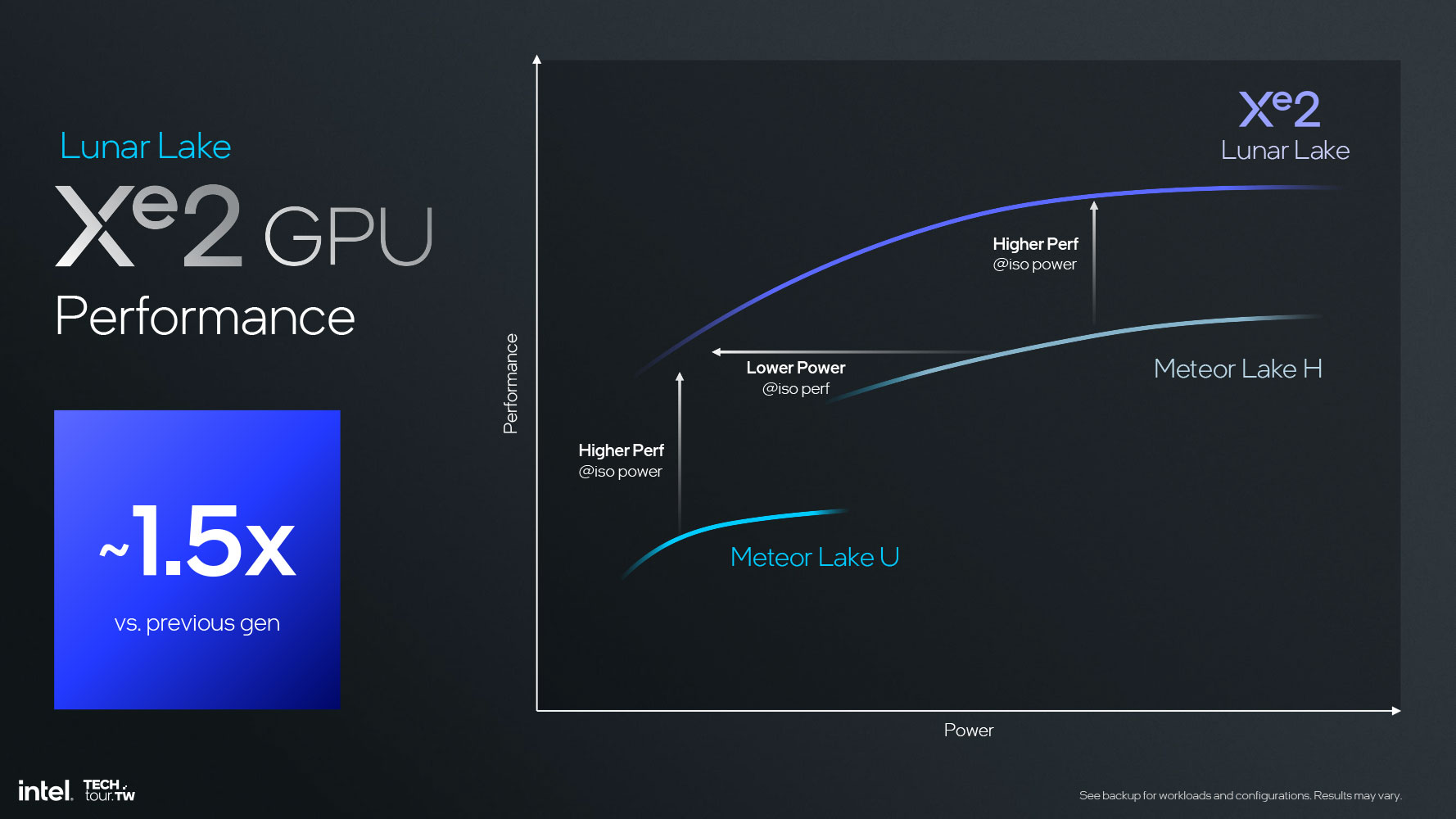
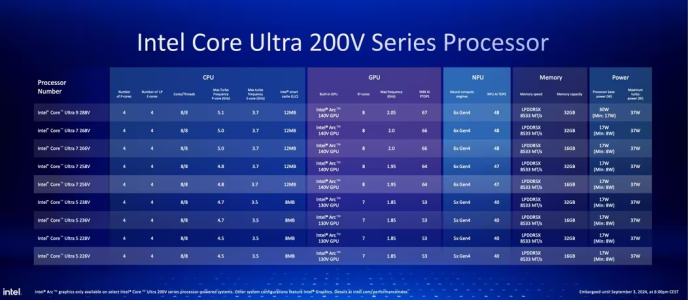
Intel Raptor Lake UIntel Wildcat Lake 15W?Intel Lunar LakeIntel Panther Lake 4+0+4
Launch DateQ1-2024Q2-2026Q3-2024Q1-2026
ModelIntel 150UIntel Core 7Core Ultra 7 268VCore Ultra 7 365
Dies2223
NodeIntel 7 + ?Intel 18-A + TSMC N6TSMC N3B + N6Intel 18-A + Intel 3 + TSMC N6
CPU2 P-core + 8 E-cores2 P-core + 4 LP E-cores4 P-core + 4 LP E-cores4 P-core + 4 LP E-cores
Threads12688
Max Clock5.4 GHz?5 GHz4.8 GHz
L3 Cache12 MB12 MB12 MB
TDP15 - 55 W15 W ?17 - 37 W25 - 55 W
Memory128-bit LPDDR5-520064-bit LPDDR5128-bit LPDDR5x-8533128-bit LPDDR5x-7467
Size96 GB32 GB128 GB
Bandwidth136 GB/s
GPUIntel GraphicsIntel GraphicsArc 140VIntel Graphics
RTNoNoYESYES
EU / Xe96 EU2 Xe8 Xe4 Xe
Max Clock1.3 GHz?2 GHz2.5 GHz
NPUGNA 3.018 TOPS48 TOPS49 TOPS


PPT1.jpg
PPT2.jpg
PPT3.jpg


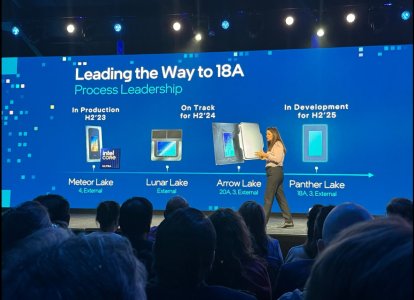
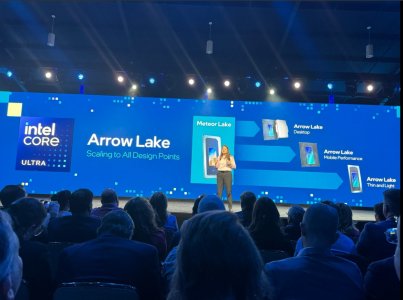
As Hot Chips 34 starting this week, Intel will unveil technical information of upcoming Meteor Lake (MTL) and Arrow Lake (ARL), new generation platform after Raptor Lake. Both MTL and ARL represent new direction which Intel will move to multiple chiplets and combine as one SoC platform.

MTL also represents new compute tile that based on Intel 4 process which is based on EUV lithography, a first from Intel. Intel expects to ship MTL mobile SoC in 2023.

ARL will come after MTL so Intel should be shipping it in 2024, that is what Intel roadmap is telling us. ARL compute tile will be manufactured by Intel 20A process, a first from Intel to use GAA transistors called RibbonFET.


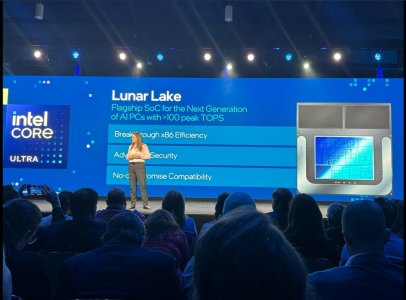
LNL-MX.png
 

Attachments

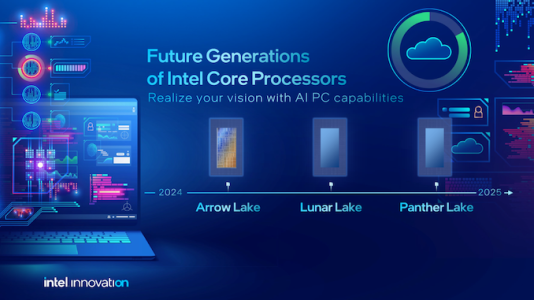
  • PantherLake.png
    PantherLake.png
    283.5 KB · Views: 24,042
  • LNL.png
    LNL.png
    881.8 KB · Views: 25,531
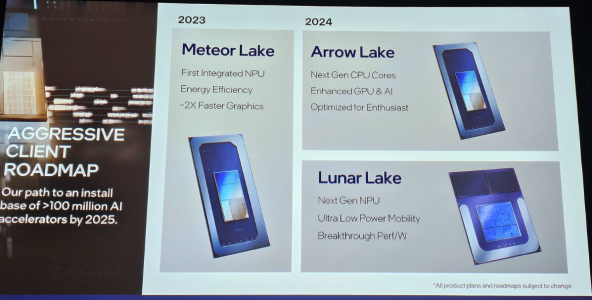
  • INTEL-CORE-100-ULTRA-METEOR-LAKE-OFFCIAL-SLIDE-2.jpg
    INTEL-CORE-100-ULTRA-METEOR-LAKE-OFFCIAL-SLIDE-2.jpg
    181.4 KB · Views: 72,439
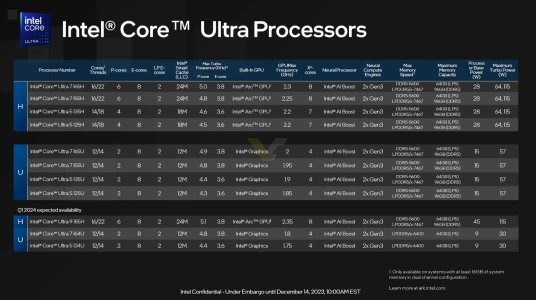
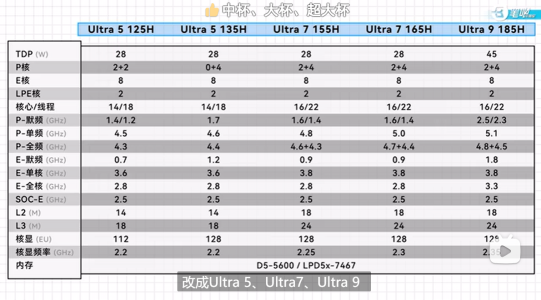
  • Clockspeed.png
    Clockspeed.png
    611.8 KB · Views: 72,326
Last edited:

ondma

Diamond Member
Mar 18, 2018
3,320
1,709
136
P cores do well when fed massive amounts of power. If you just keep adding P cores, then within a given power budget, each subsequent P core gets less and less power. Meaning, very soon you get P cores with not enough power to work well. It could actually perform worse in games unless you get a CPU with a pitiful base clock and a massive power hungry turbo clock--but only turbo for the right number of cores to match your game.

If power use and heat dissipation weren't issues, then your desire would be great. But, in a real world situation, no chip can follow your dream path.
Huh?? AMD puts 16 "P" cores in 7950x and they seem to work just fine, and at much lower power than Intel 8+16 which is required to give similar MT performance.
 

dullard

Elite Member
May 21, 2001
26,192
4,860
126
Huh?? AMD puts 16 "P" cores in 7950x and they seem to work just fine, and at much lower power than Intel 8+16 which is required to give similar MT performance.
AMD has a more power efficient big core, and a different TDP, so their optimum number of big cores is different than Intel. But even AMD doesn't gain and might lose performance from adding more. Heck, you won't find the 7950X in the leadership position on very many games (if any). It is close, but usually loses out to CPUs with more power per core, bigger cache, etc.

If you want Intel to have more cores, which are efficient at lower power each, well that is their E core.
 
Last edited:
  • Like
Reactions: pcp7

HoveringStyle

Junior Member
Dec 11, 2022
22
26
51
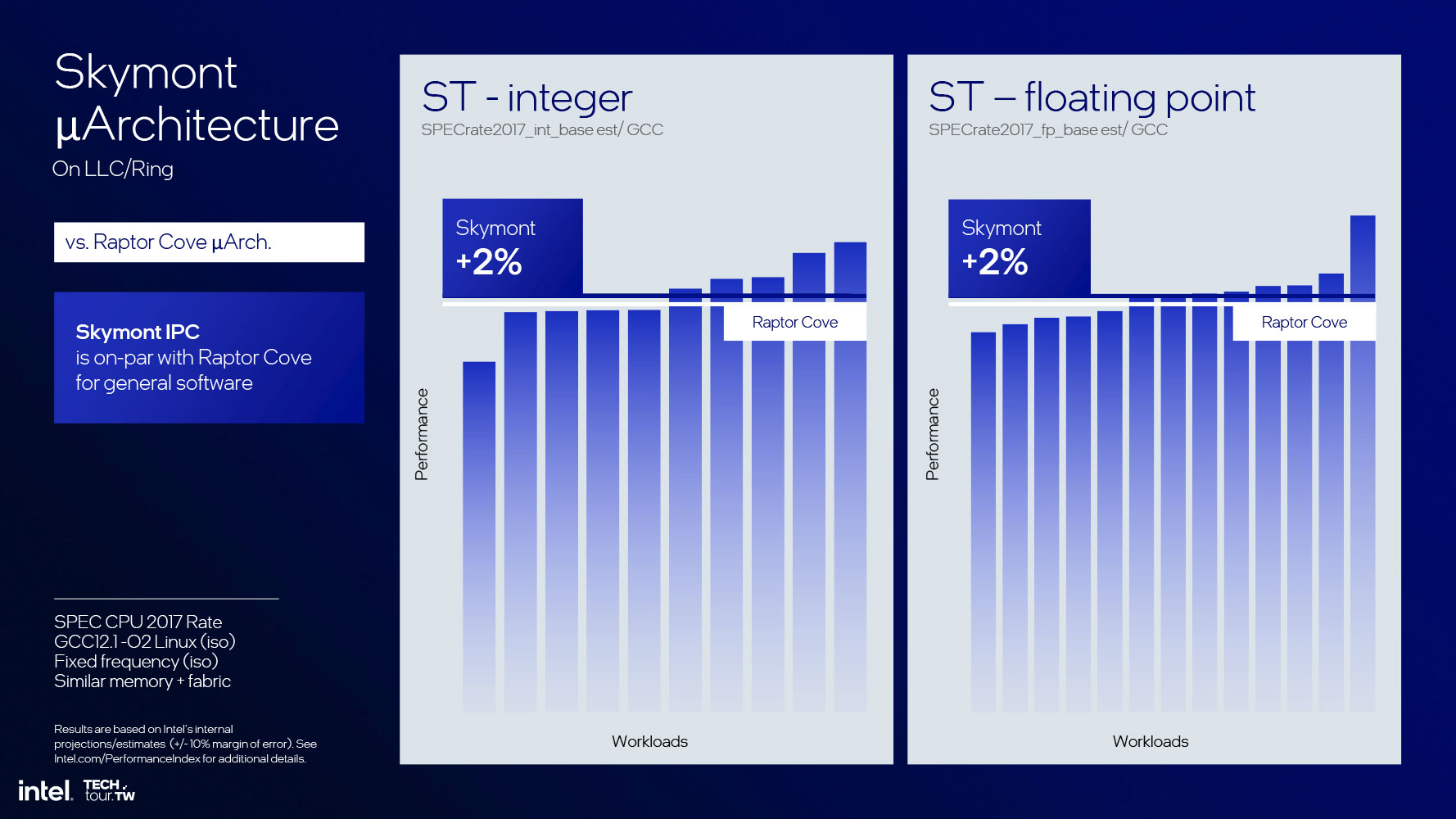
My point is that the the uplift over non-LP gracemont must be on the order of 20% for int and 50% for fp in Specint, adroc's fud notwithstanding.

Forgot to mention that intel state's on average LP gracemont IPC is down only ~5% with non-LP.

Using the SPEC2017 results in this Geekerwan video (8:15-9:40) and Intel's claimed increases, Skymont's IPC in LNL is 21% and 71% higher in int and fp respectively than RPL-S Gracemont and 30% and 73% higher than RPL-H Gracemont.

Mobile skus have lower IPC, for example, when compared to its appropriate mobile counterpart, RWC saw no IPC regression.
 
Last edited:

TESKATLIPOKA

Platinum Member
May 1, 2020
2,696
3,260
136
Intel Lunar Lake Technical Deep Dive - So many Revolutions in One Chip

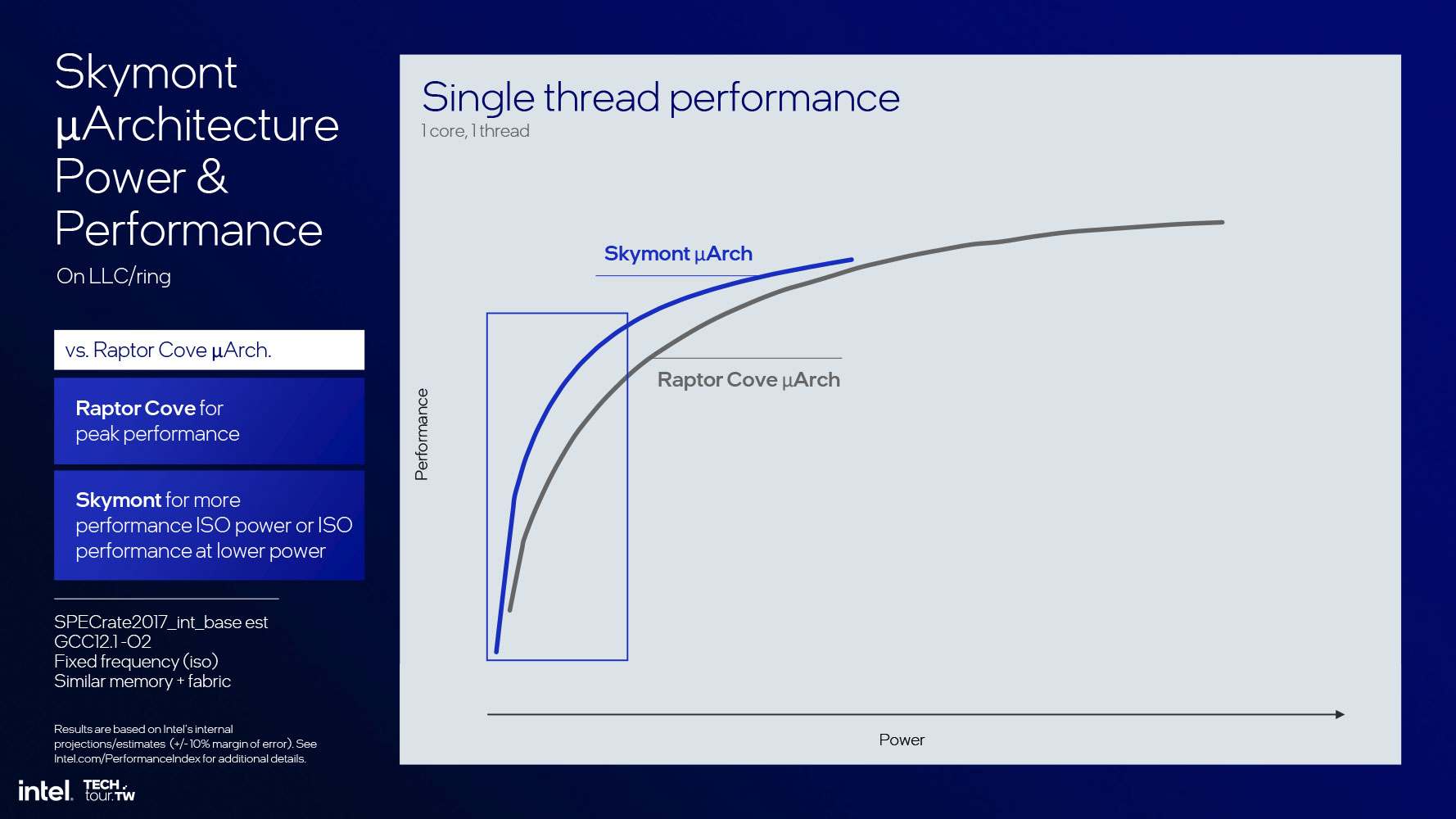
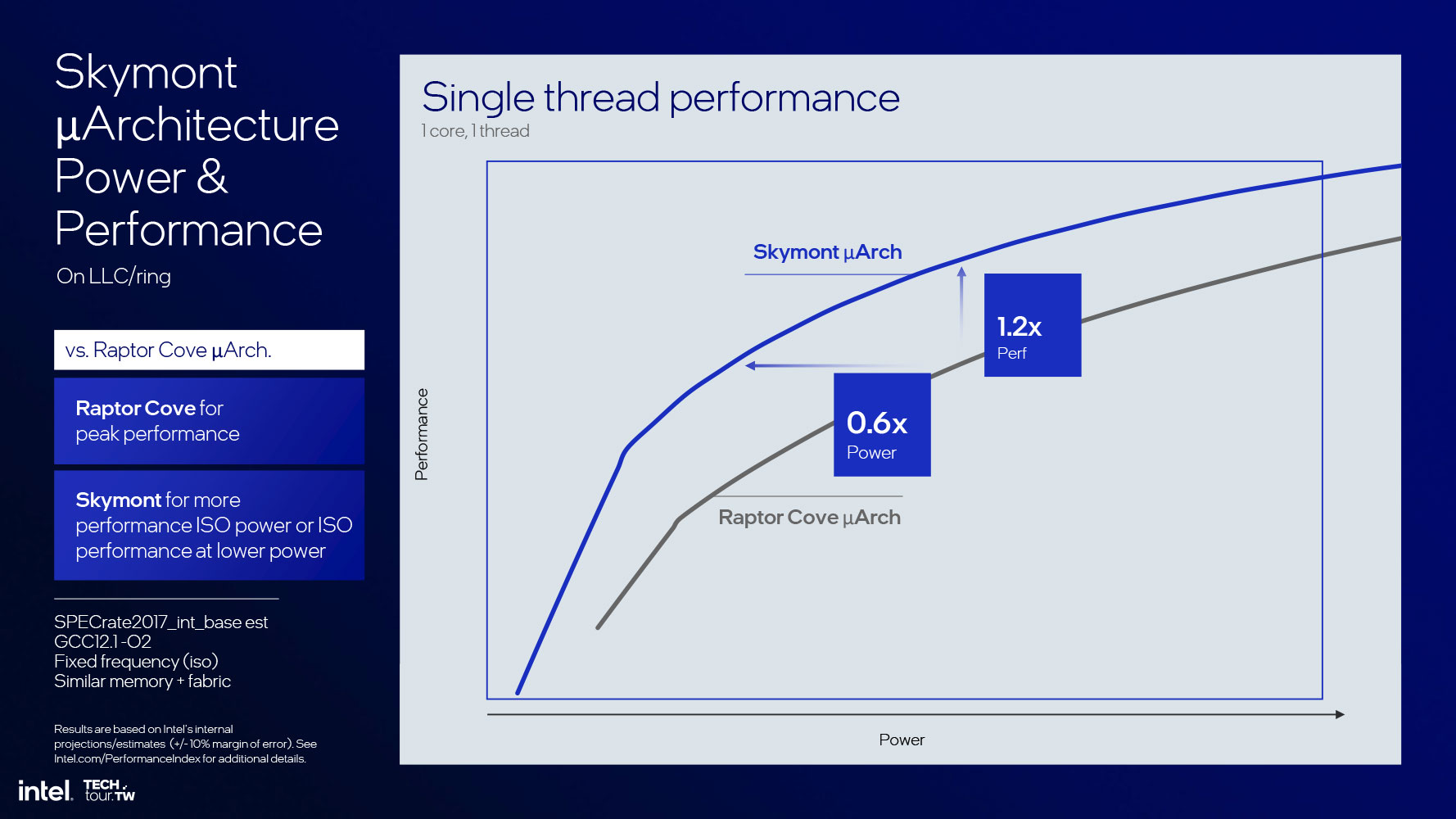
E-core looks great on paper.
skymont-17-.jpg
skymont-18-.jpg
skymont-19-.jpg

Even a CPU with only Skymont cores would be strong.

P.S. I am kinda more excited about Lunar Lake than Strix.
 

ondma

Diamond Member
Mar 18, 2018
3,320
1,709
136
AMD has a more power efficient big core, and a different TDP, so their optimum number of big cores is different than Intel. But even AMD doesn't gain and might lose performance from adding more. Heck, you won't find the 7950X in the leadership position on very many games (if any). It is close, but usually loses out to CPUs with more power per core, bigger cache, etc.

If you want Intel to have more cores, which are efficient at lower power each, well that is their E core.
I thought that was supposed to be Arrow Lake/Lion Cove (new architecture on leading edge process (which turned out to be TSMC!!))

Note: I dont mean to sound like an intel hater, there are plenty of those in this forum already. I would love to see ARL kick butt vs Zen 5. I am somewhat hopeful after these latest leaks that it will at least be competitive (if late vs Zen 5), but remain skeptical since early leaks were so pessimistic. I just get tired of Intel proclaiming all these gains when they cant seem to catch up to AMD in core design and efficiency.
 

H433x0n

Golden Member
Mar 15, 2023
1,224
1,606
106
I thought that was supposed to be Arrow Lake/Lion Cove (new architecture on leading edge process (which turned out to be TSMC!!))
They’re not having issues competing with TSMC leading edge processes. Look at the Sierra Forest benchmarks that uses only Intel silicon taking the lead for x86 efficiency in the 250W TDP range against Bergamo / Genoa on TSMC silicon.
 
  • Like
Reactions: DavidC1

CouncilorIrissa

Senior member
Jul 28, 2023
786
2,854
106
Huh?? AMD puts 16 "P" cores in 7950x and they seem to work just fine, and at much lower power than Intel 8+16 which is required to give similar MT performance.
AMD's "P" cores are somewhere in-between Golden Cove and Gracemont. Skymont is straight up larger than Z4 is a number of aspects.
 
  • Like
Reactions: Tlh97
Jun 4, 2024
116
146
71
In two years,
-P core Intel got 14% gains
-P core AMD got 16% gains
-E core Intel got 50% gains

Three years of 14%: 48%
Three years of 16%: 56%

Skylake was late 2015. So it took the Intel P core team 9 years to deliver 60% gains. E core team did it in two.

Conclusion 1: Three times two year gains of P cores delivered in 2 years. Feast on that. I had a good feeling the E core team will make a breakout someday.
Conclulsion 2: 50% is Bulldozer to Zen level gains. Unlike Bulldozer though Gracemont was pretty good already.
Yeah skymont is wild and the biggest sign that Intel is alive and going to make a comeback. May the tendies print
 

eek2121

Diamond Member
Aug 2, 2005
3,473
5,150
136
This generation x86 was kinda disappointing, eh?

Zen5 = 16% IPC, iso clock
LNL P-core = 14% IPC, clock regression (?)
1. Wait for reviews. The situation with Zen 5 is a lot more interesting than an average. Front end changes are always fun. Some applications aren’t much faster, if at all, others get completely blown up. Don’t misunderstand, if AMD says 16%, that is the average, but there are going to be some inter things north of that average. wait for reviews.

2. Arrow Lake will have a different performance profile from Lunar Lake. so comparisons are meaningless. Skymont is definitely steeling the show, however.

Hero is here lol

similar conclusion. FSP too low for FrameGen on, but too high for FG off

13700k@5.6g, avg 181fps
9900x , avg 229fps

See above.
Back in Gracemont days, Intel said it was approximately like Skylake without giving explicit figures. We found out that the FP is substantially slower(66% advantage for Golden Cove, meaning Skylake is likely 20% or so faster), and even in Integer it wasn't fully up to par.

Now they are saying it'll outright outperform Raptor Cove.
Yes, it is a beast.
Huh?? AMD puts 16 "P" cores in 7950x and they seem to work just fine, and at much lower power than Intel 8+16 which is required to give similar MT performance.
Not anymore, things are changing. AMD will have to figure it out because they are going to get clobbered in terms of performance. I figured Intel was going to over perform with skymont based on what was leaked. Now I wonder if they will even lead single core performance.

I am expecting a good 15-20% total single core uplift (ipc + clocks) over Raptor Lake. Multicore is going to come down to what process gets used due to power limits. The more power efficient the process is, the better the performance. We could see Intel lead AMD by a substantial amount here, but they are also (allegedly) pulling back power limits to be similar to AMD’s limits, so who knows?
 

poke01

Diamond Member
Mar 8, 2022
4,814
6,140
106
1. Wait for reviews. The situation with Zen 5 is a lot more interesting than an average. Front end changes are always fun. Some applications aren’t much faster, if at all, others get completely blown up. Don’t misunderstand, if AMD says 16%, that is the average, but there are going to be some inter things north of that average. wait for reviews.
Those applications that are faster make use of AVX-512. It’s not hard to get. Wasn’t Zen5 supposed to the core everyone was supposed to catch up to…
 

Hitman928

Diamond Member
Apr 15, 2012
6,753
12,492
136
I am expecting a good 15-20% total single core uplift (ipc + clocks) over Raptor Lake. Multicore is going to come down to what process gets used due to power limits. The more power efficient the process is, the better the performance. We could see Intel lead AMD by a substantial amount here, but they are also (allegedly) pulling back power limits to be similar to AMD’s limits, so who knows?

You’re expecting ARL to clock higher than RPL-R?
 

dullard

Elite Member
May 21, 2001
26,192
4,860
126
I thought that was supposed to be Arrow Lake/Lion Cove (new architecture on leading edge process (which turned out to be TSMC!!))
That isn't the goal with the P cores, and likely never will be. The P cores are to have a single task done ASAP at the cost of high power. Move to a new architecture, or process and the goal is still the same: complete a single task ASAP at the cost of high power. The P cores are for when you want something very responsive and fluid. But, you can't have large numbers of cores all doing tasks at the cost of high power. There is no free lunch. With 8 P cores, running at 125 W, each gets ~15.6 W. Those P cores can clock a lot faster than 16 P cores each with only ~7.8 W. No matter the architecture or process, when you split your power budget up amongst more and more cores, each core gets less and less to work with.

The E cores are designed to be the workhorses that you can spam in large numbers to do grunt work. The real issue was when the P/E core was first released, the E cores were clocked too high and there were too few of them. The result was that the first E cores were neither that efficient nor that good at grunt work. So, people got the whole idea of P and E cores backwards in their mind thinking that P cores were for the grunt work. You have to switch your mindset. You want more E cores for more work done.
 
Last edited:

desrever

Senior member
Nov 6, 2021
339
831
136

DavidC1

Platinum Member
Dec 29, 2023
2,157
3,298
106
Using the SPEC2017 results in this Geekerwan video (8:15-9:40) and Intel's claimed increases, Skymont's IPC in LNL is 21% and 71% higher in int and fp respectively than RPL-S Gracemont and 30% and 73% higher than RPL-H Gracemont.
It's higher than 21% in Int, but lower than 71% in FP. You got the calculations wrong.
They are still 19% behind on perf/watt using Intel 3 vs Bergamo using TSMC N5:
Take Skymont, add a few % because it'll be Darkmont, on 18A and 176 cores for -SP and 288 cores for -AP, on Foveros Omni interconnect. Make conclusions.
"Undisputed performance leadership by 2025"
 
  • Like
Reactions: Henry swagger

eek2121

Diamond Member
Aug 2, 2005
3,473
5,150
136
You’re expecting ARL to clock higher than RPL-R?
No, but I am expecting single core clocks to be nearly the same. Multicore clocks may regress, but going from Intel 7 to N3 or Intel 20A will be a substantial improvement.
 
Jun 4, 2024
116
146
71
They are still 19% behind on perf/watt using Intel 3 vs Bergamo using TSMC N5:
You don’t understand what perf/watt means. They are far ahead of bergamo in terms of perf/watt, just behind by 20% in performance.


Around 28 geo mean/watt for SRF, 24 for Bergamo, eyeballing mean power use at 150 for SRF and 250 for bergamo, top parts each.

“The power efficiency story of the Xeon 6700E series is a great one and allows Intel to regain competitiveness on that front and in a number of cases outperforming 4th Gen EPYC in performance-per-Watt for both Genoa(X) and Bergamo”

This is with Crestmont which is slow and hot compared to Skymont, and with a mixture of HPC workloads which Zen5 is optimized for and Crestmont is not
 

DavidC1

Platinum Member
Dec 29, 2023
2,157
3,298
106
Around 28 geo mean/watt for SRF, 21 for Bergamo, eyeballing mean power use at 150 for SRF and 250 for bergamo, top parts each.
You are on a computer, desktop/laptop or smartphone. Use a calculator. Did you not read cutting edge research goes through heroic efforts for 0.5-1% now? Getting 35% when it's 40% is not a small difference.

Here, I will do it for you:
-13 geo mean/watt for Xeon 6780(4233/321)
-15.7 geo mean/watt for EPYC 9754(5905/375)
 
Last edited:

StinkyPinky

Diamond Member
Jul 6, 2002
6,991
1,284
126

DavidC1

Platinum Member
Dec 29, 2023
2,157
3,298
106
I’m a scientist, we round to the nearest order of magnitude :D. I don’t care about 1%.
If you are a CPU enthusiast you should.

I am pretty sure Zen 5 people wanted 20% not 16%. But you are saying 20% and 30% is the same thing.

That makes me doubt your claims.

Here, I will do it for you:
-13 geo mean/watt for Xeon 6780(4233/321)
-15.7 geo mean/watt for EPYC 9754(5905/375)

You claimed 28 for SRF and 21 for EPYC. Again, I doubt your claims, or do a much better job.
 

desrever

Senior member
Nov 6, 2021
339
831
136
You don’t understand what perf/watt means. They are far ahead of bergamo in terms of perf/watt, just behind by 20% in performance.


Around 28 geo mean/watt for SRF, 24 for Bergamo, eyeballing mean power use at 150 for SRF and 250 for bergamo, top parts each.

“The power efficiency story of the Xeon 6700E series is a great one and allows Intel to regain competitiveness on that front and in a number of cases outperforming 4th Gen EPYC in performance-per-Watt for both Genoa(X) and Bergamo”

This is with Crestmont which is slow and hot compared to Skymont, and with a mixture of HPC workloads which Zen5 is optimized for and Crestmont is not
You don't seem to not understand how it work.

"The dual Xeon 6780E configuration was at 85% the power consumption on average as AMD's flagship Bergamo processor, the EPYC 9754"

While the performance is only 73% as much as the EPYC 9754:

Like how do you mess up this hard? Just look at the chart ffs.
 

Det0x

Golden Member
Sep 11, 2014
1,488
5,109
136
I am expecting a good 15-20% total single core uplift (ipc + clocks) over Raptor Lake
No, but I am expecting single core clocks to be nearly the same. Multicore clocks may regress, but going from Intel 7 to N3 or Intel 20A will be a substantial improvement.
Going by the latest leak from wccftech (i know)

Intel Core Ultra 9 285K “Arrow Lake” Desktop CPU Rumored To Clock Around 5.5 GHz​

Thats a 9% or 13% clockspeed deficit depending on if you compare against 14900K or the KS, that you need to overcome with purely IPC
  • For the 285K to reach +20% ST performance over 13900K they need a IPC increase of ~31%
  • For the 285k to reach +20% ST performance over 13900KS they need a IPC increase of ~35%

*edit*

If the 285k runs at 5.7ghz ST:
  • ..then it need a IPC increase of ~26% to reach the 14900K +20%
  • ...then it need a IPC increase of ~30% to reach the 14900KS +20%
 
Last edited: