• We’re currently investigating an issue related to the forum theme and styling that is impacting page layout and visual formatting. The problem has been identified, and we are actively working on a resolution. There is no impact to user data or functionality, this is strictly a front-end display issue. We’ll post an update once the fix has been deployed. Thanks for your patience while we get this sorted.

Discussion Intel Meteor, Arrow, Lunar & Panther Lakes + WCL Discussion Threads

Page 336 - Seeking answers? Join the AnandTech community: where nearly half-a-million members share solutions and discuss the latest tech.

Tigerick

Senior member
Wildcat Lake (WCL) Specs

Intel Wildcat Lake (WCL) is upcoming mobile SoC replacing Raptor Lake-U. WCL consists of 2 tiles: compute tile and PCD tile. It is true single die consists of CPU, GPU and NPU that is fabbed by 18-A process. Last time I checked, PCD tile is fabbed by TSMC N6 process. They are connected through UCIe, not D2D; a first from Intel. Expecting launching in Q1 2026.
Intel Raptor Lake UIntel Wildcat Lake 15WIntel Lunar LakeIntel Panther Lake 4+0+4
Launch DateQ1-2024Q2-2026Q3-2024Q1-2026
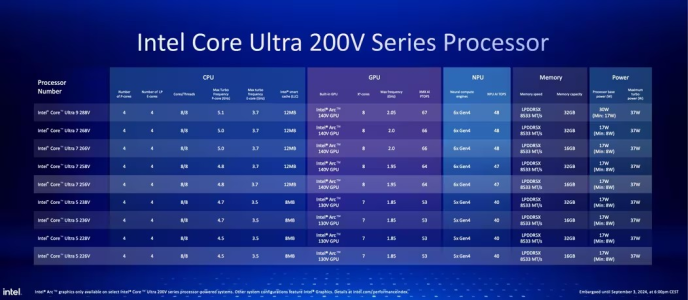
ModelIntel 150UIntel Core 7 360Core Ultra 7 268VCore Ultra 7 365
Dies2223
NodeIntel 7 + ?Intel 18-A + TSMC N6TSMC N3B + N6Intel 18-A + Intel 3 + TSMC N6
CPU2 P-core + 8 E-cores2 P-core + 4 LP E-cores4 P-core + 4 LP E-cores4 P-core + 4 LP E-cores
Threads12688
Max Clock5.4 GHz4.8 GHz5 GHz4.8 GHz
L3 Cache12 MB6 MB12 MB12 MB
TDP15 - 55 W15 - 35 W17 - 37 W25 - 55 W
Memory128-bit LPDDR5-520064-bit LPDDR5x-7467128-bit LPDDR5x-8533128-bit LPDDR5x-7467
Size96 GB48 GB32 GB128 GB
Bandwidth83 GB/s60 GB/s136 GB/s120 GB/s
GPUIntel GraphicsIntel GraphicsArc 140VIntel Graphics
RTNoNoYESYES
EU / Xe96 EU2 Xe8 Xe4 Xe
Max Clock1.3 GHz2.6 GHz2 GHz2.5 GHz
NPUGNA 3.017 TOPS48 TOPS49 TOPS


PPT1.jpg
PPT2.jpg
PPT3.jpg


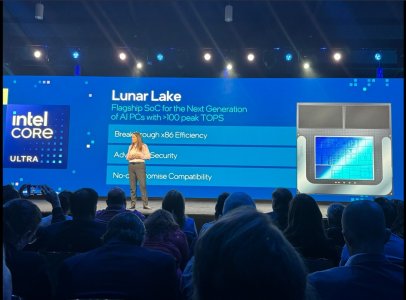
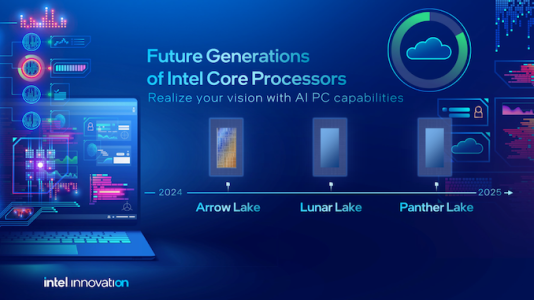
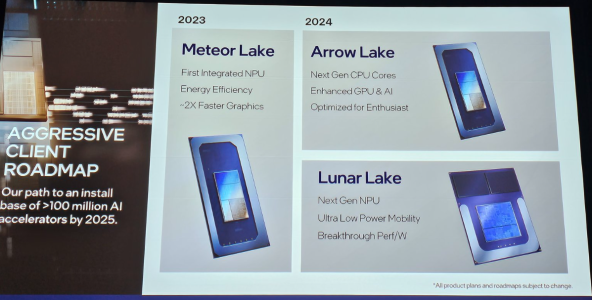
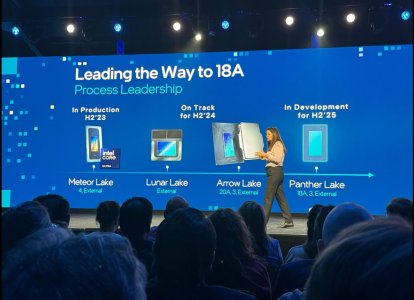
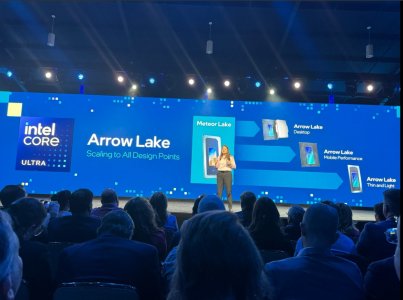
As Hot Chips 34 starting this week, Intel will unveil technical information of upcoming Meteor Lake (MTL) and Arrow Lake (ARL), new generation platform after Raptor Lake. Both MTL and ARL represent new direction which Intel will move to multiple chiplets and combine as one SoC platform.

MTL also represents new compute tile that based on Intel 4 process which is based on EUV lithography, a first from Intel. Intel expects to ship MTL mobile SoC in 2023.

ARL will come after MTL so Intel should be shipping it in 2024, that is what Intel roadmap is telling us. ARL compute tile will be manufactured by Intel 20A process, a first from Intel to use GAA transistors called RibbonFET.


LNL-MX.png
 

Attachments

  • PantherLake.png
    PantherLake.png
    283.5 KB · Views: 24,049
  • LNL.png
    LNL.png
    881.8 KB · Views: 25,534
  • INTEL-CORE-100-ULTRA-METEOR-LAKE-OFFCIAL-SLIDE-2.jpg
    INTEL-CORE-100-ULTRA-METEOR-LAKE-OFFCIAL-SLIDE-2.jpg
    181.4 KB · Views: 72,443
  • Clockspeed.png
    Clockspeed.png
    611.8 KB · Views: 72,329
Last edited:
Skymont looks awesome. But for Lion Cove, Intel's SMT yield was, what, ~25% or so? Maybe a bit less? Still, unless there's a big improvement somewhere else like area, seems a bit "one step forward, two steps back," does it not?

Intel hinted pretty heavily that they would not remove HT from Arrow Lake unless there was a net performance uplift to be gained on desktop workloads.

The 2 IP blocks discussed as being modular in Lion Cove were 1) hyperthreading, and 2) AVX 512. They stated that non-mobile designs would not need to sacrifice HT.

This is why they described Lion Cove as a uArch rather than a core.
 
Last edited:
FP theo
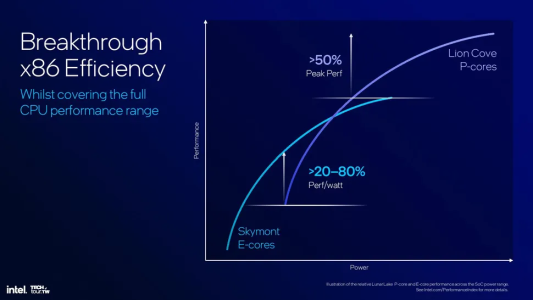
Skymont INT performance is great, but as far as FP goes I think it's roughly half throughput vs Raptor Cove (AVX256 needs to be split in 2 ops to execute on its FP units?).

They weren’t comparing to raptor cove with avx 512. FP throughout is theoretically doubled on Skymont (4*128), so may even be more performant on average fp workloads that aren’t specifically written with AVX in mind, but yeah it won’t be as good on tasks that benefit from AVX 512, vs server raptor cove (Emerald Rapids).
 
Looks like Intel went all out similar to Nvidia with adding every amount of various execution units possible along with all the front end expansion. In this light the +14% IPC seems a bit low but I guess the expansion impression is misleading because the ratio front end throughput isn't as much. It's great to see E-core IPC improvements are 10% more than expected.
This is gonna give Zen5 a run for the money. Then again Zen5 will likely beat it on cost.
Anyhow, it's good to see this major overhaul. Now, I'm excited to see what just tweaks alone could get out of these.

Edit: Just read Intel reserves +/- 10% margin of error for Skymont e-cores. Welp.
 
Last edited:
So Intel states Lunar Lake will be released this july-september timeframe, and yet no real numbers nor real perfomance comparison? Just projections/estimates. WTF?
Intel's slides are the best I've seen in years in terms of useful information (from them). You can argue you don't believe them, and that would be fair game given their past behavior, but the format and quality of info presented has improved significantly.

And when it comes to their GPU keynotes, including for LNL, Tom Petersen is doing absolute wonders for Intel, especially in building trust with both media and the end consumer.
 
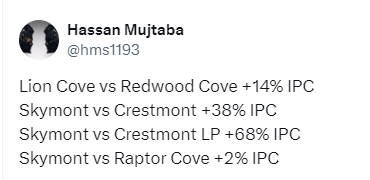
That is from twit
3d469448b1b3df7dc3bf681fbfff0a8c.png
JFC, WTFtech hires morons, I swear. Hassan couldn’t read the dang press slides accurately even when it’s right in front of him.

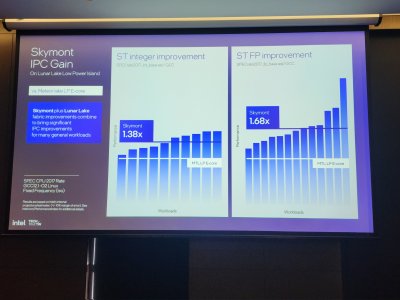
Skymont in LNL with 8MB Memory Side Cache vs Crestmont LP-E in MTL: +38% INT, +68% FP IPC
1717507910398.jpeg

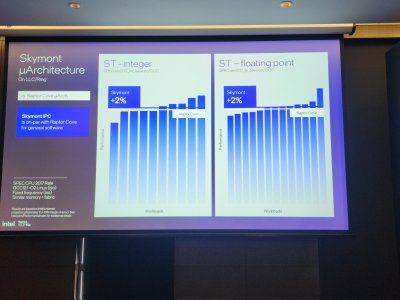
Skymont in LNL with 8MB Memory Side Cache vs Raptor Cove: +2% INT/FP IPC
1717507926104.jpeg

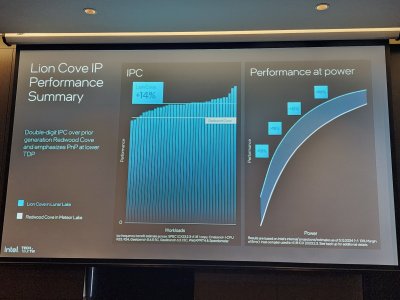
Lion Cove in LNL vs Redwood Cove in MTL: +14% IPC, perf/W varies from +18% at lower power to +10% at higher power
1717507936537.jpeg
 

So Intel states Lunar Lake will be released this july-september timeframe, and yet no real numbers nor real perfomance comparison? Just projections/estimates. WTF?
They have to get in their final tweaks. All these companies are aggressively turning knobs. Now that AMD, Qualcomm, and Apple have outed their 2024 holiday season performance, Intel has a lot of adjustments to make.
 

So Intel states Lunar Lake will be released this july-september timeframe, and yet no real numbers nor real perfomance comparison? Just projections/estimates. WTF?
It comes down to the release date (to the public, not the release date to laptop manufacturers). SPEC rule 4.2 states that the CPU must be generally available within 3 months. If Lunar Lake is launched later in Q3, it would not likely be generally available to the public within that timeframe--especially since laptops take time to launch after the manufacturers receive the CPUs. Three months from the time the slide was made is August 13, 2024.

SPEC requires anything that does not meet the rules, such as rule 4.2, must be labeled as an estimate: "If the alleged value is not from a rule-compliant run, then it is an estimate." Heck, the estimate requirement specifically calls out the 3 month availability window in the definition.

Rule 4.2: https://www.spec.org/cpu2017/docs/runrules.html#rule_4.2 (scroll up a few lines from this link)
Estimate label is required if Rule 4.2 is not met: https://spec.org/fairuse.html#DefineEstimate (scroll up a few lines)
 
Last edited:
Meanwhile it's the reverse with Skymont and its lack of L3 (I think?).

Isn't L3 cache shared between all cores on a CPU die? Or is there something about SKymont that it has a lack of access to it. I mean there is probably a catch to e-cores performing as well as Golden COve or even Raptor Cove in IPC besides just well they only run at 4.6GHz. 4.6GHz is actually pretty decent and almost Golden Cove like. If overall raw performance across all workloads and latency and memory and such for gaming to be an all P core Golden Cove clock normalized equal (without HT as HT does not really matter for games for higher core count CPUs as long as cores are on same die with good core to core latency) if Lion Cove disabled. Its the L3 right making latency much worse if it is used without the P cores for non hybrid so not in real world a Golden Cove equal without the P cores and whole die enabled?
 
For LionCove, I expected the average IPC increase to be closer to 20% than 14%. Apparently the tiles and the disabled AVX512 cause the average to be lower than it could be. Zen 5 has AVX512, and yet the average increase is only 2 percentage points higher.

Another good sign is that resources were not increased excessively during the LionCove project, including: ROB from 512 to 576.

However, the strong reconstruction and expansion of the Front-end is impressive, including: the predictor is 8x larger than in GoldenCove!


I believe the starting point is a major overhaul of LionCove's core. We'll see what the next generations will show.
 
That is Skymont with LLC and on a RING. I am 99% sure that is Skymont from Arrow Lake. Where it sits on the ring bus and has access to the L3 cache.

Where are you getting that from? It's talking about an SLC, not the regular ring-connected distributed L3.

Edit: Yeah, looking closer at it, I see now. Mea culpa.
 
Last edited:
JFC, WTFtech hires morons, I swear. Hassan couldn’t read the dang press slides accurately even when it’s right in front of him.

Skymont in LNL with 8MB Memory Side Cache vs Crestmont LP-E in MTL: +38% INT, +68% FP IPC
View attachment 100465

Skymont in LNL with 8MB Memory Side Cache vs Raptor Cove: +2% INT/FP IPC
View attachment 100466

Lion Cove in LNL vs Redwood Cove in MTL: +14% IPC, perf/W varies from +18% at lower power to +10% at higher power
View attachment 100467
You can't read the slides either 🙂

The vs raptor cove is not Lunar Lake LP Skymont vs Raptor Cove, but an undisclosed (Arrow Lake) implementation where the Skymont cluster is on the ring bus (and shares L3 with P-cores)
 
Back
Top