• We’re currently investigating an issue related to the forum theme and styling that is impacting page layout and visual formatting. The problem has been identified, and we are actively working on a resolution. There is no impact to user data or functionality, this is strictly a front-end display issue. We’ll post an update once the fix has been deployed. Thanks for your patience while we get this sorted.

Discussion Intel current and future Lakes & Rapids thread

Page 935 - Seeking answers? Join the AnandTech community: where nearly half-a-million members share solutions and discuss the latest tech.
I think I misunderstood your post (mentioning SRF).

I did think that NVidia was getting 16-channel DMR, which I think could be (one of the) reasons for cancelling 8-channel DMR - to concentrate the resources.
Nvidia is getting a custom DMR ... Like Hyperscalers get don't know what exactly they get.
The 65nm Presler seemed mostly abandoned in 2006. In fact because they were preparing for Core 2 later that year. And in that case it was the right decision. The company was stable back then though. We'll see whether cancelling -SP means further digging of the hole or Coral Rapids is indeed really good.
Coral Has SMT
Onprem dinosaurs exist and boy there are a lot of them.
Ask IBM 🤣
 
Well then I'll welcome my 1P 16ch overlords. Seems like overkill for a 1P setup. Plus as has already been mentioned/implied, it will not be cheap and will be a niche within a niche, e.g. the main shipping volume of Diamond Rapids should have been 1P/2P 8ch systems that seem to have been cancelled altogether.
 
Well then I'll welcome my 1P 16ch overlords. Seems like overkill for a 1P setup. Plus as has already been mentioned/implied, it will not be cheap and will be a niche within a niche, e.g. the main shipping volume of Diamond Rapids should have been 1P/2P 8ch systems that seem to have been cancelled altogether.
When you have 192+ Cores you kind of need that bandwidth and they might want to upsell a 192C/12Channel Platform instead of 8+
 
What's wrong with that?

Definitely better to have 1 x 16 memory channels than 2 x 8 channels.

Having two DIMMs per channel is pointless when you have MRDIMM and LRDIMM that can deliver all 8 ranks that a single channel maxes out at in a single DIMM, so you don't lose capacity and with MRDIMM you also double bandwidth.

Nothing requires you to fill all 16 slots/channels so you can get the same as an 8 channel system if that's all you need. Yeah I suppose Intel will charge more for the 16 channel CPUs than they did for the 8 channel, but they always offer some gimped SKUs at lower prices so I could see them offering ones that are gimped to only 8 or 12 channels down the road.
 
The difference between DDR4 and 5 is now several generations of performance difference on LGA 1700. Anyone that kept their DDR4 when upgrading, or chose it because DDR5 speeds and prices were unsavory at the time, is sometimes being held back with even a low end mid tier GPU.


I think it was 128C/96C for SP don't know the exact count
For DMR-SP, I guess top configs were 144 cores(3*48 core tiles) changed to 96 cores(2*48) and a 64 core config?
Though not sure if there were any later changes and a possible 128 core(2*64 ?).

Hopefully RRF(Arctic Wolf E-Cores based Server line) doesn't get cancelled or delayed. If they could get their fabric and other stuff right it could be decent and much more versatile(performance and Instructions support) than SRF.



For DMR-SP, I guess top configs were 144 cores(3*48 core tiles) changed to 96 cores(2*48) and a 64 core config?
Though not sure if there were any later changes and a possible 128 core(2*64 ?).

Hopefully RRF(Arctic Wolf E-Cores based Server line) doesn't get cancelled or delayed. If they could get their fabric and other stuff right it could be decent and much more versatile(performance and Instructions support) than SRF.
Uhh about that it has been renamed to DMR-HD
 
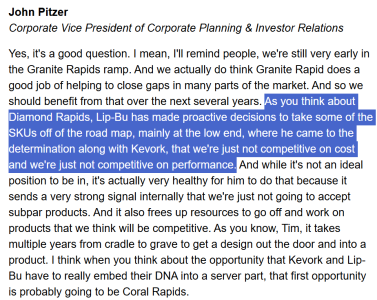
How does it make sense that they won't be competitive in performance on the low end, but will be on the higher end?
1764823688783.png
Only explanation I have is that per-core perf might be much stronger with Zen 6 than DMR, and in lower end skus where the boosts are also typically higher, you can really push that advantage, unlike in higher core count skus where you get limited by power-per-core much faster.

A little bit worryingly though, those lower end skus are also typically where the AI headnode skus are coming from. You don't need 192 or 256 cores for an AI headnode.
 
A little bit worryingly though, those lower end skus are also typically where the AI headnode skus are coming from. You don't need 192 or 256 cores for an AI headnode.

I was wondering what the demand is on the CPU in these AI nodes.

Since NVidia contracted Intel for high core count DMR and AMD is going to be using 256 core Venice in the Helios racks, I would think that you do need high core count CPU.
 
I was wondering what the demand is on the CPU in these AI nodes.
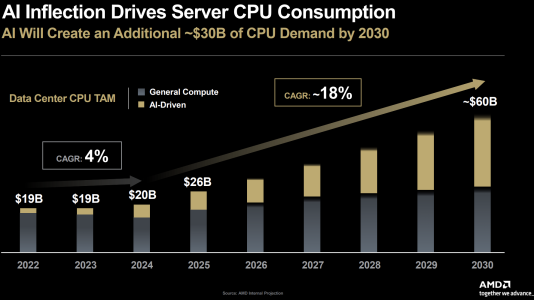
Interesting slide presented at FAD:
1764827145822.png
Since NVidia contracted Intel for high core count DMR
I think it's just for NV-Link
and AMD is going to be using 256 core Venice in the Helios racks,
Has AMD confirmed they will be using the highest core count config of Venice though in their AI racks?
I would think that you do need high core count CPU.
I'm basing my reasoning on Nvidia's current custom Intel sku only going up to what, 86? cores and 8 mem channels despite GNR maxing at 128. They also explicitly list high boost clocks as one of the optimizations made for that sku.
 
How does it make sense that they won't be competitive in performance on the low end, but will be on the higher end?
Prices and therefore margins are MUCH lower relative to SoC production cost on the low end.
The 2000$ SKUs aren't all that much cheaper to make than the 12K SKUs.

They probably expect Zen6 to be superior in PPW, max clocks, and thanks to SMT in terms of threads/MT perf per core as well.

Basically, in the high-end, margins are probably high enough Intel can stay somewhat competitive through price, without killing their margins entirely.
On the low end, margins already aren't that high, so there's just not enough margin headroom to compete against AMD entirely through competitive pricing.
 
Has AMD confirmed they will be using the highest core count config of Venice though in their AI racks?

I was not able to confirm that from the published slides, but I think that is the assumption

I'm basing my reasoning on Nvidia's current custom Intel sku only going up to what, 86? cores and 8 mem channels despite GNR maxing at 128. They also explicitly list high boost clocks as one of the optimizations made for that sku.

NVidia is using 2 Intel CPUs (Emerald Rapids) with 56 cores each for total of 112 cores.

I don't know if any specs for NVidia box with DMR have been released, but since DMR is cancelling low end configuration, it is a safe bet that NVidia will use the highest core count version.

Also, AMD is going with single Venice Zen 6 CPU per node, which to me suggests it will be the 256 core CPU.
 
I'm basing my reasoning on Nvidia's current custom Intel sku only going up to what, 86? cores and 8 mem channels despite GNR maxing at 128.

BTW, as far as GNR, I don't think NVidia is using it currently in their reference designs. But 3rd parties can.

As far as Vera Rubin based boxes, don't know if it was announced which x86 CPU Intel will use, but most likely GNR. It would be too risky to bet on DMR.
 
Back
Top