• We’re currently investigating an issue related to the forum theme and styling that is impacting page layout and visual formatting. The problem has been identified, and we are actively working on a resolution. There is no impact to user data or functionality, this is strictly a front-end display issue. We’ll post an update once the fix has been deployed. Thanks for your patience while we get this sorted.

AMD Ryzen 5000 Builders Thread

Page 97 - Seeking answers? Join the AnandTech community: where nearly half-a-million members share solutions and discuss the latest tech.
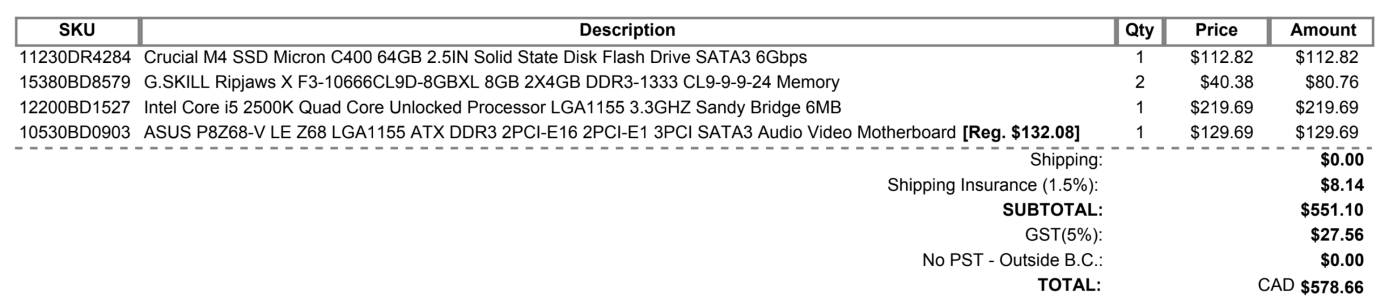
I paid I think $100 for my i3-2100 just before the launch of Ivy Bridge and got an expensive $215 Z77 mobo and 32GB RAM for $300. I think it lasted me more than 5 years with most of the time not using it because I was playing games on PS4 or Xbox One S or using my Haswell laptop. I did upgrade it to i7-3770 for about $125 but that didn't see much use either. In my entire life, the single personal desktop CPU that I spent the most waking hours with is the Coppermine Celeron 700 MHz. Such is life.
I don't regret it in any way. I bought two i7-970s in 2009, or whenever they were first released, for about $700 each. I don't remember the exact price. Paired with some mid to high end Asus X58 chipset motherboards. I used them for 10+ years. I probably still have both around here somewhere and could power them up and use them today.
 
I don't regret it in any way. I bought two i7-970s in 2009, or whenever they were first released, for about $700 each. I don't remember the exact price. Paired with some mid to high end Asus X58 chipset motherboards. I used them for 10+ years. I probably still have both around here somewhere and could power them up and use them today.
I have an i7-920 system that was running 24/7 doing folding@home. I shut it down a few months ago due to temps in my office. One heck of a platform!
 
I have an i7-920 system that was running 24/7 doing folding@home. I shut it down a few months ago due to temps in my office. One heck of a platform!
I probably still have 5 i7-920 processors and X58 chipset motherboards around here too. The X58 platform was very performant in its day.
 
Funny thing. I was considering getting a 990X ($99 used for CPU) and a combo from ebay (MSI X58 mobo, i7-950 and 48GB RAM), also for $99. Changed my mind after I saw some benchmarks. When the thought popped into my head, I was like, "Wouldn't it be cool to own an Extreme Edition CPU?" and saw the benchmarks and went, ah hell no!

I do have a i7-950 (only CPU) in my possession. Someone gave it to me as a gift because probably they themselves had no use for it.

What a wonderful dream it would be if I went to a party and all these different CPU models of different architectures were there and we could have small talk on branch mispredictions and pipeline stalls 😀
 
$72 for a 6 core, 12 thread CPU. Anyone care to guess what the first 6 core, 12 thread CPU cost me in like 2009?
It was effectively $56 on Prime Day for card holders.
I don't regret it in any way. I bought two i7-970s in 2009, or whenever they were first released, for about $700 each.
That's $1071 now. It's why I laugh when goofy goobers try to make AMD CPUs out to be too expensive and stagnant on cores. It's one of the worst talking points in a long long time. We get more compute for dollar now than probably ever before. The horse💩 "Hurr durr muh extra PCIe lanes and quad channel!" is funnier yet. Retail/DIY= gaming. Everything else is a distant second. Cry harder. Trying to extend their niche needs to what the vast majority of the market needs is extra weaksauce.
I probably still have both around here somewhere and could power them up and use them today.

200w.gif


I had trouble with Polaris GPUs with a Dell X58 workstation back in 2018? Ended up pairing it with a GTX 970 which worked perfect.

a3n7tf.jpg
 
It was effectively $56 on Prime Day for card holders.

That's $1071 now. It's why I laugh when goofy goobers try to make AMD CPUs out to be too expensive and stagnant on cores. It's one of the worst talking points in a long long time. We get more compute for dollar now than probably ever before. The horse💩 "Hurr durr muh extra PCIe lanes and quad channel!" is funnier yet. Retail/DIY= gaming. Everything else is a distant second. Cry harder. Trying to extend their niche needs to what the vast majority of the market needs is extra weaksauce.


200w.gif


I had trouble with Polaris GPUs with a Dell X58 workstation back in 2018? Ended up pairing it with a GTX 970 which worked perfect.

View attachment 128999
I'd love to be able to buy a few threadrippers.

I still have 4 GTX-970s in use today. I bought them back when $299 was the top price I'd pay for a GPU. 😁

Now back to regular scheduled programming...
 
It was effectively $56 on Prime Day for card holders.

That's $1071 now. It's why I laugh when goofy goobers try to make AMD CPUs out to be too expensive and stagnant on cores. It's one of the worst talking points in a long long time. We get more compute for dollar now than probably ever before. The horse💩 "Hurr durr muh extra PCIe lanes and quad channel!" is funnier yet. Retail/DIY= gaming. Everything else is a distant second. Cry harder. Trying to extend their niche needs to what the vast majority of the market needs is extra weaksauce.


200w.gif


I had trouble with Polaris GPUs with a Dell X58 workstation back in 2018? Ended up pairing it with a GTX 970 which worked perfect.

View attachment 128999
I will say that when I built my new rig 2 years ago (the 7700 in my sig) the thought did occur to me that my new machine was only doubling the cores/threads from a machine I built 13 years prior. I won't say that I had a hard time convincing myself 8 cores would be enough because I knew the compute performance was far greater in the new CPU than the old one. But I did kind of feel like 10/12/16 should have been mid level, not 8, if that makes any sense.
 
I will say that when I built my new rig 2 years ago (the 7700 in my sig) the thought did occur to me that my new machine was only doubling the cores/threads from a machine I built 13 years prior. I won't say that I had a hard time convincing myself 8 cores would be enough because I knew the compute performance was far greater in the new CPU than the old one. But I did kind of feel like 10/12/16 should have been mid level, not 8, if that makes any sense.
I think a lot of the reason 6-8 core is still the entry level and midrange for AMD is because of the CCX problem - Most consumer workloads, including gaming, won't see a benefit once you move beyond a single CCX/CCD layout. So the chips for the vast majority of people are limited to the best single CCD they can ship.

I think this is all going to finally change with the 12 core CCD of Zen 6, since that brick wall goes from 8 to 12 cores.
 
But I did kind of feel like 10/12/16 should have been mid level, not 8, if that makes any sense.
It doesn't to me. But I'm admittedly preferential to the historical frame of reference. And constraining the criteria to the mainstream consumer platforms. Not HEDT/workstation.

First 1GHz Athlon MSRP was $1299 for 1000 units. Adjusted = $2488 for a single core 25 years ago.

7700K MSRP is adjusted $465. i7 2600K is $465 adjusted. 9800X3D is $450. Seems like that has been the going rate for top tier gaming performance for a long time now. (Interesting when you look at it that way) While the core and thread counts have doubled in 8 years. The mid level would be a i5 7600K adjusted $319. 8 years later you get at least 8c/16t for that money. 8 years is the magic number, as that is how long we were stuck on 4c/8t as the high end. Now the high end has increased 4x in the same time frame.

My conclusion is that going from 4/4 to 8/16 in 8 years is plenty of progress in the mid level.
 
It doesn't to me. But I'm admittedly preferential to the historical frame of reference. And constraining the criteria to the mainstream consumer platforms. Not HEDT/workstation.

First 1GHz Athlon MSRP was $1299 for 1000 units. Adjusted = $2488 for a single core 25 years ago.

7700K MSRP is adjusted $465. i7 2600K is $465 adjusted. 9800X3D is $450. Seems like that has been the going rate for top tier gaming performance for a long time now. (Interesting when you look at it that way) While the core and thread counts have doubled in 8 years. The mid level would be a i5 7600K adjusted $319. 8 years later you get at least 8c/16t for that money. 8 years is the magic number, as that is how long we were stuck on 4c/8t as the high end. Now the high end has increased 4x in the same time frame.

My conclusion is that going from 4/4 to 8/16 in 8 years is plenty of progress in the mid level.
Well I wasn't a gamer then, and only a casual one now, so perhaps that's why we see it differently. I bought the i7-920 for photo editing. The GPU for that system was a Radeon HD3450. I didn't necessarily need an HEDT platform, I just wanted good performance for running Lightroom and Photoshop. So even though X58 was HEDT/Workstation I don't think most treated it as much a workstation, but as just high end consumer. Admittedly I also didn't follow the tech as much back then. I liked computers and building them, using them, but I didn't read up on the stuff as much.
 
X58 was a good platform, but it definitely had it's quirks too. Was pretty good for overclocking, even on cheap 6 core Xeons down the road, but the main issue was the boards were often fragile and finicky. I still have an X58 board with a X5660 here, but it's retired.

I think the main reason we remember the X series HEDT fondly, is that we could often swap in used server parts for cheap upgrades, and many boards even supported ECC RAM as well. Plus, RAM was 3 or 4 channels. And they had more PCIe lanes. It is unfortunate IMO that HEDT has kinda died out.
 
It is unfortunate IMO that HEDT has kinda died out.
I'm not. I am stoked AM4 took over the DIY gaming market. Much lower costs CPUs for getting on the platform, with a more affordable upgrade path offering enormous performance gains to be had.

Zen 3 was almost too good; preventing faster and higher adoption of AM5.
 
I think my 5900X has degraded somehow. I keep getting lock ups and machine check exceptions.
It has been running linux 24/7 for years now but suddenly started this problem.

Still need to put it in a different board to be sure. But I put a 3600X in the same board and it didn't crash for many days now. Curious.
Following up on this - with a 3600X in the system it remains stable for over a month now.
I cannot be 100% sure the 5900X is now defective, since I do not have another available board to test. But it sure seems like it was the cause.

Is anyone interested in a possibly damaged 5900X?
 
Holy... that's a fantastic deal!

Because the solution could be a very simple one:
Can you summarize?
In any case, igor will be receiving it.
I considered giving it more voltage as recommended on the archwiki but
1. this system needs to run 24/7 in eco mode and negative offset seems antithetical to long term stability (In a year will I need to apply even more?) and also eco-ness
2. I used the 5900X because I had that spare after upgrading to AM5. This system didn't need that much CPU.
3. the 3600X I got for free is working fine so I see no reason to go back
 
Can you summarize?
In any case, igor will be receiving it.
I considered giving it more voltage as recommended on the archwiki but
1. this system needs to run 24/7 in eco mode and negative offset seems antithetical to long term stability (In a year will I need to apply even more?) and also eco-ness
2. I used the 5900X because I had that spare after upgrading to AM5. This system didn't need that much CPU.
3. the 3600X I got for free is working fine so I see no reason to go back
He applied -300MHz offset with PBO and it was stable.

Possibly a degraded chip or one that squeaked through qualification without being caught and downrated to a lower SKU
 
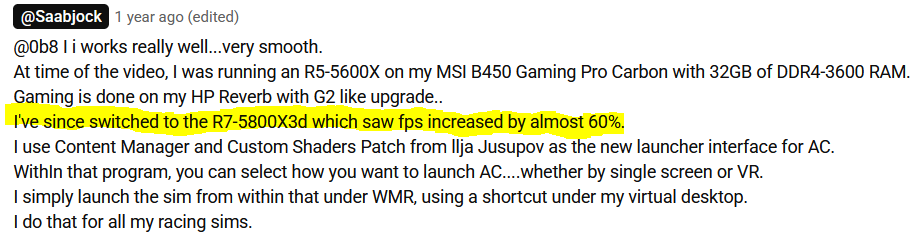
That video is over 2 years old, but is a good example of the overhead issue being there with Alchemist. AC is also one of those games that loves 3D V-cache. Sick drop in performance boost. Have to love AM4's swan song.
 
Back
Top