adroc_thurston
Diamond Member
yeah they rebranded them.N5X doesn't exist in TSMC's official roadmaps as far as I know, but a perf-oriented "N5HPC" was publicly mentioned years ago
It was N7HPC and N5HPC until it wasn't.

yeah they rebranded them.N5X doesn't exist in TSMC's official roadmaps as far as I know, but a perf-oriented "N5HPC" was publicly mentioned years ago
N5X doesn't exist in TSMC's official roadmaps as far as I know, but a perf-oriented "N5HPC" was publicly mentioned years ago, so I guess it's basically the same thing?
Interesting that everyone seems to now accept that an enhancement to an existing process node is a new process node.Sure it does, its just that it is called N4X.

Not me. Until TSMC or Intel or other chips mfg has a new node, I don't.Interesting that everyone seems to now accept that an enhancement to an existing process node is a new process node.
Nodelets are a thing and they're whatever.Interesting that everyone seems to now accept that an enhancement to an existing process node is a new process node.
What do they lose? Are yields lower for the X nodes?X-stuff isn't pure enhancement per se, they're the nuclear option.

Leakage.What do they lose? Are yields lower for the X nodes?
leakageWhat do they lose?

So like a three-legged stool that you need to be level (balanced).Remember, it's a triangle. You get efficiency on one point, performance on the second, and density on the third. You can tweak the node to push out any vertex at the expense of one or both of the other two. The X nodes just push the performance vertex at the expense of density AND efficiency. This is a vast oversimplification, but it gets the point across.
No. It just means that all 3 can't be maximized simultaneously.So like a three-legged stool that you need to be level (balanced).

View attachment 121296
Interesting
It may use less power than N2P if N4P is anything to go by.Sooooo, if Zen 6 really uses N2X as a node...how much better is that compared to Zen 5 purely regarding the nodeadvantage? Anyone here who can answer that? If possible an answer with a rough percentage and not an answer like "waaaaaaay better my friend". Thanks guys. 🙂
 forums.anandtech.com
Sooooo, if Zen 6 really uses N2X as a node...how much better is that compared to Zen 5 purely regarding the nodeadvantage? 🙂
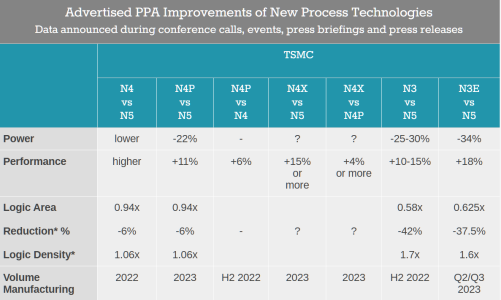
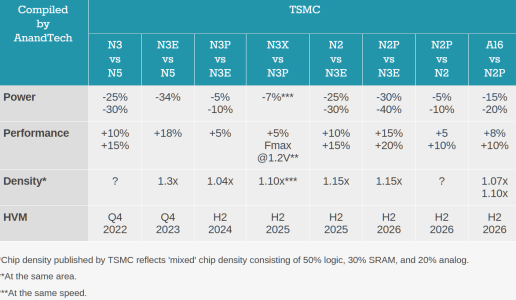
Thank you, great answer! So Zen 6 could be an absolute banger, if they also manage a nice architecture-boost. Nice!!looking at TSMC announcements, can't find exact N4P vs N2X (zen5 and zen6 accordingly) but based on below two tables:
View attachment 121389
View attachment 121390
N5 -> N4P (z5)
-22% power
+11% perf
+6% density
N5 -> N3E
-34% power
+18% perf
+30% density
N3E -> N2P
-30% / -40% power
+15% / +20% perf
+15% density
* (for N2P -> N2X let's assume around +5%)
** (we get approximate N4P base by subtracting N5 -> N4P from N5 -> N3E percentages)
so based on above tables just the node improvement from zen5 to zen6 will offer up to:
-57% power
+32% perf
+44% density


10% more IPC, 13-14% more max frequency, I expect something like that. So 6.5GHz 10950X with 25% higher single core performance seems reasonable.
Those improvements should have "or" between them. If you push maximum density, you sacrifice performance and get higher leakage. If you push maximum performance, you have to relax density and suffer excess power draw. If you optimize for power, density and performance suffer.
Overall, N2X will offer considerably better performance while delivering improved performance per watt numbers while still allowing you to bloat the cores by a good 50% or more as compared to Zen5 on N3P. It's not magic, but it is a bigger jump than we've seen in a while.
11950X*10% more IPC, 13-14% more max frequency, I expect something like that. So 6.5GHz 10950X with 25% higher single core performance seems reasonable.