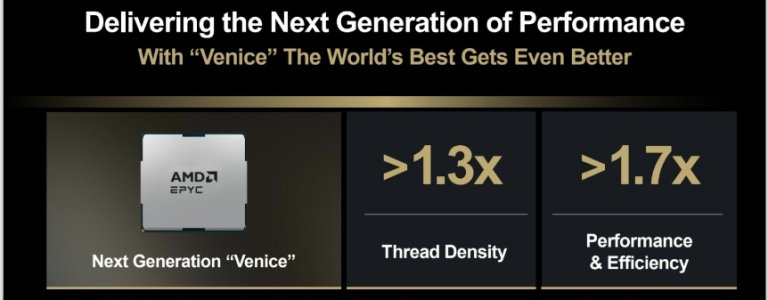
How did they get >1.7x perf uplift?
Efficiency is also >1.7x which mean same 500W TDP.
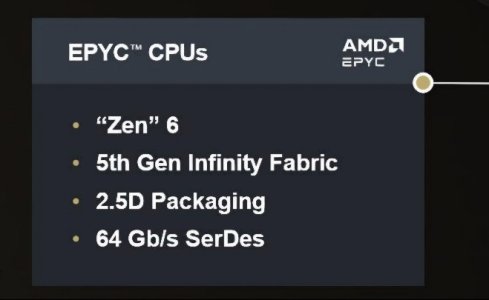
- 8x IF links vs 12x on Turin Dense, so lesser number of links to power.
- 2.5D packaging to bring immense power savings in signalling
- New process for IOD for more efficiency
- But signalling rate is higher at 64 Gbps vs 36 Gbps on Turin D
They would need to bring IOD power usage really down to the 60W - 80W to allow around 1.65W< per core for 256 cores in same SoC at 500W. Below that honestly seems difficult considering all the various functions in the IOD.
If they can do <1.65W per core they would need all the power efficiency gains from N2. At minimum 1.1x efficiency per Core.
But they need frequency gains too to get to the 1.7x perf gain.
1.1x power efficiency gain on top of 1.1x frequency gain would be something of an optimistic outcome from the N2 process jump.
1.33x cores * 1.1x frequency * 1.18x perf/clock = 1.73x perf uplift
If there is indeed no increase in TDP, the clocks would be conservative to keep efficiency high which means the perf per clock would be quite high. I would suspect high teens.
Another thing I suspect is additional 2x FP pipes (new AI pipelines by Papermaster, suggesting at least 2x) something new since Z3. This would bring some easy gains in common benches like cinebench and stuff.