DisEnchantment
Golden Member
Speculate at will
Last edited:


Apple sell phones and computers. AMD sells chips. Besides us at tech forums, the general public really has very little knowledge or desire to know about chips and performance.My point is: I am against fake MSRPs with subsequent deep discounts. Makes the company look amateurish.
Apple products sell mostly at MSRP. That should be the goal of AMD establishing itself as a premium brand.
So how about gold electroplating?
It would be a thin enough layer, while still offering the lustre and shine of gold.Wouldnt be too expensive.
Suitable for ultra-high end CPUs like Intel's KS parts.
No, it's just that.
Margins dawg AMD loves margins.
DIY is a margin cow segment.
Units sold in DIY don't ever really change. Margins do, though.
Nope, kids will run and make it vanish off the shelves.

Well, I am lucky then. I have 2 MicroCenters within a subway ride and another 3 within an easy car drive.Using micro center is disingenuous, as not everything is available to ship, and the store locations are sparse.
As I am looking for a 7900xtx, no option to ship from Micro Center.View attachment 96148
Apple sell phones and computers. AMD sells chips. Besides us at tech forums, the general public really has very little knowledge or desire to know about chips and performance.
AMD will set prices high to get highest margins in the beginning selling to all the 1 day buyers and until they are fully stocked, then they will evaluate their sales a regulate prices accordingly to maximize profits. Which is what any company would want.
It might be so, but this time motherboards and memory is readily available. Sure somebody will want a newer chipsets, but besides mandatory USB4 it doesn't sound like it will bring a ton extra.I am not sure if this is valid. A stronger variable for long lasting success is first impression and initial reviews.
That first impression of Zen 4 was lousy. Overpriced chips, overpriced platform, overpriced DDR5. Day 1 sales were noise. Inconsequential.
It took almost a year and V-Cache release to compensate for that lousy first impression, and first year of sales were poor.
AMD tried the tactics you are suggesting again, with 7950x3d 2 months ahead of 7800x3d, to get those day 1 sales at the highest price. And again, it only resulted in lousy first impression poor sales and lost sales.
It could very well be that the buyers of these CPUs are not idiots, and these underhanded tactics are not swaying them...

Assuming Zen 5 is as good as many expect, there are different prices that achieve different results.
- greatest total revenue. Let's call it $299
- greatest total profit. Let's say $399
- greatest margin. Let's say $549
It clearly makes sense to maximize total profit rather than to leave $$$ on the table to try for greatest margin.
Optimizing for highest margin only makes sense if there are capacity limits, that there is a tradeoff between different products, and you go with the product that can achieve the highest margin from the limited resource.
But we are not in the times of shortage. TSMC can double the output of Zen 5 desktops - no problem.
You COULD also add the ... 'increase market share' factor to your reasoning ...
Which might penalize Intel a bit ... and would help AMD in the medium term ...
For Zen 4 initial impression add the power/temp hike along with the not so popular "freq gains > IPC gains" formula.I am not sure if this is valid. A stronger variable for long lasting success is first impression and initial reviews.
That first impression of Zen 4 was lousy. Overpriced chips, overpriced platform, overpriced DDR5. Day 1 sales were noise. Inconsequential.
It took almost a year and V-Cache release to compensate for that lousy first impression, and first year of sales were poor.
AMD tried the tactics you are suggesting again, with 7950x3d 2 months ahead of 7800x3d, to get those day 1 sales at the highest price. And again, it only resulted in lousy first impression poor sales and lost sales.
It could very well be that the buyers of these CPUs are not idiots, and these underhanded tactics are not swaying them...

Where is that information sourced from? It may be factual, but it set off my BS detector.Not even 1 percent (just a fraction). But still very significant as it leads the way. Kinda clearly shows which components are better and/or preferred by power users.
Yes, it is important to impress.A stronger variable for long lasting success is first impression and initial reviews. [...] It could very well be that the buyers of these CPUs are not idiots, and these underhanded tactics are not swaying them...
[...] the DIY desktop market is [...]
Computer cases with glass windows. Mainboards with camo print. RAM sticks with LED lighting.[...] still very significant as it leads the way. Kinda clearly shows which components are better and/or preferred by power users.
And you forgot to answer the question. Either produce data to back up your claim or make it clear you pulled the numbers out of your butt.I think you forgot something like CPU/GPU.
May you do. I'm not into butt stuff....out of your butt.

My point is: I am against fake MSRPs with subsequent deep discounts. Makes the company look amateurish.
Apple products sell mostly at MSRP. That should be the goal of AMD establishing itself as a premium brand.
CPUs are somewhat thankless, as they at best come with an impressive box, but then vanish under a cooler which steals the show. A GPU add-on card on the other hand brings its own defining cooler and lighting. The braided and combed cables which plug into it merely underline a GPU's beauty. So the CPU is more like a hidden treasure which value waits to be uncovered by CB and GB screenshots.I think you forgot something like CPU/GPU.

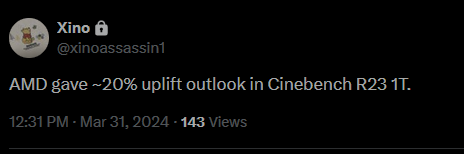
Is that 1T perf uplift of 20% or IPC uplift of 20%?

Let alone Cu and Ag conduct the heat better. The issue is with the oxide layer (sulfide in case of silver)Expensive and copper gets the job done.


Xino always deletes stuff quicklyLooks like the tweet has been deleted.