
- Mar 3, 2017
- 1,779
- 6,798
- 136



I have a 6400MT/s 2x48GB EXPO kit that's on my motherboard QVL and when I enable EXPO it sets it 6400MT/s, 2000MHz FCLK, and 2:1 UCLK. This is actually stable, indicating the ram and motherboard are fine at 6400. If I change to 1:1, it spams memory errors from virtually every address, indicating the IMC can't handle it. This isn't a motherboard issue.

Yes, but you're missing the point ... 4x48GB not 2x48GB, a massive difference!I have a 6400MT/s 2x48GB EXPO kit that's on my motherboard QVL and when I enable EXPO it sets it 6400MT/s, 2000MHz FCLK, and 2:1 UCLK. This is actually stable, indicating the ram and motherboard are fine at 6400. If I change to 1:1, it spams memory errors from virtually every address, indicating the IMC can't handle it. This isn't a motherboard issue.
Until I see some independent verification that demonstrates MSIs boards will actually do 1:1 UCLK with 2+ dual rank dimms, I will assume it is at 2:1. Considering this is silicon lottery for your IMC territory, I am skeptical this is even possible.

Could be very good for a cheap server, if only that memory was supporting ECC and if AMD gifts us dual chiplet 3D cache...Yes, but you're missing the point ... 4x48GB not 2x48GB, a massive difference!
Last I heard it was 25H1.I'm just waiting for 64GB sticks, hopefully it won't be too long.
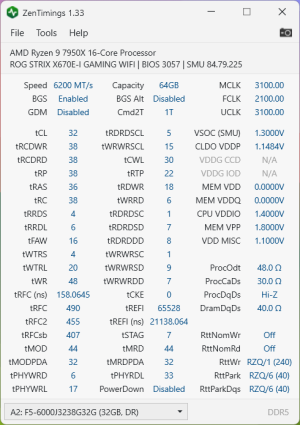
I have 64gb in 1:1 mode I run at 6200 with a 2100 mhz IF clock. The system also boots at 6400, but I haven’t had time to get it stable. I’ve seen people hit 6400 1:1 and 8200 with 1:2 with their 96gb kits and a 2200 MHz IF clock.I have a 6400MT/s 2x48GB EXPO kit that's on my motherboard QVL and when I enable EXPO it sets it 6400MT/s, 2000MHz FCLK, and 2:1 UCLK. This is actually stable, indicating the ram and motherboard are fine at 6400. If I change to 1:1, it spams memory errors from virtually every address, indicating the IMC can't handle it. This isn't a motherboard issue.
Until I see some independent verification that demonstrates MSIs boards will actually do 1:1 UCLK with 2+ dual rank dimms, I will assume it is at 2:1. Considering this is silicon lottery for your IMC territory, I am skeptical this is even possible.
.... it's the same architecture at the same clockspeed, why would strix halo at 5.1 GHz score meaningfully different from strix point at 5.1 GHz?Single core performance closer to Strix Point, not Granite Ridge? I was hoping for the latter.
Perhaps it's because this is an ES, and the score will be higher in retail devices.


I thought Strix Halo would clock higher than Strix Point..... it's the same architecture at the same clockspeed, why would strix halo at 5.1 GHz score meaningfully different from strix point at 5.1 GHz?
Seems ok. Multiply by four and it's roughly 8000 MT/s.Looks like the ram is only running at a quarter the speed it should be? 1994MT/s? Or is that just reporting shenanigans?


Are they the same? Wasn't Halo supposed to be using desktop like chiplets with full SIMD and twice L3 cache?.... it's the same architecture at the same clockspeed, why would strix halo at 5.1 GHz score meaningfully different from strix point at 5.1 GHz?
Twice the L3 cache at twice the cores, so same amount of L3 per coreI thought Strix Halo would clock higher than Strix Point.
And it also has twice the L3 cache per Zen5 CCX.
It's reporting. 7500 MT/s LPDDR5 is reported as 1867.Looks like the ram is only running at a quarter the speed it should be? 1994MT/s? Or is that just reporting shenanigans?
Isn't Strix Halo supposed to have a 100W TDP? Seems hot for a 13" tablet. But apparently the previous Flow Z13 could draw 100W under load, so I guess that tracks.
It's presumably using the GNR CCD (meaning it should have Zen 5 cores with the full FPU rather than the STX chop) and a different IOD that should remedy the IOD <-> CCD throughput bottleneck caused by the single 32B/clk GMI3 link..... it's the same architecture at the same clockspeed, why would strix halo at 5.1 GHz score meaningfully different from strix point at 5.1 GHz?
Single core performance closer to Strix Point, not Granite Ridge? I was hoping for the latter.
Perhaps it's because this is an ES, and the score will be higher in retail devices.

This is the future of laptops. Exciting isn’t it.Seems ok. Multiply by four and it's roughly 8000 MT/s.
Look at the Max GO in MT!
8 wins against a higher TDP desktop chip!
Even beats Det0x's souped up 9950X in the photo filter MT test! https://browser.geekbench.com/v6/cpu/compare/9460276?baseline=9430627
I knew Ryzen was badly bandwidth starved. This confirms it.
And the real kicker is that GB6 can't isolate EVERY performance aspect of any given chip!
So there's gotta be more wins in store for the Max in other benchmarks!

STH does. 32 MB worth, if I remember correctly.Doesn't this chip have MALL cache? Shouldn't that help with memory latency a bit?
Think it helps GPU more than CPUDoesn't this chip have MALL cache? Shouldn't that help with memory latency a bit?

Look at the Max GO in MT!
8 wins against a higher TDP desktop chip!
Even beats Det0x's souped up 9950X in the photo filter MT test! https://browser.geekbench.com/v6/cpu/compare/9460276?baseline=9430627
I knew Ryzen was badly bandwidth starved. This confirms it.
And the real kicker is that GB6 can't isolate EVERY performance aspect of any given chip!
So there's gotta be more wins in store for the Max in other benchmarks!
There's your answer. I bet we may see a lot of performance unlocked at 150W TDP and better cooling in workstation laptops like Thinkpads, Dell Precisions and HP Zbooks.but how is Ray Tracer MT 63% explained? Almost half score
and why ST -15%?
also Flow Z13 is tiny and probably throttles in full load





 Facebook
 Twitter