• We’re currently investigating an issue related to the forum theme and styling that is impacting page layout and visual formatting. The problem has been identified, and we are actively working on a resolution. There is no impact to user data or functionality, this is strictly a front-end display issue. We’ll post an update once the fix has been deployed. Thanks for your patience while we get this sorted.

Question Zen 4 builders thread

Page 96 - Seeking answers? Join the AnandTech community: where nearly half-a-million members share solutions and discuss the latest tech.
Another? How old was your unit?
I have been buying Corsair PSU's for many years, but I almost have none still working. I changed over to EVGA in 2017 or so. None of them have died.

Not sure when I bought it but the only review I can find is 2021.

Edit: found a 2015 review
 
I have been buying Corsair PSU's for many years, but I almost have none still working. I changed over to EVGA in 2017 or so. None of them have died.

Not sure when I bought it but the only review I can find is 2021.
that's bizarre. corsair psus are the only brand that seem to not die because they work close with their integrator. they did have some crappy cheap models back in the day but what brand hasn't. are these for 24/7 systems?
 
that's bizarre. corsair psus are the only brand that seem to not die because they work close with their integrator. they did have some crappy cheap models back in the day but what brand hasn't. are these for 24/7 systems?
all mine are 24/6/365 computers.

Edit: the Thermaltake PSU tester says the 24 pin is good, but the cpu and PCIE are dead. Computer would not power on and had no lights before I removed it.
 
all mine are 24/6/365 computers.

Edit: the Thermaltake PSU tester says the 24 pin is good, but the cpu and PCIE are dead. Computer would not power on and had no lights before I removed it.
that'll do it. you mention having frequent outages a while back? May have a small roll in that.
 
I'm curious as to if the 7900 series with 64Mb Level 3 cache, if one disables the HT or SMT, do the 12 cores access the full 64Mb of level 3 cache still?
 
I have used Corsair PSUs exclusively for the last 10 years and they have been pretty good. They are all CWT though, don't know if the others are as good. Corsair PSUs are all made by other brands.
 
I'm curious as to if the 7900 series with 64Mb Level 3 cache, if one disables the HT or SMT, do the 12 cores access the full 64Mb of level 3 cache still?

Each group of 6 cores access it's own full 32MB of L3, so yeah, full 64MB in total per SoC. But if for whatever reason L3 caching is Your main concern ( for example special workload that fits in L3 ), i'd strongly recommend 7800X3D. Full 96MB of L3 is huge and 8C is not that big downgrade from 12 and having to deal with different clocks and different L3 cache pools.
 
Each group of 6 cores access it's own full 32MB of L3, so yeah, full 64MB in total per SoC. But if for whatever reason L3 caching is Your main concern ( for example special workload that fits in L3 ), i'd strongly recommend 7800X3D. Full 96MB of L3 is huge and 8C is not that big downgrade from 12 and having to deal with different clocks and different L3 cache pools.
So in effect, its just like a 7600(X) can access 32MB of cache with 6 cores. From a gaming perspective & considering current gen consoles only use up to 8 cores (99% PC games ported over) then a 6c/12t chip is all that's needed for this task & the value for money proposition - virtually double $ for the X3D 8c/16t chip is a debatable issue indeed.
 
Took apart my machine yesterday to change coolers and add one of those socket support thingies. Noticed my 7950X has several darkened areas where the pins make contact, likely from the vSOC debacle. Unfortunately, the chip still technically works fine. ASUS/AMD really dropped the ball.

Side note, the doohickey dropped my temps by about 5 degrees C. Worth it.
 
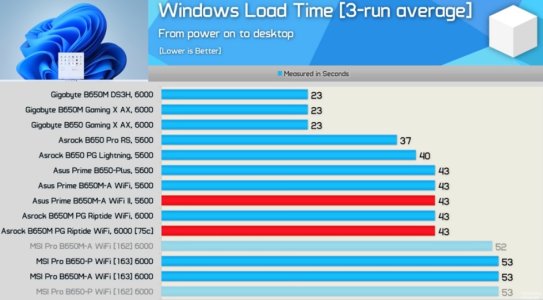
Just wonder what Windows boot-up times you're getting with your AM5 Zen4 PC builds (and with what MB, CPU, and RAM)?

I found this review testing some different motherboards:


Screenshot from video review:
am5_bootup_times.jpg

As can be seen the results vary from from 23 to 53 seconds! I would have expected more like 5-15 seconds.

Is this a common problem with AM5? And why does it differ so much between different motherboard manufacturers?

Can we expect future BIOS updates to bring down the AM5 boot-up time to around 5-15 seconds which I'm used to from other PC builds?
 
Last edited:
Just wonder what Windows boot-up times you're getting with your AM5 Zen4 PC builds (and with what MB, CPU, and RAM)?

I found this review testing some different motherboards:


Screenshot from video review:
View attachment 85188

As can be seen the results vary from from 23 to 53 seconds! I would have expected more like 5-15 seconds.

Is this a common problem with AM5? And why does it differ so much between different motherboard manufacturers?

Can we expect future BIOS updates to bring down the AM5 boot-up time to around 5-15 seconds which I'm used to from other PC builds?
I built a new AsRock B650M-HDV rig recently, boot-up times are good. Nice, cheap board. Haven't measured them, but here's Hardware Unboxed’s video on it:
 
Just wonder what Windows boot-up times you're getting with your AM5 Zen4 PC builds (and with what MB, CPU, and RAM)?

I found this review testing some different motherboards:


Screenshot from video review:
View attachment 85188

As can be seen the results vary from from 23 to 53 seconds! I would have expected more like 5-15 seconds.

Is this a common problem with AM5? And why does it differ so much between different motherboard manufacturers?

Can we expect future BIOS updates to bring down the AM5 boot-up time to around 5-15 seconds which I'm used to from other PC builds?
What makes boot times so important to you?
 
Took apart my machine yesterday to change coolers and add one of those socket support thingies. Noticed my 7950X has several darkened areas where the pins make contact, likely from the vSOC debacle. Unfortunately, the chip still technically works fine. ASUS/AMD really dropped the ball.

Side note, the doohickey dropped my temps by about 5 degrees C. Worth it.
the what now?
What makes boot times so important to you?
some people want to hop onto their chair first thing in the morning and get to 'puting.

The boot times are longer than Intel but so what. Go make a cuppa tea or coffee.
 
the what now? Are you confused with the intel contact frame?
No, it's the AM5 heatspreader that's the issue. Its height is a bit too much if I recall correctly. I think the contact frame helps somehow to ameliorate the problem of improper contact of the CPU heatspreader with the heatsink surface.
 
No, it's the AM5 heatspreader that's the issue. Its height is a bit too much if I recall correctly. I think the contact frame helps somehow to ameliorate the problem of improper contact of the CPU heatspreader with the heatsink surface.
How? does it bow inward or outward? the ihs is fairly thick on am5 and glued through a lead solder. this is the first time I'm hearing of an am5 contact frame.
 
How? does it bow inward or outward?
No idea. It was just a guess, judging by the reported decrease in temps. The "secure" frame, as it is called, is supposed to mainly prevent the thermal paste from getting into the notches of the heatspreader but I guess it improves the thermal properties somehow by giving the paste a larger area to spread on.
 
The boot times are longer than Intel but so what.
Is it confirmed that this is an AMD vs Intel issue? If so, what's the reason AMD based PCs take longer to boot up? Seems strange that AMD PCs would take longer too boot up. What would be the technical root cause for that?

Or is it an AM5/Zen4 specific issue (so the problem does not apply to earlier AMD sockets or CPUs)? In that case, may BIOS updates be able to improve the boot-up times?
 
Just wonder what Windows boot-up times you're getting with your AM5 Zen4 PC builds (and with what MB, CPU, and RAM)?

I found this review testing some different motherboards:


Screenshot from video review:
View attachment 85188

As can be seen the results vary from from 23 to 53 seconds! I would have expected more like 5-15 seconds.

Is this a common problem with AM5? And why does it differ so much between different motherboard manufacturers?

Can we expect future BIOS updates to bring down the AM5 boot-up time to around 5-15 seconds which I'm used to from other PC builds?
After training my memory I've disabled memory training and boot times are around 15 secs.
 
Back
Top