
Gloomy
Golden Member
- Oct 12, 2010
- 1,469
- 21
- 81
http://www.sisoftware.eu/rank2011d/...dbe6deedd4e7d3f587ba8aacc9ac91a187f4c9f9&l=en
4096 SPs
HBM
this kills the nvidia
4096 SPs
HBM
this kills the nvidia


AMD will have no problems hitting 250W even on 250mm2 20nm GPU.
GCN needs serious perf/W upgrade.
Q2/Q3, or H2 2015 20nm launch suggests >500mm2 28nm design was ditched.
But yeah, I guess (and hope) that hybrid cooling was made for that 28nm design.
AMD will have no problems hitting 250W even on 250mm2 20nm GPU.
GCN needs serious perf/W upgrade.
Q2/Q3, or H2 2015 20nm launch suggests >500mm2 28nm design was ditched.
But yeah, I guess (and hope) that hybrid cooling was made for that 28nm design.

While nVidia's "boost software" is exceptionally good, they don't have the market cornered on writing good software. AMD can improve their perf/W just like nVidia has.
250W@250mm² is smile worthy, though.

A whisperer told me Fiji is much bigger than Hawaii.

That's not true.
http://en.wikipedia.org/wiki/Fiji
http://en.wikipedia.org/wiki/Hawaii
18,274 km2 vs 28,311 km2
j/k
If you're implying that the secret to Nvidia's power savings in Maxwell is all due to software, I'd be interested in knowing what made you say that.
If not, my bad and I misunderstood.
"Software" as in Firmware. Fast response for optimal usage of power gating and clock gating. nVidia did a great job in this area.
While nVidia's "boost software" is exceptionally good, they don't have the market cornered on writing good software. AMD can improve their perf/W just like nVidia has.
250W@250mm² is smile worthy, though.

Can anyone familiar with HBM advise how this will affect GPU performance? I know that the 290x has a wider bus than the 780ti and that contributed to better performance @ higher resolutions... Just wondering at the implications of having so much more bandwidth...


It's not. Take a look at Hawaii 20nm ideal shrink, ie +30% higher clocks option.
200mm2, 1300MHz, TDP remains the same
Add some mm2 to bring this into real world and to save the power.
We've been over this...
You make it seem as though AMD cannot make architectural efficiency improvements and improve perf / sq mm and perf/watt.
We should expect some memory compression scheme similar to NV with the next AMD release too, right?

This leak indicates that the HBM modules on the R9 390X have been clocked slightly above the default 1.2Ghz frequency to 1.25Ghz. Which should drive overall bandwidth up to ~533.3GB/s. That’s more than double the memory bandwidth available to the GTX 980 which is 224GB/s. And easily surpasses the 320GB/s bandwidth of the R9 290 series and the 336GB/s data rate of the GTX 780 Ti. The R9 390X has by far the greatest amount of memory bandwidth we’ve seen on any graphics card to date.
Read more: http://wccftech.com/amd-fiji-r9-390x-specs-leak/#ixzz3ImFcRdJp
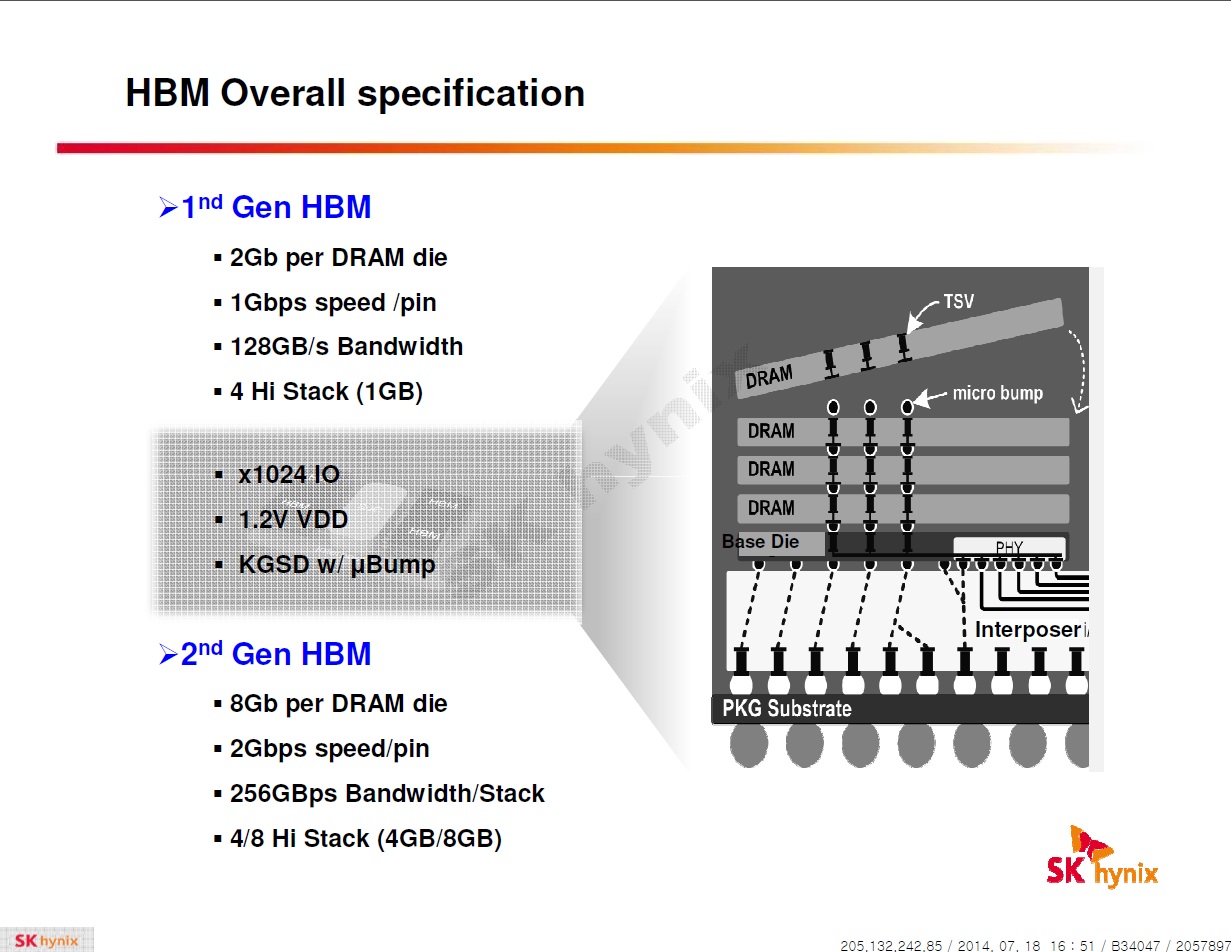


Can anyone familiar with HBM advise how this will affect GPU performance? I know that the 290x has a wider bus than the 780ti and that contributed to better performance @ higher resolutions... Just wondering at the implications of having so much more bandwidth...
Yeah I keep seeing this posted. Does HBM provide more/similar memory bandwidth using a smaller bus interface to the GPU than what we have now does ?
edit: Yes. Looks like it's a massive potential increase to bandwidth, lower power use and denser modules.
http://www.skhynix.com/gl/products/graphics/graphics_info.jsp

lol you win the Internet for today.That's not true.
http://en.wikipedia.org/wiki/Fiji
http://en.wikipedia.org/wiki/Hawaii
18,274 km2 vs 28,311 km2
j/k
Well yes, direct shrink is what we have been discussing.
Far from me saying that they won't improve GCN



 Facebook
 Twitter