[VC]AMD Fiji XT spotted at Zauba

Page 4 - Seeking answers? Join the AnandTech community: where nearly half-a-million members share solutions and discuss the latest tech.

garagisti

Senior member
Aug 7, 2007
592
7
81
How about a 285 for 169.99AR w/3 free games?
That's a bloody good price... even though there's rebate involved. :D

No, i shalt not get tempted for anything less than a brand new $500 295x2 (hey, it is the middle of the night, man can dream right?) or a new top of the line card.
 

3DVagabond

Lifer
Aug 10, 2009
11,951
204
106
Yea that is a nice price, even at $199 with out AR is very good and easily can be recommended over R9 280. But the problem is, that is a one day offer only. 2GB R9 285 price needs to come down.

It's the last day of the offer. I'm not sure how long it was going on but I saw it a couple of days ago.
 

RussianSensation

Elite Member
Sep 5, 2003
19,458
765
126
1. More memory efficiency is good, but given that Hawaii already has plenty to handle 4K, and R390X has stacked memory to nearly double bandwidth, I don't think this is a meaningful improvement in gaming.

2. AMD GPUs have not been limited by tessellation performance in GAMES since Tahiti. Sure in artificial benchmarks you can see the difference, but games that are optimized well or even poorly (Crysis 2/3), GCN keeps up with the competition just fine. I don't think Tessellation will be the bottleneck in games, not when cross-platform devs have to design for consoles running GCN. Maybe in a few Gameworks titles it will make a difference.

On paper, there's just no way for R390X to be 50% faster than R290X. The shader count growth alone discounts that possibility unless Fiji is GCN2.0 with major IPC gains. Somehow I don't think it's AMD's Maxwell.

Look at it this way, since you already said that memory bandwidth and tessellation are not major bottlenecks of Hawaii, and Tonga improves in both of those areas, not to mention 50% more efficient color fill-rate, AMD doesn't need to spend that much time on these areas of 390X. You see they used Tonga as a testbed for GCN1.2 to improve the color fill-rate, rasterization, geometry, and memory bandwidth efficiency. That means now the other team working on 390X only has focus primarily on SPs, TMUs, cache sizes and ACE compute engine efficiency. Since Tonga gives us 90% (!) more tessellation, nearly double the rasterization rate of Tahiti, 40% more memory/color fill rate efficiency, all in a die size similar to Tahiti, AMD's engineers are now free to expand SPs, TMUs and ROPs without worrying that the aforementioned parts will bottleneck 390X severely. AMD also did all that with 700 million transistors only if rumours of Tonga XT packing 384-bit memory bus are true.

http://techreport.com/review/26997/amd-radeon-r9-285-graphics-card-reviewed/2

That means if AMD grows the die size to 520mm2, they can probably hit 3840-4096 SPs. At 1.1-1.2Ghz, you will be 40-45% faster than 290X in GPU limited games without any other improvements GCN 2.0 brings over 290X. Remember 980 is only 20% faster on average, but much slower as you go up in resolutions.

I don't expect 390X to use 165W of power. However, I would take a 275W card 20% faster than 980 because I don't spend $500+ on cards to save $10 a year in electricity. I just don't know if AMD is going mid-range 20nm die or massive 500-550mm2 28nm die. If AMD goes the latter, they will not be able to beat GM200 since it will be a maxed out balls out chip. AMD goes the former, they will likely do a 2-step Tahiti--> Hawaii transition where the first chip is going to be slightly faster than 980 but they'll need a 2nd iteration to combat GM200.

I think as long as 390X beats 980 by 18-20% at $550, the wait will be worthwhile. If 390X is only 10% or less faster, well that would be disappointing to me.

* as you know I speak highly of AMD's 2nd best cards as they continue to deliver unbeatable price performance (5850s, 6950s, 7950s, 290s). Even if 390X doesn't beat GM200, I think we will have yet another generation where 2 of AMD's 2nd best cards crush NV's single flagship by 40-60% for not much more $. I would love for AMD to bring unlocking of 6950 back. That would make the 390 as smoking value. I also like that AMD doesn't have a 16-20% gap on performance betwen their top and 2nd best card once oth are overclocked and doesn't cripple VRAM or bus width (5850/6950/7950/290 all share this). With HBM, I doubt AMD will care to cripple the bus or memory size on the 390.
 
Last edited:

raghu78

Diamond Member
Aug 23, 2012
4,093
1,476
136
Remember 980 is only 20% faster on average, but much slower as you go up in resolutions.

The 20% lead maybe at 1080p but not at 1440p/1600p/4k. Its more like 10 -15% avg according to most reviews at 1440p and higher resolutions . In fact in recent games the gap is reducing further and there are games like Ryse Son of Rome, Middle Earth Shadow of Mordor, Civilization Beyond Earth, Dragon Age Inquisition where R9 290X is even winning against GTX 980.
 
Last edited:

Erenhardt

Diamond Member
Dec 1, 2012
3,251
105
101
Great post RS!

AMD is not known for big dies, but the rumorer chips is bigger than hawaii, which points to 28nm.

I would love for AMD to bring unlocking of 6950 back. That would make the 390 as smoking value. I also like that AMD doesn't have a 16-20% gap on performance betwen their top and 2nd best card once oth are overclocked and doesn't cripple VRAM or bus width (5850/6950/7950/290 all share this). With HBM, I doubt AMD will care to cripple the bus or memory size on the 390.

Some 290 unlocked to full 290X.

AMD had a lot of time to tweak their arch to improve efficiency. The fact that 285 is not very efficient is not indicative of anything. Those are rejected dies that didn't make it to apple standards. Those run on increased voltage with large chunk of die disabled.
 

Actaeon

Diamond Member
Dec 28, 2000
8,657
20
76
Has there ever been a previous instance where the next generation flagship was 40-50% faster than the previous generation flagship?
 

sm625

Diamond Member
May 6, 2011
8,172
137
106
AMD's upcoming HBM GPU processor is operating in HBM2 pseudo-channel mode.

HBM2 pseudo-channel => 64-bit data width, rather than 128-bit data width.

Think unganged versus ganged. (16*64 for unganged/pseudo channel or 8*128 for ganged/full channel)

HBM1 => 1/2th tFAW of DDR3
HBM2 => 1/3rd tFAW of DDR3 // 1/2th tFAW of DDR4


Quit spewing information without any sources. This is your last warning until I start infracting upon it.

-Moderator Rvenger

This is probably his source:

http://www.memcon.com/pdfs/proceedings2014/NET104.pdf
see pg 13
 

Actaeon

Diamond Member
Dec 28, 2000
8,657
20
76
Sure. Compare a 780Ti to a GTX 580.

Wasn't there a 680 that was released between the two? I've been out of the HW scene for a while, so some of this is new to me, but a quick search led me to see that there was a 3 year gap between the 780Ti and 580. The 680 was in the middle in terms of release and performance.

Didn't check the performance gaps between all of them, but I can see or understand a 40% increase across two generations, but my question was around specifically the next in line successor which is what Fiji will be to Hawaii.

Also seems like the 780Ti was a level above the regular 580 & 680? I know they are all flag ships of their line, but seems like the 7xx series had a higher segment that wasn't seen in previous lines, which makes me wonder if it really was the 580/680's direct successor.

580 Launch Price - $499
680 Launch Price - $499
780Ti Launch Price - $699
 

Keysplayr

Elite Member
Jan 16, 2003
21,219
56
91
Wasn't there a 680 that was released between the two? I've been out of the HW scene for a while, so some of this is new to me, but a quick search led me to see that there was a 3 year gap between the 780Ti and 580. The 680 was in the middle in terms of release and performance.

Didn't check the performance gaps between all of them, but I can see or understand a 40% increase across two generations, but my question was around specifically the next in line successor which is what Fiji will be to Hawaii.

Also seems like the 780Ti was a level above the regular 580 & 680? I know they are all flag ships of their line, but seems like the 7xx series had a higher segment that wasn't seen in previous lines, which makes me wonder if it really was the 580/680's direct successor.

580 Launch Price - $499
680 Launch Price - $499
780Ti Launch Price - $699

680 was not the top end of the Kepler architecture. GTX580 was the top end of the Fermi architecture. Technically, 680 was a mid range card. It's just that it came out so much earlier than GTX780Ti or Titan.
 

KaRLiToS

Golden Member
Jul 30, 2010
1,918
11
81
680 was not the top end of the Kepler architecture. GTX580 was the top end of the Fermi architecture. Technically, 680 was a mid range card. It's just that it came out so much earlier than GTX780Ti or Titan.

GTX 680 wasn't a mid range card.
 

KaRLiToS

Golden Member
Jul 30, 2010
1,918
11
81
Yes of course it was. 680 was not the top end of it's architecture. GK110 was.

Doesn't mean it was midrange, if they did the Titan it was because of GK110 chips not good enough for going into the Tesla cards. And you know that, when the yield was better about GK110, they released the GTX 780.

Is the HD 7970 a mid range card because it's not the top of GCN architecture?

_________________

Anyway, seems like I'll keep my cards for another year.
 
Last edited:

Keysplayr

Elite Member
Jan 16, 2003
21,219
56
91
Doesn't mean it was midrange, if they did the Titan it was because of GK110 chips not good enough for going into the Tesla cards. And you know that, when the yield was better about GK110, they released the GTX 780.

Is the HD 7970 a mid range card because it's not the top of GCN architecture?

Ok man. Back on topic, yes?
 

Actaeon

Diamond Member
Dec 28, 2000
8,657
20
76
Don't want to beat a dead horse, but I think the question is relevant to the topic and something I am interested in hearing.

There is some debate and thoughts about whether the 390X could be 40% faster than the generation its replacing. The question I'm asking is if this has ever happened before. Certainly looking at generation to generation performance increases would give us some insight into what to expect from the 390X. Maybe I can rephrase the question to keep it more on topic and we don't go off topic and debate what card is high end or mid range.

Has the equivalent market place successor in this price range (Approx. $500-$600 MSRP market launch) ever been 40% higher than the generation it replaced?

If not, then we can say a 40% increase for the 390X is unlikely (though anything is possible). If we've seen leaps like this before, then it certainly increases the possibility it could happen.
 

KaRLiToS

Golden Member
Jul 30, 2010
1,918
11
81
Don't want to beat a dead horse, but I think the question is relevant to the topic and something I am interested in hearing.

There is some debate and thoughts about whether the 390X could be 40% faster than the generation its replacing. The question I'm asking is if this has ever happened before. Certainly looking at generation to generation performance increases would give us some insight into what to expect from the 390X. Maybe I can rephrase the question to keep it more on topic and we don't go off topic and debate what card is high end or mid range.

Has the equivalent market place successor in this price range (Approx. $500-$600 MSRP market launch) ever been 40% higher than the generation it replaced?

If not, then we can say a 40% increase for the 390X is unlikely (though anything is possible). If we've seen leaps like this before, then it certainly increases the possibility it could happen.

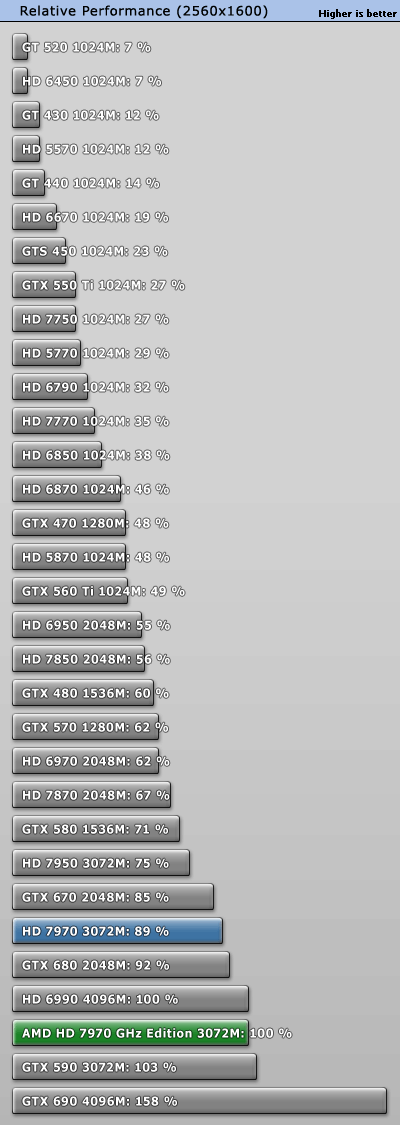
From HD 6970 to HD 7970 it was quite a big jump, but it was from a 40nm chip to a 28nm one.

Almost 35%-40% increase
perfrel_2560.gif


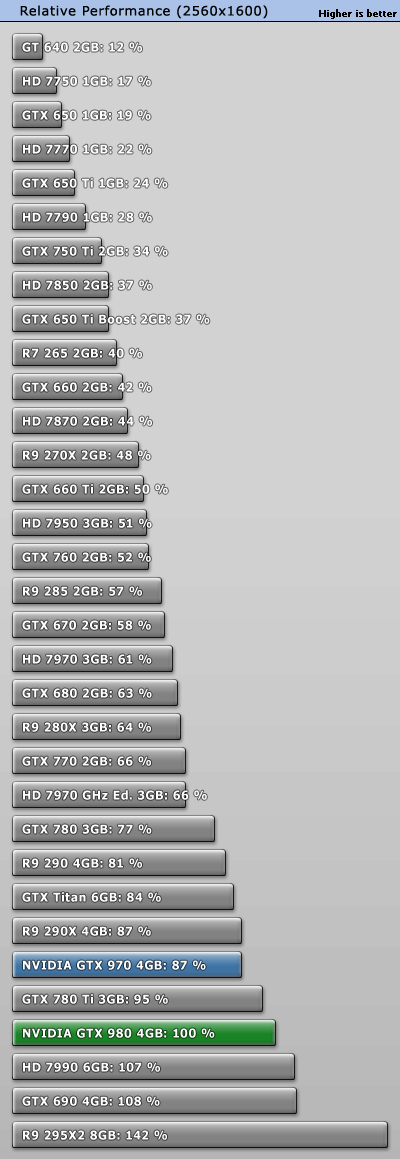
Don't expect huge increase from 290x to 390x especially that the 290x was already a very big die that heats and will probably be on the same node (28nm).

Check the GTX 980: from GTX 780 to GTX 980 it is like 23% difference, and lets not forget that the GTX 780ti is between that.

So between the GTX 780ti and the GTX 980, there is a 5% gain on overall relative performance. I don't expect much more with the 390x....but depends if they release HBM memory.

perfrel_2560.gif
 
Last edited:

Actaeon

Diamond Member
Dec 28, 2000
8,657
20
76
From HD 6970 to HD 7970 it was quite a big jump, but it was from a 40nm chip to a 28nm one.

Don't expect huge increase from 290x to 390x especially that the 290x was already a very big die that heats and will probably be on the same node (28nm).

Check the GTX 980: from GTX 780 to GTX 980 it is like 23% difference, and lets not forget that the GTX 780ti is between that.

Thanks, I do not mean to go off topic and bring up mid-range vs high end again :), but I did think about the 6970 and the update to the 7970, but if I recall correctly, AMD priced the the 6970 quite low relative to the high end at the time because they knew it wasn't a game changing performer and they decided to compete on price/value instead. IIRC, the 6970 was around $350 while the 7970 was 'full priced' at $550. Heck, I think the 6970 was cheaper than the 5870's launch MSRP too.

So bringing this back to the 390X's potential performance, this says that we have seen generational leaps like that before, but this could be an exception since the 7970 wasn't exactly the direct market replacement for 6970 and its the 40nm to 28nm node change as you mentioned.

The 7970 to 290X is an interesting comparison though. Both had the same $550 MSRP and were notable performers upon release. They are also on the same 28nm manufacturing process. Looking that up, according to HardOCP, at 1080p the 290X was around 20% quicker than the 7970GHZ edition with bigger gains when you move to higher resolutions.

So with that in mind, a 20% increase sounds reasonable when it comes to the equivalent market place successor, but bigger gaps has been seen on certain generations before. It will be very interesting to see what the 390X comes out with and what they price it at.
 

ShintaiDK

Lifer
Apr 22, 2012
20,378
146
106
From HD 6970 to HD 7970 it was quite a big jump, but it was from a 40nm chip to a 28nm one.

Almost 35%-40% increase


Don't expect huge increase from 290x to 390x especially that the 290x was already a very big die that heats and will probably be on the same node (28nm).

Check the GTX 980: from GTX 780 to GTX 980 it is like 23% difference, and lets not forget that the GTX 780ti is between that.

So between the GTX 780ti and the GTX 980, there is a 5% gain on overall relative performance. I don't expect much more with the 390x....but depends if they release HBM memory.

Lets see.

780Ti - 7.1B transistors, 250W
GTX980 - 5.2B transistors, 165W.
HD6970 - 2.64B transistors, 250W.
HD7970 - 4.31B transistors 250W.

So on a performance/watt base using your numbers.
HD6970 -> HD7970 35-40%.
GTX780Ti -> GTX980 55-60%.

Not to mention in newer games cards like the GTX980 shines quite abit more than 5%. Just like we see with Tonga. In AC Unity, just to mention a bad game, the GTX980 is more in the 20-25% area over the GTX780Ti.

The GTX980 was also cheaper than the GTX780Ti. 549$ vs 699$.
While in your case the HD6970 was 369$ and the HD7970 549$.
 
Last edited:

KaRLiToS

Golden Member
Jul 30, 2010
1,918
11
81
Lets see.

780Ti - 7.1B transistors, 250W
GTX980 - 5.2B transistors, 165W.
HD6970 - 2.64B transistors, 250W.
HD7970 - 4.31B transistors 250W.

So on a performance/watt base using your numbers.
HD6970 -> HD7970 35-40%.
GTX780Ti -> GTX980 55-60%.

Not to mention in newer games cards like the GTX980 shines quite abit more than 5%. Just like we see with Tonga. In AC Unity, just to mention a bad game, the GTX980 is more in the 20-25% area over the GTX780Ti.

The GTX980 was also cheaper than the GTX780Ti. 549$ vs 699$.
While in your case the HD6970 was 369$ and the HD7970 549$.

Why are you telling me that?

I answered Actaeon. Did he speak about efficiency? Did we speak about Tonga?

This forums is cursed with endless debates. I'm really tired about that. Can we be all neutral and owe nothing to these companies that constantly bend us over?
 
Feb 19, 2009
10,457
10
76
So between the GTX 780ti and the GTX 980, there is a 5% gain on overall relative performance. I don't expect much more with the 390x....but depends if they release HBM memory.

You can't just do broad-sweeps like comparing GK110 to GM104 (mid-range) and call it on low performance gains moving to the R390X. Does not make sense AT ALL.

Performance is a combination of multiple factors, but ultimately it comes down to (if on the same node):

1. Perf/mm2
2. Perf/w

R390X if as rumored, a 550mm2 chip, that already means without any major architectural improvements, it should be ~20-25% faster than R290X.

They need to be ~50% faster than R290X to be competitive with GM200.


