• We’re currently investigating an issue related to the forum theme and styling that is impacting page layout and visual formatting. The problem has been identified, and we are actively working on a resolution. There is no impact to user data or functionality, this is strictly a front-end display issue. We’ll post an update once the fix has been deployed. Thanks for your patience while we get this sorted.

Trivia: Congratulations humanity for causing it. Congrats to Republicans fighting against fixing it. What is it?

Page 6 - Seeking answers? Join the AnandTech community: where nearly half-a-million members share solutions and discuss the latest tech.

From CNN:​

The $52.6 billion plan to save the NYC region from climate change​

The New York and New Jersey Harbor and Tributaries Study, also known as the HATS study, looks at how to protect the NYC area from another Hurricane Sandy. The Army Corps of Engineers is recommending a $52.6 billion plan to protect the region from climate change including seawalls, levees and elevated promenades. Watch the video to find out more about what the plan entails and why the price tag is so high.
SAT, MAR 4 20237:54 AM EST

Lindsey Jacobson
Juhohn Lee
Andrea Miller
Charlotte Morabito

That's just one city, for 50 years of protection. Southern Florida is beyond hope. I imagine Miami is going to become an island behind sea walls - if they have any brains.

Sounds like WOKE policy to me.
 
Thank you. I did know. Ran that experiment in high school (dry bulb/wet bulb). Anyway, I also checked the Wikipedia article you posted earlier this morning - making sure I hadn't regressed to an idiot level understanding. My humans as 'wet-bulbs' comment was tongue-in-cheek.

And, it is one of the most dangerous risks to human life as we fail to adequately cut greenhouse emissions (that and floods). I was watching a anthropologist who specializes in climate change make the point that humans never developed in such a way to react to long term, slow moving threats (we eventually just roamed looking for better food and water resources, etc.). Education is the key - but in the US, the majority of people either don't trust, or do not understand researched based scientific evidence.
CNN article about temps

reaching level of human endurance 🥺
 
To clarify, if this was an unknown term to you:
View attachment 83168

It's predicted that if there's extreme wet bulb conditions in a region (esp a high population density region) and power fails, theoretically hundreds of thousands to millions could die within a day.
A 90 degree wet bulb is so insane. Wet bulb was around 86 the day last month I posted this, which was the grossest day I had ever experienced and maybe the nastiest day the San Antonio, Tx area has seen since Chicxulub tbh.

From the weather station a couple of blocks away

fkme.png


homer-suicide.gif
 
Already happening. Note that water breaks don't help you in wet bulb event conditions.
I am extremely confused. WTF are you guys citing 80 degrees as if that isn't a cool summer day?
And the South LIVES in 90s all summer long from May to Oct.
So why are these numbers being mentioned at all?
 
Humidity.
Redundant, was already talking about the South.
I never heard wet bulb until here and now, in this topic.
It makes no sense. Something under 90 degrees will never be a deadly heat wave.

Now... the South is hot and humid every summer. But they're talking numbers that are WELL below expectations for anything of note.

To clarify, I am asking, what is this?

A 90 degree wet bulb is so insane.
 
Last edited:
Redundant, was already talking about the South.
I never heard wet bulb until here and now, in this topic.
It makes no sense. Something under 90 degrees will never be a deadly heat wave.

Now... the South is hot and humid every summer. But they're talking numbers that are WELL below expectations for anything of note.

To clarify, I am asking, what is this?

Your Body is unable to Cool when there is a Wet Bulb condition. Even moderate exertion can quickly become a Health issue when your body temp begins to rise.
 
Redundant, was already talking about the South.
I never heard wet bulb until here and now, in this topic.
It makes no sense. Something under 90 degrees will never be a deadly heat wave.

Now... the South is hot and humid every summer. But they're talking numbers that are WELL below expectations for anything of note.

To clarify, I am asking, what is this?


SteveGrabowski linked to the Wikipedia article explaining Wet-bulb temperature in post #131.
 
SteveGrabowski linked to the Wikipedia article explaining Wet-bulb temperature in post #131.
Right.... but these numbers make no sense.
90 and 95 degrees are not going to reach a heat index of 130 or 160.
Right?

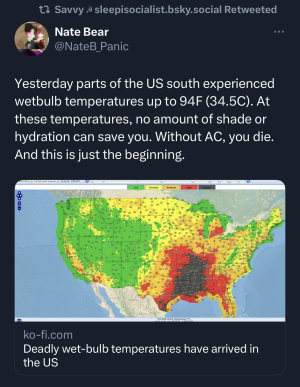
Even heat-adapted people cannot carry out normal outdoor activities past a wet-bulb temperature of 32 °C (90 °F), equivalent to a heat index of 55 °C (131 °F). A reading of 35 °C (95 °F) – equivalent to a heat index of 71 °C (160 °F) – is considered the theoretical human survivability limit for up to six hours of exposure.[3][4]
 
Right.... but these numbers make no sense.
90 and 95 degrees are not going to reach a heat index of 130 or 160.
Right?
That's the whole point. An average 'hot, humid' day in Louisiana (today, for instance) is 97, with 56% humidity. Water absorbs a lot of energy so if it's more humid, it tends to be a little cooler, so on Sunday when it's going to be 71% humidity, it's only going to be 88. That's the principal behind swamp coolers for instance. Now per this calculator, today's wet bulb temp is 83.72f, pretty unpleasant but quite survivable if you are drinking water/hitting the shade some. Sunday will be 80.22, so even better.

Now for heat index, per this calculator, today's heat index is 115. Sunday is 101. That's where those higher values start coming from.

The values we're referencing for a wet bulb event happen around 100f at 85% humidity. That's a wet bulb of 95.8f, neither the 100f or 96f there 'sound' scary, but the heat index is 167f. You've got supersaturated air that's so goddamn hot you may as well be bathing in a pot of boiling water for all the help it'll be cooling you. For additional reference, you get roughly the same wet bulb event at 97f/90% humidity, 96f/95% humidity, and swinging the other way, 101f at 80%, 103f at 75%, 105f at 70%, and 107f at 65%. You can infer the sliding curve from there I imagine.
 
Wonder if the formula I used or the one he used is wrong. Formula I found for wet bulb showed a bit under 86F but that map is showing more like 89F for my area. Can't believe it actually got significantly worse than 105F air temperature with 78F dewpoint in Mississippi.
105f with a dewpoint of 78f is a heat index of 125f. Working backwards, that's a humidity of around 45%, which is a wet bulb of around 86.5f so yeah your calcs might be right. You could have had a microclimate that got hotter though, or just a measurement from a different elevation.
 

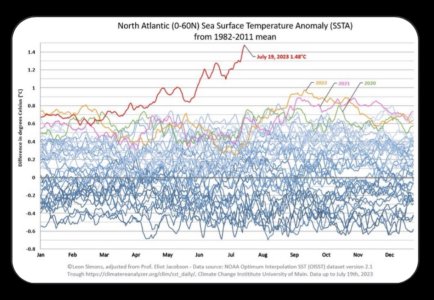
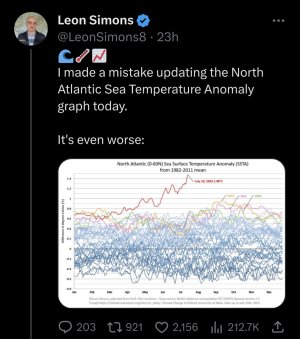
Original Data source - plus some more link for the intrepid reader. Inlcudes JSON data if someone wants to make their own graph. I want to look at the mean delta between the +/- 2 sigma data, if I get around to it. Anyway, not looking good. There is current a > 1°C delta from highest to lowest temp for this time of year. Yay us! 🙁
 
What a great time for Gov. Abbot to override local ordinances and ban water breaks for construction workers. Good thing Biden came in with new federal OSHA requirements.
 
Back
Top