
RampantAndroid
Diamond Member
So what's the debate? It still doesn't show "nVidia doing better than AMD here."
It doesn't disprove it either, if the argument is about nvidia doing better in CPU limited situations, using D3D.

So what's the debate? It still doesn't show "nVidia doing better than AMD here."

Bit-tech found very small gains with Mantle over DX11.
Even when underclocking the CPU down to 2.8GHz
And with R9 280x and down, they sometime got negative results when using Mantle over DX11.
http://www.bit-tech.net/hardware/graphics/2014/02/05/amd-mantle-bf4-performance/

Basically Mantle will only help in the situations where the GPU calculations are limited due to waiting on the CPU.
And common sense doesn't support it either. Dice would not have been asking GPU vendors for a better API. Dice wouldn't have invested the time, they would have told AMD to figure out how to fix their drivers. And NVidia would be showing off their own benchmarks.except for where all the data doesn't support that.
I doubt it is related only to a better threading, I would assume it is related to a lower CPU overhead as well, Nvidia seems to handle high drawcall numbers better than AMD under directx 11.
I did a quick test in BF4 at three resolutions, 1366x768, 1920x1080, and 2560x1440 using the settings I play with. This is using i5 and 7850
In test range
2560x1440 ~Same frame rates
1920x1080 5-10% more fps
1366x768 30-50% more fps
unless stuttering all resolutions get smoother frame rates with mantle.
If I use vsync, or gametime.maxvariablefps GPU usage is much smoother. With mantle I just get a strait line that goes up and down with gpu usage, where is DX I get lots of spikes even though it doesn't spike over the max frame rate.
So what's the debate? It still doesn't show "nVidia doing better than AMD here."
it is interesting dataThe high CPU overhead primarily comes from the API, or Direct3D. Better threading is one of the best ways to reduce your CPU overhead, as the workload is distributed across more threads.
I'm sure there are other factors involved as well (like the DX11.1 constant buffers CPU optimization), but this is the primary one I believe. I base this on the PClabs.pl review which clearly shows that AMD drivers have much poorer scaling past two threads,
from the data the game has little to do with it, even SC2 sees core scaling on NV thats a DX9 game. so the question is whats NV doing differently across the board in the way the drivers operate. You can see at low thread counts that they get poor clock scaling, if i had to guess i would say that's synchronization costs across the threads/cores.whereas NVidia's drivers easily scale up to four and beyond, provided the game supports that many threads..
no you haven't and no it isn't... i notice that you haven't explained the bit i pointed out as well.
the funny thing is lots of people who work with or on GPU's say DX multithreaded submission say it is fundamentally broken.
That's just a bunch of speculation. The PClabs.pl review shows that AMD's drivers have poor scaling on multicore processors.and here more of the stuff im talking about, possible reasons for NV's overall superior showing.
Mantle is unquestionably more efficient than Direct3D, but it's not huge unless we're comparing AMD to AMD.Drivers can get in the way of performance but they dont magically create higher then peak performance as determined by the hardware. The simple fact mantle scales so well on low end CPU's when NV doesn't ( magical DX multithreading working so well!) yet scale CPU performance high enough they end up in front and AMD stop scaling at not much more then a 7850K.
Where are you getting "NV seems CPU limited up to around a 4.5ghz 4770K in multiplayer."There's no question that NV seems CPU limited up to around a 4.5ghz 4770K in multiplayer. but thats not the question, the question is why do they have so much more performance when not CPU limited vs Mantle on hardware that on many other games is far closer. ie 290x battling the 780 and not the 290.
You post questionable benchmarks from God knows how many years ago, and expect them to have any sort of impact today?also if DX multithreading works so well, why does it gen pwnd so hard by openGL extensions?
https://static.slo-tech.com/52734.jpg
https://static.slo-tech.com/52736.jpg
Interesting interview just posted on PCper. It covers some of the "how hard will it be to port DX to Mantle and vice versa" type questions.
http://www.pcper.com/reviews/General-Tech/Core-Mantle-Questions-Interview-AMDs-Guennadi-Riguer

Who on Earth said anything about DX multithreaded submission? I was talking about basic driver multithreaded enhancements, something which NVidia has been doing for almost 15 years with their drivers when the first dual core processors became available:
NVidia drivers multithreaded since 2005
But if DX11 multithreading is broken, how on Earth did NVidia manage to squeeze out a 50% gain (in CPU limited situations) over AMD in Civilization 5?
And why is Slightly Mad Studios, the developers of Project CARS using the technology in their game?
In fact, in this comparison posted video posted on youtube last year pitting a GTX 660 vs a HD 7850, the GTX 660 has a 55% lead over the AMD card, courtesy of DX11 multithreading:
GTX 660 vs HD 7850
So apparently, DX11 multithreading does work, at least on NVidia hardware.
That's just a bunch of speculation. The PClabs.pl review shows that AMD's drivers have poor scaling on multicore processors.
I'll take that over some random internet post on the net any day.
Mantle is unquestionably more efficient than Direct3D, but it's not huge unless we're comparing AMD to AMD.
The 7850K plus 780 Ti pairing was only 18% slower than the 7850K plus R290x pairing running on Mantle.
But when you compare the 7850K plus R290x pairing running on DX to Mantle, Mantle gives you almost 60% more performance..
The problem basically, is that AMD's DX drivers suck ass..
Where are you getting "NV seems CPU limited up to around a 4.5ghz 4770K in multiplayer."
I posted some benchmarks many pages back comparing my 4.5ghz 3930K vs stock clocks at the South China Sea mission in the SP campaign, the same area AMD used to showcase their Mantle improvements as it's very CPU intensive.
Overclocking the CPU surprisingly had little performance gain, around 10 FPS or so, which considering I was already in triple digit frame rates, wasn't much for a 1ghz overclock.
So on my setup, I wasn't really CPU limited at all; at least not appreciably so. Frostbite 3 engine can scale up to 8 threads, so as long as you have a strong multithreaded processor, you're unlikely to be CPU limited to the point where it affects gameplay.
You post questionable benchmarks from God knows how many years ago, and expect them to have any sort of impact today?
DX11 multithreading performance is wholly contingent on the drivers. From the time when NVidia first introduced DX11 multithreading capable drivers with the 270xx, to the very recent 334.67 drivers, the performance has undoubtedly increased.
So that's not really a good point.
Old Anandtech review.But if DX11 multithreading is broken, how on Earth did NVidia manage to squeeze out a 50% gain (in CPU limited situations) over AMD in Civilization 5?
CIV5 doesn't have a 50% lead for nvidia anymore.


Lack of optimization is playing a role, but so is DX11 multithreading, which the engine supports. We're talking 55% here, that's huge, and mirrors past comparisons between NVidia and AMD in Civilization 5.I play project cars a lot and I switch GPUs very often. Yes the game runs much faster on Nvidia hardware without even looking at the framerate. That is not because of the CPU, that cause the AMD drivers are not optimised for this ALPHA game.
We don't know what settings the guy used, but I have a hard time believing a racing game (particularly one like this) isn't going to be CPU limited, as you're moving so fast so things have to be rendered quickly.I know it isn't the CPU cause the things that hit amd cards the most is AA mostly and that is in a very GPU limited scenario. Project cars is very GPU limited. I can tell you right now CPU makes very little difference in that game regardless of the GPU.
The IQ settings may have been high, but the resolution was 1280x720, which effectively makes it CPU limited.Even in your own video, you can see the settings are maxed out. If it were indeed cause of CPU limitation the higher the settings the smaller the gap. There is a 7850 at work and I am currently running a GTX660. I have both Project cars and CIV5, I also have BF4 I will do some benchmarks for you for 3 games this weekend with my system at various resolutions and CPU clocks/core in DX and mantle.
Old Anandtech review.
http://www.anandtech.com/show/5699/nvidia-geforce-gtx-680-review/16
Remember when NVIDIA used to sweep AMD in Civ V? Times have certainly changed in the last year, thats for sure. It only seems appropriate that were ending on whats largely a tie. At 2560 the GTX 680 does have a 4% lead over the 7970, however the 7970 reclaims its lead at the last possible moment at 1920. At this point weve seen the full spectrum of results, from the GTX 680 losing badly to winning handily, and everything in between.
http://www.anandtech.com/show/5699/nvidia-geforce-gtx-680-review/17
"Remember when NVIDIA used to sweep AMD in Civ V Compute? Times have certainly changed. AMDs shift to GCN has rocketed them to the top of our Civ V Compute benchmark."
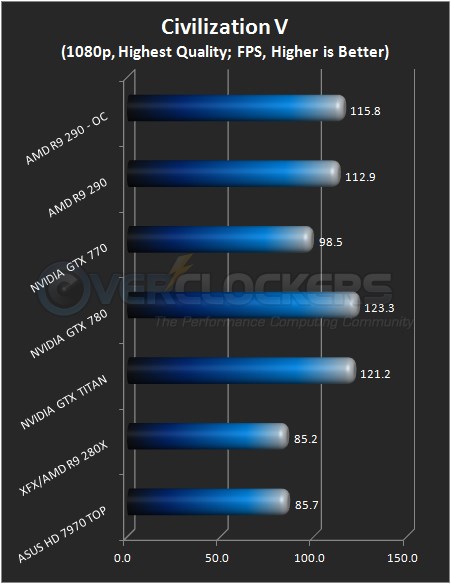
I meant to post both. I thought I could just change the 17 to 16, but both went to the same page.You posted the COMPUTE benchmarks, not the actual game benchmarks.

Many review sites, if not most, do not use the dedicated benchmarking tools supplied by games. Unless specified, you have no idea what is used. The better sites tend to tell you how it was tested, and it surprised me how often they do not use supplied benchmark tools.Doesn't Civ 5 have a dedicated benchmarking tool?

Why am I using the GTX 780 instead of the GTX 770 you might ask? It's simple. The GTX 780 is the most CPU limited card in the benchmark.


