• We’re currently investigating an issue related to the forum theme and styling that is impacting page layout and visual formatting. The problem has been identified, and we are actively working on a resolution. There is no impact to user data or functionality, this is strictly a front-end display issue. We’ll post an update once the fix has been deployed. Thanks for your patience while we get this sorted.

Discussion Speculation: Zen 4 (EPYC 4 "Genoa", Ryzen 7000, etc.)

Page 520 - Seeking answers? Join the AnandTech community: where nearly half-a-million members share solutions and discuss the latest tech.

Vattila

Senior member
Except for the details about the improvements in the microarchitecture, we now know pretty well what to expect with Zen 3.

The leaked presentation by AMD Senior Manager Martin Hilgeman shows that EPYC 3 "Milan" will, as promised and expected, reuse the current platform (SP3), and the system architecture and packaging looks to be the same, with the same 9-die chiplet design and the same maximum core and thread-count (no SMT-4, contrary to rumour). The biggest change revealed so far is the enlargement of the compute complex from 4 cores to 8 cores, all sharing a larger L3 cache ("32+ MB", likely to double to 64 MB, I think).

Hilgeman's slides did also show that EPYC 4 "Genoa" is in the definition phase (or was at the time of the presentation in September, at least), and will come with a new platform (SP5), with new memory support (likely DDR5).

Untitled2.png


What else do you think we will see with Zen 4? PCI-Express 5 support? Increased core-count? 4-way SMT? New packaging (interposer, 2.5D, 3D)? Integrated memory on package (HBM)?

Vote in the poll and share your thoughts! 🙂
 
Last edited:
Just saw new RedGamingTech video titled HUGE Zen5 clocks and benchmarks news, or something like that. Pretty much rehashing the previous video. I am mildly annoyed.
EDIT: Wrong thread, sorry
 
I've said this before: there is a real market for a motherboard manufacturer and a chip producer to produce a motherboard for AM5 that has a 16 PCIe 5.0 to 64 lane PCIe 4.0 (2x oversubscribed) PLX chip for a "prosumer" motherboard that has 4 x X16 slots or 6 X x8/x16 slots. There are precious few PCIe 5 cards out there and still not many 4.0 cards. Such a board would more than satisfy most of the "needs tons of I/O market" that would be more than happy with a vanilla 7950x chip. Even at a board cost if $1000, it would still be considerably cheaper than the lowest end TR setup.
 
I've said this before: there is a real market for a motherboard manufacturer and a chip producer to produce a motherboard for AM5 that has a 16 PCIe 5.0 to 64 lane PCIe 4.0 (2x oversubscribed) PLX chip for a "prosumer" motherboard that has 4 x X16 slots or 6 X x8/x16 slots. There are precious few PCIe 5 cards out there and still not many 4.0 cards. Such a board would more than satisfy most of the "needs tons of I/O market" that would be more than happy with a vanilla 7950x chip. Even at a board cost if $1000, it would still be considerably cheaper than the lowest end TR setup.
Threadripper 1000/2000/3000 still exists though. Manufacturers would be competing with the second hand market if they'll create boards with all features already present in previous gens
 
TR 1000/2000 are broadly irrelevant at this point. Yes, they exist, but all are out of warranty and surpassed by the 7900/50 in every measure, especially when you include avx-512. You know what else has been out there forever? Used servers. Those have always competed with the "needs tons of I/O" market.

TR 3000 is pricey across the board, and to get to 7900/50 performance levels, you are spending even money or better.

ALL of that consumes considerably more power than 79xx am5.
 
TR 1000/2000 are broadly irrelevant at this point. Yes, they exist, but all are out of warranty and surpassed by the 7900/50 in every measure, especially when you include avx-512. You know what else has been out there forever? Used servers. Those have always competed with the "needs tons of I/O" market.

TR 3000 is pricey across the board, and to get to 7900/50 performance levels, you are spending even money or better.

ALL of that consumes considerably more power than 79xx am5.
I have to agree. I am trying to sell all my hardware below Zen 4. Not having a lot of luck.
 
I have to agree. I am trying to sell all my hardware below Zen 4. Not having a lot of luck.
We're in a bit of a strange economy at the moment as well. Cash availability is low due to rising interest rates, but prices are continuing to creep upward (though not at 9% anymore, thank goodness). In other words it's hard to sell a depreciating asset right now.
 
chrome_screenshot_1699384570016.pngchrome_screenshot_1699384610659.png

Hey guys.

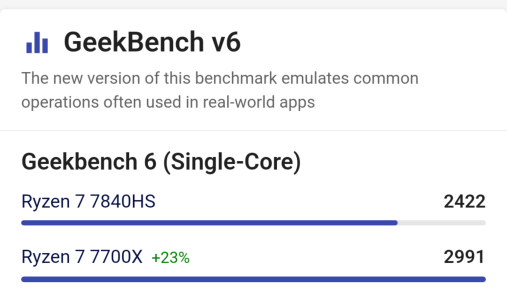
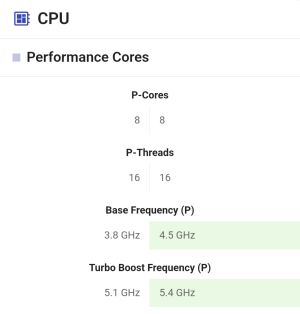
So I am going to calculate the ST IPC of 7840HS and 7700X.

7840HS = 474.9

7700X = 553.8

Now that's a substantial (~15%) IPC advantage for the 7700X.

Now, I am aware that the 7840HS only has 16 MB L3 cache vs the 32 MB L3 in the 7700X. That's the L3 cache.

What other factors account for the 15% IPC gap?
 
View attachment 88502View attachment 88503

Hey guys.

So I am going to calculate the ST IPC of 7840HS and 7700X.

7840HS = 474.9

7700X = 553.8

Now that's a substantial (~15%) IPC advantage for the 7700X.

Now, I am aware that the 7840HS only has 16 MB L3 cache vs the 32 MB L3 in the 7700X. That's the L3 cache.

What other factors account for the 15% IPC gap?
The real frequency gap is larger than the on-paper specs.
 
Even an old gen 1/2 threadripper / epyc would welcome in my classroom, really.
Quad core server is meh...

When Epyc first launched, we put together a 64 core server (2P 32-core Epyc CPUs) for a little over $11k. It cost about the same as a single top-end Xeon (at that time) that had 28 cores.

It's still in use to this day hosting various VMs for an odd assortment of projects and other stuff.

Maybe check around with local companies. Some might have some servers like that getting close to their EOL that they might just give away if it's going to educational use.
 
When Epyc first launched, we put together a 64 core server (2P 32-core Epyc CPUs) for a little over $11k. It cost about the same as a single top-end Xeon (at that time) that had 28 cores.

It's still in use to this day hosting various VMs for an odd assortment of projects and other stuff.

Maybe check around with local companies. Some might have some servers like that getting close to their EOL that they might just give away if it's going to educational use.
I have a 1950x that I would give to a good home, but you need to be within driving distance of Portland, Oregon
 
If this is true, and AMD is releasing 5700x3d and 5500x3d, I am wondering why not 7600x3d?

 
Who says they won't? Just calculate how long AMD took to launch the former to get an idea when it may launch the latter. 😛

I think the incentive for AMD is to grow volume for the AM5 platform. And to be able to remove any reason for people to get Intel's 1x600 and 1x700 CPUs.

OTOH, the Zen 3 chips on trailing edge 7nm and Global Foundries I/O die must be extremely inexpensive to manufacture.

I think one notable observation we can draw from this is that the cost of adding V-Cache is extremely low. Based on adding V-Cache to quite a low end CPUs.

I also wonder how long the 5600x3d is with MicroCenter. It would make sense to make that one widely available, before launching these new models...
 
As I understand it (its somewhere in this forum) the 3495x score of 131k was with ln2. So, yea they are blown to hell.

Edit: here it is ! 1900 watts for 132K. So confirmed that 3495x records are history and the 7995 does it on air with almost 50% of the power of the 3495x under LN2 !!!

 
Not much discussion for me to add but C&C posted a new article on the Zen 4 CCD, which includes some comparison to Zen 3 and Zen 2's CCD.
Given all the talking points relying on area used the complete omission of Zen 4c is kind of unfortunate. I guess C&C can do a follow up post once a high res die photo of that exists.
 
Back
Top