• We’re currently investigating an issue related to the forum theme and styling that is impacting page layout and visual formatting. The problem has been identified, and we are actively working on a resolution. There is no impact to user data or functionality, this is strictly a front-end display issue. We’ll post an update once the fix has been deployed. Thanks for your patience while we get this sorted.

Discussion Samsung Exynos SoC thread

Page 5 - Seeking answers? Join the AnandTech community: where nearly half-a-million members share solutions and discuss the latest tech.
I read somewhere that China is doing a lot of research into using free electron lasers for EUV light. It seems to me that might be a technically better/cheaper pathway than how ASML's EUV machines work, only because of how hideously complex and Rube Goldberg those are
A recent paper from Okinawa Institute of Science and Technology showed how that complexity could be drastically reduced with less mirrors, more power and greater efficiency.

euv_comparison.jpg
 
Canon's "nanoimprint lithography" is also making the rounds as a possible alternative.

Currently, the NZ2C is best served on more mature nodes. Anything that uses SADP/SAQP larger than 40nm on metal pitches. As the current spec makes it about on-par with Nikon's NSR-S622D on throughput and NSR-S635E on everything else. Where it starts to replace current-gen EUV LELE and High-NA EUV is by 2027~2029.

We'll have to see how fast the Canon Tochigi (Spring 2025) can deliver NIL tools, to Tata/PSMC Dholera (End of 2026). As well if AIST/Canon can get the 12.5 half-pitch&L/S(Metal pitch: 25nm 3D-NIL Dual Damascene) ready for 2nm (plus?) Rapidus.
 
Last edited:
A recent paper from Okinawa Institute of Science and Technology showed how that complexity could be drastically reduced with less mirrors, more power and greater efficiency.

euv_comparison.jpg


You did notice the NA vs scan field limitation of that design. It also requires a "compact EUV source". Who's going to build that?

Its all well and good to say "wow why so many mirrors" but ASML didn't design it that way because they like mirrors.
 
Still, Japanese tends to make excellent inventions when the situation requires. Seems that they are starting to wake up after a big slumber. About time.
 
I am beginning to think that Samsung's days, for whatever they are currently worth, as a "leading edge" logic foundry are done. They need to accept that they are second tier like GloFo and plan accordingly.
 
I am beginning to think that Samsung's days, for whatever they are currently worth, as a "leading edge" logic foundry are done. They need to accept that they are second tier like GloFo and plan accordingly.
Maybe they need to start collaborating with others to keep up (to a greater degree than they already do).
 
I don't necessarily think that it has a lot to do with the US and their actions with respect to China. Samsung hasn't had a quality, high yield node that can be produced in volume, since their 8nm to 5nm generation transition. Everything since then has either missed on yield, or missed on the power/thermal side of the triangle. That's years of struggle.
 
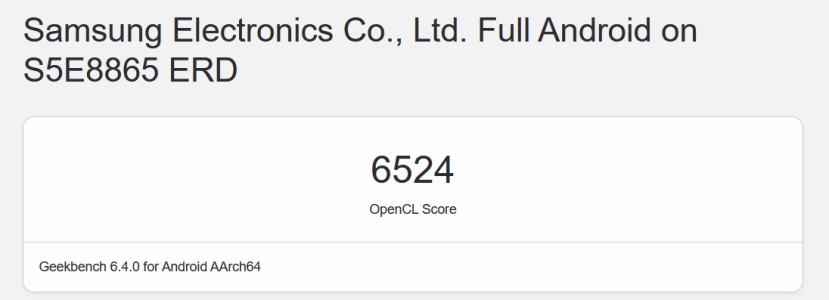
Meanwhile... Samsung is preparing the Exynos 1680:


View attachment 129558

Even more GPU score than the Tensor G5...

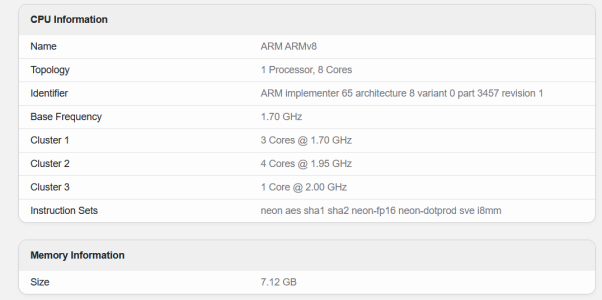
CPU Wise goes on the Big Penta Core... Mediatek has a pretty easy year if they launches a Big Hexa Core.
View attachment 129559
Dimensity 8400 use 8 big cores already.
 
Dimensity 8400 use 8 big cores already.
Yeah, but I mean to the Dimensity 7 and 6 series... are using Quad and Dual cores... and are behind the competition now.

MTK should start to use Hexa on the 7K series and Quad in the 6K ones.

And MTK are capable to pull that.
 
What a time to see Exynos being back on the track. Even going on SD 8 Elite tier, is enough to bring Samsung back on track.
So SF2-class nodes aren't as trash as SF3/3GAE/3GAP? If they're getting yields again, the foundry race is back on! Sort of.
 
So SF2-class nodes aren't as trash as SF3/3GAE/3GAP? If they're getting yields again, the foundry race is back on! Sort of.

All we know is that the yields are good enough for this particular case of Samsung fabbing their own SoC design. The cost per chip only has to be less than what they're paying per Qualcomm SoC for it to make sense - which I'd guess is around 25% or so.

The same math doesn't apply for third parties who have TSMC as an option. Let's see if Samsung lands any customers other than themselves before we pronounce the race back on lol
 
Better for consumers to have an oligopoly than a monopoly.
It depends on the other source's willingness or ability to do anything cheaper than the monopoly.
If there is an actual monopoly they will attract state attention. Having a theoretical competitor can be better than a monopoly position for monopolists.
E.g. The mere existence of Radeon or Firefox doesn't really help consumers much. Nvidia does their price hikes regardless, Chrome pushes their user-hostile changes regardless.
But Samsung will probably actually try. They want diversified business. Overexposure to memory market is painful.
 
Last edited:
The problem isn't just technical parity, it's also one of volume. If Samsung can only manage enough volume on a somewhat comparable node for one SoC, what does it matter to the rest of the industry? Everyone else either chooses a vastly inferior node, or goes with TSMC, or if Intel, mixed in in-house production. Even if Rapidus can get production going with a 2nm class node, their volume will be paltry for years.
 
Back
Top