• We’re currently investigating an issue related to the forum theme and styling that is impacting page layout and visual formatting. The problem has been identified, and we are actively working on a resolution. There is no impact to user data or functionality, this is strictly a front-end display issue. We’ll post an update once the fix has been deployed. Thanks for your patience while we get this sorted.

Question Qualcomm's first Nuvia based SoC - Hamoa

Page 15 - Seeking answers? Join the AnandTech community: where nearly half-a-million members share solutions and discuss the latest tech.
Yes and no.

Reading between the lines I think that they are very competitive on 1T perf and at good power.

The fact that they didn't specify which laptop SoC's they were comparing against with nT makes me think that they may have been SoC's with majority Intel E/mont cores - which is a valid comparison, but it also makes me think that they don't want to compare to certain AMD configurations (Dragon Range) at similar TDP, plus we have Strix Point coming up next year which isn't exactly going to be a slouch either.

I may be wrong, but the lack of transparency being shown here is out of place with the rest of their claims given this is a first impression they are trying to give with a brand new platform launch (as Elite X is effectively rebooting that segment for them).

Other sites have versions of the slides with comparison points - Anandtech seems to be using an out-of-date version. The main Intel 14c compare is the i7-13800H. That's a 6+8 config at aggressive clocks.

I don't think there's a deliberate lack of transparency here.
 
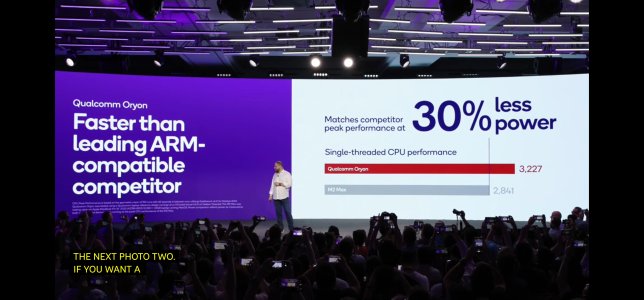
This chip has 50% better performance than an M2 in multi-threaded tasks, according to the slide.
Didn't they mean M2 Pro/Max?
Because if their chip scores 3227 in Geekbench single-core and have 12 performance cores, I would expect it to be much more than 50% faster than an M2, which has only 4 performance core scoring ~2800 Geekbench points each.

EDIT: I see the M2 Pro/Max are only about 50% faster than the M2 in Geekbench 6, which appears to be the tool Qualcomm use for their comparisons. Which makes their new chip about as fast as an M2 Pro/Max in multicore tasks, at 30% less power consumption than an M2 Max. Not bad, but we'll see what Apple has to offer with the M3.
 
Last edited:
This chip has 50% better performance than an M2 in multi-threaded tasks, according to the slide.
Didn't they mean M2 Pro/Max?
Because if their chip scores 3227 in Geekbench single-core and have 12 performance cores, I would expect it to be much more than 50% faster than an M2, which has only 4 performance core scoring ~2800 Geekbench points each.
I think all are performance cores but they won't be same configuration, some will be low clocked for efficiency, same like Zen 4 and 4C cores.
 
Hmm, really strong performance if the shown data holds true with 3rd party reviews. I wonder how it holds up against AMD's mobile CPU offerings though as they are quite significantly more efficient than Intel as well. If it had launched this year, I think it would have made huge waves. If it launches mid 2024, I'm not sure it will have nearly the same impact with next gen x86 products coming out at the same time or earlier. Very cool to see someone on the ARM side (outside of Apple) going after the high performance market though!
 
I think all are performance cores but they won't be same configuration, some will be low clocked for efficiency, same like Zen 4 and 4C cores.

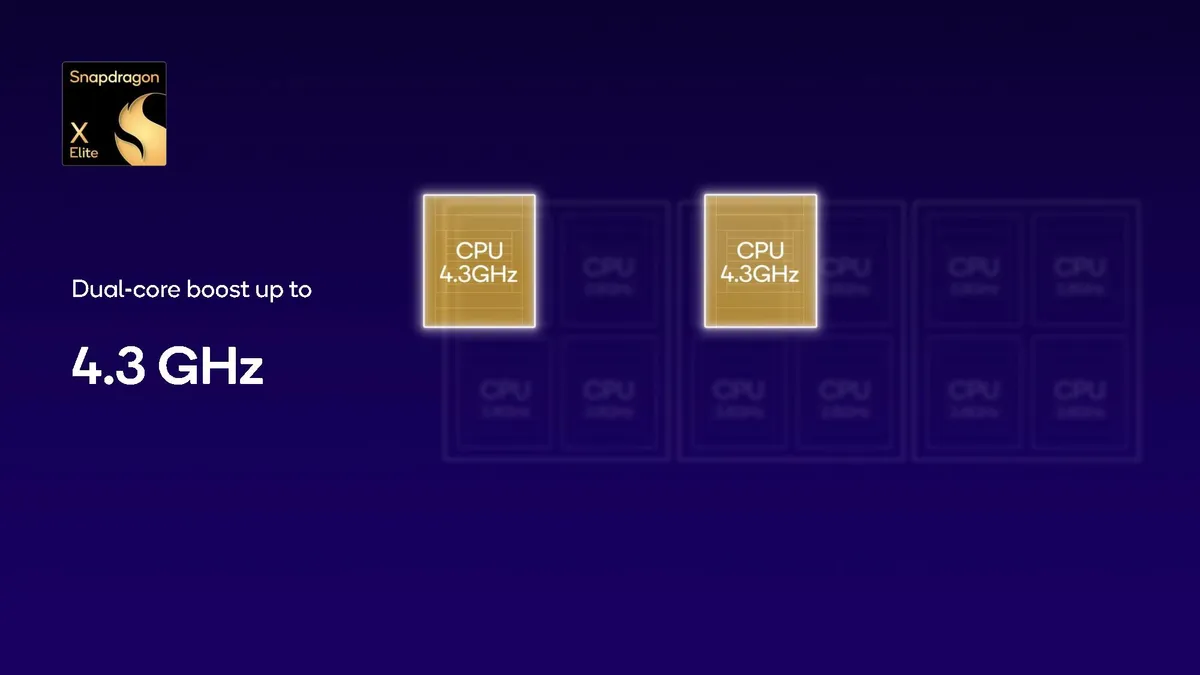
Based upon the slides, that doesn't seem to be the case outside of 2 cores being able to boost to 4.3 GHz in low threaded loads.


Pd3wXs5uCPHXenP2FcdkTa-1200-80.jpg.webp

KqjdWD2AF7EHjGXxvh9oaa-1200-80.jpg.webp
 
This chip has 50% better performance than an M2 in multi-threaded tasks, according to the slide.
Didn't they mean M2 Pro/Max?
Because if their chip scores 3227 in Geekbench single-core and have 12 performance cores, I would expect it to be much more than 50% faster than an M2, which has only 4 performance core scoring ~2800 Geekbench points each.

EDIT: I see the M2 Pro/Max are only about 50% faster than the M2 in Geekbench 6, which appears to be the tool Qualcomm use for their comparisons. Which makes their new chip about as fast as an M2 Pro/Max in multicore tasks, at 30% less power consumption than an M2 Max. Not bad, but we'll see what Apple has to offer with the M3.
No, this chip as 50% better performance than "Competitor" in this slide.

The second you assume which "competitor" it is, marketing won. If it really was that fast they'd just say it, instead all these slides are "Look how much faster (not that you can see it on the unmarked up axis) these cores are than Intel (not AMD's) old chips, ignore that both will have new ones out by the time we hit the market!"

I'm not saying this isn't an interesting, potentially very cool product. Just that, never look at a marketing slide and assume it says anything directly useful.
 
This chip has 50% better performance than an M2 in multi-threaded tasks, according to the slide.
Didn't they mean M2 Pro/Max?
Because if their chip scores 3227 in Geekbench single-core and have 12 performance cores, I would expect it to be much more than 50% faster than an M2, which has only 4 performance core scoring ~2800 Geekbench points each.
Who knows - not as much memory bandwidth as M2 Pro. Being in-between the two wouldn't be surprising.
 
Who knows - not as much memory bandwidth as M2 Pro. Being in-between the two wouldn't be surprising.

I feel like I'm going crazy, or the Mandela effect/multiple worlds is real, or most likely they've switched out the slides several times.

I read the entire article on Ananadtech and it said "Competitor a" on the slides. And the slides had "14 core CPU" and not a specific CPU.

And now the slides have specific CPU models, but the slides comparing it to any ARM competitor at all have vanished. So I guess some press places got some sort of "wrong altogether" slides and then Qualcomm rushed out the "real" slides. Either way there's no comparison at all to M2 now: https://www.anandtech.com/show/2110...agon-x-elite-soc-oryon-cpu-starts-in-laptops-
 
What I am surprised is the amount of CPU claimed by Qualcomm, ie. 12 HP cores vs rumored 8P+4E. Yet CPU cores are divided by 3 clusters of quadcore and only two clusters of CPU able turbo boost up to 4.3GHz. That's mean the last cluster of quadcore might be getting lesser power? As mentioned by AT:

"but it’s a safe assumption that each cluster is on its own power rail, so that unneeded clusters can be powered down when only a handful of cores are called for."

It is possible that Qualcomm might completely disable one main cluster of quadcore CPU, thus lower the power to compete with M3 which most likely still maintain 4P+4E configuration. Pretty clever CPU design, instead of two different dies, they just design one die for 2 product categories. I am curious how big the die size would be?
 
What I am surprised is the amount of CPU claimed by Qualcomm, ie. 12 HP cores vs rumored 8P+4E. Yet CPU cores are divided by 3 clusters of quadcore and only two clusters of CPU able turbo boost up to 4.3GHz. That's mean the last cluster of quadcore might be getting lesser power? As mentioned by AT:

"but it’s a safe assumption that each cluster is on its own power rail, so that unneeded clusters can be powered down when only a handful of cores are called for."

It is possible that Qualcomm might completely disable one main cluster of quadcore CPU, thus lower the power to compete with M3 which most likely still maintain 4P+4E configuration. Pretty clever CPU design, instead of two different dies, they just design one die for 2 product categories. I am curious how big the die size would be?
It is very clever design. I can see why Apple does efficient cores tho because the M3 has to fit in a 11" Inch iPad Pro.

I think the real competition for these Elite cores are the M3 Pro/Max.
 
They did compare their chip to Apple on the live stream. It has 50% more performance in multicore compared to M2.View attachment 87750

Ahhh, ok so it was on the live stream. But now it's gone from the press deck? This is stupid, I don't know what to make of this conference now.

Either way we know the M2 at "peak performance" is really, really bad performance per watt comparison. M2 max is only impressive in mobile efficiency, and not designed at all for peak clock efficiency. What a waste of a comparison, you can see how much they tried to minimize it by putting the asterisks in smaller font.
 
Ahhh, ok so it was on the live stream. But now it's gone from the press deck? This is stupid, I don't know what to make of this conference now.

Either way we know the M2 at "peak performance" is really, really bad performance per watt comparison. M2 max is only impressive in mobile efficiency, and not designed at all for peak clock efficiency. What a waste of a comparison, you can see how much they tried to minimize it by putting the asterisks in smaller font.

As previously said in this thread, other sites have versions of the press deck with the comparison points (Intel or Apple) and benchmark fine-print. Anandtech seems to have an older version of the deck without the comparison points.
 
IPC;

Oryon: 3200 ÷ 4.3 = 744.1

A17 P-core = 3000 ÷ 3.78 = 793.6

Now that makes me wonder where M3 will land. We believe it uses the same P-core as A17.
 
Fascinating time in the CPU world with this Arm v x86 war

I think Arm will win. It is just more efficient.

Those of us who followed cpu's in the stagnant 2010-17 era thank the lord that's long gone.
 
Back
Top