• We’re currently investigating an issue related to the forum theme and styling that is impacting page layout and visual formatting. The problem has been identified, and we are actively working on a resolution. There is no impact to user data or functionality, this is strictly a front-end display issue. We’ll post an update once the fix has been deployed. Thanks for your patience while we get this sorted.

Discussion Qualcomm Snapdragon Thread

Page 195 - Seeking answers? Join the AnandTech community: where nearly half-a-million members share solutions and discuss the latest tech.
Give me a break. Valve did it just fine even without vendor drivers:


Valve did Linux without vendor drivers for the GPU. Now do the ISP, the codec blocks, power management, wifi/modem, device enumeration, etc, etc

I also suspect, by the way, that Valve is using Halium, and therefore cribbing heavily from what is available for phones. This is not common or desired practice for desktop Linux, as it inherits a bunch of dependencies on out-of-tree, out-of-distro-repos Android bits.
 
Valve did Linux without vendor drivers for the GPU. Now do the ISP, the codec blocks, power management, wifi/modem, device enumeration, etc, etc

I also suspect, by the way, that Valve is using Halium, and therefore cribbing heavily from what is available for phones. This is not common or desired practice for desktop Linux, as it inherits a bunch of dependencies on out-of-tree, out-of-distro-repos Android bits.
My point is that it isn't some vendor conspiracy as the trolls on this board seem to think. Qualcomm is actually excellent at b2b customer support:


(Also inb4 "Arduino is ruined" as the new terms of service only apply to the Arduino cloud service and not the projects themselves.)

It's simply that the resources needed to get a competitive Linux laptop to market profitably and in time before the next generation of SoCs dropped were too much for a small company.
 
Didn't see the computerbase.de benchmarks listed here:


Qualcomm's reference designs tend to always perform better than actual laptops, but still relatively impressive
Compared to Lunar Lake (288V), the 12-core variants of X2E are ~30% faster in Single Thread depending on the benchmark. What do we expect Panther Lake to be compared to Lunar Lake, ~10% faster in ST? So X2E would be 20% faster than Panther Lake in 1T workloads. Panther Lake will close the gap considerably in terms of nT workloads, at least with it's bigger compute die that has 4p+8e+4lp cores, which is probably what the 12-core X2E chips will go up against.

While 20% is a decent advantage, I'm not sure it's enough to overcome the 'perceived' ARM deficiencies on Windows.
 
Is this something new?


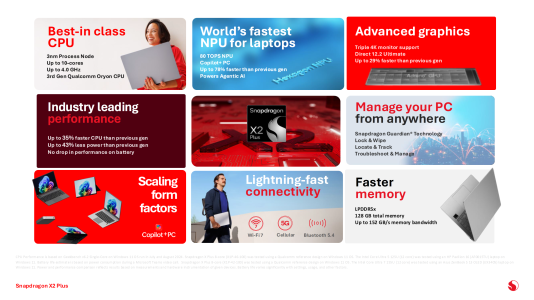
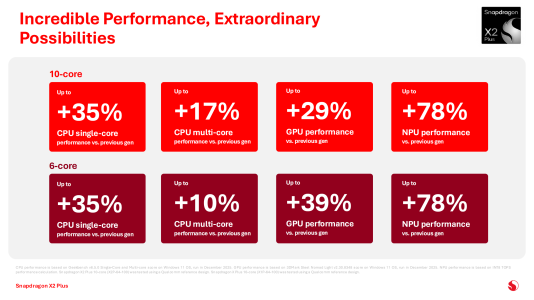
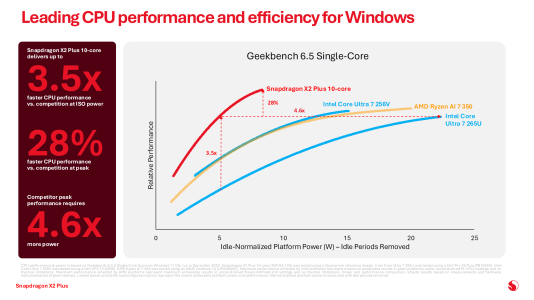
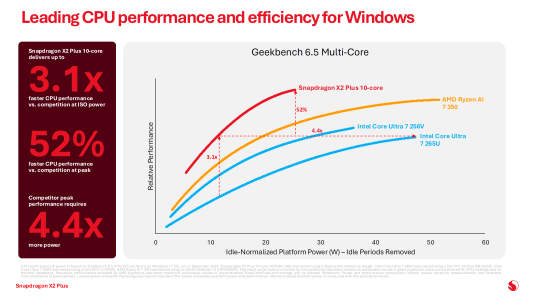
Qualcomm is claiming some wild gains. 3.1x faster MT performance than competitors at the same power (!)
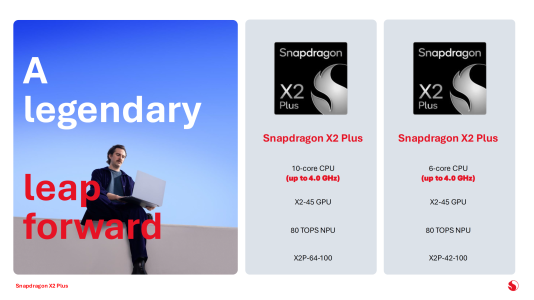
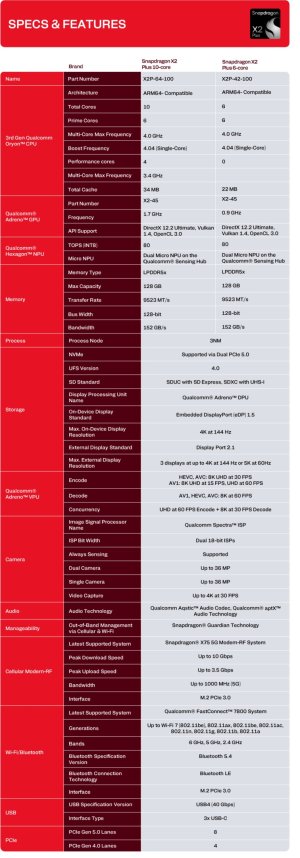
It should be new die, codename Mahua: different than X2 Elite. It is supposed to have 6+6 CPU config; not sure due to conflict with X2 Elite (6+6) & 128-bit memory bus. The X2P-64 comes with 4+6? configuration. iGPU should cut off 1 WGP net 3.5TF. The only thing not cut is NPU: still remains 80 TOPS which is expected.

As I said, AMD will refresh almost all desktop/mobile lineup with min 80 TOPS in 2026/27; Gorgon Point excluded. 😛
 
Last edited:
That hexa core part has no small cores? NOW this is wild, damn Qualcomm, if compatibility wouldn't be an issue, it could destroy Intel and AMD big time.
 
That hexa core part has no small cores? NOW this is wild, damn Qualcomm, if compatibility wouldn't be an issue, it could destroy Intel and AMD big time.
Is there a market for budget with less battery life? I don’t quite get it unless OEMs can really open up a price gap with the Elites. A bigger price gap than with the X1s.
 
Is there a market for budget with less battery life? I don’t quite get it unless OEMs can really open up a price gap with the Elites. A bigger price gap than with the X1s.
Don't forget: mini PCs. Those little things could be a good way to sell the X1 Plus without E Cores. Of course for laptops won't be but for Mini PCs it might be another story.

Of course weak GPU could be an issue on that.
 

George: And in terms of API, what will you support for the X2 GPU?

Eric: Obviously we’ll have DirectX 12.2 and all the DirectX versions behind that, so we’ll be fully compatible there. But we also plan to introduce native Vulkan 1.4 support. There’s a version of that which Windows supplies, but we’ll be supplying a native version that is the same codebase as we use for our other products. We’ll also be introducing native OpenCL 3.0 support, also as used by our other products. And then in the first quarter of 2026 we’d like to introduce SYCL support, and SYCL is a higher-end compute-focused API and shading language for a GPU. It’s an open standard, other companies support it, and it helps us attack some of the GPGPU use-cases that exist on Windows for Snapdragon.
SYCL support was already mentioned in one of their slides, now they have stated a timeline.
 
Back
Top